
Best countertops for bathroom vanities must handle regular water exposure, cosmetics, cleaning products and daily use while fitting the sink, faucet, cabinetry and overall bathroom design.
The right material is not determined by appearance alone. A countertop suitable for a lightly used powder room may not provide the same practical value in a primary or family bathroom used several times each day.
Quartz, granite, quartzite, marble and porcelain can all be considered for custom vanity countertops. However, they differ in water absorption, maintenance, natural variation, edge construction and compatibility with different sink configurations.
This guide compares the main bathroom vanity countertop materials and explains how bathroom use, sink style, cabinet condition and maintenance expectations should influence the final choice.
A bathroom countertop generally receives less food-preparation wear than a kitchen surface, but it experiences a different combination of water, cosmetics, toiletries, styling tools and cleaning products.
The countertop should be selected according to the actual bathroom rather than broad claims about durability, hygiene or moisture resistance.
Water commonly collects around faucets, sink rims, soap dispensers and backsplash joints. Cosmetics, fragrances, hair products and cleaning liquids may also remain on the surface long enough to create residue, staining or dull areas.
Important material characteristics include:
No countertop should be described as completely stain-proof or maintenance-free. Prompt cleanup and material-appropriate cleaning remain important even for low-absorption surfaces.
The sink configuration influences the required cut-out, edge finishing and amount of usable countertop space. Undermount, drop-in and vessel sinks each create different fabrication and cleaning considerations.
Before fabrication, the project may require confirmation of:
A vessel sink places more of the fixture above the countertop, while an undermount sink requires a finished and visible cut-out edge. These details should be coordinated with the selected material before the countertop is fabricated.
Vanity cabinets should be stable, appropriately installed and compatible with the selected countertop, sink and plumbing configuration.
Double vanities, floating cabinets, extended overhangs and narrow sections around sink openings may require additional planning. Countertop thickness, cabinet construction and support should be reviewed together rather than assumed from the material name alone.
The room’s use also matters. A family bathroom may require straightforward cleaning and a surface that tolerates frequent activity. A powder room may allow greater emphasis on natural variation, statement veining or a more maintenance-sensitive material.
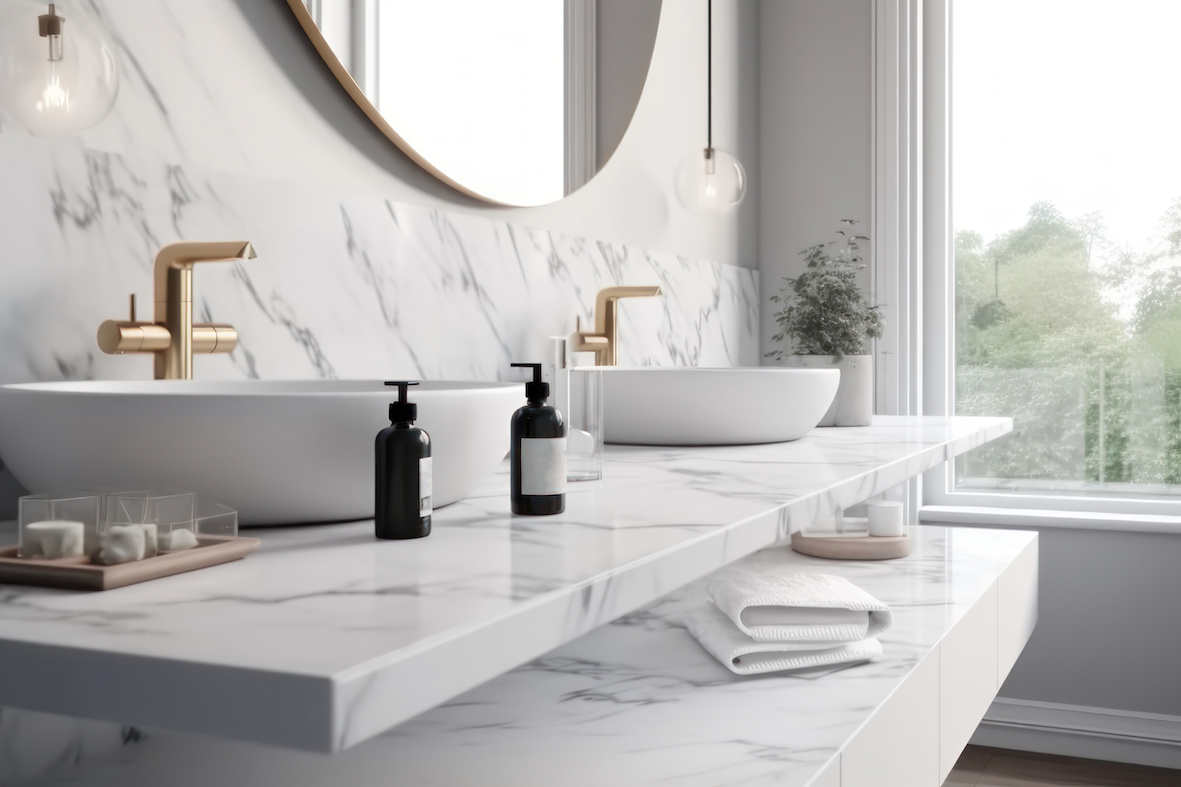
The following comparison summarizes the main materials commonly considered for custom bathroom vanity countertops. Actual suitability depends on the selected slab or product, bathroom use, fabrication details and maintenance expectations.
| Material | Main Advantage | Main Consideration | Common Use |
|---|---|---|---|
| Quartz | Controlled designs and generally straightforward routine care | Protection from concentrated heat and product-specific limitations | Primary and family bathrooms |
| Granite | Natural variation and practical everyday performance | Slab-specific absorption and sealing guidance | Traditional and natural-stone bathrooms |
| Quartzite | Distinctive natural movement and focal-point potential | Stone identification, porosity and slab layout | Feature vanities and primary bathrooms |
| Marble | Natural veining and architectural character | Etching, staining, scratches and patina | Design-focused bathrooms and powder rooms |
| Porcelain | Low absorption and coordinated wall applications | Edge appearance and specialized fabrication | Modern and low-maintenance designs |
Quartz is commonly selected for bathroom vanities because it provides controlled colours, repeatable patterns and generally straightforward routine cleaning. It also normally does not require routine sealing.
Quartz may be suitable for:
Its consistent appearance can make it easier to coordinate the vanity top with cabinet finishes, wall tile and flooring. Full-pattern designs should still be reviewed carefully when the vanity is long or includes two sink openings.
Explore Quartz Countertop Options
Hot styling tools should not be placed directly on quartz. A heat-resistant mat or holder can help protect the surface from concentrated heat.
Strong solvents, abrasive products and cleaners that are not approved for the selected surface should also be avoided. Low maintenance does not mean that every cosmetic or cleaning product can remain on the countertop without being removed.
Granite can provide a durable natural-stone surface for bathroom vanities while introducing mineral variation that differs from one slab to another. Depending on the selected stone, its pattern may range from relatively quiet and uniform to highly detailed.
Granite may work well in primary bathrooms, guest bathrooms and double-vanity installations when the selected slab matches the expected use and maintenance requirements.
Potential advantages include:
Hot styling tools should still be placed on a protective mat rather than directly on the countertop. Exposed corners and narrow areas around sink openings also require reasonable protection from impact.
Explore Granite Countertop Options
Granite slabs vary in absorption, mineral composition and finish. Some stones may benefit from sealing, but a fixed resealing schedule should not be applied to every granite vanity top.
Before fabrication, review:
Natural variation is part of granite’s character. Homeowners seeking an exact match between several vanity sections may prefer a more controlled manufactured surface.
Quartzite is a natural stone often selected for vanities where prominent veining and geological movement are important to the design. It can create a strong focal point in a primary bathroom or on a long double vanity.
The actual slab should be evaluated rather than relying only on the material name. Stones sold within the broader quartzite category may differ in porosity, mineral composition, finish and maintenance requirements.
Before approving quartzite, confirm:
Strong veining should be planned carefully when the countertop includes two sinks, a tall backsplash or several adjoining sections. Poorly positioned openings can interrupt the most important areas of the pattern.
Quartzite may suit homeowners who want natural movement and are prepared to follow slab-specific maintenance guidance. It should not be presented as maintenance-free or identical in performance to engineered quartz.
Marble is frequently selected for bathroom vanities because its veining, depth and softer appearance can create a refined architectural feature. It can work particularly well in powder rooms, guest bathrooms and design-focused primary bathrooms.
Its suitability depends on the homeowner’s expectations. Marble can develop etching, staining, scratches and patina from water, cosmetics, fragrances and cleaning products.
Sealing may help manage absorption, but it does not prevent every type of surface change. Acidic or chemically reactive products can still affect the finish.
Marble may be appropriate when:
A marble vanity does not need to be limited to a low-use bathroom, but a heavily used family bathroom requires more realistic expectations about maintenance and visible surface changes.
Explore Marble Countertop Options
Porcelain slabs can provide low water absorption, controlled designs and coordination between the vanity top, backsplash and surrounding wall surfaces. They are commonly considered for modern bathrooms and projects where routine maintenance is an important priority.
Available designs may include stone-look, concrete-look and solid-colour surfaces. Product specifications, slab thickness and intended applications should be reviewed before selection.
Porcelain may be useful for:
Fabrication requires particular attention to sink cut-outs, exposed edges, corners and transportation. Some designs are printed mainly on the visible surface, so an exposed edge may not display the same pattern as the countertop face.
An undermount sink may be possible with an appropriate product and fabrication method, but edge appearance and cut-out construction should be confirmed before final approval.
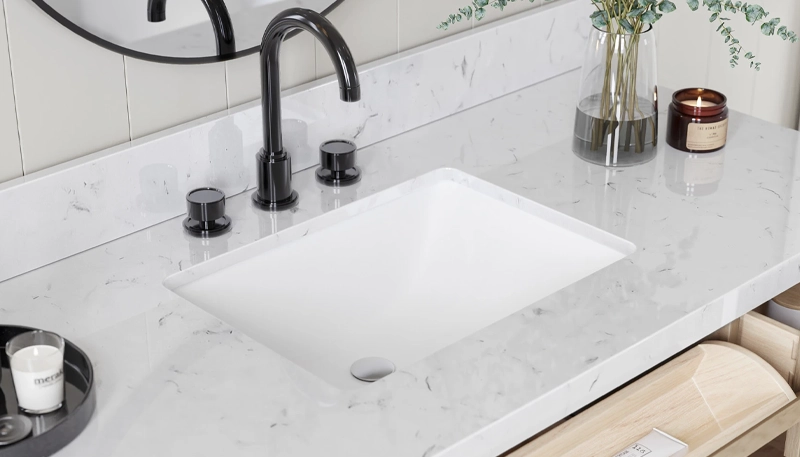
Laminate, ceramic tile, solid surface, concrete and wood can also be used for bathroom vanities, but they involve different fabrication methods and maintenance considerations from slab stone and quartz.
Laminate can provide an economical surface for guest bathrooms, rentals and short-term renovation projects.





Hot styling tools should not be placed directly on laminate, and damaged edges may allow moisture to reach the underlying material.
Ceramic tile allows extensive colour, pattern and layout customization. The tile surface itself may manage bathroom moisture well, but grout joints can collect residue and may require more detailed cleaning.
Tile vanities may suit traditional or decorative bathrooms where visible grout lines are an intentional part of the design.
Solid-surface materials may support integrated sinks and visually continuous installations. Their heat and scratch limitations should be reviewed for the selected product.
Concrete can create a custom architectural appearance and may include an integrated basin. Its performance depends heavily on the mix, fabrication, reinforcement, finish and sealing system.
Wood can introduce warmth, but it requires careful detailing around sinks, faucets and backsplash joints. Standing water, damaged finishes and inadequate ventilation can contribute to swelling, staining or deterioration.
Wood is generally better suited to controlled applications where the homeowner accepts periodic refinishing and close attention to water exposure.
The sink should be selected before final countertop fabrication because its mounting style, dimensions and faucet layout affect the required openings and finished edges.
Nominal sink width alone is not enough. The fabricator may require the manufacturer, model, installation instructions and template to confirm the cut-out and clearances.
An undermount sink is installed beneath the countertop, leaving the cut-out edge visible. Quartz, granite, quartzite and marble are commonly used with undermount sinks when the material, opening and support method are appropriate.
Important details include:
Sink support should not rely only on adhesive. The approved mounting method should be coordinated with the cabinet, sink and countertop installation.
A vessel sink sits partly or fully above the countertop. It usually requires a drain opening rather than a full sink-shaped cut-out, but the final height of the basin and faucet must be considered.
A vessel sink that is too tall for the vanity can create an uncomfortable finished height. Wall-mounted and deck-mounted faucets also require different spacing from the sink and backsplash.
Drop-in sinks rest on the countertop surface and cover the edge of the opening. They can work with many countertop materials and may simplify the visible cut-out treatment, although the rim creates an additional area that requires routine cleaning.
Faucet holes should be positioned using the confirmed fixture specifications. The plan may also need to account for handles, soap dispensers, drains and other accessories.
Before fabrication, verify:
Changing the faucet configuration after the countertop has been fabricated may leave unnecessary holes or require openings that cannot be added safely.
Backsplash height, edge profile and countertop thickness influence both the appearance and practical performance of a vanity installation.
A short matching backsplash can help manage water around the wall junction, while a full-height backsplash may create stronger visual continuity. Tile, stone and porcelain wall finishes can also be coordinated with the countertop without using the same material throughout the room.
Backsplash planning should consider:
Edge profiles should suit the countertop material, thickness and bathroom design. Simple eased or slightly rounded edges are often practical for frequently used vanities, while more detailed profiles may suit traditional interiors.
Thin-profile designs can create a contemporary appearance, but visible thickness may be produced through different slab and edge-construction methods. The finished edge should be reviewed rather than assumed from the nominal material thickness.
The best vanity countertop material depends partly on how frequently the bathroom is used and who uses it.
Frequently used bathrooms generally benefit from manageable cleaning, realistic stain resistance and straightforward sink-area maintenance.
Quartz is commonly considered for this purpose because of its controlled appearance and lack of routine sealing. Granite, quartzite, porcelain and marble can also work when their specific maintenance requirements align with the household.
A powder room may allow greater emphasis on visual impact because the vanity usually receives less daily exposure to toiletries, standing water and styling tools.
Strongly veined marble, quartzite or another statement surface can become a focal point in a small room, provided the homeowner accepts the material’s expected care and natural variation.
Guest bathrooms often require a balance between simple maintenance and broad design compatibility. A restrained quartz, granite or porcelain surface may be easier for occasional users to maintain.
Long double vanities require attention to slab dimensions, pattern placement and the amount of material remaining around two sink openings.
Manufactured surfaces may provide greater consistency across the full length, while natural stone can create a distinctive result when the vein and sink positions are planned using the actual slab.
Long-term performance depends on more than the countertop material. Cabinet stability, accurate openings, sink support, wall conditions, sealants and installation details all influence the finished vanity.
Before final measurement, the vanity cabinet should be installed in its confirmed position, and the sink and faucet information required for fabrication should be available.
Routine care should include:
Sealing natural stone can help manage absorption, but it does not make the countertop immune to staining, etching or surface damage.
For service information, review vanity countertop services in Ontario.
There is no single best material for every bathroom. Quartz is often suitable for frequently used bathrooms, while granite, quartzite, marble and porcelain may provide better value for different natural-stone, design or maintenance priorities.
Yes. Quartz generally offers low absorption, consistent designs and no routine sealing. It should still be protected from hot styling tools and cleaned with suitable products.
Granite can perform well in bathrooms. The selected slab should be reviewed for absorption, natural variation, sealing recommendations and pattern placement around sink openings.
Yes, but the homeowner should accept possible etching, staining, scratches and patina. Prompt cleaning and material-appropriate care are especially important in a frequently used bathroom.
Quartz and suitable porcelain products are commonly considered for relatively straightforward routine care. Both still require regular cleaning and protection from product-specific risks.
Quartz, granite, quartzite and marble are commonly fabricated for undermount sinks. Porcelain may also be suitable when the product and fabrication method support the required cut-out and edge detail.
The sequence depends on the sink type. Undermount sinks are normally coordinated with the countertop installation, while vessel and drop-in sinks follow different installation requirements. The sink information should be finalized before countertop fabrication.
A backsplash is not mandatory in every design, but it can help protect the wall junction from water and simplify cleaning. Height and material should be coordinated with the faucet, mirror and surrounding wall finish.
Choosing a vanity countertop requires coordination between the material, cabinet, sink, faucet, backsplash and bathroom use.
Share photographs, approximate vanity dimensions, preferred materials, sink and faucet information and project location to support an initial review.
Plan a Custom Bathroom Vanity Countertop
Compare materials, sink configurations, edge details and maintenance requirements before approving the final vanity top.
Request a Vanity Countertop Quote
Browse Countertop Materials
Explore Vanity Countertop Services