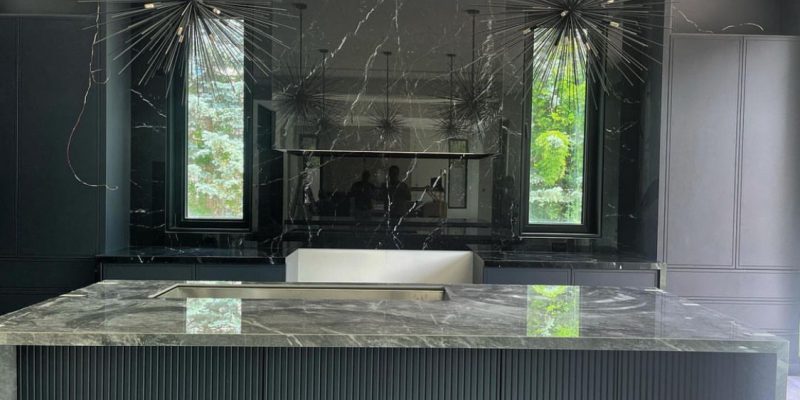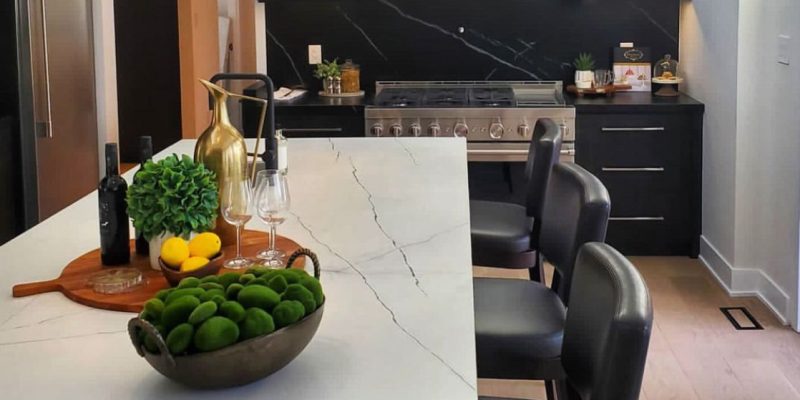

Emerging countertop materials expand the choices available beyond conventional quartz and granite. Large-format porcelain, sintered surfaces, terrazzo, recycled-glass composites, concrete and paper-composite products can introduce different textures, slab formats, edge details and maintenance requirements.
These materials should not automatically be treated as newer or better replacements for established surfaces. Some provide a useful design or performance advantage, while others involve limited inventory, specialized fabrication, product-specific care or greater difficulty with future replacement.
The most important distinction is between a broad material category and the exact product proposed for the kitchen. Two products described with similar terminology may differ in composition, thickness, heat limitations, approved applications and installation requirements.
This guide explains how to evaluate countertop trends, compares several alternatives beyond quartz and granite and identifies the technical, fabrication and availability questions that should be answered before the kitchen design is finalized.
Consider one when: The exact product provides a specific design or performance benefit that established materials do not provide as effectively.
Confirm before selection: Technical documentation, local inventory, qualified fabrication, edge construction, opening limitations and maintenance requirements.
Avoid trend-first decisions: An attractive online image is not evidence that the product is practical, available or supported locally.
Keep established options in the comparison: Quartz or granite may remain the better choice when predictable fabrication, broad availability and familiar care are priorities.
A countertop trend should be evaluated as a complete product and installation system. Visual novelty is only one part of the decision.
Terms such as porcelain, sintered stone, recycled glass and terrazzo describe broad categories. The proposed brand, collection, composition, thickness and finish should be identified before technical claims are accepted.
A product suitable for wall cladding may not automatically be suitable for a kitchen countertop, exposed island edge or exterior installation. Documentation should confirm the approved horizontal or vertical application.
A material may have strong published specifications but still create project risk when qualified fabrication is unavailable. The fabricator should confirm experience with the exact product family, not only with conventional quartz or natural stone.
Sink cut-outs, cooktop openings, inside corners, mitred edges and waterfall panels can expose limitations that are not visible in a flat sample. The required substrate, support and minimum material dimensions should be established before measurement.
Confirm approved cleaners, heat precautions, possible sealing, colour development, scratching, patina and repair expectations. Low absorption does not mean that the complete countertop assembly is maintenance-free.
Limited inventory, changing product collections and a small supplier network can make future matching difficult. The project should confirm current stock, compatible batches and whether additional material can be retained.
Terms such as recycled, natural or low-impact should be supported by product-specific documentation. Recycled content alone does not account for binders, manufacturing, transportation, expected service life or replacement requirements.
Trend Evaluation Rule
A countertop trend becomes a practical material option only when the exact product, fabrication method, maintenance plan and supply chain have been verified.
The following comparison identifies the primary reason to consider each category and the evidence that should be confirmed before approval.
| Material | Main Reason to Consider It | Confirm Before Selection | Primary Project Risk |
|---|---|---|---|
| Large-format porcelain | Low absorption, architectural profiles and coordinated vertical surfaces | Countertop approval, thickness, backing, edges and cut-out requirements | Specialized fabrication and vulnerable exposed details |
| Sintered or compact surface | Controlled architectural design and product-specific technical performance | Composition, application approval and manufacturer documentation | Applying one brand’s claims to the entire category |
| Terrazzo | Aggregate pattern, colour control and strong visual identity | Binder, sealing, acid sensitivity and repair matching | Unexpected maintenance or pattern variation |
| Recycled-glass composite | Distinctive aggregate appearance and documented recycled content | Binder, recycled-content data, sealing and heat limitations | Unsupported environmental or performance assumptions |
| Concrete | Custom form, thickness, colour and architectural character | Mix, reinforcement, curing, sealing, weight and production method | Cracking, staining and variable workmanship |
| Paper composite | Warm matte finish and restrained contemporary appearance | Heat limits, resin system, colour development and local supply | Limited fabrication or replacement availability |
An emerging material is not necessarily newly invented. Terrazzo and concrete, for example, have long histories but may gain renewed attention through contemporary colours, large-format production or new residential applications.
A countertop category may be described as emerging because:
Greater visibility does not prove that a product is suitable for a specific project. Technical documentation and local execution remain more important than its status as a trend.
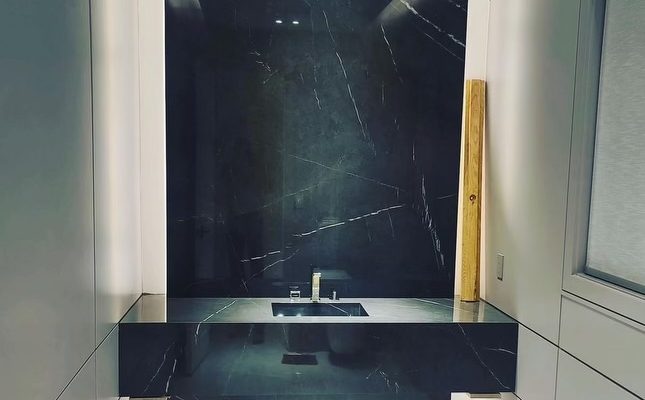
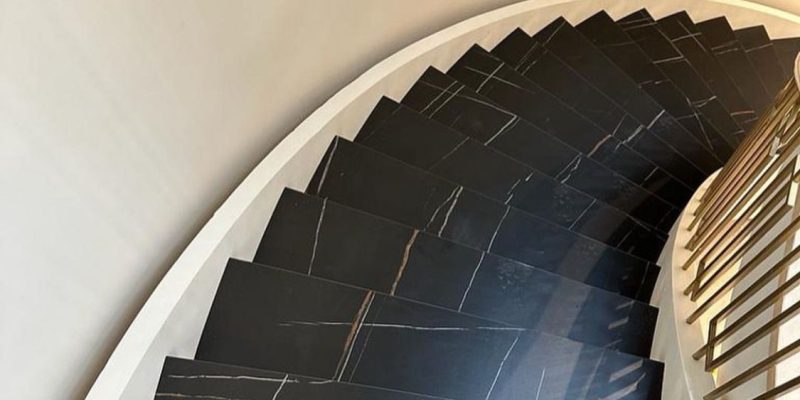
Large-format porcelain extends ceramic manufacturing into slab-sized surfaces that may be used for countertops, backsplashes, waterfall panels and selected wall applications.
Suitable products can provide low absorption, controlled patterns and coordinated horizontal and vertical surfaces. However, the exact slab thickness, backing, reinforcement and approved applications vary.
Porcelain may suit projects requiring:
Browse available porcelain countertop options.
Before approval, review:
A thin slab should not be assumed to be easier to fabricate. Exposed edges, corners and openings may require more specialized planning than conventional quartz or granite.
Sintered and compact surfaces are manufactured from mineral-based components using processes that vary by product and manufacturer. They may resemble porcelain in appearance or application, but the terms should not automatically be treated as interchangeable.
Depending on the exact product, documented characteristics may include:
These characteristics should be taken from current technical documentation for the selected product. Claims from one manufacturer should not be generalized to every sintered or compact surface.
Confirm whether qualified local fabrication is available for the selected thickness, edge construction and opening design. Repair or replacement may be more difficult when the product is supported by only a limited supplier network.
Porcelain and Sintered Surface Rule
Compare exact products and approved applications rather than assuming that all thin mineral-based slabs share the same composition, performance or fabrication requirements.
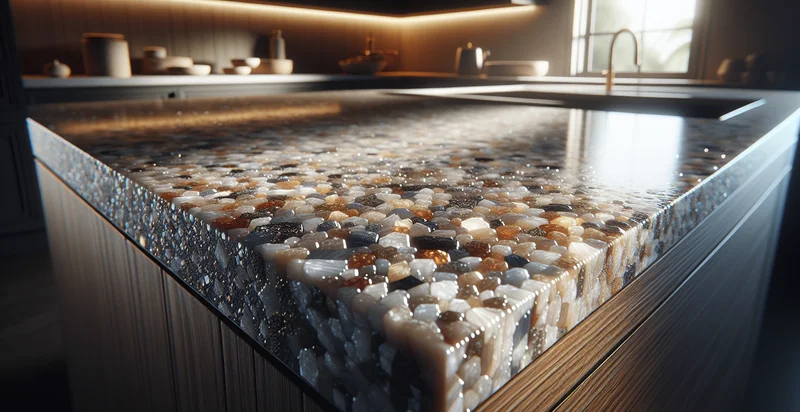
Terrazzo combines decorative aggregates with a cement-based, resin-based or other product-specific binder. The aggregate may include marble, stone, glass or manufactured components, creating patterns that range from subtle and uniform to highly expressive.
Terrazzo is not one standardized countertop material. Its absorption, heat response, acid sensitivity, sealing requirements and repair options depend heavily on the binder, finish and manufacturing system.
Terrazzo may suit projects seeking:
The aggregate scale should be reviewed using a large sample or full-format image. A small sample may not show how fragments repeat, how colour is distributed or how the pattern will interact with seams, edges and openings.
Before selecting terrazzo, confirm:
A visually suitable terrazzo sample may still be impractical when local fabrication, replacement stock or product-specific care support is unavailable.
Recycled-glass countertops use glass fragments within a cement-based, resin-based or other manufactured slab system. Their appearance may range from quiet aggregate patterns to reflective, colourful surfaces with a strong visual identity.
The recycled-glass label does not establish one level of performance or environmental impact. Products may differ in glass content, binder composition, manufacturing location, slab thickness and technical limitations.
A recycled-glass composite may be appropriate when the project requires:
Environmental claims should be based on current documentation for the exact product. Confirm the reported recycled-content percentage, binder composition and any applicable certifications rather than assuming every recycled-glass surface has the same environmental profile.
Recycled content is only one factor. Manufacturing, transportation, durability, maintenance and future replacement can also influence the broader material impact.
The binder can affect stain resistance, absorption, heat limits and sealing requirements.

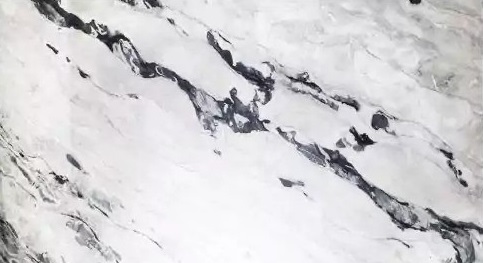
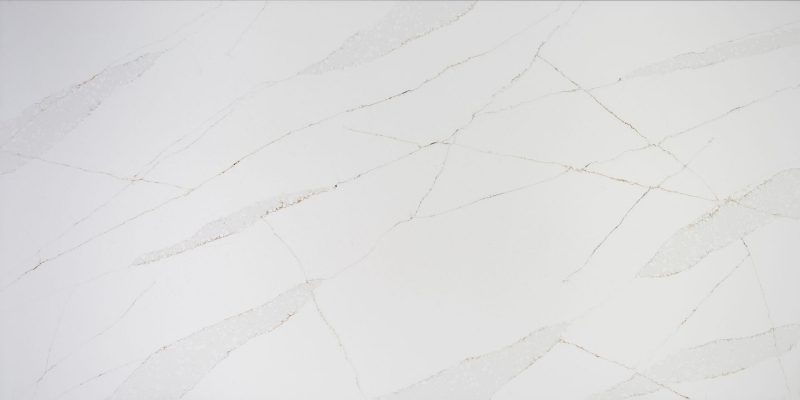





Before approval, review:
Environmental Claim Rule
Do not select a countertop from the word recycled alone. Review the exact product’s composition, documentation, service expectations and supply chain.
Concrete countertops can provide custom dimensions, formed details, matte finishes and substantial architectural profiles. They may be precast and installed after curing or produced through another project-specific fabrication method.
Performance depends on the complete system, including mix design, reinforcement, curing, surface finishing, sealing, cabinet support and installer experience.
Concrete may support:
Generic photographs should not replace a sample produced by the proposed fabricator. Colour, texture, aggregate exposure and finish can vary according to the actual mix and production method.
Concrete can be heavy, although some systems use built-up edges or alternative construction to create visual thickness without a fully solid section.
The project should confirm:
Concrete may develop fine cracks, colour variation, surface marks or patina. Sealers can reduce absorption, but they do not make every concrete system stain-proof, heat-proof or maintenance-free.
Homeowners should decide whether gradual appearance changes are acceptable before approving the material.
Paper-composite countertops are manufactured from compressed paper or paper-derived fibres combined with resin or another binding system. They often provide a matte, warm and visually restrained alternative to polished stone.
Products in this category may vary in recycled content, resin type, thickness, colour range and technical performance. Selection should therefore rely on the exact product documentation.
Paper-composite surfaces may suit:
Heat limits vary by manufacturer. Direct contact with hot cookware should not be assumed acceptable, and sink areas, seams and exposed edges require appropriate detailing.
Before selecting the product, confirm:
Specialty materials can offer design features that quartz or granite do not reproduce in the same way. However, quartz and granite often remain practical because their supply chains, fabrication methods and care expectations are more familiar.
| Selection Factor | Quartz | Granite | Emerging Materials |
|---|---|---|---|
| Design direction | Controlled manufactured patterns | Unique natural mineral variation | Architectural, aggregate, matte or custom-formed options |
| Availability | Often broadly available by brand and colour | Often broadly available with slab variation | May depend on a limited supplier or specialist network |
| Fabrication | Established slab-fabrication methods | Established natural-stone fabrication | May require specialized cutting, forming or installation |
| Maintenance | Generally no routine sealing, with heat precautions | Slab-specific sealing and care may apply | Varies significantly by binder, finish and product system |
| Replacement risk | Colours and production batches may change | Exact natural-slab matching is unlikely | Limited stock or discontinued products may create greater difficulty |
Quartz may be more practical when the project requires a controlled pattern, relatively straightforward routine care and widely understood fabrication details.
Explore available quartz countertop options.
Granite may remain suitable when natural slab character, established stone fabrication and broad material availability are priorities.
Each slab should still be reviewed for absorption, natural features, finish and layout.
Explore available granite countertop options.
A specialty material is most defensible when it provides a clear project benefit—such as a slim porcelain profile, terrazzo aggregate pattern, custom concrete form or matte paper-composite finish—and when its technical and fabrication requirements have been confirmed.
An emerging material does not need to cover every countertop surface to contribute meaningfully to the design.
Terrazzo, recycled glass, concrete or another visually distinctive surface may be concentrated on an island while a quieter, established material is used on the perimeter.
Large-format porcelain and selected compact surfaces may provide visual continuity across countertops and vertical applications. Pattern alignment, wall preparation and installation sequencing should be confirmed before fabrication.
A specialty material that is not preferred for a heavily used preparation area may still suit a bar, vanity or serving surface where its visual character provides a stronger benefit.
Design Application Rule
Use a specialty surface where it solves a specific design or performance need rather than extending it throughout the kitchen solely for novelty.
Specialty countertop materials should be evaluated as complete supply, fabrication and installation systems. An attractive product may still create project risk when local inventory, technical support or qualified fabrication is limited.
Experience fabricating quartz or granite does not automatically establish experience with thin porcelain, sintered surfaces, terrazzo, recycled-glass composites, concrete or paper composite.
Before finalizing the material, confirm:
Some specialty products are available only through selected suppliers or are imported for individual projects. Availability can affect lead time, slab inspection, compatible production batches and the possibility of obtaining additional material.
Confirm:
Replacement matching can be difficult for both established and emerging materials. Quartz colours may be discontinued, natural-stone slabs cannot usually be duplicated exactly and specialty products may have limited distribution.
The risk becomes greater when one rare product is used across countertops, backsplashes and waterfall panels. Replacing one damaged component may be difficult when the matching collection is no longer available.
Directional patterns, large aggregates and surface printing should be reviewed before cutting. The layout should show how the material will appear across islands, seams, corners, backsplashes and vertical panels.
For thin slabs, mitred profiles and built-up edges, review the guide to choosing the right countertop thickness before approving the visible construction.
Supply and Fabrication Rule
Do not design the complete kitchen around a specialty product until inventory, qualified fabrication, installation details and future replacement risks have been reviewed.
No countertop is completely resistant to every stain, scratch, impact, chemical or heat source. Performance claims should come from current documentation for the exact product rather than from the general material category.
Cleaning requirements can vary significantly between cement-based, resin-based, mineral and fibre-composite products. Acidic cleaners may affect selected terrazzo or concrete systems, while strong solvents and abrasives may damage binders, sealers or finishes.
Written care guidance should identify:
Porcelain and selected sintered products may have strong product-specific heat characteristics, but countertop performance also depends on joints, adhesives, backing and openings.
Resin-based terrazzo, recycled-glass composites, paper composite and concrete sealers may have different temperature limitations. Trivets should remain part of normal kitchen use unless the exact manufacturer documentation permits direct contact with hot cookware.
A durable surface can still be vulnerable at exposed corners, mitred edges, sink rails and inside corners around cooktops. Concentrated impact may damage these areas even when the broad surface performs well under routine use.
Edge selection should reflect:
Review the guide to countertop edge profiles before selecting thin, mitred or highly exposed edges.
Concrete, paper composite, terrazzo and other specialty surfaces may develop changes in sheen, colour, texture or visible wear. These changes are not always installation defects.
The homeowner should understand how the material is expected to age and whether that appearance remains compatible with the project.
The cost of an emerging countertop material cannot be evaluated accurately from the slab or panel price alone. Specialist fabrication, limited inventory and complex edge construction may have a substantial effect on the completed project.
Cost factors may include:
A less expensive panel may require additional backing or specialist labour. A higher-priced surface may be easier to fabricate through an established local process.
Each quotation should identify:
For a broader explanation of project-cost variables, review the kitchen countertop cost guide.
| Cost Area | What to Confirm | Possible Hidden Risk |
|---|---|---|
| Material supply | Physical stock, compatible batches and required quantity | Additional shipping or unavailable replacement material |
| Fabrication | Cutting, edges, openings, backing and specialist handling | Material price excludes essential production work |
| Installation | Access, support, vertical panels and installation sequence | Additional trades or site preparation are required |
| Long-term ownership | Care, repairs and replacement availability | A limited product becomes difficult to maintain or match |
An emerging countertop material should be selected because it provides a clear project benefit—not simply because it appears new or different.
Confirm whether the material will be used for:
Review the proposed product’s:
The proposed fabricator should review the product before cabinets, sinks, appliances, openings and edge details are finalized. Late changes may affect support, seams or whether the material can be fabricated as intended.
For the broader sequence from preparation through installation, review the kitchen countertop installation process.
Final Material Selection Checklist
Confirm the exact product, physical sample, technical documentation, inventory, qualified fabricator, edge construction, opening limits, maintenance and replacement availability before ordering.
Options include large-format porcelain, sintered or compact surfaces, terrazzo, recycled-glass composites, concrete and paper-composite products. Availability and fabrication support depend on the exact product and supplier.
Not universally. A specialty material may provide a particular finish, format or design benefit, while quartz or granite may offer broader availability and more familiar fabrication.
Not necessarily. Their composition, manufacturing process and technical specifications may differ. Product documentation should determine how each surface is classified and used.
Many do. Thin slabs, compact surfaces, concrete, terrazzo and paper composite may require tools, support systems or construction methods that differ from conventional stone fabrication.
Some products contain documented recycled material, but broader environmental performance also depends on binders, manufacturing, transportation, durability and replacement requirements.
Yes. A specialty surface may be used on an island, backsplash or feature section while an established material is used elsewhere. Thickness, colour, transitions and maintenance should be coordinated.
They can be when inventory, suppliers or product collections are limited. Replacement risk should be reviewed before using one product across large or highly visible areas.
It can be when the exact product is approved for countertop use and the edges, openings, backing and installation are designed appropriately.
No. Trends can provide design inspiration, but product suitability, fabrication, maintenance, availability and long-term compatibility should guide the final decision.
They may be more practical when the project prioritizes established fabrication methods, broader inventory, familiar maintenance and reduced supply-chain complexity.
Emerging countertop materials can provide distinctive profiles, patterns and finishes, but each option should be evaluated through actual samples, technical documentation and confirmed fabrication capability.
TecCorp Stone can review available stone and porcelain options for kitchen countertops and related applications. Other specialty materials discussed in this guide may require separate qualified suppliers and fabricators.
Compare Countertop Materials for Your Project
Review product suitability, edge construction, maintenance, availability and fabrication requirements before finalizing the surface.
Discuss Your Countertop Project
Explore Kitchen Countertop Services
Explore Porcelain Countertops