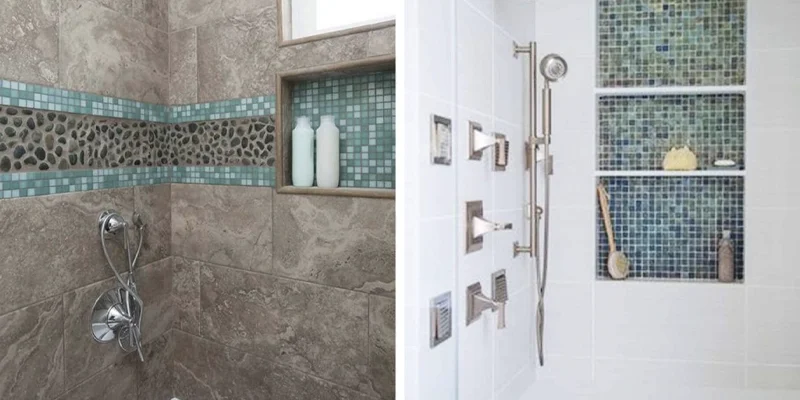
Choosing between a stone shower niche and a tiled niche affects more than the finished appearance. The decision changes the number of visible joints, edge details, cleaning routine, fabrication requirements, installation sequence and options for future repair.
A fabricated stone niche may use quartz, granite, marble, porcelain slab or another suitable surface for the shelf, sill, returns or complete lining. A tiled niche uses individual tiles inside the opening, usually coordinated with or contrasted against the surrounding shower wall.
Neither option is automatically better for every bathroom. The right choice depends on the design, selected materials, maintenance expectations, wall preparation, installer capabilities and project budget.
Quick answer: Choose a fabricated stone niche when you want fewer grout lines, coordinated slab details and custom finished edges. Choose a tiled niche when tile continuity, intricate patterns, easier individual-piece replacement or simpler material sourcing is more important. Both options still require a correctly prepared and waterproofed niche enclosure behind the visible finish.
Table of Contents
| Decision Factor | Fabricated Stone Niche | Tiled Niche |
|---|---|---|
| Visual appearance | Larger continuous surfaces and coordinated slab details | Can blend with the wall tile or create a contrasting feature |
| Visible joints | Usually fewer surface joints, but perimeter and component joints remain | Usually more grout lines, especially with small-format tile |
| Edge finishing | Polished, eased, mitred or built-up fabricated edges | Bullnose tile, profiles, mitred tile or exposed factory edges |
| Cleaning | Smooth shelf and sill surfaces can simplify routine wiping | Additional grout lines may require more detailed cleaning |
| Material maintenance | Varies significantly between quartz, porcelain and natural stone | Depends on tile, grout and sealant selections |
| Installation planning | Requires measurement, fabrication, edge scheduling and installation sequencing | Requires detailed tile layout, cuts, trim and grout planning |
| Individual-piece repair | Large custom pieces may be more difficult to match or replace | A damaged tile may be easier to replace if matching stock is available |
| Waterproofing | Requires a waterproof assembly behind the stone | Requires a waterproof assembly behind the tile and grout |
Important: The table compares visible finishes and project workflow. It does not imply that either finish is the primary waterproofing layer.
The phrase “stone shower niche” can describe several different assemblies. Defining the intended finish prevents confusion when comparing design, maintenance and pricing.
A fully stone-lined niche uses fabricated pieces for the back, sides, top, bottom and sometimes an internal shelf. The pieces may be produced from engineered quartz, natural stone or a suitable porcelain slab.
This approach creates larger continuous surfaces than a small-format tiled niche, but it is not necessarily made as one piece. Separate components are normally required for practical fabrication, transportation and installation. Controlled joints remain at the corners and transitions.
A full lining provides the greatest opportunity to coordinate the niche with a vanity countertop, shower jamb, wall slab or another fabricated bathroom feature.
A hybrid niche combines tile with selected fabricated components. Common configurations include:
This option can place smooth stone where it provides the most practical benefit while preserving the tile design elsewhere. It may also reduce the quantity of slab material required.
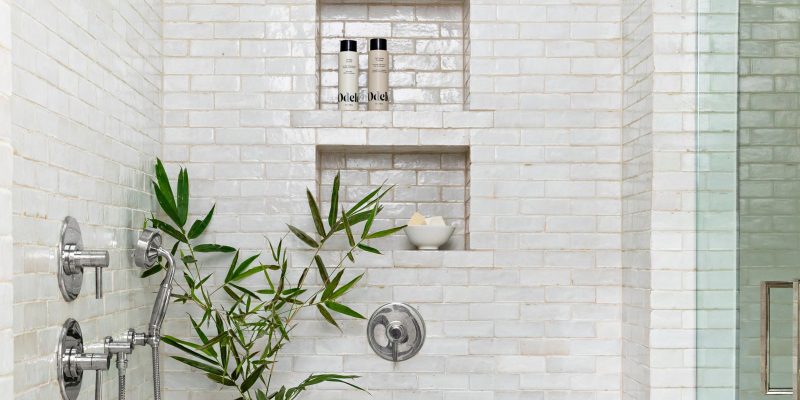
A tiled niche uses tile throughout the back, sides, top and bottom. It may repeat the surrounding wall tile for continuity or use mosaic, patterned or contrasting tile to create a feature.
The finish may require bullnose pieces, metal profiles, mitred tile edges or another method for completing exposed corners. Small tiles can adapt to compact surfaces and irregular layouts, but they also introduce more grout lines.
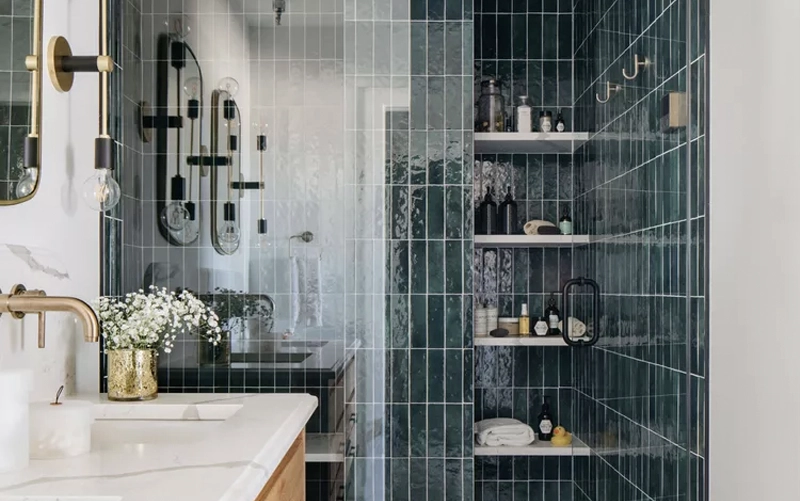
Fabricated stone can reduce the number of grout lines across the shelf, sill and back panel. This often creates a quieter appearance, especially when the niche is intended to coordinate with large-format bathroom surfaces.
A tiled niche can either disappear into the wall or become a deliberate feature. Continuing the same tile and grout grid through the opening creates visual continuity, while mosaic or contrasting tile draws attention to the niche.
Fewer grout lines should not be described as “seamless.” A stone niche still requires controlled component and perimeter joints, particularly where materials or planes change.
Stone edges can be polished, eased, mitred or built up before installation. This provides control over exposed shelf fronts, returns and frames, but every visible edge and underside must be included in the fabrication schedule.
A tiled niche may rely on:
The chosen edge method should coordinate with the tile thickness and surrounding shower details. A profile that sits above the shelf surface can affect both appearance and water movement.
Fabricated stone can connect the niche visually to other slab elements in the bathroom. A quartz shelf may match the vanity, while marble or porcelain returns continue the material used on shower jambs.
Large veins require cutting-layout approval if pattern continuity is important. A small remnant may provide the right colour but not enough material or the correct vein direction for every component.
Tile offers a broader range of small-scale patterns and contrast options. It can repeat the main wall surface, introduce texture or highlight the niche with a decorative back panel. The design should still account for grout width, edge pieces and tile cuts at every side of the opening.
Design rule: Choose the niche finish after reviewing the wall elevation, shelf dimensions, exposed edges and surrounding materials together. Selecting the back-panel colour alone does not resolve the complete niche detail.
The number of joints affects routine cleaning, but material selection is equally important. A smooth quartz shelf, a polished marble sill and a porcelain-tiled niche may look similar in a finished photograph while requiring different cleaning products and long-term care.
Regardless of finish, removing excess water and product residue regularly is easier than treating heavy soap film or mineral buildup later. Bottles should also be moved periodically so water and residue do not remain underneath them.
Suitable engineered quartz and porcelain surfaces generally provide smooth, low-absorption areas that are easy to wipe. A solid sill or shelf can reduce the number of grout lines directly beneath shampoo and soap containers.
Routine care should follow the exact surface manufacturer’s instructions. In most cases, a soft cloth or non-abrasive sponge with an approved mild cleaner is more appropriate than aggressive acids, scouring powders or harsh chemical combinations.
Even a low-maintenance surface can show:
Quartz should not be described as maintenance-free. It may simplify routine cleaning, but perimeter joints, corners and adjacent tile still require attention.
Natural stones vary in mineral composition, absorption and sensitivity. Marble and other calcium-based stones can be affected by acidic cleaners, while granite and quartzite may behave differently. One maintenance instruction should not be applied to every natural stone.
A natural-stone niche may require:
An impregnating sealer can improve stain resistance for certain stones, but it does not make the niche or shower wall waterproof.
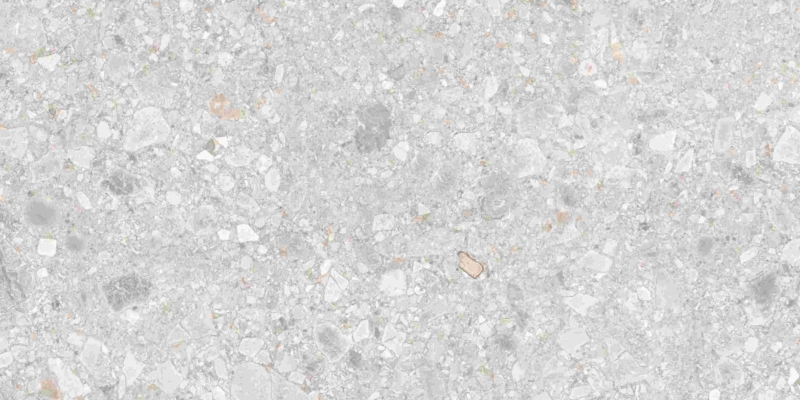




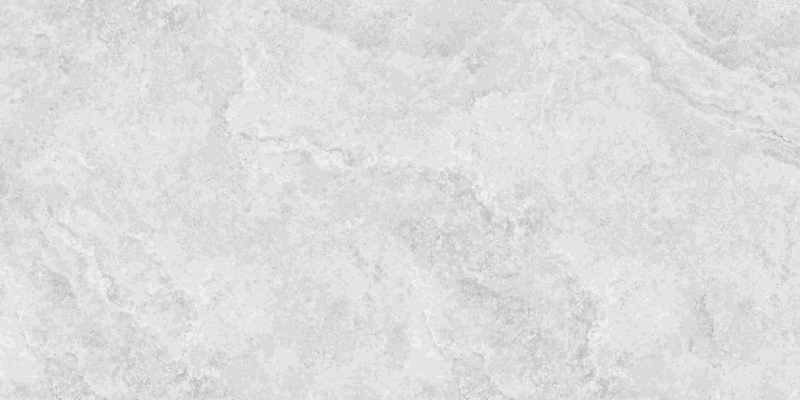
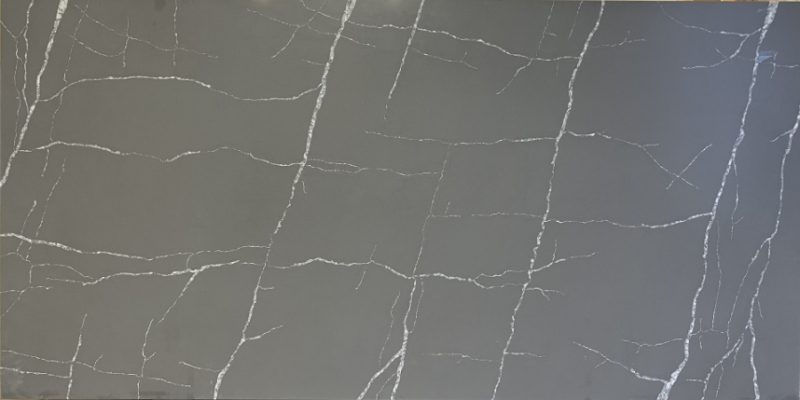




Before selecting marble or another sensitive stone, consider whether the household is comfortable using material-specific cleaners and accepting natural changes in finish over time.
A fully tiled niche typically contains more grout lines than one finished with large fabricated pieces. Smaller tiles and mosaics increase the number of intersections where soap residue and mineral deposits may accumulate.
Grout performance depends on the grout type, installation quality, joint width and cleaning routine. Flexible perimeter joints should also be inspected periodically for separation, cracking, loss of adhesion or areas where water and residue remain trapped.
Do not cover a failed joint with another layer of sealant without identifying the reason it failed. The old material, joint preparation, movement and compatibility may need to be evaluated before the joint is renewed.
| Surface or Joint | Routine Care | Main Caution |
|---|---|---|
| Engineered quartz | Approved mild cleaner and soft cloth | Avoid unapproved abrasive or aggressive chemicals |
| Porcelain slab or tile | Routine wiping with a compatible non-abrasive cleaner | Joint and edge maintenance still remains |
| Marble or natural stone | Stone-compatible neutral cleaner and regular drying | Acids may etch sensitive stone; sealing needs vary |
| Grout joints | Gentle brushing or wiping with an approved cleaner | More joint area can require more detailed cleaning |
| Flexible perimeter joints | Keep clean and inspect for separation or damage | Replacement requires proper removal and joint preparation |
Both stone and tiled niches require a stable opening and a compatible waterproofing system integrated with the surrounding shower wall. The visible finish does not determine whether the enclosure is waterproof.
Before either finish is installed, the project team should confirm:
The same well-prepared enclosure can potentially receive different finish strategies, but the dimensions and installation sequence must be adjusted for the chosen material thickness and edge detail.
A fabricated stone niche requires accurate measurements and a component schedule. The fabricator must know which surfaces will be covered, which edges remain visible and whether the back, sides, sill, top or shelf is installed first.
The stone workflow may include:
Fabrication can produce clean edges and larger surfaces, but errors are difficult to conceal. A piece cut too tightly may damage the prepared opening, while an undersized piece may leave an excessive perimeter joint.
A tiled niche requires a detailed tile layout across multiple small planes. The installer must coordinate the back, sides, top and sill while controlling tile cuts and maintaining the intended grout pattern.
Layout decisions include:
Small tiles can adapt to detailed shapes, while large tiles may reduce grout lines but require precise cutting. A tile that works well on the main shower wall may not provide suitable factory edges or proportions inside the niche.
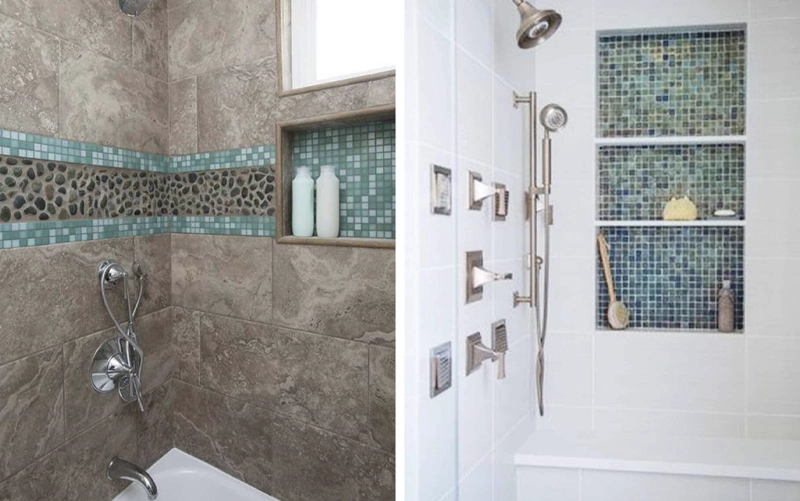
Installation comparison: Stone shifts more work into measurement, fabrication and edge planning. Tile shifts more work into field layout, cutting, trim and grout control. Both require skilled waterproofing and careful changes-of-plane detailing.
Both niche types can perform well when the substrate, waterproofing and finish are installed correctly. Durability depends more on the complete assembly and material selection than on whether the visible surface is stone or tile.
A fabricated stone sill or shelf reduces the number of small pieces on key horizontal surfaces. However, replacing a damaged custom component may require a new template, matching material and removal of adjacent finishes.
Individual tile can sometimes be replaced more easily if matching stock is available. Removal still requires care because aggressive demolition inside a niche can damage the waterproofing immediately behind the tile.
Future repair considerations include:
Keep spare tile when using a distinctive collection and record the manufacturer, colour and finish of any fabricated slab material. These details can make future repairs more manageable, although exact colour or pattern matching is never guaranteed.
Neither option is automatically less expensive. A simple quartz sill cut from a suitable remnant may be economical, while a fully lined niche with mitred edges and vein matching can require substantial fabrication. Tile material may be affordable, but detailed cuts, profiles and mosaics can increase installation labour.
| Cost Factor | Stone Niche Impact | Tiled Niche Impact |
|---|---|---|
| Material selection | Slab type, remnant availability, thickness and finish | Tile format, collection, mosaic and specialty pieces |
| Edge work | Polished, mitred or built-up fabricated edges | Bullnose, profiles or mitred tile corners |
| Design complexity | Number of pieces, shelves and pattern matching | Number of cuts, tile modules and decorative layouts |
| Labour stage | Measurement, shop fabrication, transport and setting | On-site layout, cutting, trim, setting and grouting |
| Future repair | Custom replacement and material matching may be required | Replacement depends on access and matching tile stock |
Waterproofing, wall preparation and structural support should not be removed from the budget comparison. Both options require a correctly prepared enclosure, regardless of the price of the visible finish.
A fabricated stone niche is often the better fit when:
A tiled niche may be the better fit when:
A hybrid niche may provide the most balanced solution. A solid stone sill or shelf can simplify horizontal surfaces while tile maintains continuity on the back and side walls.
Best overall approach for many projects: Use fabricated stone where smooth surfaces and finished edges provide a clear benefit, then use tile where pattern continuity and flexible field layout are more valuable.
No. The visible finish does not determine waterproofing. Both stone and tile must be installed over a properly integrated waterproof enclosure.
Large fabricated pieces can reduce grout lines on the sill, shelf and back panel, which may simplify routine wiping. Cleaning requirements still depend on whether the material is quartz, porcelain, marble, granite or another natural stone.
No. Cost depends on material, remnant availability, number of components, edge finishing, fabrication and installation. Detailed tile work, mosaics and specialty profiles can also increase cost.
Yes. A hybrid niche can use a fabricated quartz or stone sill and shelf with tile on the back and sides. The thickness, support, joints and installation sequence must be planned before fabrication.
No. It may have fewer grout lines, but separate stone pieces and perimeter transitions still require controlled joints. Changes of plane may require compatible flexible joint materials.
An individual tile may be easier to replace if matching stock exists. A custom stone component may require new fabrication. Repair difficulty also depends on access and the risk of damaging the waterproofing behind the finish.
Conversion is possible in some renovations but usually requires removal of existing finishes. The waterproofing must be protected and inspected, and the remaining opening must accommodate the new stone thickness and joints.
Quartz or porcelain slab can provide larger marble-look surfaces with fewer joints, while marble-look tile offers more format and pattern options. Natural marble provides genuine variation but requires material-specific cleaning and maintenance.
The best niche finish is the one that aligns design expectations with cleaning, fabrication and installation requirements. Compare the complete assembly and project workflow before choosing between stone, tile or a hybrid layout.
Fabricated niche components can also coordinate with custom stone shower jambs to create consistent edge profiles and material transitions throughout the enclosure.
Compare Stone Options for Your Shower Niche
Explore custom stone shower boxes and available materials for shelves, sills, returns and full niche linings.