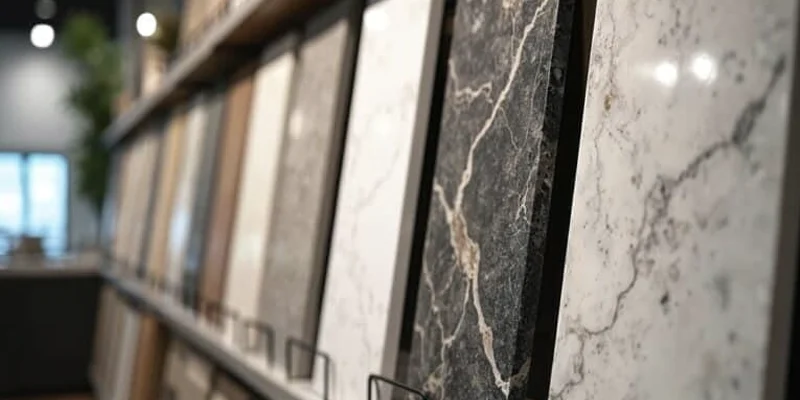
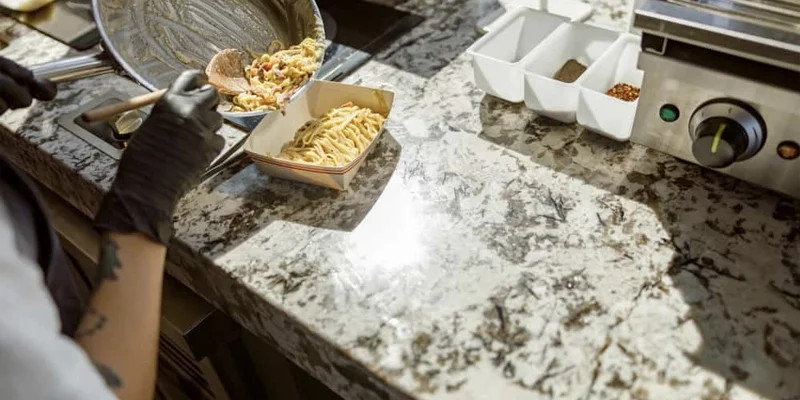
The best countertops for serious home cooks need to do more than look good in a finished kitchen. Frequent cooking exposes a work surface to hot cookware, oils, sauces, acidic ingredients, repeated cleaning, heavy appliances and constant food preparation. A countertop that works well in a lightly used kitchen may therefore be less convenient for someone who cooks from scratch every day.
There is no single material that performs best in every category. Granite, quartz, quartzite, porcelain, soapstone and marble each respond differently to heat, staining agents, impact and maintenance. The right choice depends on which demands matter most in the way you actually cook.
This guide compares countertop materials from a cooking-focused perspective, helping frequent home cooks evaluate heat management, spills, daily cleaning, surface care and prep habits before selecting a kitchen countertop.
Cooking-Focused Principle: Do not choose a countertop from one performance claim alone. For a high-use kitchen, heat habits, spills, cleaning, cutting practices and willingness to maintain the surface should be considered together.
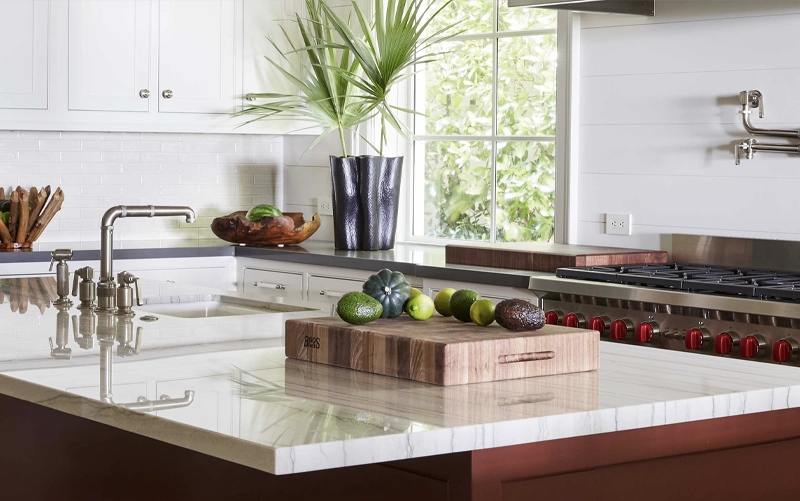
The table below provides a starting point rather than an absolute ranking. Performance can vary by the specific stone, product, finish and manufacturer, and good kitchen habits remain important with every countertop material.
| Material | Cooking Advantage | Main Consideration | Often Suits |
|---|---|---|---|
| Granite | Natural stone suited to high-use kitchen applications | Care and sealing needs depend on the specific stone | Frequent cooks comfortable with natural-stone care |
| Quartz | Nonporous surface and straightforward daily cleaning | Hot cookware should be kept on trivets or hot pads | Busy kitchens prioritizing easy everyday care |
| Quartzite | Natural stone suitable for working countertops | Characteristics and care vary between individual stones | Cooks wanting natural stone with prominent visual character |
| Porcelain | Low-absorption surface with contemporary slab options | Edges, cutouts and fabrication are product-specific | Modern kitchens with carefully planned fabrication |
| Soapstone | Nonporous natural stone with useful thermal characteristics | Softer surface can develop scratches and patina | Cooks comfortable with a naturally ageing surface |
| Marble | Natural work surface valued in some baking and design-focused kitchens | Acidic ingredients can etch the surface | Cooks who accept natural wear and material-specific care |
Frequent cooking changes what matters in countertop selection. A surface is repeatedly exposed to ingredients, cookware, appliances and cleaning, so everyday habits deserve more attention than showroom appearance alone.
Hot pans, baking trays and countertop appliances are part of an active kitchen, but “heat resistant” should not be interpreted as permission to place very hot cookware directly on every surface.
Engineered quartz contains binders that can be affected by excessive or sudden heat, so manufacturers commonly recommend trivets or hot pads. Natural stones respond differently depending on their composition and condition, but using a trivet remains a sensible protective habit around any countertop.
For a serious cook, this means heat performance should be considered together with kitchen workflow. Keeping landing space and trivets near the cooktop and oven can matter as much as the material itself.
Tomato sauce, oil, coffee, wine, citrus and other ingredients can remain on the work surface during busy meal preparation. Different materials react differently to these exposures.
Nonporous engineered surfaces can simplify routine spill management, while natural stone care depends on the specific material and finish. Calcareous stones such as marble require particular attention around acidic foods because acids can etch the surface.
Regardless of material, wiping spills promptly is a better strategy than relying on claims such as “stain proof.”
A countertop used several times a day needs a cleaning routine that fits the household. Some homeowners prefer a surface with minimal periodic care, while others are comfortable maintaining natural stone in exchange for its variation and character.
Quartz products generally do not require routine sealing. Natural-stone sealing requirements are less universal: some stones may benefit from an impregnating sealer while others may not require one. The appropriate approach should be confirmed for the actual slab and finish.
Heavy cookware, small appliances and repeated prep can create impact around countertop edges, sink openings and other exposed areas. No premium countertop should be treated as indestructible.
Use cutting boards rather than cutting directly on the countertop, and consider edge geometry, sink placement and appliance locations when planning a heavily used kitchen. These habits protect both the countertop and kitchen knives while reducing unnecessary surface wear.
Practical Rule: A countertop that fits your cooking habits is usually more useful than one selected because it wins a single “durability” category. Evaluate the complete pattern of heat, spills, cleaning and prep.
Granite is a natural-stone option worth considering for kitchens that see frequent cooking. Its characteristics vary from stone to stone, but properly selected and fabricated granite is widely used for working kitchen surfaces.
For a serious home cook, one advantage is that granite does not rely on the polymer binders used in engineered quartz. Even so, using trivets remains good practice, particularly to reduce the risk associated with rapid temperature changes and to protect the countertop over time.
Granite also requires material-specific expectations around staining and sealing. Some slabs may benefit from an impregnating sealer while others may require little additional treatment. Rather than assuming that every granite must be sealed on a fixed schedule, the appropriate care plan should be based on the selected stone.
For cooks who want a natural surface and are comfortable following stone-specific care recommendations, granite can provide a practical balance between a working countertop and the visual variation of natural stone.
Quartz countertops are a practical option for serious home cooks who prioritize straightforward daily cleaning and do not want routine sealing to become part of countertop maintenance.
Because quartz is an engineered, nonporous surface, spills from coffee, sauces, oils and many everyday ingredients can usually be cleaned without the absorption concerns associated with more porous materials. This makes it particularly convenient in kitchens where prep happens several times a day.
Heat management is the important limitation. Quartz contains resins, and manufacturers recommend placing hot cookware on trivets or hot pads rather than directly on the surface. For cooks who already use landing boards or trivets beside the stove and oven, this may be a simple habit rather than a significant drawback.
Quartz can therefore make sense for high-use family kitchens where frequent wiping, spills and low routine maintenance matter more than direct-hot-pan flexibility.
Quartzite is a natural stone that can suit an active kitchen while providing the variation and movement of a quarried material.
For serious cooks, the important point is to evaluate the actual stone rather than assume that every slab sold under the quartzite category behaves identically. Porosity, finish and maintenance requirements can vary, so the fabricator or stone supplier should confirm the appropriate care for the selected slab.
As with granite, using cutting boards and trivets remains a sensible working habit even when the material itself can tolerate demanding kitchen conditions. Quartzite may be especially appealing to homeowners who want a natural-stone countertop and are comfortable with material-specific maintenance.
Porcelain countertops deserve consideration in cooking-focused kitchens because large-format porcelain surfaces have very low water absorption and are designed for demanding surface applications.
For frequent food preparation, the practical advantage is a surface that can be cleaned easily and does not depend on routine sealing. Porcelain is also produced at high temperatures, making it relevant for kitchens where heat performance is an important selection factor.
The main consideration shifts from routine surface care to fabrication. Large-format porcelain can require specific handling, edge construction and cutout techniques, particularly around sinks and cooktops. A well-planned installation is therefore important in a kitchen where those areas will see repeated use.
Soapstone offers a different performance profile from granite, quartz and quartzite.





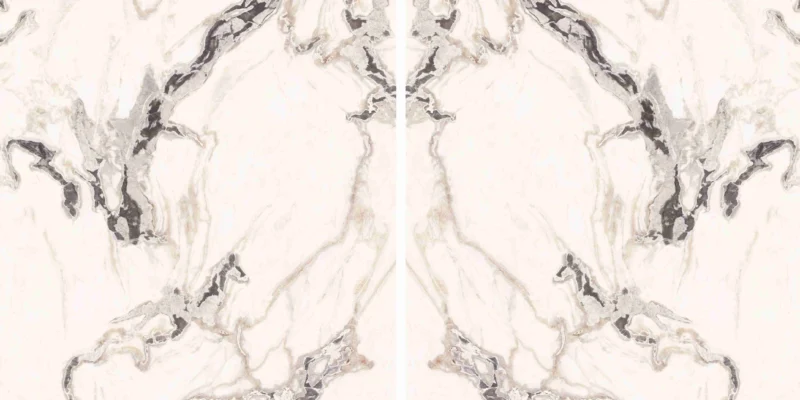

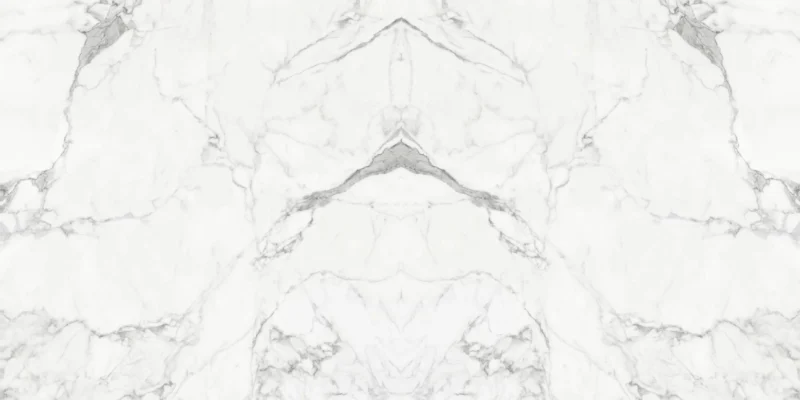



For a serious cook, those characteristics can be attractive around prep and cooking zones. The trade-off is surface hardness: soapstone is softer than granite or quartzite and can develop scratches, marks and a natural patina through use.
Some homeowners appreciate this ageing process because the surface gains character rather than remaining visually unchanged. Others who expect a consistently pristine appearance may find it less suitable.
Soapstone therefore makes the most sense when its softer, evolving surface is viewed as part of the material rather than as a defect that must be prevented entirely.
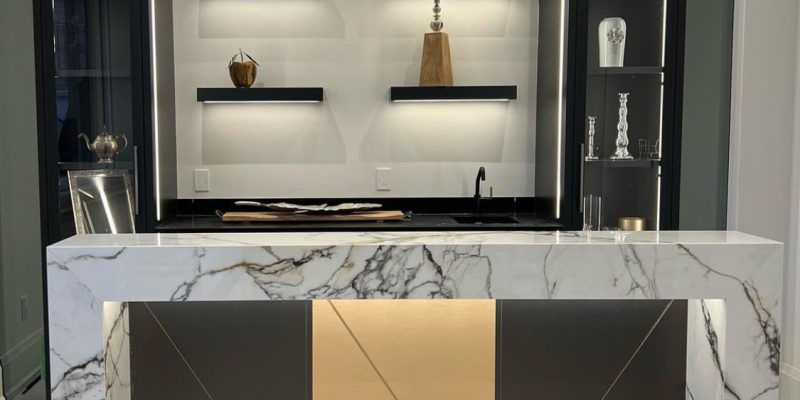
Marble has a long history as a working surface in food preparation, and its naturally cool feel can be useful for pastry and dough work. However, a serious cook should understand its care profile before choosing it for an entire high-use kitchen.
Marble is calcium-based and can etch when exposed to acidic ingredients such as citrus or vinegar. In a kitchen where sauces, wine, tomatoes and acidic foods are frequently prepared, visible surface changes may develop over time even when the stone is properly maintained.
This does not automatically make marble unsuitable for cooking. It means the homeowner needs to be comfortable with patina and material-specific care. Another option is to use marble selectively—for example, on a baking or pastry zone—while choosing a different surface for the most spill-intensive preparation areas.
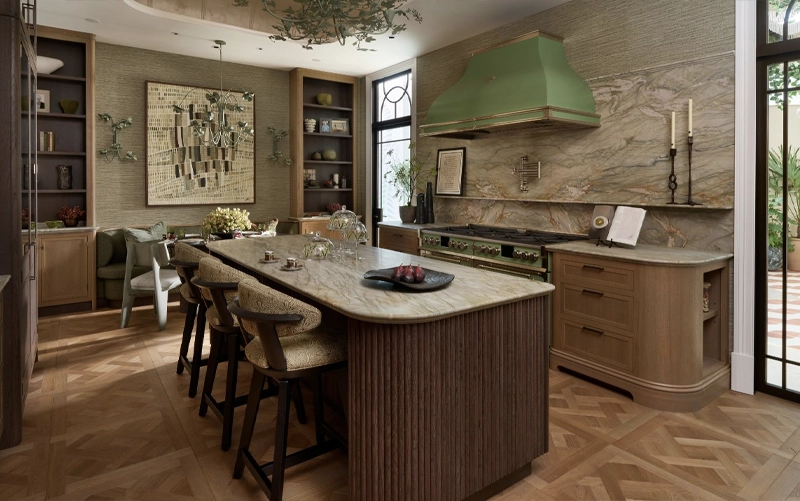
Instead of looking for one material that wins every performance category, identify what happens most often in your kitchen. Someone who regularly moves cookware between the oven and countertop has different priorities from a baker or a household preparing several meals each day.
| Cooking Style | Materials Worth Considering | Why | Watch For |
|---|---|---|---|
| Frequent High-Heat Cooking | Granite, porcelain, soapstone | Useful options where heat exposure is an important consideration | Trivets remain good practice; fabrication and stone-specific care still matter |
| Heavy Daily Meal Prep | Quartz, granite, porcelain, quartzite | Can support frequently used preparation surfaces with appropriate care | Use cutting boards and clean spills promptly |
| Baking & Pastry | Marble or other smooth stone surfaces | Marble’s naturally cool feel can be useful for dough and pastry work | Acid etching and surface patina |
| Spill-Heavy Family Cooking | Quartz, porcelain, soapstone | Low-absorption or nonporous surfaces simplify routine spill management | Follow product-specific cleaning and heat guidance |
| Citrus, Wine & Acidic Ingredients | Quartz, porcelain, soapstone; selected natural stones | Can reduce some of the care concerns associated with acid-sensitive marble | No surface should be treated as completely maintenance-free |
Decision Shortcut: If easy cleanup is the priority, begin with quartz or porcelain. If natural stone and heat-intensive cooking matter more, compare granite, quartzite and soapstone. If pastry work is central to the kitchen, marble may deserve consideration—but only with realistic expectations about etching and patina.
For a frequently used kitchen, material performance is only part of the decision. The location and size of countertop work zones can have just as much influence on everyday cooking.
Try to preserve usable countertop space near the sink, cooktop and refrigerator rather than allowing appliances or decorative elements to interrupt every working area. A continuous prep zone makes chopping, mixing and ingredient organization easier during multi-step meals.
Before fabrication, accurate dimensions and appliance information should be incorporated into the countertop plan. Teccorp Stone’s Countertop Survey & Measurement service supports this stage before fabrication begins.
Serious cooks regularly move hot cookware, baking trays and ingredients between appliances and countertops. Useful landing space beside the cooktop and oven can reduce awkward movement and make protective habits such as using trivets easier to maintain.
The same principle applies around refrigerators and sinks: countertop areas should support the actual sequence of preparation, cooking and cleanup.
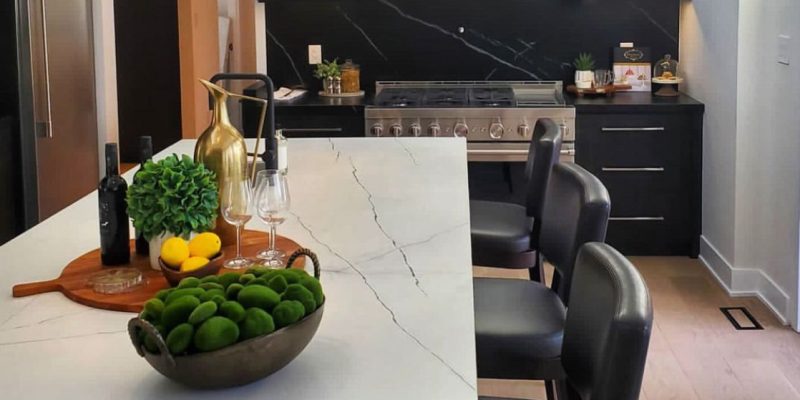
A kitchen island can provide valuable uninterrupted prep space, especially when perimeter countertops are divided by sinks, cooktops or tall appliances.
For high-use kitchens, island dimensions should be evaluated around circulation, seating and the tasks that will actually happen there. Large stone islands may also require careful slab planning so that pattern direction, seams and fabricated sections are resolved before production.
Fabrication details become particularly important when the countertop will be used heavily every day.
Long countertop runs or large islands may require more than one fabricated section. Seam locations should be planned around slab size, geometry, openings, support and installation conditions rather than placed arbitrarily.
Our Countertop Seam Placement Guide explains the factors that influence where seams may be positioned.
Countertop edges around sinks, dishwashers and primary prep areas experience frequent contact with cookware, dishes and small appliances. Edge design should therefore be considered as both a visual and functional fabrication decision.
Highly detailed profiles may suit some kitchen styles, while simpler edges can support a cleaner working surface. The appropriate choice depends on material, thickness and project design.
Sink and cooktop openings interrupt the countertop and require accurate fabrication based on approved fixture information. Appliance and sink models should therefore be finalized before the relevant pieces are cut whenever possible.
Working-Kitchen Principle: A high-performance material cannot compensate for poor layout. Countertop material, work zones, openings and fabrication details should be planned as one system.
Before making the final decision, identify the demands your countertop will face most often.
| Ask Yourself | Why It Matters |
|---|---|
| How often do I cook? | Frequent use increases the importance of cleaning, workflow and maintenance. |
| How much hot cookware moves through the kitchen? | This affects heat-management habits and landing-space planning. |
| Do I frequently use citrus, wine or acidic sauces? | Acid exposure is particularly relevant when considering marble. |
| How much maintenance am I comfortable with? | This can help separate lower-maintenance engineered surfaces from natural stones requiring material-specific care. |
| Do I need a large uninterrupted prep surface? | Slab dimensions, seams and island planning may become important. |
For a broader comparison that includes design, budget and general material selection, see How to Choose the Right Kitchen Countertop. This guide remains focused specifically on the needs of frequent home cooks.
There is no universal winner. Quartz can simplify routine cleaning, granite and quartzite provide natural-stone options, porcelain offers a low-absorption surface, and soapstone has useful heat-related characteristics. The best choice depends on cooking habits and maintenance preferences.
Granite, soapstone and porcelain are worth considering when heat exposure is an important priority. However, trivets or hot pads remain a sensible protective habit regardless of countertop material.
Yes, particularly for cooks who value a nonporous surface and straightforward daily cleaning. Hot cookware should not be placed directly on quartz; manufacturer heat-protection guidance should be followed.
It can be, but the cook needs to accept its sensitivity to acidic ingredients and the possibility of etching and patina. Marble may also be used selectively in a baking or pastry zone.
Scratch behaviour is only one factor. Heat management, spills, maintenance, impact, work-zone layout and fabrication details should be considered together.
Yes. Seam placement affects how large countertop sections are fabricated and installed. Locations should be planned around geometry, openings, slab dimensions and support rather than simply minimizing the number of seams.
The best countertop for a serious home cook is the one that fits the way food is actually prepared in the kitchen. A household that cooks several meals every day may prioritize easy cleaning and practical work zones, while another may place greater importance on heat exposure, natural stone or dedicated baking space.
Compare those priorities before choosing a surface, and plan the countertop layout and fabrication details around the appliances, sink and prep areas that receive the most use.
Explore Teccorp Stone’s Stone Surfaces or review options through our Kitchen Countertops service.
Plan a Countertop Around the Way You Cook
Compare materials, fabrication requirements and kitchen-use priorities before finalizing your countertop.