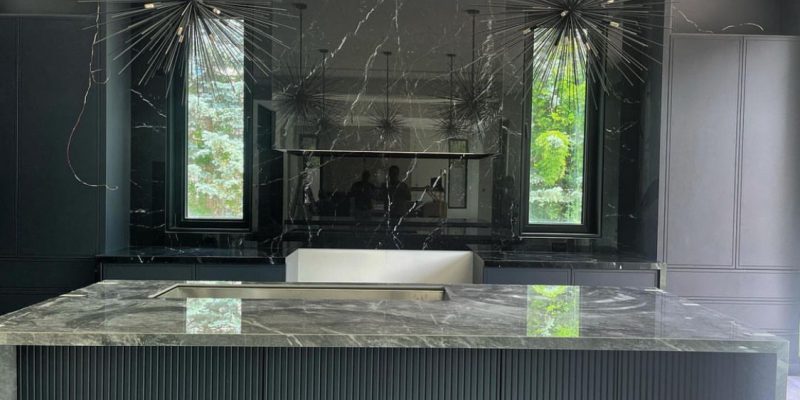
Choosing the right countertop material in Ontario is no longer just about durability or price. Today’s homeowners are equally focused on aesthetics, lifestyle compatibility, and how a surface contributes to the overall kitchen design. Concrete and wood countertops represent two very different design philosophies, yet both have gained popularity across Toronto and the GTA for custom and character-driven kitchens.
While concrete countertops are associated with modern, industrial, and architectural spaces, wood countertops bring warmth, texture, and a natural feel that softens contemporary interiors. Understanding how these materials perform in Ontario homes helps homeowners make a confident, long-term decision.
Ontario homeowners are increasingly moving beyond mass-market countertop options and exploring materials that feel more personal and design-forward. Concrete and wood both appeal to clients seeking uniqueness rather than uniformity.
Concrete countertops are favored in Toronto lofts, modern homes, and custom renovations where clean lines, minimalism, and bold surfaces dominate. Wood countertops, often seen in farmhouse, Scandinavian, and transitional kitchens, are popular in suburban homes where warmth and comfort are priorities.
Both materials are frequently considered alongside premium kitchen countertop projects where customization plays a central role in the final design.
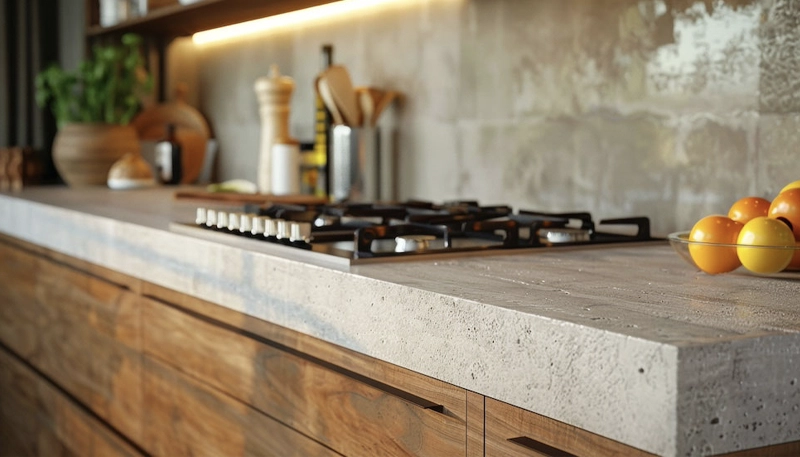
Concrete countertops are fully customizable surfaces poured or precast to fit specific kitchen layouts. Unlike natural stone or engineered materials, concrete allows complete control over thickness, shape, color, and finish.
In Ontario homes, concrete is most often used in:
Concrete can be finished smooth, matte, polished, or textured. Pigments and aggregates can be added to achieve unique tones ranging from soft grey to deep charcoal or warm earth hues. This flexibility makes concrete a favorite for designers seeking a one-of-a-kind surface.
However, concrete is a porous material that requires professional sealing. Without proper sealing, it can absorb moisture and develop stains, particularly in busy Ontario kitchens.
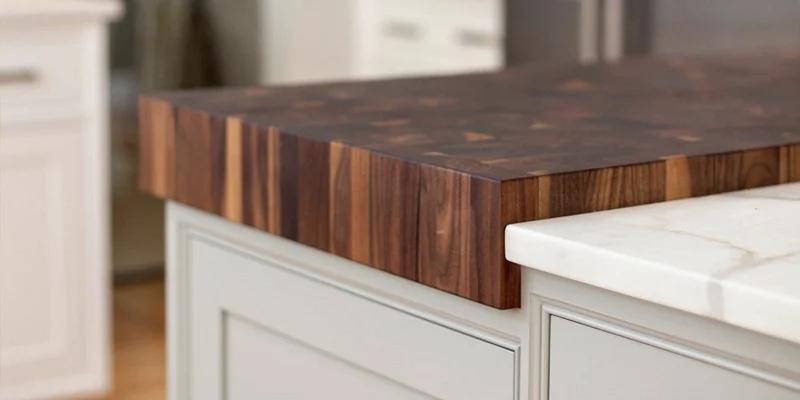
Wood countertops, often referred to as butcher block, introduce natural warmth and organic texture into kitchen spaces. In Ontario homes, they are commonly crafted from maple, oak, walnut, or bamboo.
Wood countertops are most often used in:
Unlike concrete, wood surfaces develop character over time. Scratches, dents, and patina are often embraced as part of the material’s charm rather than seen as flaws.
Many Ontario homeowners combine wood with stone or engineered surfaces, pairing it with materials such as quartz countertops or granite to balance warmth with durability.
From a design perspective, concrete and wood affect the feel of a kitchen in very different ways.
Concrete introduces visual weight and structure. It works best in kitchens with strong architectural elements, clean cabinetry lines, and neutral color palettes. Concrete pairs well with stainless steel appliances, handleless cabinets, and modern lighting.
Wood, by contrast, softens spaces. It adds warmth to white or neutral kitchens and creates contrast when paired with darker cabinetry. In Ontario homes with colder climates, wood surfaces often create a more inviting, lived-in atmosphere.
Ontario kitchens experience frequent temperature changes, humidity fluctuations, and daily use. Both concrete and wood can perform well, but only when homeowners understand their maintenance requirements.
Concrete countertops are heat-resistant and durable but can develop hairline cracks over time due to natural curing and temperature shifts. These cracks are often cosmetic and considered part of concrete’s character.
Wood countertops are more sensitive to moisture and heat. They require regular oiling or sealing to prevent drying, warping, or water damage. For this reason, wood is often used strategically rather than across all countertop surfaces.
In high-use kitchens, homeowners sometimes reserve wood for islands or prep areas while using stone or porcelain on perimeter counters.
The decision between concrete and wood countertops comes down to lifestyle, design goals, and willingness to maintain the surface. Concrete appeals to homeowners seeking bold, modern design with custom flexibility. Wood suits those who value warmth, texture, and a natural aesthetic.
Both materials work best when integrated into a thoughtfully planned kitchen layout. Proper measurement, sealing, and fabrication are essential to long-term performance, particularly in Ontario’s climate.
When comparing concrete and wood countertops for Ontario homes, durability and maintenance play a decisive role. While both materials can last for years, they respond very differently to moisture, temperature changes, and daily kitchen use common across Toronto and the GTA.
Concrete countertops are known for their strength and structural stability. When properly fabricated and reinforced, concrete performs well in high-traffic kitchens and open-concept layouts. Its resistance to heat makes it suitable for busy cooking environments, including homes with gas ranges or professional-style appliances.
However, concrete is not completely immune to wear. Over time, small hairline cracks may appear due to curing processes and seasonal temperature fluctuations common in Ontario. These cracks are typically cosmetic and do not affect structural integrity.
With professional sealing, concrete resists staining from food, oils, and liquids. Without sealing, it can absorb moisture and discolor, especially in family kitchens. For this reason, concrete installations are often included as part of professionally planned kitchen countertop installations.
Wood countertops are naturally softer than concrete and stone. They are more prone to scratches, dents, and surface marks, particularly in high-use areas. However, many homeowners consider this aging process part of wood’s appeal rather than a drawback.
In Ontario kitchens, wood performs best when homeowners understand its limitations. Prolonged exposure to standing water, steam, or heat can cause swelling, cracking, or warping if the surface is not properly maintained.
Because of these factors, wood is often used selectively — such as on islands or prep areas — while more durable materials are used on perimeter counters. Pairing wood with materials like granite countertops or quartz provides a balance of warmth and resilience.
Maintenance expectations differ significantly between concrete and wood countertops, and this often influences long-term satisfaction.
Concrete countertops require sealing at installation and periodic resealing every 1–3 years, depending on usage and the type of sealer applied.







Wood countertops require more frequent attention. Regular oiling or sealing is essential to prevent drying and moisture absorption. Spills must be wiped immediately, and cutting directly on the surface can accelerate wear.
For homeowners who enjoy hands-on care and natural aging, wood can be rewarding. For those seeking lower ongoing maintenance, concrete tends to be the more forgiving option.
Ontario’s climate presents unique challenges for countertop materials. Humid summers and dry winters can stress surfaces that are sensitive to moisture changes.
Concrete handles humidity well when sealed correctly. Temperature fluctuations may cause subtle movement, but this is rarely problematic when the countertop is professionally fabricated.
Wood is more reactive to seasonal changes. In winter, dry indoor air can cause shrinkage, while summer humidity can lead to expansion. Consistent maintenance and proper sealing are essential to keep wood surfaces stable year-round.
From a hygiene standpoint, both materials can be safe when properly maintained. Sealed concrete surfaces are non-porous and resistant to bacteria buildup.
Wood countertops, despite common misconceptions, can also be hygienic. Certain wood species have natural antimicrobial properties, but this benefit depends on consistent care and sealing.
For households prioritizing low-risk surfaces with minimal effort, concrete generally offers a more predictable performance profile.
Concrete suits homeowners who value durability, modern aesthetics, and minimal maintenance intervention. It performs well in busy households, rental properties, and modern Toronto homes where function and design must coexist.
Wood suits homeowners who prioritize warmth, craftsmanship, and tactile design. It works best in kitchens where maintenance is seen as part of ownership and where the surface contributes to a lived-in, personal atmosphere.
Understanding these performance differences helps Ontario homeowners choose a countertop material that aligns not only with design goals, but with daily routines and long-term expectations.
Beyond design and durability, cost and installation complexity play a major role when Ontario homeowners compare concrete and wood countertops. While both materials fall outside mass-produced options, their pricing structures and long-term value differ significantly.
Concrete countertops are considered a custom product rather than a standardized surface. In Ontario, pricing typically reflects the level of customization, fabrication method, and installation complexity.
On average, concrete countertop costs in Toronto and the GTA range from $90 to $160 per square foot installed. Factors influencing price include:
Because of its weight and curing requirements, concrete installation must be handled by experienced professionals. Improper installation can lead to cracking, uneven surfaces, or sealing failure.
For large or complex kitchens, accurate planning through a countertop survey and measurement is essential to ensure structural support and proper layout.
Wood countertops generally have a lower upfront cost compared to concrete, but pricing varies widely based on wood species and construction quality.
In Ontario, installed wood countertop costs typically range from $60 to $120 per square foot. Pricing depends on:
Premium hardwoods such as walnut command higher prices, while maple and oak remain more accessible. Custom wood islands are especially popular as focal points in Ontario kitchens.
However, long-term costs should be considered. Regular oiling, resealing, and occasional refinishing add to ownership expenses over time.
Concrete countertops are heavy and require reinforced cabinetry and precise support planning. In Ontario homes, especially older properties, structural assessment is critical before installation.
Wood countertops are lighter and easier to install, making them more flexible for renovations where cabinetry may not support heavier materials.
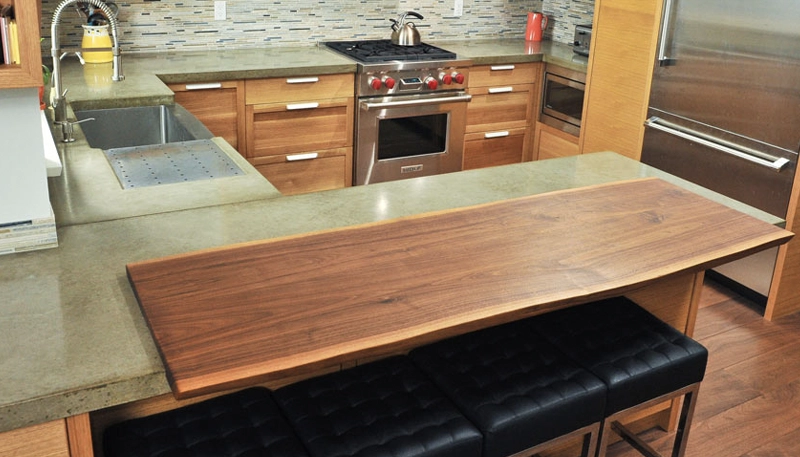
In many Ontario projects, homeowners choose a hybrid approach — installing concrete or stone on perimeter counters while using wood on islands to reduce structural demands and costs.
In competitive real estate markets such as Toronto, Vaughan, and Oakville, countertop material can influence buyer perception and resale value.
Concrete countertops are often viewed as a high-end, design-forward feature. In modern homes, they can enhance perceived value, especially when paired with minimalist cabinetry and professional installation.
Wood countertops tend to appeal to a narrower audience. Buyers who appreciate craftsmanship and natural materials see wood as a premium feature, while others may view it as higher maintenance.
For homeowners planning to sell in the near future, concrete generally offers broader market appeal, while wood works best in homes where design cohesion and lifestyle alignment are prioritized.
Concrete countertops, when properly sealed and maintained, can last decades with minimal structural degradation. Minor cracks and patina often enhance character rather than diminish value.
Wood countertops may require resurfacing or refinishing over time, but they are also renewable. Scratches and damage can often be sanded out, extending the life of the surface.
From a long-term investment perspective, concrete offers durability with lower ongoing maintenance, while wood offers flexibility and repairability at the cost of more frequent care.
For Ontario homeowners seeking a bold, modern statement with long-term durability, concrete often represents stronger overall value. For those prioritizing warmth, character, and tactile design, wood delivers aesthetic value that cannot be replicated by engineered materials.
Ultimately, value is determined not only by price, but by how well the countertop supports daily life, design goals, and long-term plans for the home.
Choosing between concrete and wood countertops ultimately comes down to lifestyle, design priorities, and long-term expectations. Both materials offer distinctive advantages, but they perform very differently under real-world conditions common in Ontario homes.
Concrete countertops are best suited for homeowners who value durability, architectural presence, and low long-term maintenance. They perform exceptionally well in:
Concrete integrates seamlessly into contemporary kitchen designs and pairs well with flat-panel cabinetry, stainless steel appliances, and minimalist layouts. Its ability to be customized in shape, thickness, and finish makes it ideal for statement islands and focal surfaces.
In Toronto and the GTA, concrete countertops are increasingly used in premium renovations where homeowners want a surface that feels permanent, architectural, and distinctive.
Wood countertops shine in homes where warmth, texture, and character are central to the design vision. They are particularly well-suited for:
Wood creates an inviting, lived-in atmosphere that no stone or engineered surface can replicate. In Ontario homes, wood countertops are often chosen for islands while perimeter counters use stone for durability.
For homeowners who enjoy maintaining their surfaces and appreciate natural aging and patina, wood offers a deeply personal and evolving aesthetic.
One of the most effective design strategies in Ontario kitchens is combining both materials. This approach balances performance and warmth without compromise.
Hybrid designs allow homeowners to enjoy the best attributes of each material while managing cost, maintenance, and structural considerations.
Concrete requires sealing but minimal daily care. Once properly installed and sealed, it resists heat, scratches, and stains effectively in Ontario’s variable climate.
Wood requires more hands-on maintenance. Regular oiling, moisture control, and careful use around sinks are essential to preserve appearance and prevent damage.
Homeowners should choose based on how much ongoing care they are realistically willing to commit to, not just initial aesthetics.
If you want a countertop that delivers long-term durability, strong resale appeal, and modern architectural impact, concrete is the more practical choice.
If you value warmth, craftsmanship, and a natural surface that evolves with your home, wood offers unmatched character and comfort.
For many Ontario kitchens, the smartest solution is not choosing one over the other — but using both strategically to create a balanced, functional, and visually compelling space.