Concrete vs wood countertops is an important comparison for Ontario homeowners because these materials create very different kitchens and require different approaches to fabrication, moisture protection, maintenance, repair, and long-term use.
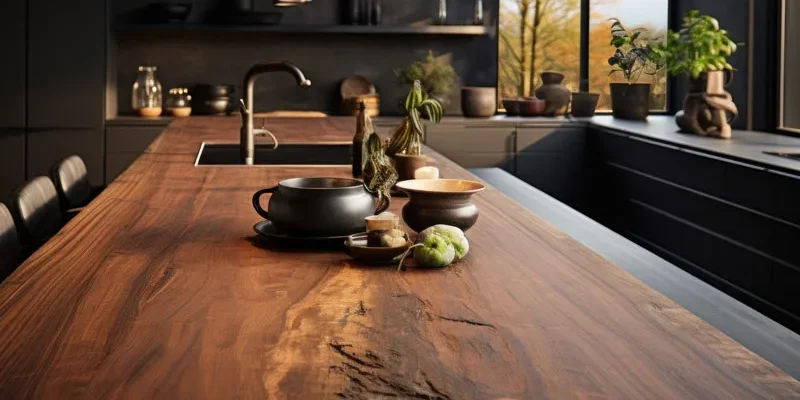
Concrete creates a substantial architectural surface with customizable colours, textures, thicknesses, aggregates, and integrated details. Wood provides visible grain, natural warmth, lighter visual weight, and a surface that can often be sanded or refinished as it ages.
The right choice depends on more than appearance. Kitchen traffic, sink placement, exposure to heat and standing water, indoor humidity, cabinet support, willingness to maintain the finish, and expectations for natural wear can all affect which material performs better.
Homeowners planning a custom kitchen should compare the actual construction method, finish system, edge details, seams, support requirements, and intended use before selecting either material. Teccorp Stone helps homeowners throughout Toronto and Ontario evaluate countertop layouts and compare surface options as part of a complete kitchen countertop project.
Quick Comparison
Choose concrete when architectural appearance, custom shapes, integrated details, and a substantial modern surface are priorities. Choose wood when natural warmth, repairability, lighter weight, and visible grain character matter most. Both materials require moisture protection and maintenance, but their care methods and damage risks are different.
The following table summarizes the main differences Ontario homeowners should evaluate before choosing between concrete and wood countertops.
| Comparison Factor | Concrete Countertops | Wood Countertops |
|---|---|---|
| Material Type | Cement-based custom surface containing aggregates, reinforcement, pigments, admixtures, and a protective finish system | Solid or laminated wood surface made from joined boards, strips, blocks, or other wood components |
| Appearance | Architectural, industrial, minimalist, monolithic, or handcrafted | Warm, natural, textured, traditional, rustic, Scandinavian, or transitional |
| Pattern and Colour Variation | Variation may result from pigments, aggregates, casting, curing, polishing, and handmade finishing | Variation depends on wood species, grain, colour, knots, board selection, and construction method |
| Customization | Highly customizable in shape, thickness, colour, texture, aggregate, edge design, and integrated details | Customizable through species, grain orientation, board layout, stain, finish, thickness, and edge profile |
| Scratch Resistance | Depends heavily on the sealer and finish; surface scratches and wear can still occur | More vulnerable to scratches, knife marks, abrasion, and dragged objects |
| Dent and Impact Resistance | Resists ordinary denting but edges, corners, and thin sections may chip under concentrated impact | Can dent or compress under heavy impact, particularly with softer wood species |
| Heat Resistance | The concrete body tolerates heat relatively well, but sealers and sudden temperature changes remain vulnerable | Direct heat may scorch, darken, crack, or damage the finish |
| Stain Resistance | Depends on porosity, sealer quality, finish condition, and spill response | Depends on species, finish system, maintenance, and how quickly spills are removed |
| Moisture Resistance | Requires an appropriate sealer and careful detailing around seams, sinks, and penetrations | Sensitive to standing water, unsealed edges, sink areas, joints, and prolonged moisture exposure |
| Cracking or Movement Risk | Hairline cracking or small movement may occur because of curing, reinforcement, support, or structural conditions | Wood naturally expands and contracts as indoor humidity changes |
| Maintenance | Moderate; depends on the sealer, finish, use, cleaning products, and exposure | Moderate to high; depends on the finish, sink exposure, cutting practices, and moisture control |
| Sealing or Oiling | Normally requires a compatible sealer or protective finish system | May use oil, wax, varnish, polyurethane, hardwax oil, or another finish depending on intended use |
| Repairability | Some stains, finish damage, chips, or cracks may be treated, but repairs may remain visible | Many scratches, stains, burns, and surface marks can be sanded and refinished if sufficient material remains |
| Weight | Heavy and potentially demanding on cabinets, floors, transport, and installation access | Generally lighter and easier to transport than concrete or stone slabs |
| Fabrication Complexity | Requires mould planning, reinforcement, casting, curing, finishing, sealing, and controlled installation | Requires species selection, moisture conditioning, stable construction, joinery, sanding, finishing, and movement allowance |
| Relative Cost | Typically a mid-range to premium custom product | Ranges from accessible to premium depending on species, construction, thickness, and finish |
| Expected Service Life | Can remain in service for many years when correctly reinforced, supported, sealed, and maintained | Can remain in service for many years and may be renewed through sanding and refinishing |
| Best Suited For | Modern kitchens, architectural islands, custom shapes, industrial interiors, and integrated design details | Warm kitchens, feature islands, breakfast bars, farmhouse designs, Scandinavian interiors, and mixed-material layouts |
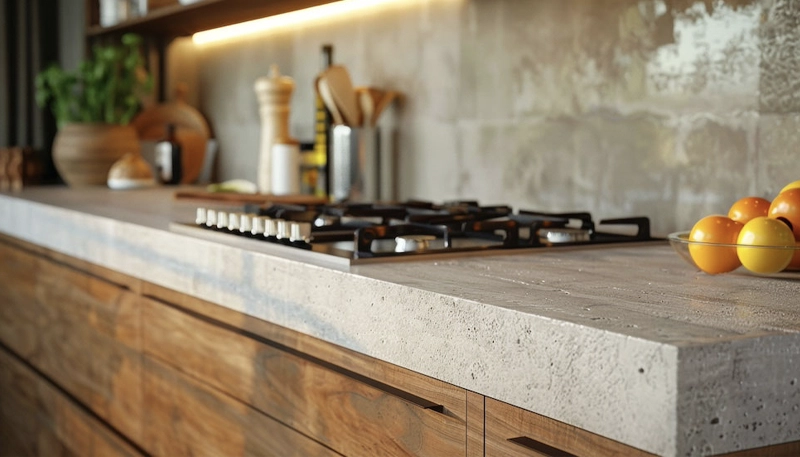
Concrete and wood countertops differ in composition, fabrication, movement, finishing, and maintenance. Concrete is a cast cement-based material whose performance depends on its mix, reinforcement, curing, sealing, and support. Wood is an organic material whose behaviour depends on species, grain orientation, moisture content, construction method, finish, and indoor conditions.
Neither material should be evaluated only by its surface appearance. The complete countertop system—including substrate, joints, cutouts, sink details, edge construction, cabinet support, and finish—determines how well it performs in a working kitchen.
A concrete countertop is a custom cement-based surface made from a formulated mixture that may include cement, aggregates, water, pigments, reinforcement, admixtures, and decorative materials. It may be fabricated in a workshop as a precast piece or poured and finished at the installation site.
The appearance can range from relatively uniform and refined to visibly handcrafted. Colour variation, pinholes, aggregate exposure, movement, small tonal differences, and minor surface irregularities may be part of the intended design rather than manufacturing defects.
Concrete can be moulded into custom shapes and may accommodate integrated drainboards, thick edges, unusual curves, decorative aggregates, inlays, and other architectural details. The level of customization depends on the fabricator, casting method, reinforcement system, and project design.
The material itself is naturally porous. Its resistance to staining, food exposure, moisture, acids, and cleaning products therefore depends heavily on the selected sealer or finish system.
Concrete can also develop hairline cracks as it cures, moves, or responds to support conditions. Proper reinforcement, joint planning, slab thickness, cabinet preparation, and controlled fabrication help reduce risk but do not make every surface completely crack-free.
A wood countertop is made from solid wood boards, laminated strips, blocks, or other joined wood components. Common species may include maple, oak, walnut, cherry, beech, birch, and other hardwoods selected for appearance, availability, hardness, stability, and intended use.
Wood offers natural grain, colour variation, knots, growth patterns, and tactile warmth. Each countertop develops its own appearance according to the species, board selection, grain orientation, stain, finish, exposure, and aging process.
Wood naturally responds to moisture and indoor humidity. It expands and contracts across the grain as environmental conditions change. Proper construction, acclimation, movement allowance, fastening, sealing, and indoor humidity management help reduce cupping, gaps, splitting, or warping.
The selected finish determines how the surface should be used. An oil-finished preparation surface behaves differently from a film-finished decorative countertop. Cleaning, maintenance, food contact, sink exposure, and repair methods must match the actual finish system.
Wood can be scratched, dented, scorched, or stained, but one of its advantages is renewability. Many forms of surface wear can be sanded and refinished, provided the construction and remaining material allow it.
Wood countertop and butcher block are often used as interchangeable terms, but they do not always mean exactly the same thing. A wood countertop describes the broader material category, while butcher block usually refers to a laminated construction made from joined strips or blocks of wood.
Butcher block may use edge-grain, face-grain, or end-grain construction. These orientations create different appearances and respond differently to impact, cutting, moisture, and refinishing.
Not every wood countertop is designed for direct knife use. Some surfaces are intended primarily as finished countertops or furniture-like islands and should be protected with cutting boards.
Before using a wood surface for direct food preparation, homeowners should confirm the species, adhesive system, finish, manufacturer instructions, and whether the product is specifically intended for that use.
Concrete and wood create nearly opposite visual effects. Concrete contributes mass, structure, and architectural presence, while wood adds grain, warmth, softness, and natural variation.
Both can be highly customized, but the source of that customization is different. Concrete is shaped through moulds, pigments, aggregates, casting, polishing, and sealers. Wood is designed through species, board selection, grain orientation, joinery, stain, texture, and finish.
Concrete is commonly associated with grey, but it can be produced in a much broader range of colours. Integral pigments, stains, aggregates, polishing methods, and finish systems can create white, charcoal, warm grey, brown, muted earth tones, or other custom appearances.
The surface may be polished and smooth, matte and understated, textured, lightly mottled, or designed to expose decorative aggregate. Samples should be treated as general references because hand-cast concrete may not reproduce colour and movement with complete uniformity.
Concrete works particularly well with flat-panel cabinetry, metal details, minimalist lighting, stainless steel appliances, natural oak, black finishes, and open-concept architectural layouts.
Its substantial appearance can make a large island or long countertop run feel permanent and integrated. However, thick sections and dark colours may visually overwhelm compact kitchens unless cabinetry, lighting, and surrounding materials are balanced carefully.
The appearance of a wood countertop depends strongly on species. Maple often creates a lighter and relatively controlled surface, oak displays pronounced grain, and walnut provides deeper brown tones and stronger contrast.
Face-grain construction highlights broad board surfaces and natural figure. Edge-grain construction creates a more linear pattern from laminated strips, while end-grain construction produces a block-like appearance and is commonly associated with traditional butcher block.
Board width, grain matching, knots, sapwood, heartwood, stain, sanding, brushing, distressing, and finish sheen all influence the final appearance.
Wood can support farmhouse, Scandinavian, transitional, rustic, heritage, and contemporary kitchens. In modern interiors, a wood island can soften white, grey, black, concrete, quartz, or metal surfaces without making the entire kitchen feel traditional.
Concrete has greater visual weight. It makes a kitchen feel grounded, architectural, restrained, and often more industrial. Thick edges, integrated forms, and neutral colours can turn the countertop into a major structural feature.
Wood has a softer visual presence and introduces warmth through colour, grain, and natural texture. It can make a white or grey kitchen feel more inviting and can reduce the visual coldness of metal, glass, tile, or engineered surfaces.
In compact Toronto condos, concrete works best when its thickness and colour are carefully controlled. A lighter finish, slim visual profile, or limited feature application may prevent the space from feeling heavy.
Wood can make a small open-concept kitchen feel warmer, but strong grain, dark stain, or extensive use may compete with flooring and cabinetry. Material samples should therefore be reviewed alongside the complete kitchen palette.
Concrete offers extensive shape flexibility because it is formed in a mould or cast at the project location. Curves, unusual angles, thick edges, integrated drainboards, recessed details, and selected sink configurations may be possible depending on the fabricator and reinforcement system.
These custom features increase planning and fabrication complexity. Mould construction, reinforcement, shrinkage, handling, curing, weight, sealing, and installation access must all be considered before production begins.
Wood can also be fabricated into custom curves, shaped islands, waterfall-style panels, raised breakfast bars, thick laminated edges, and furniture-inspired details. Joinery, grain direction, movement, and fastening must be planned so the countertop can respond naturally to humidity changes.
Edge profiles on wood may range from simple eased edges to rounded, bevelled, or more decorative profiles. Concrete edges may be crisp, eased, chamfered, rounded, or moulded, but sharp corners can remain vulnerable to chipping.
Integrated features should be evaluated for maintenance as well as appearance. Grooves, sink transitions, seams, joints, and textured areas may collect moisture or require more careful cleaning than a simple flat surface.
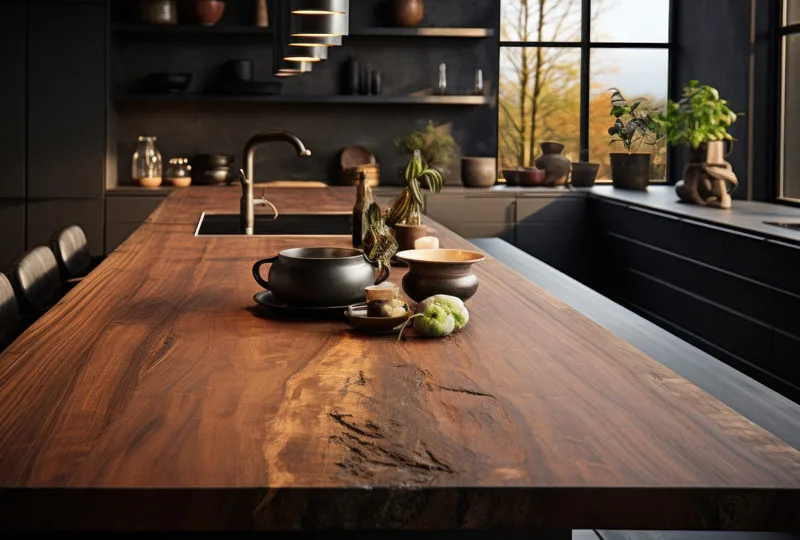
Homeowners considering a feature island or mixed-material kitchen can review Teccorp Stone’s kitchen island countertop services and compare wood or concrete accents with options from the quartz countertop collection or granite countertop collection.
Concrete and wood countertops can both remain functional for many years, but they respond differently to scratching, impact, heat, moisture, stains, movement, and daily food preparation. Concrete provides a hard and substantial surface whose performance depends heavily on its sealer and reinforcement. Wood is softer and more vulnerable to visible wear, but many forms of damage can be sanded and refinished.
Concrete resists ordinary denting because it is a hard cement-based material. However, the visible finish or sealer may scratch, scuff, or wear even when the concrete beneath remains structurally sound.
Heavy impacts can chip exposed concrete edges, corners, sink openings, and thin sections. The risk depends on the concrete mix, reinforcement, edge design, fabrication quality, support, and the type of impact.
Wood is more easily scratched or dented by knives, heavy cookware, appliances, abrasive debris, and dragged objects. Softer species generally show dents more readily than harder species.
Visible wear is not always considered a defect in wood. Some homeowners value the patina created by light scratches, colour changes, and daily use. When a renewed appearance is preferred, many wood surfaces can be sanded and refinished.
Surface Hardness vs Repairability
Concrete is harder and less likely to dent, but repairs may remain visible. Wood shows wear more easily, yet scratches, burns, and surface stains can often be reduced through sanding and refinishing.
The concrete body generally tolerates heat better than wood, but the countertop should not be treated as heat-proof. Direct heat can discolour, soften, dull, or damage certain sealers and finish systems.
Sudden temperature changes may also place stress on the surface, seams, reinforcement, or surrounding installation components. Trivets should therefore be used beneath hot cookware and heat-producing countertop appliances.
Wood is more vulnerable to direct heat. Hot pans, electric skillets, air fryers, slow cookers, and similar appliances may scorch the surface, dry the wood, damage the finish, or create local cracking.
Heat protection is recommended for both materials. The correct protective pad should allow airflow and prevent prolonged heat transfer into the countertop.
Concrete is naturally porous. Its resistance to coffee, wine, oils, sauces, citrus, food colouring, and standing water depends primarily on the sealer or finish system.
A well-maintained finish can slow absorption and make routine cleaning easier, but it does not make every concrete countertop completely stain-proof. Seams, pinholes, chips, worn areas, and exposed edges may remain more vulnerable.
Wood also absorbs moisture when its finish is damaged, incomplete, or unsuitable for the application. Standing water around sinks, faucets, seams, appliance openings, and unsealed edges can contribute to swelling, darkening, joint movement, mould growth, or finish failure.
Spills should be wiped promptly on both materials. Sink cutouts, faucet holes, joints, and wall connections require particular attention because moisture can remain in these areas longer than on the open countertop surface.
Concrete may develop hairline cracks because of curing shrinkage, reinforcement conditions, structural movement, inadequate support, large unsupported sections, or stress around cutouts.
Some small cracks are primarily cosmetic, while others may indicate movement or support problems. Cracks should not automatically be described as harmless without considering their width, location, progression, moisture exposure, and effect on the finish.
Wood behaves differently because it naturally expands and contracts across the grain as indoor humidity changes. This movement may create minor gaps, cupping, splitting, or pressure against surrounding materials when the countertop is not properly constructed or installed.
Stable construction, appropriate moisture content, acclimation, movement allowances, suitable fastening, and controlled indoor humidity help reduce dimensional problems. Wood should not be rigidly restrained in a way that prevents normal seasonal movement.
Concrete and wood countertops can both be maintained as hygienic kitchen surfaces when the correct finish, cleaning method, and moisture control practices are used.
Concrete hygiene depends largely on the condition of its sealer. Worn, chipped, cracked, or poorly sealed areas may retain moisture or food residue more readily than a smooth, intact finish.
Wood countertops require careful distinction between decorative surfaces and products specifically intended for direct food preparation. Not every wood finish, adhesive, or construction method is designed for direct knife contact.
When a wood countertop is approved for food preparation, it should be cleaned according to the product and finish instructions and allowed to dry properly. Deep cuts, open joints, damaged finishes, and prolonged moisture exposure should be addressed promptly.
Cutting boards remain the safest general recommendation for both materials. They protect the countertop, simplify sanitation, and reduce unnecessary wear.
Outdoor weather does not directly determine the performance of an indoor countertop, but seasonal heating and cooling can change indoor humidity levels throughout Ontario homes.
Wood is especially responsive to these indoor changes. Dry heated air may encourage shrinkage, while higher indoor humidity may contribute to expansion. Stable humidity and correct installation help limit excessive movement.
Concrete is less dimensionally responsive to indoor humidity than wood, but structural movement, substrate conditions, temperature changes, and curing history can still influence cracking and joint performance.
Homeowners should manage indoor conditions for the entire kitchen system, including cabinetry, flooring, woodwork, adhesives, and countertop joints—not only the visible countertop surface.
Both concrete and wood require more finish-specific care than many engineered surfaces. The correct maintenance routine depends on the actual sealer, coating, oil, wax, varnish, hardwax oil, or other finish used on the countertop.
Concrete countertops normally require a compatible sealer or protective finish to reduce staining, moisture absorption, and chemical exposure. Different systems provide different levels of resistance to heat, acids, abrasion, and food contact.
There is no universal resealing schedule for every concrete countertop. Maintenance frequency depends on the sealer type, application quality, kitchen use, cleaning products, surface wear, and manufacturer or fabricator instructions.
Daily cleaning should generally be completed with warm water, mild soap, and a soft cloth. Abrasive pads, harsh solvents, strong acids, highly alkaline products, and cleaners that are incompatible with the sealer should be avoided.
Changes in sheen, increased water absorption, persistent staining, surface tackiness, or visible finish wear may indicate that professional evaluation or finish renewal is required.
Wood maintenance depends on the finish system. Oil-finished surfaces require a different routine from film-forming finishes such as varnish, polyurethane, or other protective coatings.
An oil-finished countertop may require periodic reapplication when the surface appears dry, absorbs moisture rapidly, or loses its protective appearance. The correct product and frequency should follow the manufacturer or fabricator guidance.
Film-finished wood countertops may offer stronger resistance to moisture and staining, but scratches, chips, or finish separation can expose the wood beneath. Local repairs may require sanding, recoating, or refinishing a larger connected area.
Sink edges, joints, end grain, faucet holes, dishwasher areas, and exposed undersides should be protected carefully because these locations may absorb moisture faster than broad finished surfaces.
Mild soap, warm water, and a soft cloth are generally appropriate starting points for both materials, provided the products are compatible with the selected finish.
Concrete sealers may be damaged by acidic cleaners, strong solvents, bleach-based products, abrasive powders, or highly alkaline degreasers. Wood finishes may also be dulled, softened, stripped, or discoloured by unsuitable chemicals.
Standing water should not be left on either surface. Wet cloths, sponges, plant containers, soap dispensers, coffee machines, and small appliances can trap moisture against the countertop.
Cutting boards, trivets, coasters, appliance mats, and prompt spill cleanup help reduce daily wear. Protective accessories should be cleaned and dried regularly so they do not trap moisture or abrasive debris.
Concrete repair options depend on the location and type of damage. Small chips, cracks, stains, pinholes, or worn finish areas may sometimes be filled, refinished, resealed, or treated professionally.
Colour, aggregate, texture, and sheen can be difficult to match perfectly, so repaired areas may remain visible.
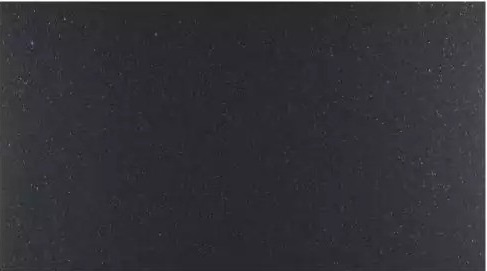


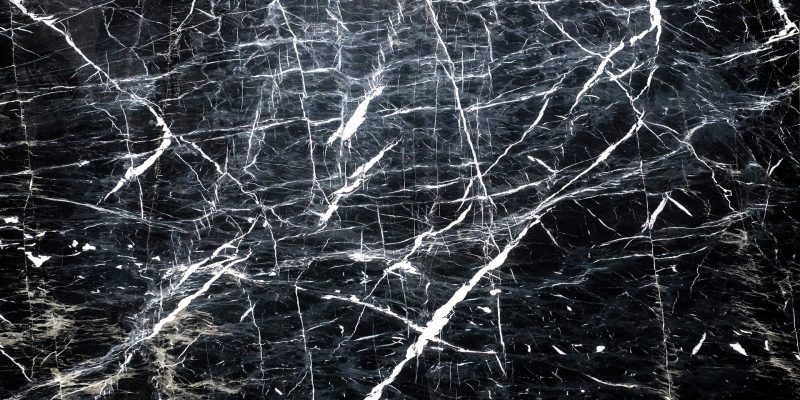
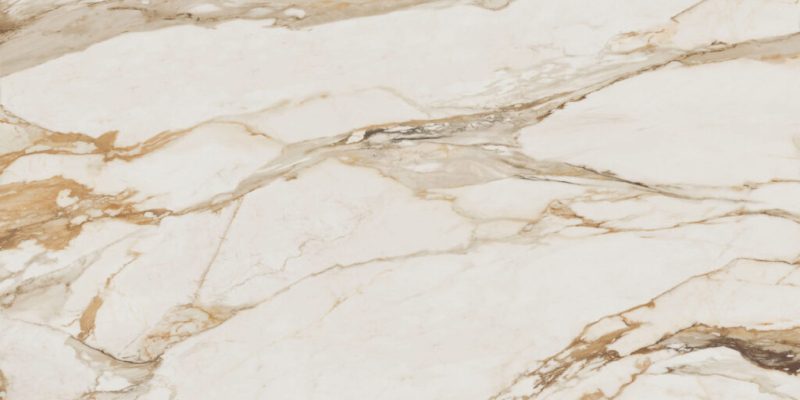


Wood generally offers greater surface renewability. Light scratches, stains, shallow burns, and worn finish areas may be reduced through sanding and refinishing.
Deep splits, open joints, water damage, rot, movement, or damaged sink areas may require section replacement or more substantial repair. Sanding should not be repeated indefinitely because each refinishing removes material.
The installed cost of concrete and wood countertops in Ontario depends on the construction method, material quality, dimensions, finish, fabrication complexity, access conditions, and installation requirements. Neither material has a single reliable price category that applies to every project.
| Material | General Price Position | Main Cost Drivers | Ongoing Maintenance | Installation Considerations |
|---|---|---|---|---|
| Concrete | Mid-range to premium custom product | Casting method, moulds, thickness, pigments, aggregates, reinforcement, integrated features, finish, and installation complexity | Moderate; depends on sealer wear, cleaning, crack treatment, and finish renewal | Heavy sections, support requirements, curing, transport, access, and controlled installation |
| Wood | Entry-level to premium | Species, grade, grain orientation, construction method, thickness, board selection, joinery, edge details, and finish | Moderate to high; depends on finish, moisture exposure, oiling, repairs, and refinishing | Lighter handling, but careful moisture conditioning, movement allowance, fastening, and sink detailing are essential |
This table compares relative cost positions rather than fixed rates. Final quotations should be based on the actual design, dimensions, construction, finish, property access, and scope of installation.
Concrete is generally priced as a custom-fabricated product rather than a standardized slab. Simple precast sections may have a different cost structure from cast-in-place work or highly customized architectural pieces.
Mould complexity, curved shapes, thick edges, pigments, exposed aggregates, polishing, decorative inlays, integrated drainboards, sink configurations, reinforcement, and specialized finish systems can increase the project cost.
Transport and installation also matter. Large precast sections may require additional labour, lifting equipment, reinforced cabinetry, or more seams to accommodate access limitations.
Wood pricing varies according to species, grade, board width, thickness, grain orientation, construction style, finish, and sourcing. Common species and simple laminated construction may be more accessible than premium walnut, selected grain, or custom end-grain fabrication.
Long, wide, knot-free boards and carefully colour-matched material generally cost more than mixed-grade or narrower-strip construction.
Custom curves, thick laminated edges, waterfall-style panels, complex joinery, sink detailing, stains, specialty finishes, and furniture-style fabrication can substantially increase the installed price.
Concrete ownership costs may include sealer renewal, stain treatment, finish repair, crack evaluation, or resurfacing. The frequency and extent of these costs depend on the original finish and how the countertop is used.
Wood ownership costs may include oil or finish products, sanding, local repairs, sink-area restoration, and periodic refinishing. Much of the routine maintenance may be manageable, but larger repairs should be completed by an experienced professional.
Wood may offer greater surface renewability because worn material can often be removed through sanding and refinishing. Concrete may require less visible daily maintenance in some installations, but matching repaired colour and finish can be more difficult.
The total project price may be influenced by:
Accurate measurements and site conditions are required before a final quotation can be established. Teccorp Stone’s countertop survey and measurement service can help document dimensions, wall conditions, appliance locations, overhangs, access restrictions, and support requirements for a countertop project.
Concrete and wood require different fabrication skills. Concrete performance depends on moulds, reinforcement, curing, sealing, weight management, and structural support. Wood performance depends on species selection, moisture conditioning, grain direction, stable construction, joinery, finishing, and movement allowance.
Precast concrete countertops are fabricated and cured in a workshop before being transported to the property. This approach provides greater environmental control during casting, finishing, and curing.
Precast sections must be sized for transport and installation. Large pieces, complex layouts, narrow access routes, stairs, and elevators may require additional seams or smaller sections.
Cast-in-place concrete is formed and poured at the project location. It may reduce transport limitations and allow more continuous forms, but it requires careful protection of the property and controlled on-site mixing, placing, curing, grinding, and finishing.
The best method depends on the project design, fabricator’s process, access conditions, finish expectations, seam strategy, and installation schedule.
Wood countertop fabrication begins with selecting an appropriate species and construction method. Hardness alone does not determine suitability; stability, grain, moisture content, finish compatibility, sourcing, and intended use also matter.
Face-grain, edge-grain, and end-grain constructions each create different appearances and performance characteristics. End-grain construction can be highly labour-intensive, while long face-grain boards may require careful selection and movement planning.
Boards should be conditioned appropriately before fabrication. Joinery and adhesives must be suitable for the intended environment, and the construction should allow normal wood movement rather than attempting to eliminate it completely.
Concrete is significantly heavier than many wood countertop systems. Cabinets must be level, stable, securely connected, and capable of supporting the completed countertop, overhangs, appliances, sinks, and any concentrated loads.
Large islands, thick sections, unsupported spans, integrated sinks, and unusual shapes may require reinforcement or structural review before fabrication.
Wood is generally lighter, but large overhangs, breakfast bars, wide slabs, waterfall panels, and unsupported sections may still require brackets, steel supports, or additional cabinet preparation.
Support requirements should be resolved before fabrication begins. Correcting cabinets after a custom countertop has been produced may create delays, stress, poor fit, or installation damage.
Sink areas are among the most demanding locations for both materials. Cutout design, faucet holes, seams, caulking, support, splash exposure, and access for plumbing must be coordinated carefully.
Concrete cutouts can create stress concentrations if the surrounding sections are too narrow or insufficiently reinforced. The selected sealer should also be appropriate for frequent moisture and cleaning around the sink.
Wood sink cutouts expose end grain and internal edges that may absorb water rapidly if they are not completely finished and maintained. Undermount sinks can be particularly demanding because the exposed edge remains close to standing water.
Seams and joints should be positioned away from the most vulnerable wet areas when possible. Caulking and finish condition should be inspected periodically rather than waiting for visible water damage.
Toronto and GTA properties may have elevators, loading reservations, hallway restrictions, narrow stairs, limited parking, noise rules, or restricted working hours that affect fabrication and installation planning.
Large precast concrete pieces may be difficult to transport into condos or older homes. Section size and seam placement should be planned around the actual carrying route before moulds are produced.
Wood is lighter and may be easier to transport, but long pieces can still be limited by elevator dimensions, corners, stairways, door openings, and unit layout.
Access should be documented during measurement so the countertop can be divided into practical sections without creating unnecessary seams or installation risks.
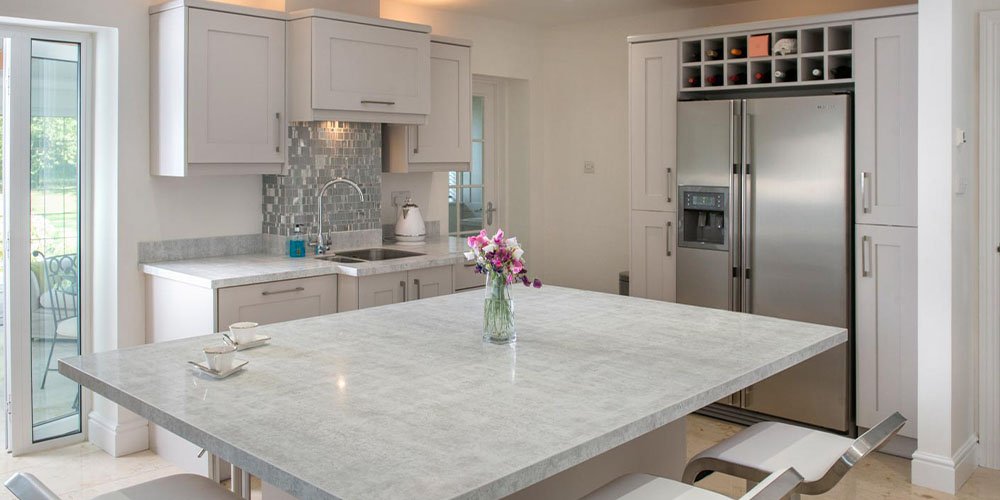
Homeowners planning a custom island, mixed-material layout, or detailed countertop installation can review Teccorp Stone’s kitchen island countertop services and kitchen countertop services when comparing practical surface options.
The best countertop depends on how the kitchen is used, the desired appearance, the homeowner’s maintenance tolerance, cabinet conditions, moisture exposure, and overall project budget. Concrete is usually better suited to architectural and highly customized applications, while wood is a stronger fit for homeowners who value warmth, repairability, and natural material character.
Concrete is generally a strong choice for design-led projects where customization and architectural presence matter more than standardized colour or low-weight installation. Its long-term performance depends heavily on reinforcement, curing, sealing, support, and fabrication quality.
Wood is best suited to homeowners who appreciate natural aging and are prepared to manage moisture, heat, cutting practices, and indoor humidity. Its strongest advantage is renewability, but this depends on species, construction, thickness, and finish.
A mixed-material kitchen can assign each surface to the application where it performs best. Wood may work well on a breakfast bar or feature island, while concrete, quartz, granite, or another surface may be used in higher-moisture or heavier-use zones.
Simple Decision Rule
Choose concrete for architectural customization and visual weight, wood for natural warmth and renewability, or combine materials when different kitchen zones have different performance needs.
Concrete and wood are not equally suitable for every part of a kitchen. The strongest results come from matching the material to the design style, level of use, moisture exposure, support conditions, and maintenance expectations.
Concrete is particularly effective in modern, minimalist, industrial, and loft-style kitchens. Its mass, neutral colour range, and custom construction work well with flat-panel cabinetry, stainless steel appliances, matte black hardware, glass, metal, and open-concept layouts.
Concrete can be used for statement islands, thick architectural edges, integrated drainboards, custom angles, or visually continuous surfaces. The design should still account for weight, seams, access, reinforcement, and finish maintenance.
Wood can also work in contemporary interiors when used as a contrasting feature. A wood island, raised bar, or breakfast ledge can soften an otherwise cool palette without changing the overall modern character.
Wood is naturally suited to farmhouse, Scandinavian, rustic, heritage, and transitional kitchens. Its grain and colour create warmth and help connect cabinetry, flooring, furniture, and natural finishes.
Lighter species can support clean Scandinavian interiors, while walnut, oak, distressed finishes, or wider boards may create a more traditional or handcrafted appearance.
Concrete can still be used in these styles when its colour and finish are softened. Warm pigments, matte finishes, exposed aggregate, or pairing with natural wood cabinetry can reduce an overly industrial effect.
Neither material should automatically be described as maintenance-free for a busy family kitchen. Concrete can resist ordinary denting and heavy daily use, but its sealer must remain intact to limit staining and moisture absorption.
Wood can perform well when homeowners accept visible wear and use cutting boards, trivets, and prompt spill cleanup. Sink areas and high-traffic preparation zones require particular attention.
For households seeking lower maintenance around sinks, dishwashers, cooking zones, or heavily used perimeter counters, a mixed-material layout may be more practical than using concrete or wood throughout the entire kitchen.
Concrete can complement Toronto lofts and contemporary condos, but weight, elevator size, hallway dimensions, loading rules, and carrying routes must be evaluated before fabrication.
Large precast sections may need to be divided into smaller pieces, which affects seam placement and visual continuity. Cast-in-place work may reduce transport constraints but creates different site-protection and curing requirements.
Wood is generally lighter and easier to transport, making it useful for condo islands, breakfast bars, and renovations with limited access. Long sections may still be restricted by elevator and hallway dimensions.
Both materials work well as feature islands because the island can be treated as a distinct furniture or architectural element.
Concrete islands can incorporate thick edges, unusual shapes, pigments, aggregates, integrated details, or substantial overhangs when the support system is designed correctly.
Wood islands create a warmer dining and gathering surface. They work particularly well for breakfast bars, seating areas, baking zones, and islands intended to contrast with stone or engineered perimeter countertops.
Homeowners planning a feature island can review Teccorp Stone’s kitchen island countertop services.
Concrete and wood both require careful detailing around sinks, faucets, dishwashers, seams, and wall joints.
Concrete performance in wet zones depends on the sealer, finish condition, cutout reinforcement, caulking, and edge protection. Chips, worn finish areas, or pinholes may increase moisture exposure.
Wood is more sensitive to standing water and exposed end grain. Sink cutouts, faucet holes, joints, underside edges, and dishwasher-adjacent areas must be sealed and maintained carefully.
For a wood countertop around a sink, the finish system, sink type, edge exposure, ventilation, and maintenance routine should be confirmed before installation. Wood is often better used away from the most demanding wet zones unless the construction is specifically designed for them.
Long-term value depends on more than initial price. Maintenance, repairability, service life, design fit, structural requirements, resale perception, and the homeowner’s tolerance for natural aging all influence the final result.
Concrete is often a custom product, so moulds, pigments, reinforcement, integrated details, finish systems, transport, and support can increase the upfront cost.
Wood ranges from relatively accessible laminated products to premium custom countertops made from selected hardwoods, wide boards, or end-grain construction.
Concrete ownership costs may include sealer renewal, stain treatment, finish repair, or crack evaluation. Wood ownership costs may include oiling, finish renewal, sanding, sink-area repair, or broader refinishing.
The lower initial price does not always create the lower lifetime cost. A material that is poorly matched to the application may require more frequent repair or replacement.
Wood generally offers stronger surface renewability. Scratches, shallow burns, stains, dents, and worn finish areas may often be reduced through sanding and refinishing.
This advantage depends on the countertop’s thickness, construction, remaining material, and type of finish. Deep water damage, open joints, rot, movement, or structural splitting may require more extensive repair.
Concrete chips, stains, cracks, or finish damage may sometimes be repaired, filled, resurfaced, or resealed. Matching colour, aggregate, texture, and sheen can be difficult, so repairs may remain visible.
Concrete can appeal to buyers seeking modern, industrial, custom, or design-forward interiors. Its resale value depends heavily on finish quality, condition, colour, craftsmanship, and how well it fits the overall kitchen.
Wood appeals to buyers who value natural materials, warmth, craftsmanship, and traditional or Scandinavian design. Some buyers may appreciate patina and refinishing potential, while others may be concerned about water exposure or maintenance.
Neither material guarantees stronger resale value. Broad buyer appeal is usually greater when the countertop is well maintained, professionally installed, and appropriate for the property style.
The environmental impact of concrete depends on cement content, transport, slab thickness, reinforcement, aggregates, admixtures, fabrication method, and expected service life.
Using local fabrication, recycled aggregates, lower-impact mixes, or long-lasting designs may reduce some impacts, but environmental claims should be evaluated for the actual product rather than the material name alone.
Wood is renewable when sourced responsibly, but species, forestry practices, transportation, adhesives, finishes, durability, and replacement frequency all affect its environmental profile.
Homeowners may look for responsibly sourced wood, transparent supply chains, durable construction, repairability, and finishes appropriate for the intended use.
Yes. Concrete and wood can create a strong visual and functional contrast when their colours, thicknesses, edge details, support requirements, and intended uses are coordinated carefully.
Examples include:
Mixed-material kitchens should be planned as one complete design. Cabinetry, flooring, backsplash, lighting, hardware, grain direction, concrete colour, seam placement, and edge thickness should be reviewed together.
There is no universal winner. Concrete is better suited to architectural customization and substantial modern surfaces, while wood provides natural warmth, lighter weight, and stronger refinishing potential.
Concrete is harder and less likely to dent, but it can stain, chip, crack, or suffer sealer damage. Wood scratches and dents more easily but can often be sanded and refinished.
Concrete countertops can develop hairline or larger cracks because of curing, reinforcement, support, cutout design, structural movement, or fabrication conditions. Proper planning reduces risk but cannot guarantee a completely crack-free surface.
Yes. Concrete is naturally porous, and stain resistance depends heavily on the sealer, finish condition, spill response, and exposure to oils, acids, pigments, and moisture.
Concrete countertops normally require a compatible sealer or protective finish. Maintenance frequency depends on the sealer type, use, cleaning products, wear, and fabricator instructions.
Direct placement is not recommended. The concrete body may tolerate heat, but sealers, seams, edges, adhesives, and sudden temperature changes can still be damaged.
Not always. Wood countertop is the broader category, while butcher block usually describes a laminated construction made from joined strips or blocks of wood.
Most wood countertops require an appropriate finish. The correct product and maintenance routine depend on whether the surface uses oil, wax, hardwax oil, varnish, polyurethane, or another finish system.
Yes, but sink areas require careful sealing, edge protection, caulking, drying, and maintenance. Standing water and exposed end grain can cause swelling, staining, joint movement, or finish failure.
Only when the specific product, adhesive, construction, and finish are approved for direct food preparation. Cutting boards are the safer general recommendation.
Wood can cup, split, gap, or warp when moisture content, indoor humidity, construction, fastening, sealing, or installation are not controlled properly.
Wood is generally easier to renew because many surface marks can be sanded and refinished. Concrete repairs may be possible, but matching colour, texture, aggregate, and sheen can be difficult.
The answer depends on the finish. Concrete requires sealer-specific care, while wood requires moisture control and finish maintenance. Neither should automatically be treated as maintenance-free.
Not always. Concrete is commonly a custom mid-range to premium product, while wood ranges from accessible laminated options to expensive hardwood or end-grain fabrication.
Concrete may resist denting and heavy use better, while wood offers easier refinishing. In high-moisture and high-traffic kitchens, a mixed-material layout may be more practical than using either material throughout.
Wood is usually easier to transport because it is lighter. Concrete may suit modern condos and lofts, but elevator dimensions, carrying routes, weight, section size, and building rules must be evaluated.
Both can work well. Concrete creates an architectural statement, while wood provides a warmer seating and gathering surface. Support, overhangs, sink placement, and maintenance should guide the choice.
Yes. They can be combined successfully when each material is assigned to a suitable zone and their colour, thickness, support, edge details, and maintenance requirements are coordinated.
Concrete may appeal more in modern and industrial properties, while wood may suit farmhouse, Scandinavian, heritage, and natural-material interiors. Condition and design fit are more important than the material name alone.
Both can remain in service for many years when properly fabricated, installed, protected, and maintained. Service life depends on finish condition, moisture exposure, support, repair, and daily use.
Concrete is usually the more suitable option for architectural customization, substantial visual weight, and integrated features. Wood is better suited to homeowners who prioritize natural warmth, lighter construction, and the ability to sand and refinish the surface.
For many kitchens, the most practical solution is to use wood or concrete as a feature material while selecting quartz, granite, or another lower-maintenance surface for wet or heavily used countertop zones.
Teccorp Stone helps homeowners across Toronto and Ontario compare countertop layouts, review surface options, plan islands and seams, assess installation access, and choose materials that align with the project’s design, maintenance expectations, and budget.
Compare Countertop Materials for Your Kitchen
Send your kitchen dimensions, photos, preferred style, and project details to compare countertop materials and receive guidance for your renovation.
Review Teccorp Stone’s kitchen countertop services, explore the quartz countertop collection and granite countertop collection, or request a project-specific estimate for your kitchen.