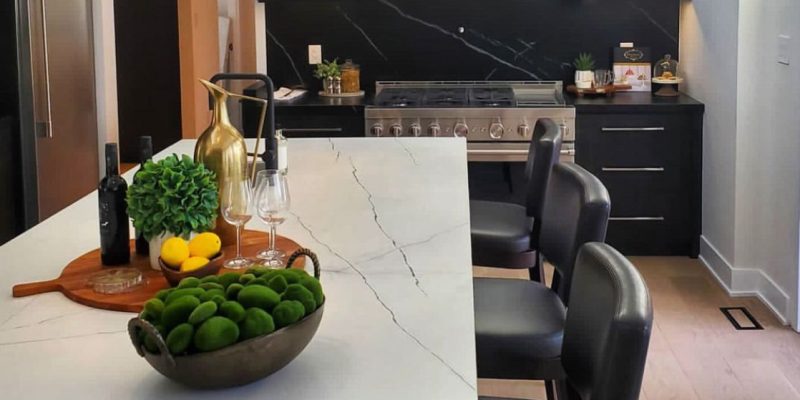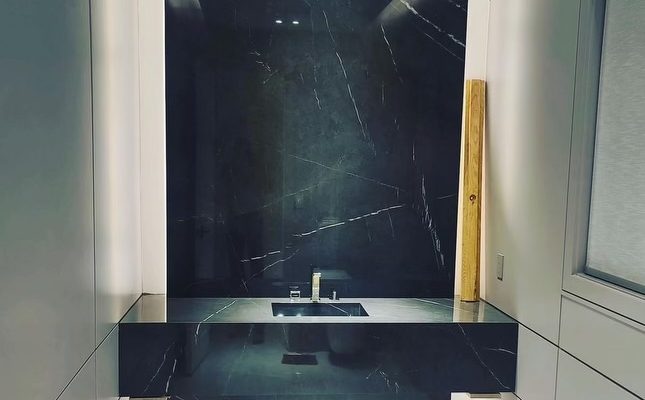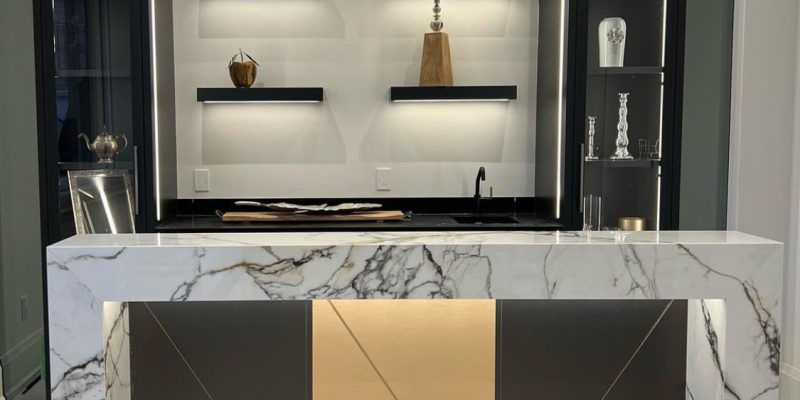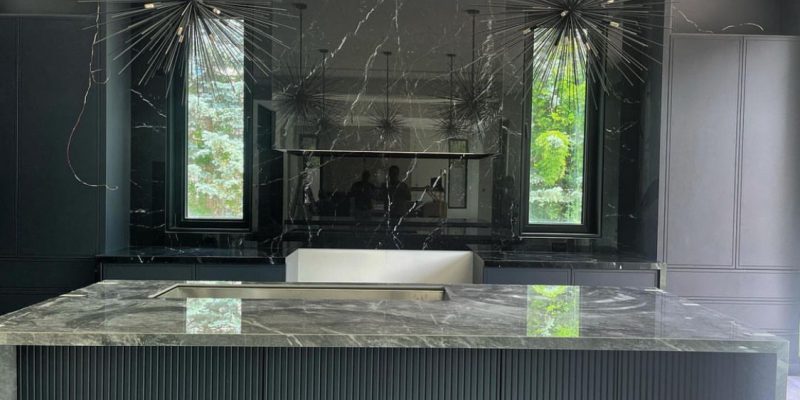
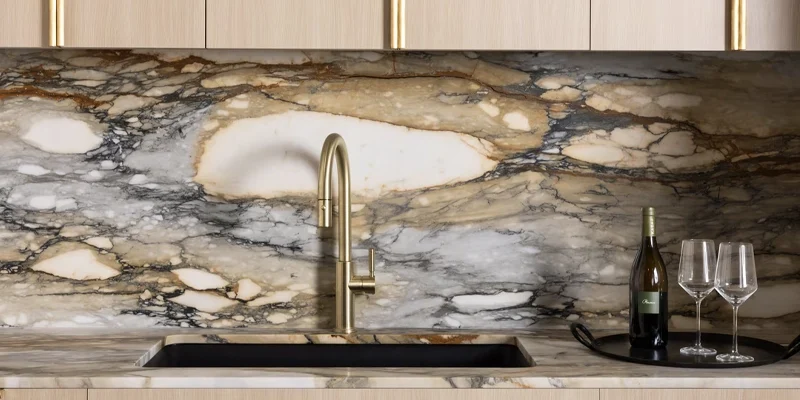
Learning how to clean a stone slab backsplash begins with identifying the exact surface. Natural stone, quartz and large-format porcelain may look similar when installed as wall panels, but they do not necessarily have the same cleaning, sealing or chemical-resistance requirements.
Routine care should therefore follow the selected material, finish and manufacturer or supplier instructions. A cleaner suitable for porcelain may be inappropriate for marble, while a product approved for one quartz collection should not automatically be used on every engineered surface.
This guide explains everyday backsplash cleaning, grease removal, stain prevention and material-specific care considerations. It does not replace the technical instructions supplied with the exact slab, sealer or installation system.
Care Principle
Do not choose a backsplash cleaner based only on the word “stone.” Confirm whether the surface is natural stone, quartz or porcelain, then follow the care instructions for that exact product and finish.
| Surface | Routine Care | Main Caution | Follow |
|---|---|---|---|
| Natural stone | Soft cloth and stone-appropriate cleaner | Acidic products, unsuitable chemicals and material-specific staining | Stone and sealer guidance |
| Quartz | Routine wiping with an approved non-abrasive product | High heat, abrasive tools and unsupported chemicals | Surface manufacturer instructions |
| Porcelain | Cleaning appropriate to the selected finish | Product-specific limits, exposed edges and adjoining joints | Panel manufacturer instructions |
This table is a general starting point. The product documentation supplied with the installed backsplash should take priority over generic cleaning advice.
Regular cleaning prevents cooking residue from remaining on the surface long enough to become more difficult to remove. The exact frequency depends on cooking habits, backsplash location and surface finish.
Food, oil, sauces and coloured liquids are generally easier to address before they dry. Use a clean, soft cloth or non-abrasive sponge with a cleaner approved for the surface.
Avoid spreading grease across a larger area with a heavily saturated cloth. Wipe the affected section first, then use a separate clean cloth for the surrounding surface.
Microfibre cloths and non-abrasive sponges are generally more appropriate than rough pads or hard brushes. Abrasive tools may alter polished, honed or printed finishes even when the panel itself is otherwise durable.
Drying with a clean cloth can reduce visible water marks and cleaner residue, particularly on polished or dark surfaces. It can also make remaining grease or streaks easier to identify.
Cleaning only the area directly behind the cooktop can create an uneven appearance over time. Periodically wipe the surrounding wall panels, corners, lower edges and areas beneath cabinets using the approved routine.
No universal list applies to every backsplash product, but several cleaning methods require caution.
Vinegar, lemon-based cleaners and other acidic products may affect acid-sensitive natural stones. They should not be promoted as universal stone-cleaning solutions.
Scouring powders, rough pads and abrasive brushes may change the appearance of polished, honed or printed surfaces. A product described as scratch-resistant should not automatically be treated as immune to abrasive cleaning.
Bleach, solvent-based products, oven cleaners and concentrated degreasers should not be used unless the exact surface manufacturer or stone-care guidance confirms their suitability.
Combining household chemicals can damage the surface or create unsafe fumes. Homemade cleaning recipes should not be applied simply because they are described as natural or suitable for kitchens.
Metal blades and sharp tools can damage finishes, printed surfaces, seams or perimeter joints. Dried material should be addressed using a method approved for the specific backsplash product.
Before Using a New Cleaner: Check the product instructions and test it in a small, less visible area when permitted by the surface-care guidance.
Grease is one of the most common backsplash-cleaning concerns, especially behind ranges and preparation areas. The safest method depends on the selected surface and finish.
Start with a soft cloth, warm water and a mild product approved for the backsplash. Allow the cleaner to work according to its instructions rather than immediately using a stronger chemical or abrasive tool.
Clean one area at a time so dissolved grease is removed rather than redistributed. Replace or rinse the cloth as it becomes oily.
Grease can collect where the backsplash meets the countertop, around outlets and beside appliances. These areas should be cleaned without damaging sealant, seams, device covers or exposed edges.
Do not saturate outlet areas, switches, unfinished edges or compromised joints. Electrical devices should be handled safely, and damaged perimeter details should be inspected rather than repeatedly flooded with cleaner.
Natural stone requires material-specific care because marble, granite, quartzite, soapstone and other stones do not respond identically to moisture, acids, oils or cleaning products.
Before selecting a cleaner, confirm the stone type and whether the surface is polished, honed, leathered or otherwise textured. A routine suitable for polished granite may not be appropriate for honed marble or another acid-sensitive stone.
Routine cleaning should follow the stone supplier’s and sealer manufacturer’s guidance. Products described only as multipurpose kitchen cleaners should not be assumed suitable for natural stone.
Oil, coloured sauces, wine, coffee and acidic food residues should not remain on the surface longer than necessary. Prompt cleaning may reduce the likelihood of staining or etching, but it cannot guarantee that every mark will be prevented.
A stain changes the colour of the stone after a substance is absorbed. Etching is a change in surface finish caused by a chemical reaction, commonly associated with acid-sensitive stones.
Etching may appear as a dull or lighter area and cannot necessarily be removed with routine cleaning. Professional refinishing may be required depending on the stone and finish.
Quartz surfaces combine mineral content with binders and pigments. They are generally maintained without stone sealer, but they should not be described as maintenance-free or resistant to every chemical, abrasive or heat condition.
Cleaning recommendations can vary between quartz brands and collections. Use products and methods approved for the installed surface rather than applying natural-stone care instructions automatically.
Rough pads, abrasive powders and aggressive scraping can alter the finish or leave visible marks. Dried residue should be treated using an approved method rather than removed with a sharp metal tool.
Concentrated degreasers, solvents, oven cleaners and unsupported disinfectants may affect the binder, finish or appearance. Rinse or remove approved cleaning products according to the manufacturer’s directions.
Routine cleaning guidance does not establish suitability behind every range or cooktop. Quartz should not be treated as universally heat-proof. The appliance configuration and surface manufacturer’s requirements should govern the application.
Large-format porcelain panels may have polished, matte, textured or printed finishes. Routine care should reflect the exact collection and surface treatment rather than relying on general assumptions about porcelain.
Smooth finishes may show streaks or water marks more visibly, while textured finishes may require additional attention to surface recesses. Use tools that clean the finish without abrading or altering it.
Porcelain is often compatible with a broad range of cleaning products, but this should not be generalized to every printed face, coating, edge treatment or adjoining joint. Manufacturer instructions remain the controlling reference.
Thin panels, window returns and open-wall terminations may contain exposed or fabricated edges. Avoid striking these areas with cookware, tools or hard cleaning equipment.
The porcelain surface may be low-maintenance, but seams, perimeter joints and transitions still require inspection and cleaning. Surface durability does not eliminate the need to care for adjoining materials.
Not every slab backsplash requires sealing. The answer depends on the exact material, finish and installation specification.
Some natural stones may benefit from an appropriate penetrating sealer, while others may require a different approach or no routine sealing schedule. The need for resealing should be assessed according to the stone and the product originally used.
A universal instruction such as sealing every natural-stone backsplash once a year is not reliable. Exposure, porosity, finish, cleaning habits and sealer performance all affect the schedule.
Quartz surfaces are generally not maintained with conventional penetrating stone sealers.





The porcelain face itself may not require sealing, but adjoining grout, joints, edges or other materials may have separate requirements. The complete wall assembly should be considered rather than only the visible panel.
Before applying any sealer, confirm:
An unsuitable or improperly applied product can leave haze, streaking or uneven appearance.
Before attempting stain removal, determine whether the issue is surface residue, absorbed staining, etching, heat-related change, cleaner residue or physical damage. These conditions require different responses.
Grease, dried food or cleaner film may remain on top of the backsplash. Begin with the mildest approved cleaning method and avoid escalating immediately to stronger chemicals.
Natural stone may absorb oil or coloured liquids depending on its porosity and protection. Repeated household cleaning may not remove an absorbed stain and can enlarge or alter the affected area.
A stone-care professional may need to identify the stain and recommend an appropriate treatment.
Dull marks on acid-sensitive natural stone may be etching rather than dirt. Cleaning will not restore material that has undergone a surface reaction. Refinishing may be necessary.
Too much cleaner, incomplete removal or use of an unsuitable product can leave haze or streaks. Stop adding new products until the surface and previous cleaning method have been identified.
Discolouration near a cooking appliance or after chemical exposure should not be treated as an ordinary stain without investigation. Review the surface and appliance guidance and obtain professional assessment where the material appears permanently altered.
Before Treating a Mark: Identify the material and determine whether the issue is residue, staining, etching, heat exposure or physical damage. Using the wrong treatment can make the condition more visible.
A slab backsplash may contain fewer joints than a tiled wall, but seams, inside corners, countertop transitions and exposed edges still require routine inspection and appropriate cleaning.
The lower perimeter joint can collect grease, crumbs and moisture. Clean it with a soft tool and a product suitable for both adjoining surfaces without scraping or pulling at the joint material.
Repeated saturation, aggressive brushing or sharp tools can damage flexible perimeter details. A joint that has separated, cracked or lost adhesion should be assessed rather than covered repeatedly with additional cleaner or sealant.
Where several backsplash panels meet, the seam should be cleaned without concentrating excessive moisture or abrasive pressure along the joint.
A visible line does not automatically indicate failure. However, widening, movement, chipping or persistent residue at a seam may require professional inspection.
Inside corners can collect grease and cleaner residue, particularly beside ranges and preparation areas. Use a soft cloth or non-abrasive tool that reaches the corner without damaging the adjoining surfaces.
Edges beside windows, cabinet ends and open-wall terminations can be more vulnerable to impact than the centre of a panel. Avoid striking them with cookware, appliances or hard cleaning equipment.
Small edge damage should not be filled with an unverified household product. The appropriate repair depends on the material, finish and visibility of the affected area.
Backsplash areas behind cooking appliances and sinks receive more frequent exposure to grease, food residue, steam and moisture. They may require more regular cleaning than quieter wall sections.
Allow the area to reach a safe cleaning condition before wiping near cooking appliances. Use only products approved for the backsplash surface and avoid applying oven cleaner or concentrated degreaser to the wall unless the surface manufacturer specifically permits it.
Cleaning guidance does not determine whether a material is suitable for a particular appliance location. Heat exposure, clearances and ventilation remain separate product and installation considerations.
Effective ventilation can reduce the amount of airborne grease reaching the backsplash, but it does not eliminate routine cleaning. Range-hood filters and surrounding surfaces should be maintained according to their own instructions.
Water, soap and food residue can collect near faucets and countertop joints. Wipe standing moisture and inspect perimeter details where the backsplash meets the countertop, window sill or plumbing fixtures.
Persistent moisture, darkening around joints or deterioration of adjoining materials should be investigated rather than treated only as a surface-cleaning issue.
Do not spray large quantities of cleaner directly into outlet covers, switches, damaged joints or unsealed openings. Apply the approved product to the cleaning cloth when that approach is consistent with the product instructions.
Cleaning cannot correct every visible defect. Chips, cracks, finish changes and loose joints should first be identified accurately so that routine care does not make the condition worse.
Small chips may occur at exposed edges, cutouts or impact points. Repairability depends on the material, colour, pattern and location of the damage.
A repair may reduce visibility without making the area completely undetectable. Highly patterned natural stone and printed surfaces can be difficult to match precisely.
A crack may be related to impact, panel stress, substrate movement, a narrow cutout section or another site condition. It should not automatically be treated as a cosmetic cleaning issue.
Before repair, the underlying cause should be assessed. Filling a crack without addressing continued movement may not provide a durable result.
Separated perimeter joints or damaged seam materials may allow moisture and residue to collect. The affected detail should be inspected and replaced with a compatible system where necessary.
Abrasive cleaning, chemical exposure or etching may alter the surface finish. Depending on the material, professional refinishing or panel repair may be possible.
Do not attempt to polish or refinish a backsplash with a generic countertop kit unless the method is approved for the exact installed surface.
Replacement may be considered when damage is extensive, structurally significant, located around critical cutouts or unsuitable for an acceptable repair.
Matching a replacement panel can be difficult when:
Identify the exact material and use a soft, non-abrasive tool with a cleaner approved for that surface and finish. Product-specific instructions should take priority over generic stone-cleaning advice.
Vinegar should not be treated as a universal stone cleaner. Its acidity can affect marble and other acid-sensitive natural stones and may be unsuitable for additional products or adjoining materials.
Not necessarily. Sealing requirements depend on the stone, finish, exposure and sealer product. A fixed annual schedule should not be applied to every natural-stone backsplash.
Quartz surfaces are generally not maintained with conventional penetrating stone sealers. Follow the instructions supplied by the manufacturer of the exact installed product.
Begin with the mildest approved cleaner and a soft cloth, work in small sections and remove dissolved residue with a clean cloth. Avoid moving immediately to concentrated chemicals or abrasive pads.
Some damage can be repaired, but the result depends on the material, pattern, location and cause. Cracks, edge damage and defects around cutouts should be assessed before a repair product is selected.
Reliable backsplash care begins with accurate material identification. Natural stone, quartz and porcelain panels may require different cleaners, sealing approaches and responses to stains or surface damage.
Routine wiping, appropriate ventilation and prompt attention to cooking residue can support ongoing care, but no single cleaner or maintenance schedule is suitable for every backsplash. Keep the product documentation and consult the relevant manufacturer, supplier or stone-care professional when the surface develops persistent marks or damage.
Homeowners still selecting a wall finish can compare stone slab and tile backsplash care before making a final material decision.