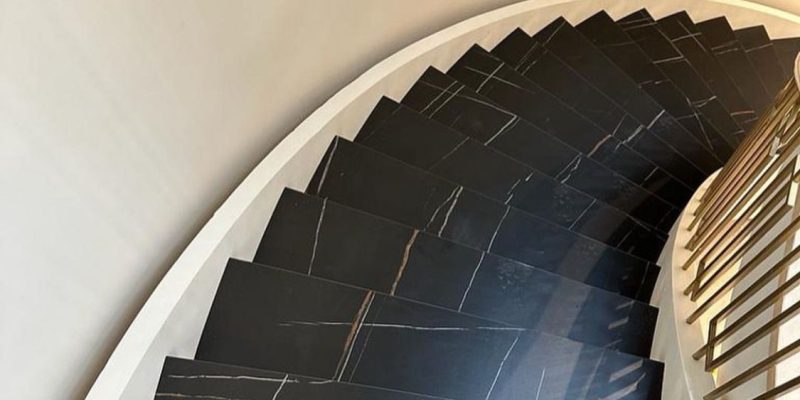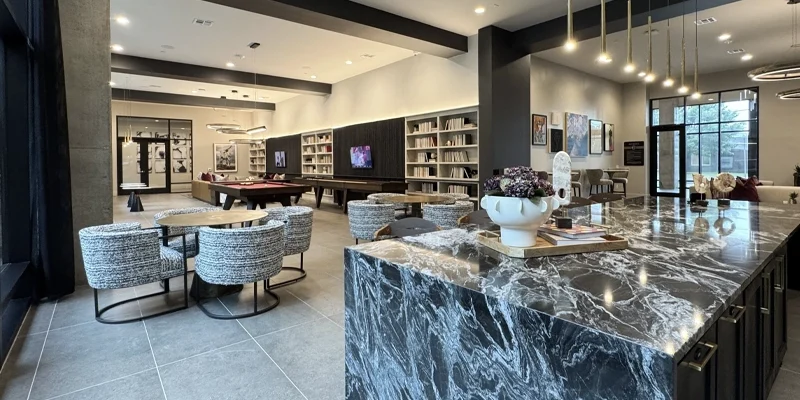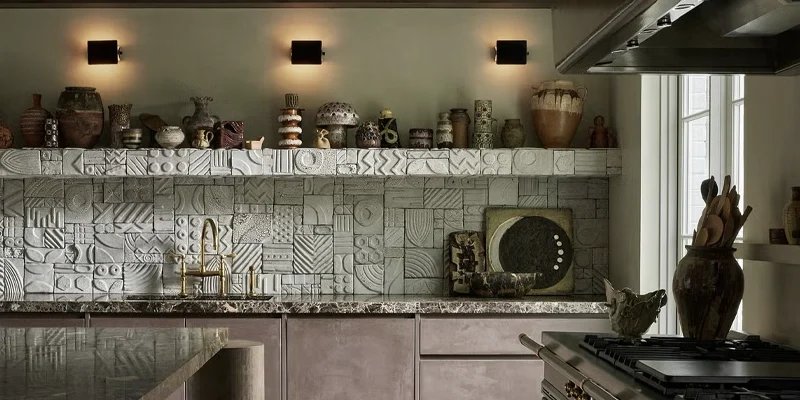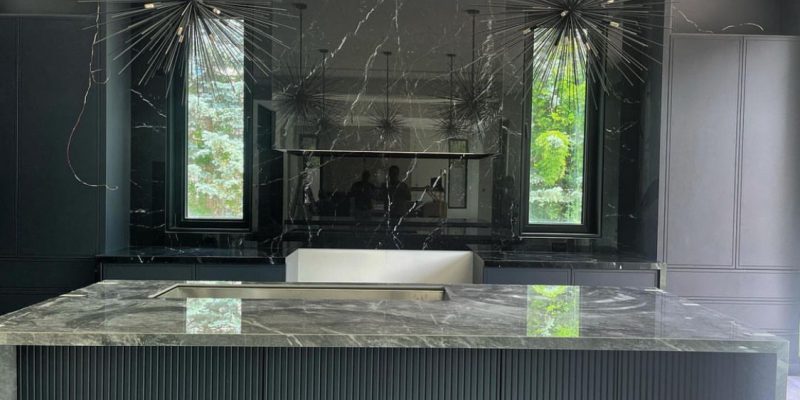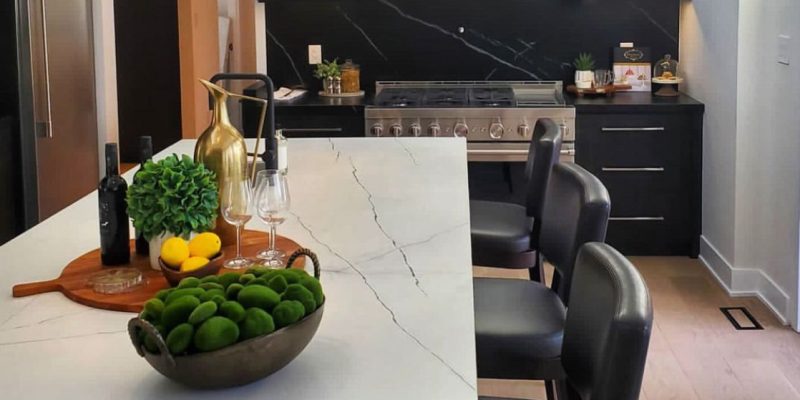
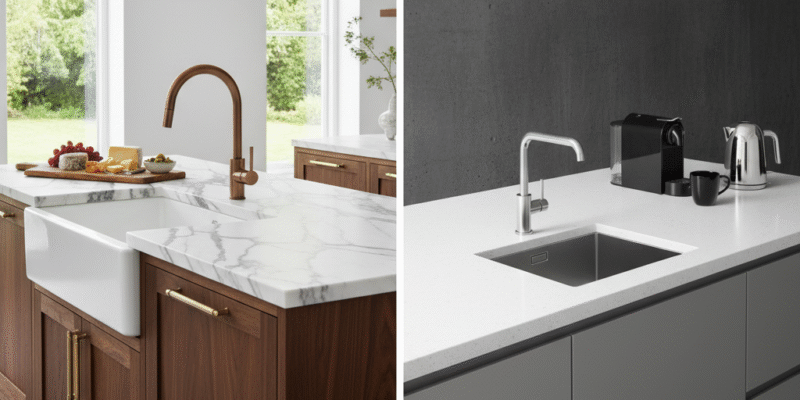
Comparing marble vs quartz countertops is an important step for Ontario homeowners because both materials offer a premium appearance but perform very differently in daily use. Marble is a natural stone known for distinctive veining and timeless character, while quartz is an engineered surface valued for consistent patterns, stain resistance, and lower maintenance.
The right choice depends on more than appearance. Cooking habits, exposure to acidic foods, tolerance for sealing and maintenance, kitchen traffic, fabrication requirements, and project budget all influence which surface will perform better over time.
At Teccorp Stone, we fabricate and install both marble countertops and quartz countertops for kitchens throughout Toronto and Ontario. Comparing full slabs, edge details, seam locations, maintenance needs, and installation conditions before ordering helps homeowners choose a material that fits both the design and everyday use of the kitchen.
Quick Comparison
Choose quartz when low maintenance, predictable patterns, and strong stain resistance are the priorities. Choose marble when natural veining, luxury character, and one-of-a-kind slab movement are more important. Marble requires more careful use and maintenance, while quartz is generally better suited to busy kitchens.
The following table summarizes the main differences Ontario homeowners should evaluate before choosing between marble and quartz countertops.
| Comparison Factor | Marble Countertops | Quartz Countertops |
|---|---|---|
| Material Type | Natural metamorphic stone quarried and cut into individual slabs | Engineered surface made with quartz minerals, resins, pigments, and other components |
| Appearance | Natural veining, mineral movement, and unique slab variation | Controlled colours, predictable veining, and broad design selection |
| Pattern Consistency | Varies naturally across each slab | More consistent across slabs and countertop sections |
| Maintenance | Requires careful cleaning and usually periodic sealing | Low maintenance and does not require sealing |
| Stain Resistance | Can absorb liquids if not properly sealed | Strong resistance because the surface is non-porous |
| Etching Risk | Sensitive to acids such as lemon juice, vinegar, and wine | Does not etch like marble, but harsh chemicals can damage the finish |
| Scratch Resistance | Softer and more vulnerable to scratches and surface wear | More resistant to everyday scratching, although cutting boards are still recommended |
| Heat Resistance | Tolerates heat better, but trivets are still recommended | More sensitive to direct heat because of its resin content |
| Fabrication | Requires detailed slab inspection, vein layout, careful cutting, and handling | More predictable structure and generally simpler layout planning |
| Typical Cost Position | Varies widely; rare and premium marble can be significantly more expensive | Available across a broad range from standard to premium collections |
| Best Suited For | Luxury kitchens, statement islands, baking areas, and natural-stone designs | Busy families, condos, rental properties, and low-maintenance kitchens |
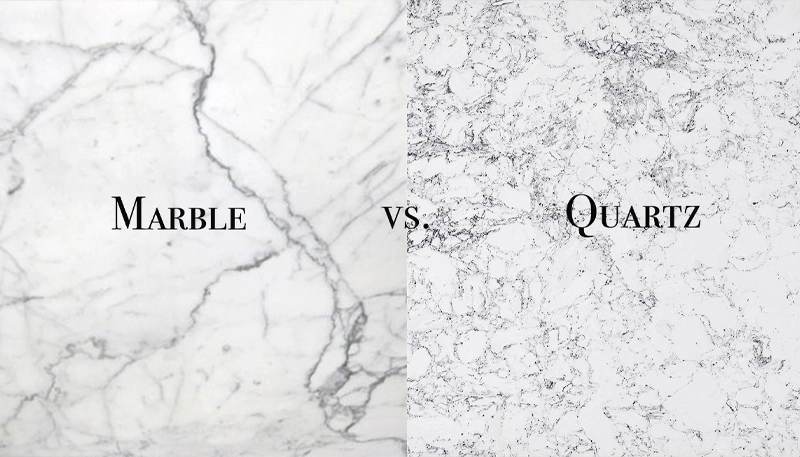
The main difference is that marble is a natural stone while quartz is manufactured. This distinction affects appearance, porosity, resistance to acids, maintenance, fabrication, and long-term surface behaviour.
Marble is a natural metamorphic stone formed when limestone is transformed by heat and pressure beneath the Earth’s surface. It is quarried in blocks and cut into slabs, with each slab displaying its own veining, colour movement, mineral deposits, and natural characteristics.
Marble is valued for its depth and visual individuality. White and light-grey varieties are widely used in kitchens, while darker, green, beige, and richly veined marbles can create more dramatic feature surfaces.
Because marble is naturally porous, liquids can penetrate the stone if the surface is not properly sealed. Marble is primarily composed of calcite, which makes it sensitive to acidic substances. Lemon juice, vinegar, wine, tomatoes, and some cleaning products can chemically react with the surface and leave dull marks known as etching.
This does not prevent marble from being used successfully in kitchens, but homeowners should understand that sealing helps reduce staining and does not stop etching. Marble is best suited to people who appreciate natural variation and are comfortable with a surface that may develop patina over time.
Quartz countertops are engineered surfaces manufactured from quartz minerals combined with resin binders, pigments, and other components. This process creates a dense, non-porous slab with controlled colours and patterns.
Because quartz is engineered, manufacturers can offer designs inspired by marble, concrete, limestone, terrazzo, and other materials. The appearance is generally more predictable than natural stone, which helps when coordinating perimeter countertops, islands, waterfall panels, and backsplashes.
Quartz does not require sealing and provides strong resistance to common kitchen spills. It is usually easier to maintain than marble and is less vulnerable to scratching and surface wear during normal residential use.
However, quartz contains resins that can be damaged by direct or prolonged exposure to high temperatures. Hot cookware and heat-producing appliances should always be placed on trivets or protective pads.
Marble and quartz can both produce elegant kitchens, but their visual character is different. Marble provides genuine geological variation, while quartz offers broader control over colour, pattern, and consistency.
Natural marble is selected for the movement and depth created by its veining. No two slabs are identical, and even different sections of the same slab may contain substantial variation.
This individuality makes marble effective for statement islands, full-height backsplashes, feature walls, and other high-visibility surfaces. A carefully selected slab can become the central design element of the kitchen rather than simply a background finish.
Natural variation also makes slab planning essential. Vein direction, focal sections, seams, cutouts, and waterfall transitions should be reviewed before fabrication. The fabricator must determine how the most visually important areas of the slab will be positioned across the finished installation.
Quartz is available in a wide range of whites, warm neutrals, greys, darker tones, concrete-inspired finishes, and marble-look patterns. The engineered manufacturing process allows greater control over the scale, colour, and direction of the design.
This predictability is useful in kitchens with several countertop sections or coordinated vertical surfaces. Quartz can make it easier to maintain visual consistency across perimeter counters, large islands, backsplashes, and waterfall panels.
Although quartz is more consistent than marble, individual production batches may still vary. Reviewing the actual slabs before fabrication remains important, particularly when multiple slabs are required for one project.
Marble-look quartz is designed to recreate the light backgrounds and flowing veining associated with natural marble while offering a non-porous surface and lower maintenance requirements.
It is a practical option for homeowners who want a marble-inspired kitchen without the same risk of staining, etching, or periodic sealing. It also provides more predictable pattern placement across large or multi-surface installations.
Natural marble, however, offers mineral depth, translucency, subtle colour shifts, and unique variation that engineered quartz cannot duplicate exactly. The difference is usually most visible when full slabs are viewed side by side rather than compared through small samples or photographs.
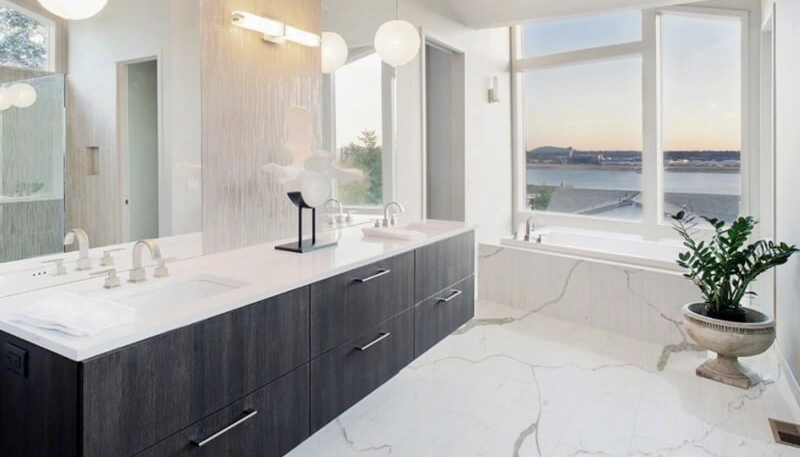
Homeowners can compare available surfaces through the marble countertop collection and quartz countertop collection. Viewing full slabs is especially important when selecting marble because veining, tone, and natural variation can change significantly across the material.
Marble and quartz can both perform well in Ontario kitchens, but their strengths are different. Quartz is generally better suited to heavy daily use, while marble requires more careful handling because it is softer, porous, and sensitive to acids.
Quartz offers strong resistance to everyday scratching because of its dense engineered structure. It performs well in busy kitchens, family homes, rental properties, and other spaces where the countertop is used frequently.
Marble is softer and more vulnerable to scratches, edge wear, and surface marks. Sharp utensils, abrasive objects, and heavy cookware can leave visible damage if they are used directly on the stone.
Neither material should be treated as indestructible. Sink cutouts, narrow strips, corners, overhangs, and decorative edges are more vulnerable to chips and impact damage. Cutting boards, proper support, and careful handling help preserve both materials.
Quartz is non-porous and provides strong resistance to common kitchen spills such as coffee, wine, oil, sauces, and food colouring. It does not require sealing, which makes it easier to maintain in high-traffic kitchens.
Marble can absorb liquids because it is naturally porous. A suitable penetrating sealer helps reduce absorption, but it does not make the stone completely stain-proof. Oils, wine, coffee, spices, and strongly coloured liquids should be cleaned promptly.
The porosity of marble varies by slab and finish. Professional inspection and appropriate sealing are therefore important before the countertop is put into regular use.
Etching is different from staining. A stain occurs when a substance penetrates the stone and changes its colour. Etching is a chemical reaction that alters the surface finish and leaves a dull or lighter mark.
Marble is calcium-based and reacts with acidic substances such as lemon juice, vinegar, wine, tomatoes, and some cleaning products. Even properly sealed marble can etch because sealing reduces absorption but does not prevent chemical reactions.
Quartz does not etch in the same way as marble. However, harsh chemicals, solvents, highly alkaline cleaners, and abrasive products can still damage or dull its finish.
Important Difference
Sealing marble helps reduce staining, but it does not prevent etching. Homeowners who choose marble should expect to protect the surface from acidic foods and cleaners.
Marble generally tolerates heat better than quartz because it is a natural stone without resin binders. However, hot cookware should still not be placed directly on the surface. Sudden temperature changes can affect the stone, sealer, seams, adhesives, or surrounding finishes.
Quartz is more sensitive to direct and prolonged heat because of the resins used in its manufacture. Hot pans, electric skillets, air fryers, slow cookers, and similar appliances should be placed on trivets or heat-resistant pads.
For both materials, using heat protection is the safest approach and helps preserve the countertop, seams, and installation components over time.
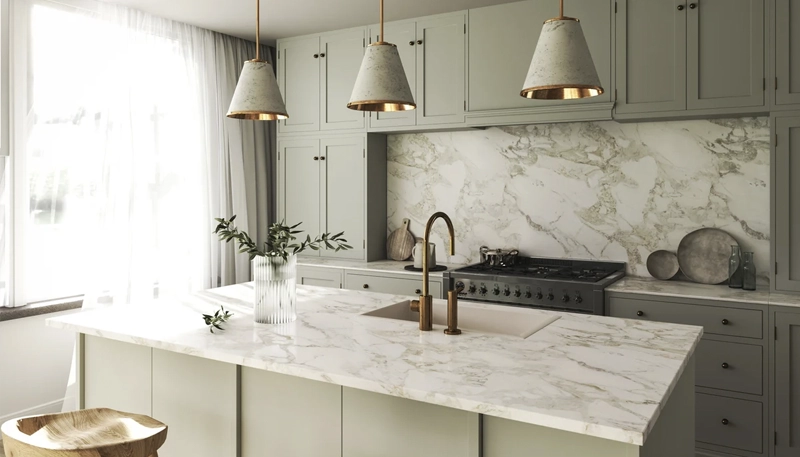
Maintenance is one of the clearest differences between marble and quartz countertops. Quartz is usually selected for convenience, while marble requires a more deliberate care routine.
Quartz normally requires only routine cleaning with warm water, mild soap, and a soft cloth. Because it is non-porous, it does not need periodic sealing.
Avoid abrasive pads, paint removers, harsh solvents, strong degreasers, and highly alkaline cleaning products. These can affect the surface finish or resin components.
Homeowners should also avoid cutting directly on quartz and placing hot cookware or heat-producing appliances directly on the surface.
Marble commonly benefits from periodic sealing, although the appropriate schedule depends on the slab, finish, porosity, sealer, and level of kitchen use. Homeowners should follow the fabricator’s recommendation rather than assuming every marble countertop needs sealing on the same schedule.
Daily cleaning should be completed with a pH-neutral stone cleaner or mild soap and water. Acidic cleaners, vinegar-based products, abrasive powders, and harsh chemicals should be avoided.
Spills should be wiped up promptly, particularly those involving citrus, wine, coffee, oil, tomatoes, or strongly coloured ingredients.
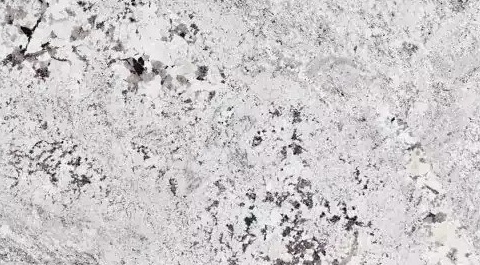
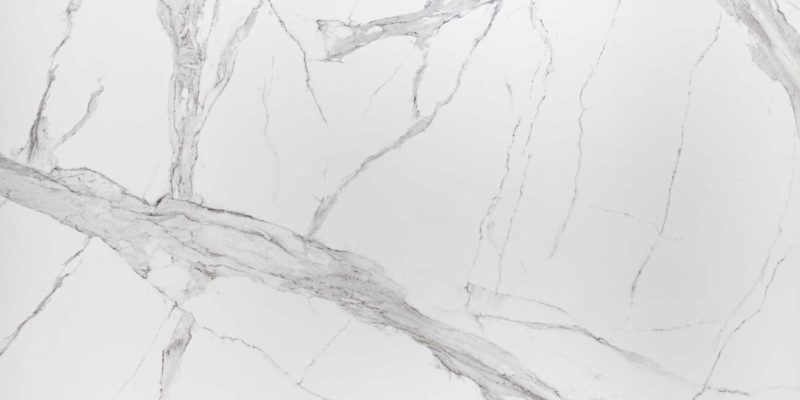
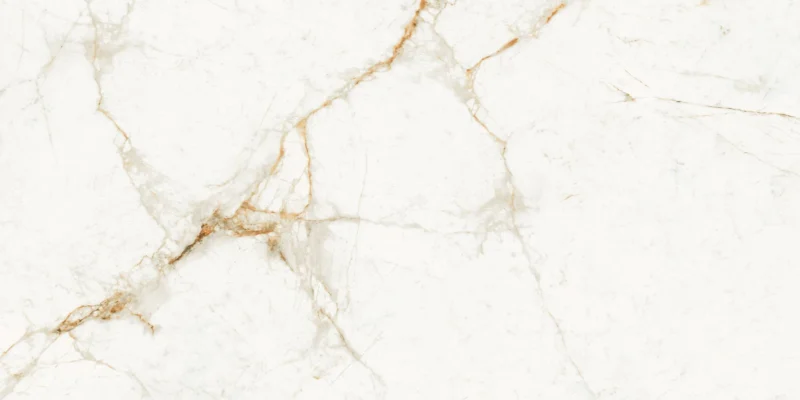
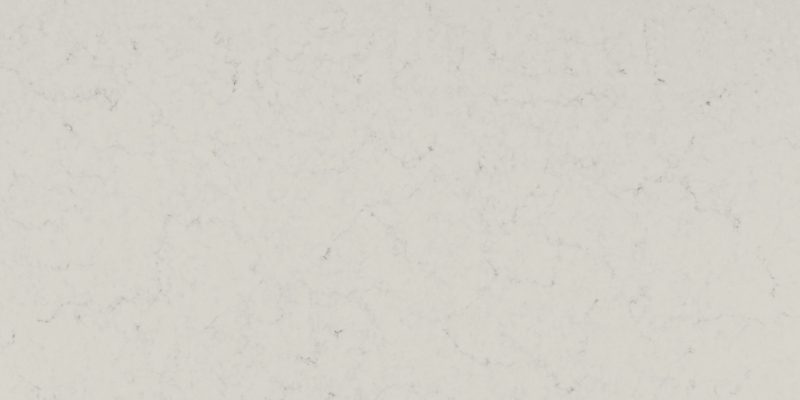



Some homeowners choose honed marble because its softer matte finish can make minor etching and wear less noticeable than on a highly polished surface. The finish should be selected based on the homeowner’s expectations for appearance and aging.
The installed price of marble and quartz countertops in Ontario depends on the selected material, slab quantity, layout, edge profile, cutouts, fabrication complexity, access conditions, and installation requirements.
| Material | Typical Cost Position | Common Cost Drivers | Ongoing Maintenance |
|---|---|---|---|
| Marble | Ranges from standard natural-stone pricing to very high premium levels | Stone variety, rarity, slab size, veining, finish, import costs, layout, and fabrication difficulty | Periodic sealing and more careful cleaning |
| Quartz | Available across standard, mid-range, and premium collections | Brand, colour collection, slab thickness, edge profile, cutouts, waterfalls, and layout complexity | Low; no sealing required |
A premium quartz design may cost more than some marble slabs, while rare or highly desirable marble can cost significantly more than standard quartz. For this reason, material names alone are not enough to estimate the final project price.
The total price is influenced by more than the cost of the slab. Important factors include:
Professional measurement is required before a final quotation can be confirmed. Teccorp Stone’s countertop survey and measurement service records final dimensions, wall conditions, appliance locations, overhangs, seams, and installation access before fabrication begins.
Quartz often offers stronger practical value for busy households because it requires less maintenance, resists staining, and appeals to a broad range of homeowners and future buyers.
Marble may offer stronger design value in luxury renovations where natural stone, visual exclusivity, and premium craftsmanship are central to the project. Its value depends heavily on proper slab selection, fabrication, installation, and the homeowner’s willingness to accept natural aging.
The better long-term choice is therefore the material that best fits the kitchen’s daily use, design goals, maintenance expectations, and expected length of ownership.
Both marble and quartz require professional measurement and fabrication, but marble generally demands more detailed slab inspection, vein planning, and handling.
Marble slabs must be reviewed individually for colour movement, veining, fissures, mineral deposits, and natural variation. The fabricator should determine how the most visually important areas will be positioned across islands, perimeter countertops, backsplashes, and waterfall panels.
Quartz is more predictable in structure and pattern, but seam planning is still important. Large islands, long countertop runs, and multiple surfaces may require careful slab matching and placement.
For both materials, seam locations should be planned around slab dimensions, structural support, sink and cooktop cutouts, access conditions, and the visual direction of the design.
Marble can support traditional and decorative edge profiles, but its softer structure requires careful cutting, polishing, and handling. Detailed edges may increase fabrication time and vulnerability to impact.
Quartz works well with modern eased edges, bevels, mitred profiles, and waterfall panels. However, sharp corners and narrow sections around cutouts still require appropriate support and careful fabrication.
Large overhangs, unsupported spans, and heavy stone sections may require reinforcement regardless of material. Cabinet conditions should be assessed before installation.
For detailed stonework, Teccorp Stone provides custom stone fabrication services for islands, backsplashes, waterfall panels, wall cladding, and other precision applications.
Delivery and installation planning are especially important for Toronto condos and properties with limited access. Elevator dimensions, loading schedules, hallway widths, stairs, parking restrictions, and carrying distance can affect the maximum size of each countertop section.
Marble may require additional handling because of natural fissures, vein direction, and the risk of damage during transport. Large quartz pieces can also be difficult to move when they include sink openings, narrow sections, or complex shapes.
Identifying access restrictions before fabrication helps prevent unnecessary seams, delivery delays, or pieces that cannot be transported safely into the property.
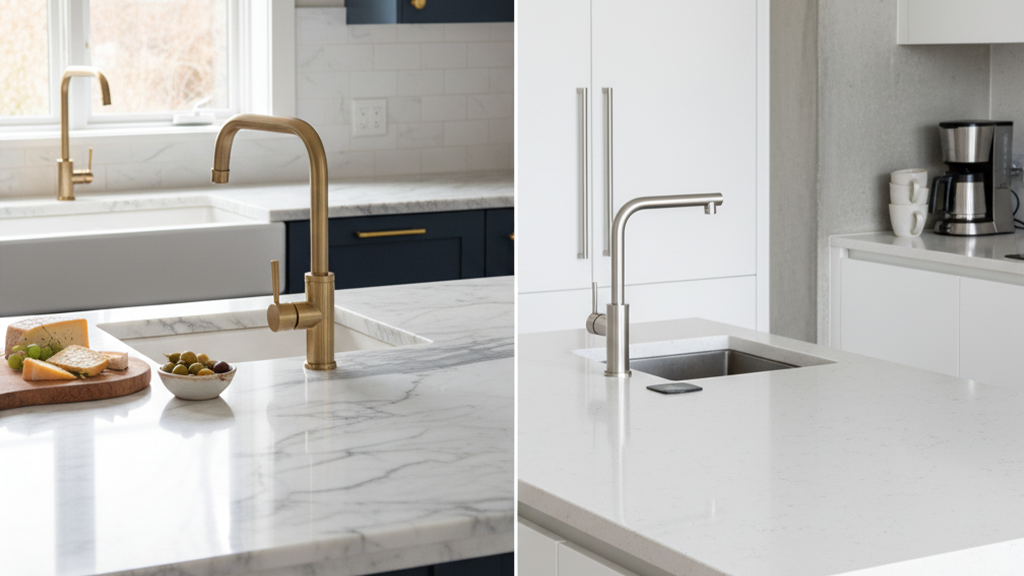
Homeowners planning a complete project can review Teccorp Stone’s kitchen countertop fabrication and installation services for Toronto and Ontario.
The better choice depends on how the kitchen is used, the desired appearance, the homeowner’s maintenance tolerance, and the overall renovation budget. Quartz is usually the more practical option for everyday use, while marble is better suited to homeowners who prioritize natural beauty and are comfortable with greater care.
Quartz is generally the stronger choice for high-traffic kitchens, households with children, rental properties, and homeowners who want a surface that maintains a consistent appearance with minimal upkeep.
Marble is usually the better fit for design-focused homeowners who value natural character and understand that the surface will require more attention than quartz. Its visual impact can be especially effective in custom homes and luxury renovations.
Yes. Marble and quartz can be combined successfully in the same kitchen when their colours, finishes, thicknesses, and patterns are coordinated carefully.
A common approach is to use quartz on perimeter countertops and primary work areas, where stain resistance and low maintenance are most important, while using marble on a statement island, baking station, or feature backsplash.
This mixed-material approach provides much of marble’s natural beauty without using it across every high-traffic surface. It also allows the island or feature area to stand out while keeping the main preparation zones easier to maintain.
Homeowners considering a feature island can review Teccorp Stone’s kitchen island countertop fabrication and installation service.
Both materials can be used throughout a kitchen, but each is particularly well suited to certain applications and design goals.
Quartz is widely used for large islands and waterfall panels because its controlled patterns make it easier to coordinate horizontal and vertical surfaces. It is also practical for islands used heavily for food preparation, dining, and entertaining.
Marble creates stronger natural movement and can turn an island into the visual centre of the kitchen. Waterfall panels and mitred edges require detailed vein planning so the pattern continues naturally across connected surfaces.
Large islands may require multiple slabs, seams, structural reinforcement, or additional handling. These factors should be confirmed during measurement and slab planning.
Quartz is often the more practical material for perimeter countertops, especially around sinks, cooktops, coffee stations, and preparation areas. Its non-porous surface and resistance to common spills reduce daily maintenance.
Marble can also be used for complete perimeter installations, but homeowners must be prepared to protect the surface from oils, acidic ingredients, and abrasive objects. Honed marble may make minor etching and wear less visible than a polished finish.
Both marble and quartz can be used for full-height backsplashes, feature walls, and coordinated vertical surfaces.
Natural marble can create dramatic movement when the backsplash is cut from the same slab or slab series as the countertop. Bookmatched or vein-aligned installations may require additional material and more detailed fabrication planning.
Quartz provides a more controlled appearance and can coordinate easily with perimeter countertops or islands. Marble-look quartz is particularly effective for homeowners who want a continuous veined surface without natural marble’s maintenance requirements.
For coordinated wall and countertop installations, Teccorp Stone provides custom stone backsplash fabrication and installation.
Quartz is commonly selected for Toronto condos because it combines low maintenance, broad design choice, and predictable appearance. It also works well in compact kitchens where spills and daily cleaning are more concentrated.
In family homes, quartz is usually the safer choice for heavy daily use. Marble may still work well on lower-traffic surfaces or when the homeowner accepts its maintenance requirements.
For luxury renovations and custom homes, marble can provide a level of natural variation and exclusivity that engineered surfaces cannot reproduce exactly. Quartz remains suitable for high-end projects when controlled patterning and easier care are higher priorities.
Simple Decision Rule
Choose quartz for lower maintenance, stronger stain resistance, and predictable design. Choose marble for natural veining, luxury character, and a surface that can develop patina over time.
Both marble and quartz can support the value and visual appeal of an Ontario home when they are appropriate for the property, professionally fabricated, and integrated into a cohesive kitchen design.
Quartz generally appeals to a wider group of buyers because it is associated with durability, low maintenance, and modern design. This can make it a practical choice for resale-focused renovations, condos, rental properties, and mid-market family homes.
Buyers are also familiar with marble-look quartz, which offers a premium appearance without the maintenance concerns commonly associated with natural marble.
Marble can create stronger perceived value in luxury properties where natural materials, custom fabrication, and distinctive slab selection are expected. A carefully planned marble island or full-height backsplash may help differentiate a high-end kitchen.
However, marble does not automatically increase resale value in every home. Some buyers may view staining, etching, or maintenance requirements as disadvantages. The material should therefore match the property, target buyer, and overall level of finishes.
Homeowners planning to remain in the property for many years should choose the material they are comfortable living with rather than selecting only for potential resale.
Quartz is better suited to people who want the countertop to remain visually consistent. Marble is better suited to those who appreciate natural aging and do not expect the surface to remain unchanged over time.
Quartz is generally better for busy kitchens because it is non-porous, does not require sealing, and resists common stains. Marble may be better for homeowners who prioritize natural beauty and are comfortable with greater maintenance and the possibility of etching or patina.
Quartz is often more predictable in price, but it is not always cheaper. Premium quartz collections can cost more than some marble slabs, while rare or highly desirable marble can be substantially more expensive. The final installed cost depends on the specific material, slab quantity, fabrication, layout, and access requirements.
Marble can absorb liquids because it is porous. Proper sealing helps reduce staining, but spills involving oil, wine, coffee, spices, and strongly coloured ingredients should still be cleaned promptly.
Staining occurs when a substance penetrates the stone and changes its colour. Etching is a chemical reaction between acidic substances and marble that alters the surface finish, usually leaving a dull or lighter mark. Sealing can reduce staining but does not prevent etching.
Most marble countertops benefit from sealing, although the correct schedule depends on the slab, finish, porosity, sealer, and level of use. Homeowners should follow the recommendation provided for their specific material rather than assuming every marble countertop needs sealing at the same interval.
Direct placement of hot cookware is not recommended on either surface. Marble generally tolerates heat better, but thermal shock can affect the stone, sealer, seams, or adhesives. Quartz contains resins that can be damaged by high temperatures. Trivets or heat-resistant pads should always be used.
Quartz is usually better for a busy family kitchen because it requires less maintenance, provides strong stain resistance, and does not etch like marble. Marble can still be used successfully when the household accepts its care requirements.
Quartz is often the more practical option for Toronto condos because it works well in compact, high-use kitchens and requires minimal maintenance. Marble can also be used when the homeowner prefers natural stone and building access, slab dimensions, and delivery conditions are planned carefully.
High-quality marble-look quartz can reproduce white backgrounds and flowing veining convincingly, especially in photographs and completed installations. Natural marble still offers greater mineral depth, translucency, and variation when full slabs are viewed closely.
Quartz often provides broader buyer appeal because of its low maintenance and practical performance. Marble can add stronger luxury appeal in high-end properties when it is well selected, professionally installed, and maintained appropriately.
Quartz is generally the better choice for homeowners who want easier care, reliable stain resistance, and predictable design. Marble is better suited to those who value natural variation, luxury character, and are comfortable with sealing, careful cleaning, and visible patina over time.
Teccorp Stone helps homeowners throughout Toronto and Ontario compare marble and quartz slabs, review fabrication requirements, plan seams and vein direction, and choose a material that fits the kitchen layout, lifestyle, maintenance expectations, and project budget.
Compare Marble and Quartz for Your Kitchen
Send your kitchen dimensions, photographs, preferred colours, and project details to receive material guidance and a project-specific estimate.
Explore available options through the marble countertop collection and quartz countertop collection before requesting your estimate.