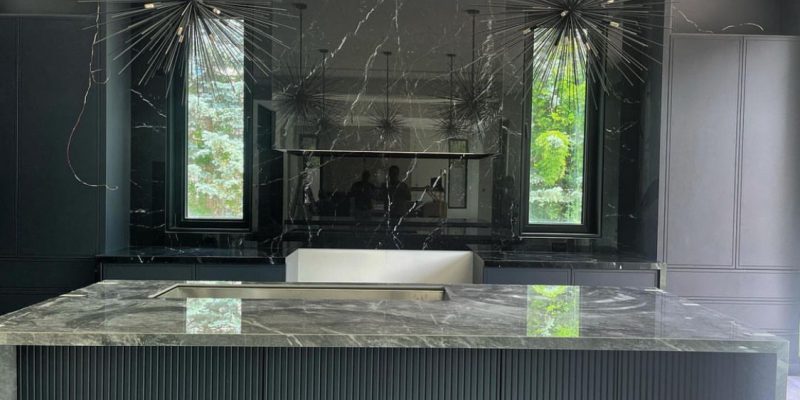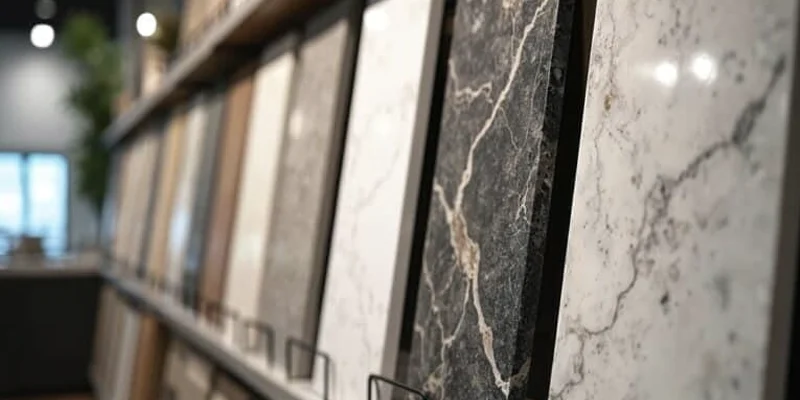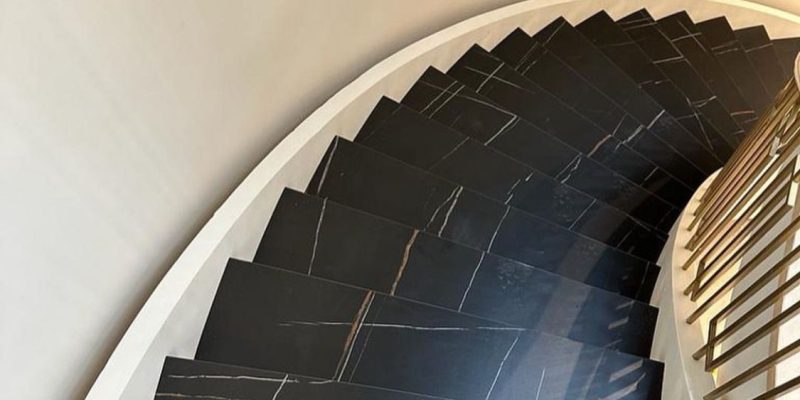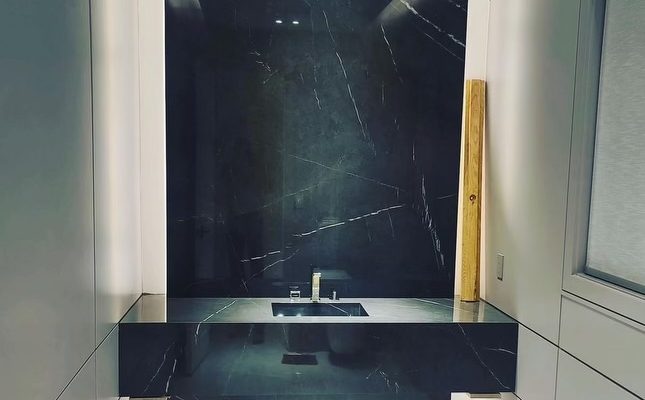
Outdoor countertop materials must be selected for exterior exposure, not simply for their appearance inside a showroom. Rain, melting snow, standing water, direct sunlight, freezing temperatures, cooking heat and seasonal movement can affect an outdoor countertop differently from an indoor kitchen surface.
A material that performs well indoors is not automatically suitable for a patio, rooftop or backyard cooking area. Exterior performance depends on the exact product or slab, water absorption, ultraviolet stability, appliance clearances, fabrication details, drainage, joints, support and installation conditions.
Suitable granite and exterior-approved porcelain are commonly among the strongest options for outdoor countertops. Soapstone, concrete and stainless steel may also work for particular applications. Engineered quartz, marble, laminate and wood require greater restrictions and product-specific confirmation.
This guide compares the best outdoor countertop materials for Canadian conditions, including freeze-thaw exposure, outdoor BBQ areas, maintenance, water management and fabrication requirements.
Best natural-stone direction: A suitable granite slab selected for its absorption, finish and exterior exposure.
Best low-absorption direction: A porcelain product specifically approved for exterior countertop use.
Engineered quartz: Use only when the manufacturer explicitly permits the exact product outdoors.
Specialty alternatives: Soapstone, concrete and stainless steel may suit projects with compatible design, fabrication and maintenance requirements.
No material should be approved by category name alone. The project still needs confirmation of the exact slab or product, level of weather exposure, appliance layout, support system and water-management details.
Outdoor countertops experience several types of exposure simultaneously. Material properties matter, but long-term performance also depends on drainage, seams, sealants, appliance openings and the supporting structure.
Moisture may enter a porous slab, unfinished edge, seam, sink opening or supporting assembly. When trapped water freezes, it expands and can place stress on vulnerable materials, joints and adjoining construction.
A low-absorption surface can reduce material-related risk, but it does not make the entire outdoor installation waterproof. The countertop, sink, seams, wall junctions, sealants, cabinets and framing must function as one water-managed assembly.
Important factors include:
Direct and reflected sunlight can affect pigments, resins, coatings and finishes. The level of exposure depends on the orientation of the outdoor kitchen, roof coverage, nearby walls and seasonal shade.
Manufactured materials should be checked against written product documentation. Interior-only products may fade, yellow or change in appearance after prolonged exterior exposure.
Natural stone should also be evaluated individually. Finish, mineral composition and weathering can influence how the installed slab changes over time.
Outdoor counters may be positioned beside grills, side burners, pizza ovens and heat-producing appliances. Heat can reach the countertop through hot cookware, appliance walls, exhaust areas and the surrounding enclosure.
A heat-tolerant surface does not remove the need for manufacturer-required clearances, ventilation, insulation or separation from combustible materials. Trivets should still be used beneath hot cookware.
Outdoor performance is strongly affected by details that are not visible in a countertop sample. The supporting structure must remain stable under the countertop and suitable for exterior conditions.
The design should address:
Material durability cannot compensate for unstable framing, trapped water, unsuitable adhesives or poorly planned openings.
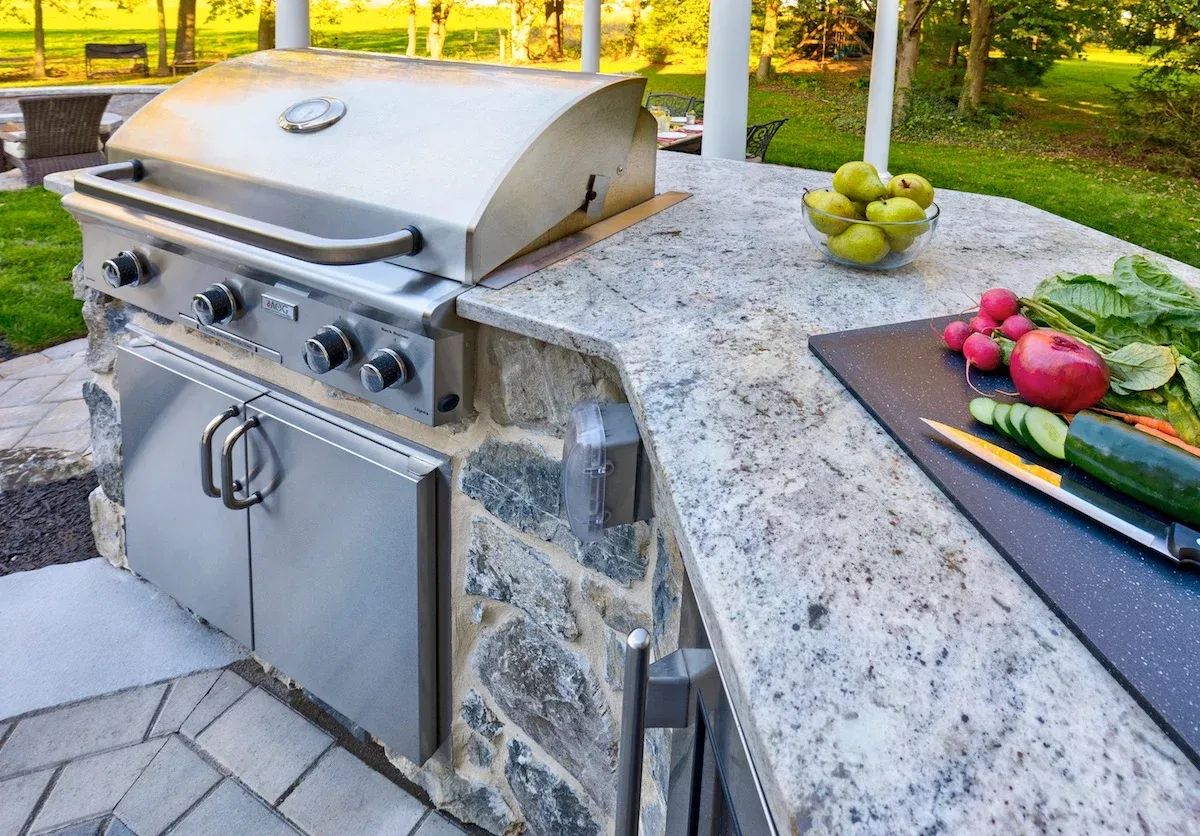
Outdoor countertops in Ontario must be planned for repeated seasonal transitions rather than one isolated cold-weather event. Rain or melting snow can enter joints and exposed areas before temperatures fall below freezing.
Canadian winter planning should include:
An outdoor sink involves plumbing considerations beyond the countertop itself. Water lines, drains and fixtures may require seasonal shutdown, drainage or other winter preparation by the appropriate trade.
The countertop opening should provide suitable support for the sink, but countertop fabrication should not be treated as a substitute for proper plumbing winterization.
Snow is not only a surface load. As it melts, water may collect near seams, appliance openings or the back of the countertop. Drainage should direct water away from vulnerable supporting materials rather than allowing it to remain trapped beneath the slab.
After winter, inspect exposed joints, sealants, edges, appliance junctions and supporting cabinets. Early maintenance of a failed sealant or blocked drainage area can prevent a minor exterior issue from affecting the broader installation.
The following comparison provides general planning direction. Final approval should be based on the exact product, slab and installation environment.
| Material | Exterior Direction | Primary Strength | Main Limitation |
|---|---|---|---|
| Granite | Commonly considered when the slab is suitable | Natural appearance and practical heat performance | Absorption, sealing and natural variation |
| Porcelain | Strong when specifically approved for exterior use | Low absorption and controlled pattern options | Edges, support and specialized fabrication |
| Soapstone | Suitable for selected projects | Low absorption and natural patina | Softer surface and visible scratching |
| Concrete | Highly dependent on construction details | Custom shapes and architectural appearance | Cracking, absorption and sealing |
| Stainless steel | Suitable with the correct grade and fabrication | Non-porous food-preparation surface | Scratches, water marks and grade selection |
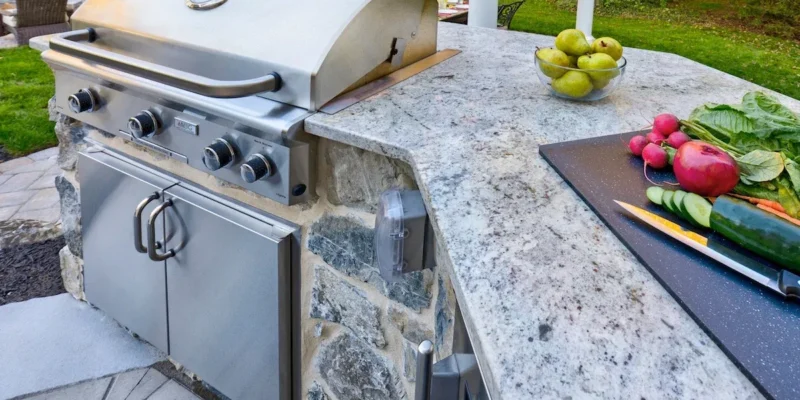
Granite is commonly considered for outdoor kitchens because suitable slabs can provide natural character, practical heat performance and compatibility with custom fabrication.
Granite may work well for:
Granite should not be approved only because it belongs to the granite category. Absorption, colour, mineral composition and finish may vary significantly between slabs.
The complete slab should be reviewed before fabrication. The evaluation should include visible natural features, pattern placement, finish, expected weathering and the position of exposed edges.
Dark slabs may absorb more heat under direct sunlight, while strongly patterned slabs require deliberate placement around grills, sinks and seams.
Some granite slabs may benefit from sealing to help manage absorption and staining, while others may require less frequent treatment. Recommendations should be based on the actual installed slab rather than a universal schedule.
Sealing does not create a waterproof outdoor installation. Drainage, seams, sink openings, joints and the supporting structure must still be detailed for exterior exposure.
Explore Granite Countertop Options
Porcelain can be a strong outdoor countertop option when the exact product is documented for exterior use. Suitable porcelain slabs generally offer low water absorption, controlled patterns and practical resistance to ordinary sunlight and weather exposure.
Exterior approval should be confirmed from the product specifications rather than assumed from the porcelain category. Thickness, surface finish, reinforcement, edge construction and installation requirements can vary between products.
Porcelain may suit:
Before approval, confirm:
Porcelain requires specialized cutting, transportation and installation. Sink openings, grill cut-outs, inside corners and long unsupported sections should be designed for the characteristics of the selected product.
Some porcelain patterns are concentrated on the visible face rather than extending through the full slab body. This can affect the appearance of exposed edges, built-up profiles and waterfall returns.
A fabricated edge may create greater visual thickness, but the corner construction and pattern relationship should be approved before production. Exposed corners should also be protected from concentrated impact during use and seasonal maintenance.
Low absorption is an advantage, but it does not make the complete assembly waterproof. Water may still enter through seams, sink openings, appliance junctions, wall connections or failed sealants.
The supporting cabinets, framing and adjoining construction should therefore be suitable for exterior exposure and protected from trapped moisture.
Explore Porcelain Countertop Options
Granite and exterior-rated porcelain are both strong candidates for outdoor countertops, but they offer different design, fabrication and maintenance characteristics.
| Comparison Point | Granite | Exterior-Rated Porcelain | Project Decision |
|---|---|---|---|
| Water absorption | Varies by slab and may require sealing | Generally very low for suitable products | Confirm the exact slab or product specification |
| Sunlight exposure | Natural material, but colour and finish may weather | Use only when exterior UV suitability is documented | Evaluate the actual exposure and product documentation |
| Heat near cooking areas | Practical heat performance with correct appliance planning | Product-specific performance and installation requirements | Follow appliance clearances and use heat protection |
| Appearance | Unique natural variation | Controlled stone-look or architectural designs | Choose between natural variation and design consistency |
| Edges and impact | Traditional edge fabrication with vulnerable corners | Requires careful edge construction and handling | Review exposed corners and appliance cut-outs |
| Maintenance | May require slab-specific sealing and inspection | Typically straightforward surface cleaning | Joints and supporting components still need inspection |
| Best fit | Natural outdoor kitchens and custom slab projects | Low-absorption and coordinated architectural applications | Match the material to exposure, design and fabrication scope |
Granite may be the clearer choice when natural slab variation and conventional stone fabrication are priorities. Exterior-rated porcelain may be preferable when low absorption, controlled patterning or coordinated vertical applications are central to the design.
Neither material removes the need for drainage, stable support, exterior-compatible joints and manufacturer-required appliance clearances.
Material Comparison Rule
Choose granite or porcelain after reviewing the exact slab or product, not from a general category comparison alone.
Soapstone, concrete and stainless steel may suit particular outdoor projects, but their fabrication, appearance and maintenance differ from granite and porcelain.
Soapstone is a natural stone with low moisture absorption and a softer surface than many granite slabs. It may suit homeowners who accept visible scratches, edge wear and gradual patina as part of the material’s character.
Soapstone may be considered for:
Its softness should be considered around exposed corners and areas where grills, tools or heavy equipment may be moved. Mineral oil may alter or even out its appearance, but it should not be described as an exterior waterproofing treatment.
Concrete can provide custom dimensions, thick profiles and an architectural appearance. Its exterior performance depends on the complete construction system, including the mix, reinforcement, curing, sealing, drainage and support.
Concrete may develop:
These possibilities should be discussed before installation. A surface sealer cannot compensate for unstable framing, unsuitable reinforcement or trapped moisture.
Stainless steel can provide a non-porous preparation surface around sinks, grills and cooking stations. The appropriate steel grade, finish, substrate and fabrication method should be selected for the exposure conditions.
Daily use may produce scratches, fingerprints and water marks.



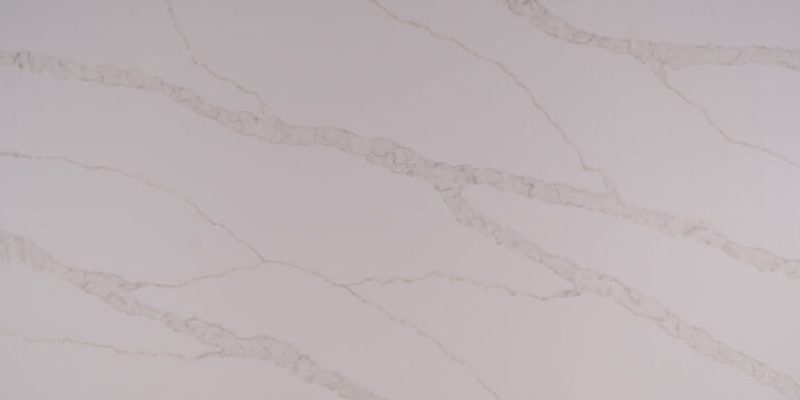



Stainless steel may work effectively as a targeted cooking or preparation zone combined with another material, rather than as the only decorative surface throughout a large outdoor kitchen.
Engineered quartz should not be assumed suitable for outdoor installation. Many quartz products contain resins, pigments and binders that may respond to prolonged sunlight, cooking heat and exterior temperature changes.
Exterior use should only be considered when the manufacturer explicitly approves the exact product for the intended application.
Before selecting quartz outdoors, confirm:
A permanent roof does not automatically make an interior-only quartz product suitable for outdoor use. Reflected sunlight, humidity, wind-driven moisture and seasonal temperature changes may still reach the countertop.
Where exterior approval is unavailable, a suitable granite slab or exterior-rated porcelain product generally provides a clearer specification.
Marble, laminate and wood may be considered in selected protected areas, but they generally require more restrictions and maintenance than suitable granite or exterior-rated porcelain.
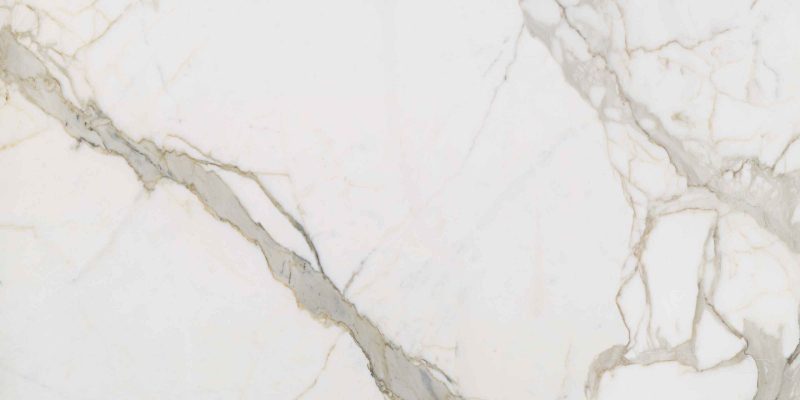
Marble can etch, stain, weather and develop visible finish changes outdoors. Some homeowners may accept this evolving appearance, but the material should not be selected with the expectation that a polished surface will remain unchanged.
A protected decorative or serving area presents a different risk level from a fully exposed BBQ counter. Suitability depends on the specific stone, finish, drainage and maintenance expectations.
Most laminate countertops are intended for indoor use. Moisture entering seams or exposed edges can affect the substrate, while sunlight and changing temperatures may affect the decorative surface and adhesives.
Laminate should only be considered when the entire product and assembly are specifically approved for exterior use. Standard interior laminate should not be treated as an outdoor countertop solution.
Wood responds to water, sunlight, humidity and seasonal movement. Exposed end grain, failed finishes and standing water can contribute to swelling, splitting, staining or decay.
Wood may suit a controlled, covered serving area when an exterior-compatible product, finish and maintenance plan are used. It is generally less predictable for fully exposed countertop applications.
Exterior Material Rule
Do not approve an outdoor countertop by appearance or material name alone. Confirm the exact product, exposure level, maintenance expectations and complete installation system.
Roof coverage can reduce direct rain, snow and sunlight, but a covered outdoor kitchen still remains part of an exterior environment. Wind-driven moisture, condensation, freezing temperatures and seasonal humidity can continue to affect the countertop and supporting structure.
A permanently covered cooking area may allow greater flexibility because the countertop receives less direct weather exposure. The design should still account for:
Coverage should not be used as justification for installing an interior-only product outdoors unless the manufacturer approves that exact application.
A fully exposed countertop places greater importance on low absorption, documented exterior suitability, drainage and joints designed for weather exposure.
Granite slabs should be evaluated for absorption, finish and expected weathering. Porcelain should be confirmed for exterior countertop use, including stated requirements for UV exposure, freeze-thaw conditions and installation.
Some outdoor kitchens are protected by a roof but have exposed ends, islands or serving counters. Each surface should be assessed according to its actual exposure rather than assigning one material decision to the entire project.
A covered grill counter and a fully exposed island may require different surface, joint or maintenance strategies even when they are part of the same outdoor kitchen.
Outdoor countertop design should begin with the exact grill, side burner, pizza oven, refrigerator and sink specifications. Appliance openings should not be fabricated from approximate dimensions or generic product categories.
The appliance manufacturer’s documentation should establish required distances from the countertop, enclosure, walls and combustible materials.
The project may need to confirm:
A heat-resistant countertop does not make an incorrectly detailed grill enclosure safe. Countertop fabrication, appliance installation and enclosure construction must follow compatible specifications.
Heat may reach the surface from cookware, appliance walls, exhaust areas and open lids. Trivets and heat-resistant pads should be used even when the selected material has practical heat tolerance.
Sealants, adhesives and supporting components around the appliance must also be suitable for the expected temperature and exterior environment.
Outdoor appliances may require repair, utility disconnection or future replacement. The countertop and enclosure should not prevent access to service panels, valves, ventilation openings or removable components.
A replacement appliance may not share the dimensions of the original model. Where practical, the design should avoid creating unnecessary stone restrictions that make future servicing more difficult.
Sink areas require coordinated planning for the bowl, faucet, drainage, supporting cabinet and seasonal plumbing shutdown.
Water should not remain trapped around the sink rim, countertop joint or supporting structure. The exact mounting method and faucet openings should be approved before fabrication.
BBQ Planning Rule
Finalize the grill and appliance specifications before countertop measurement so heat clearances, ventilation, openings and service access can be included in the fabrication plan.
The selected material must be connected with a stable exterior structure, properly designed openings and a practical installation route.
Cabinets, masonry or framing should be complete, secure and suitable for exterior exposure before final measurement. The countertop should not be expected to stabilize movement or conceal an unsuitable base.
Support should be reviewed around:
Seams may be required because of slab size, access, appliance openings or kitchen geometry. Their positions should account for support, pattern placement, drainage and exposure.
Exterior joints should not be treated as permanently maintenance-free. Sealants may require inspection and replacement as they age or move through seasonal temperature changes.
Exposed edges and corners may receive impact from cookware, furniture, snow-clearing tools or outdoor equipment. Edge selection should balance appearance with the location and expected use of the surface.
Porcelain edge construction requires particular attention because the visible pattern may not continue through the full slab body. Natural-stone edges should also be reviewed for surface finish, weather exposure and potential impact.
Long pieces, islands and counters containing large openings must be transported safely to the outdoor area. Gates, side passages, stairs, roof access and turning space can influence the final piece strategy.
A planned seam may be preferable to approving an oversized component that cannot be moved or positioned safely.
| Project Element | Confirm Before Fabrication | Potential Exterior Risk |
|---|---|---|
| Supporting structure | Stability, level and exterior suitability | Movement, trapped moisture or inadequate support |
| Appliance openings | Exact model, clearance and ventilation requirements | Heat concentration or restricted service access |
| Seams and joints | Support, drainage and exterior-compatible materials | Water entry or seasonal joint movement |
| Exposed edges | Profile, finish and impact exposure | Chipping, weathering or finish change |
| Installation route | Gate, pathway, stairs and positioning space | Impractical or unsafe fabricated-piece dimensions |
Maintenance should reflect the exact material, finish and degree of exposure. Exterior countertops should be inspected periodically rather than treated as permanently maintenance-free.
Routine care may include:
Covers may reduce debris, snow and direct weather exposure during periods of non-use. They should allow suitable ventilation and should not trap condensation against the countertop or appliances.
After winter, inspect the surface for changes in joints, sealants, edges and appliance junctions. Check that drainage remains open and that no water has collected beneath or behind the countertop.
Granite care should follow the characteristics of the installed slab. Porcelain cleaning and maintenance should follow the product documentation. Soapstone, marble, concrete and stainless steel each require their own expectations for patina, scratching, sealing or surface change.
Suitable granite and exterior-approved porcelain are commonly strong options. The final choice depends on weather exposure, absorption, appliance layout, fabrication and maintenance requirements.
Granite may suit projects seeking natural variation and conventional stone fabrication. Exterior-rated porcelain may be preferred for low absorption and controlled architectural designs. Both require correct installation and water management.
Only when the manufacturer explicitly approves the exact product for the intended exterior application. Standard interior quartz should not be assumed suitable.
Exterior performance depends on the material, absorption, support, drainage, joints and seasonal maintenance. No material eliminates risks created by trapped water or unsuitable installation.
Some slabs may benefit from sealing, while others have lower absorption. The recommendation should be based on the actual granite and exposure conditions.
Possibly, when the exact porcelain product is approved and the grill clearances, insulation, ventilation and fabrication requirements are followed.
The plumbing system may require seasonal shutdown or drainage by the appropriate trade. Requirements depend on the plumbing design and local conditions.
Coverage reduces direct exposure but does not eliminate humidity, condensation, temperature changes, indirect sunlight or wind-driven moisture.
Outdoor countertop planning should connect the material with the local weather exposure, supporting structure, drainage, appliances and fabrication details.
Provide photographs, approximate dimensions, preferred materials, property access information and the specifications for grills, sinks or other appliances so the project requirements can be reviewed.
Compare Materials for Your Outdoor Countertop
Review exterior approval, water absorption, Canadian winter exposure, appliance clearances and installation requirements before selecting the final surface.