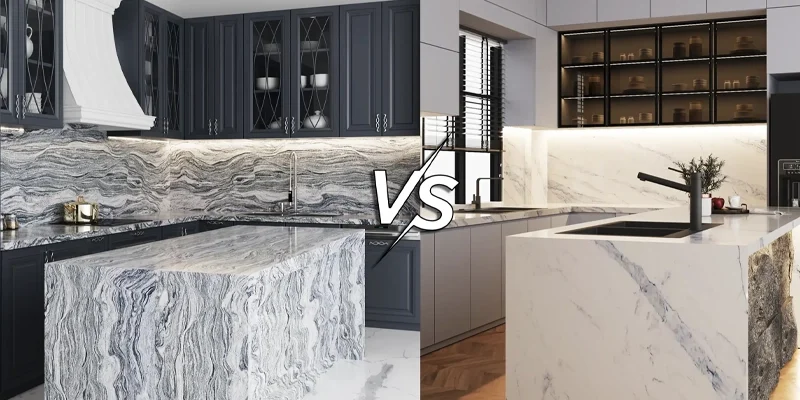
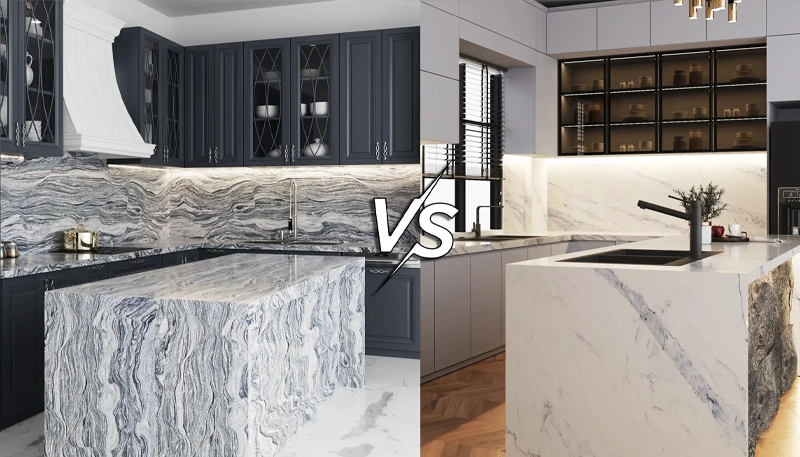
Choosing between quartz and granite countertops is one of the most common — and most important — decisions Toronto homeowners face when renovating a kitchen. Both materials dominate the Toronto & GTA countertop market, yet they perform very differently depending on lifestyle, budget, and long-term expectations. What works perfectly in a downtown Toronto condo may not be the best option for a busy family kitchen in Vaughan, Markham, or Mississauga.
At Teccorp Stone, we fabricate and install both quartz and granite in-house across Toronto and the Greater Toronto Area. After completing hundreds of projects each year — from compact condos to luxury detached homes — we’ve seen firsthand how these materials behave in real GTA kitchens, not just in showrooms.
This guide breaks down the real-world differences between quartz and granite countertops, focusing on durability, maintenance, heat resistance, pricing, and resale value in Toronto homes. If you’re also researching pricing, you can explore our detailed cost guides for kitchen countertops in Toronto or dive deeper into individual materials like quartz countertops and granite countertops.
Toronto’s housing stock is incredibly diverse — from pre-war homes in The Annex and Riverdale, to new-build townhomes in Pickering and Whitby, to luxury custom houses in Oakville and Richmond Hill. Quartz and granite remain the top two countertop choices because they handle this diversity better than almost any other surface.
Granite appeals to homeowners who value natural stone, heat resistance, and unique slab patterns. No two granite countertops are ever the same, which makes them especially popular in larger kitchens where visual character matters.
Quartz, on the other hand, has surged in popularity across Toronto condos and modern suburban homes because of its consistency, low maintenance, and predictable performance. In high-density living environments — where daily cleaning, spills, and resale value matter — quartz often becomes the safer long-term choice.
The challenge for GTA homeowners is that neither material is objectively “better”. The right choice depends on how you use your kitchen, how much maintenance you’re willing to handle, and what kind of future resale appeal you want to protect.
Durability is often the first question Toronto homeowners ask, especially in family homes where kitchens see constant use. While both materials are strong, they fail in different ways.
Granite countertops are naturally hard and highly resistant to heat. You can place hot pots directly on granite without damaging the stone — a major advantage for serious home cooks. However, granite is a natural material, meaning it contains micro-fissures that can chip if edges are impacted, especially around sinks and corners.
Quartz countertops are engineered from natural quartz crystals combined with resins. This makes them extremely resistant to chipping and cracking in everyday use. In busy Toronto kitchens with kids, quartz tends to hold up better against accidental impacts. The tradeoff is heat sensitivity — quartz does not tolerate direct heat well and always requires trivets.
In practice, we often recommend granite for homeowners who cook heavily and quartz for families prioritizing durability with minimal care. For island-heavy layouts, you may also want to review our kitchen island countertop solutions, where edge durability becomes even more critical.
Maintenance is where quartz and granite separate most clearly — especially in Toronto condos and rental properties.
Quartz is non-porous, meaning it never needs sealing. Coffee, wine, oil, and spices won’t absorb into the surface, which makes it ideal for fast-paced urban lifestyles. Most downtown Toronto condo owners choose quartz precisely because it stays clean with minimal effort.
Granite requires periodic sealing, typically every 12–18 months in GTA kitchens. While this isn’t difficult, it is a commitment. In suburban homes where owners plan to stay long-term, this maintenance is usually acceptable — but in rental units or condos, it can be a downside.
From a long-term ownership perspective, quartz offers more predictability, while granite rewards homeowners willing to invest a little care in exchange for natural beauty and heat resistance.
When comparing quartz vs granite countertops for Toronto homes, real-world durability matters more than theory. Toronto kitchens are high-use spaces, especially in family homes across North York, Vaughan, Richmond Hill, and Mississauga, where cooking frequency, temperature changes, and daily wear are constant factors.
Granite countertops are naturally hard and highly resistant to heat, making them a strong choice for homeowners who cook frequently and place hot pots directly on the surface. This heat tolerance is especially valuable in traditional kitchens and larger detached homes where heavy cooking is common. Granite’s natural crystalline structure allows it to handle thermal shock better than most engineered surfaces.
Quartz countertops, while extremely durable in daily use, are engineered with resins that make them slightly more sensitive to direct heat. In Toronto condos and modern open-concept kitchens, quartz performs exceptionally well as long as trivets are used for hot cookware. In exchange, quartz offers superior resistance to staining, making it ideal for busy households with children.
For homeowners planning a full kitchen renovation, pairing either material with professional fabrication and installation from a trusted provider like Kitchen Countertops in Toronto & GTA ensures long-term performance regardless of material choice.
Toronto’s seasonal climate plays a major role in countertop maintenance decisions. Fluctuating humidity levels, dry winters, and frequent indoor heating can impact natural stone surfaces over time.
Granite requires periodic sealing, typically every 12–18 months, depending on the stone’s porosity and kitchen usage. In homes with frequent cooking or lighter-colored granite, sealing is essential to prevent staining from oils, wine, and acidic foods. Homeowners in areas like Markham, Oakville, and Etobicoke often accept this maintenance in exchange for granite’s natural beauty and heat resistance.
Quartz countertops are non-porous and never require sealing. This makes quartz particularly appealing for downtown Toronto condos, rental properties, and busy family homes where low maintenance is a priority. Spills sit on the surface and wipe away easily, reducing long-term upkeep costs.
If minimal maintenance is a top priority, quartz often becomes the preferred option. For homeowners who appreciate natural materials and are comfortable with occasional upkeep, granite remains a strong contender.
Design preferences vary significantly across Toronto neighbourhoods, and countertop choice often reflects architectural style.
Granite offers one-of-a-kind natural patterns. No two slabs are identical, which appeals to homeowners seeking a unique, organic look. Granite works exceptionally well in traditional, transitional, and luxury kitchens, especially when paired with natural wood cabinetry or classic layouts.
Quartz provides consistency and modern aesthetics. Its controlled veining and colour uniformity make it ideal for contemporary kitchens, waterfall islands, and minimalist designs. Many Toronto homeowners choose quartz for large islands, as consistent patterns allow for seamless visual flow.
For statement kitchens, quartz is frequently selected for Kitchen Island Countertops, while granite is often chosen for perimeter counters where natural variation adds warmth.
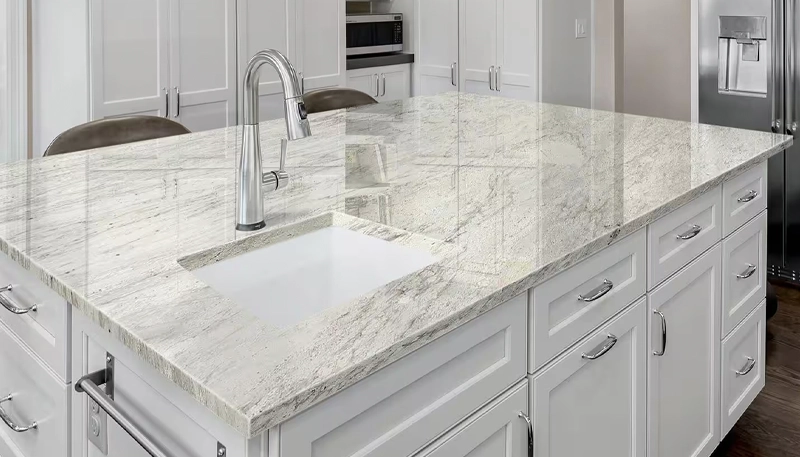












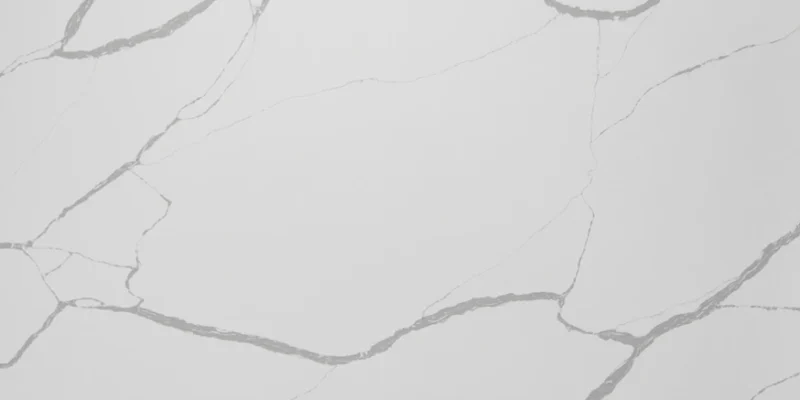
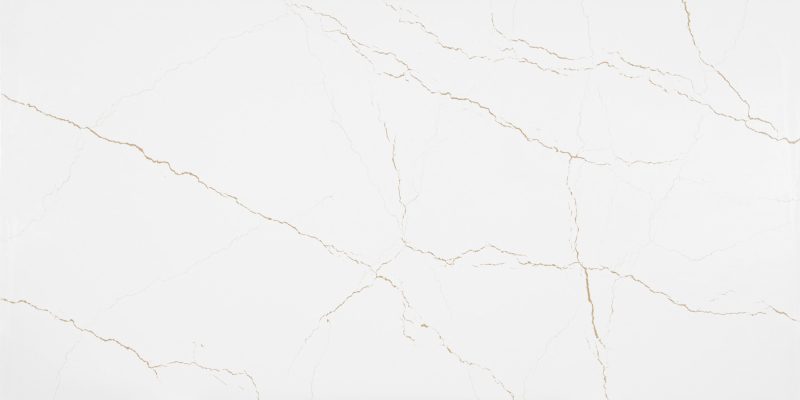
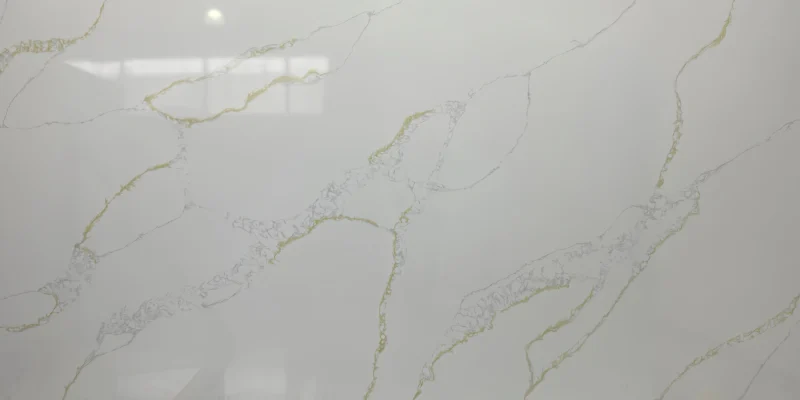





Pricing plays a decisive role for most homeowners planning a renovation.
In the Toronto market, installed granite countertops typically range from $55 to $140+ per square foot, depending on stone level, rarity, and edge detail. Entry-level granites remain cost-effective, while exotic slabs increase overall investment.
Quartz countertops in Toronto generally range from $65 to $150+ per square foot installed. While quartz may have a slightly higher starting price, its maintenance-free nature often balances long-term ownership costs.
For accurate pricing based on your layout, slab selection, and fabrication complexity, professional measurement services like Countertop Survey & Measurement ensure precise budgeting before fabrication begins.
There is no universal winner in the quartz vs granite countertops debate. The better choice depends on lifestyle, cooking habits, design goals, and maintenance preferences.
Choose granite if:
Choose quartz if:
Many Toronto homeowners combine both materials—using quartz for islands and granite for perimeter counters—to balance practicality and natural beauty. With expert fabrication and installation, both materials can deliver exceptional performance and long-term value in Toronto kitchens.
For Toronto homeowners, choosing between quartz and granite countertops isn’t just about appearance. Installation complexity, long-term maintenance, and overall return on investment play a major role—especially in GTA homes where resale value and durability matter.
Installation quality directly impacts how long your countertop will last. In Toronto condos, townhomes, and detached houses, access, slab size, and building regulations all influence the installation process.
Quartz countertops are manufactured in controlled environments, which means slabs are more uniform in thickness and structure. This consistency allows for faster templating and easier seam alignment during installation. For downtown Toronto condos with elevator restrictions and limited access, quartz is often the smoother installation option.
Granite countertops, on the other hand, are natural stone slabs. Each piece has unique density and movement patterns, requiring more careful handling, reinforcement, and seam planning. In larger GTA homes—such as those in Vaughan, Oakville, and Richmond Hill—granite installations are common and highly valued, especially for expansive kitchens with islands.
Professional fabrication and installation are critical for both materials. This is why many homeowners rely on experienced local fabricators offering full-service solutions such as
Countertop Survey & Measurement before final slab selection.
Maintenance is one of the biggest deciding factors for busy Toronto households.
Quartz is non-porous, meaning it never needs sealing. It resists staining from coffee, wine, oils, and common household spills—making it ideal for families, rental properties, and high-traffic kitchens across the GTA. Regular cleaning with mild soap and water is usually enough to keep quartz looking new.
Granite, while extremely durable, is naturally porous and requires periodic sealing—typically every 12–18 months depending on usage. In Toronto’s climate, where humidity fluctuates throughout the year, proper sealing is essential to prevent moisture absorption and staining.
For homeowners who enjoy natural stone aesthetics and don’t mind routine upkeep, granite remains a rewarding long-term choice. For those prioritizing convenience and low maintenance, quartz clearly has the edge.
Both materials perform exceptionally well in real-world Toronto kitchens, but in different ways.
Granite countertops are highly heat-resistant and can handle hot cookware directly from the stove—something many avid home cooks appreciate. This makes granite especially popular in larger family homes where cooking is frequent.
Quartz countertops offer superior resistance to scratches and chipping due to their engineered structure. However, direct exposure to extreme heat can damage the resin binders, so trivets are recommended.
In practice, most Toronto homeowners find both materials more than capable for daily use. The difference lies in habits: heavy cooking with hot pans favors granite, while busy, spill-prone households benefit from quartz.
In Toronto’s competitive real estate market, kitchens play a major role in resale value.
Real estate data consistently shows that homes with updated kitchen countertops sell faster and at higher prices. Quartz appeals to the widest range of buyers due to its clean, modern look and low maintenance. It’s especially effective in condos and newer builds throughout downtown Toronto and Midtown.
Granite, however, continues to signal luxury and craftsmanship—particularly in upscale neighbourhoods such as Forest Hill, Lawrence Park, Oakville, and King City. Buyers looking for natural materials often view granite as a premium upgrade.
Many homeowners combine both materials by using quartz for perimeter counters and granite or stone for islands, a trend commonly seen in custom projects featured on
Kitchen Island Countertops.
Ultimately, both quartz and granite offer excellent long-term value when professionally fabricated and installed. The best choice depends on lifestyle, design preference, and how you use your kitchen every day.
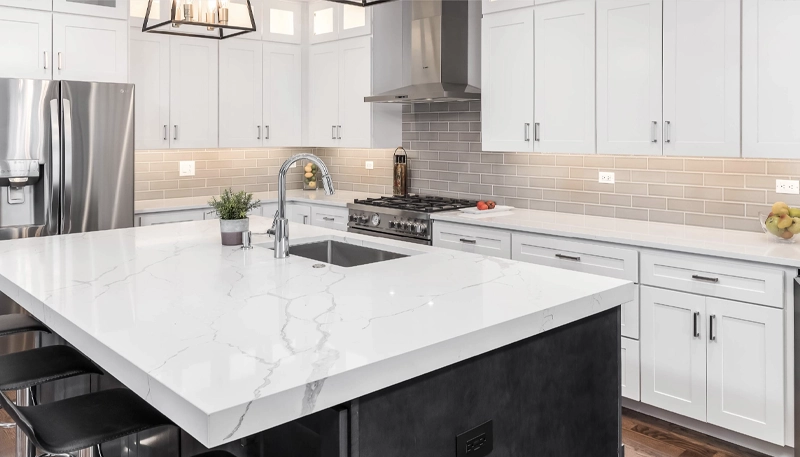
When comparing quartz vs granite countertops, there is no single “best” option for every Toronto homeowner. Both materials deliver outstanding performance, durability, and long-term value—but they shine in different lifestyles, design preferences, and property types across the GTA.
If your priority is low maintenance, consistency, and modern design, quartz remains the top choice for many Toronto homes. Its non-porous surface, wide range of colours, and uniform patterns make it ideal for busy families, downtown condos, rental properties, and contemporary renovations where convenience matters.
Granite, on the other hand, continues to attract homeowners who value natural beauty, heat resistance, and individuality. Each granite slab is unique, offering character that cannot be replicated by engineered materials. In larger kitchens and luxury homes throughout Vaughan, Oakville, Richmond Hill, and Forest Hill, granite remains a timeless and highly respected surface.
In real-world projects, many GTA homeowners don’t limit themselves to one material. A popular approach is combining quartz and granite strategically—using quartz for perimeter countertops where durability and ease of cleaning are key, and granite for kitchen islands where visual impact and heat resistance add value.
This hybrid approach is especially effective in open-concept kitchens and is frequently seen in custom designs featured on our
Kitchen Island Countertops projects.
From a cost perspective, both materials fall into similar price ranges once fabrication and installation are included. The true difference comes down to lifestyle. If you want minimal upkeep and predictable aesthetics, quartz will likely provide the best long-term satisfaction. If you enjoy cooking, value natural stone, and are comfortable with periodic sealing, granite is an investment that continues to reward over time.
For homeowners still comparing options, reviewing real pricing and installation details can help narrow the decision. Our detailed cost guides for
Kitchen Countertops in Toronto & GTA explain how layout, material choice, and fabrication complexity influence final pricing.
Choosing between quartz and granite is easier when you can see, touch, and compare slabs side by side. At Teccorp Stone, we help Toronto homeowners make confident decisions by offering expert consultation, precise measurements, and in-house fabrication tailored to your kitchen layout.
Whether you’re renovating a downtown condo, upgrading a suburban family home, or designing a luxury kitchen from scratch, our team can guide you toward the material that best fits your needs and budget.
To get accurate pricing and professional recommendations, start with our
Countertop Survey & Measurement service or request a personalized quote today.
Both quartz and granite are excellent choices when installed correctly. The right option is the one that aligns with how you live, cook, and use your kitchen—today and for years to come.