Quartz vs granite vs solid surface countertops is an important comparison for Ontario homeowners choosing between an engineered mineral surface, natural stone and a repairable acrylic-based material. Although all three can be used in residential kitchens, they differ significantly in heat resistance, scratching, repairability, seams, maintenance and design flexibility.
Quartz is often selected for its controlled appearance and low routine maintenance. Granite provides natural slab variation and stronger heat tolerance. Solid surface offers smoother-looking seams, integrated design options and greater potential for sanding or localized repair, but it is generally softer and more sensitive to heat.
The best option depends on how the kitchen will be used, which type of wear the household is prepared to accept and whether natural stone character, consistent pattern or repairability is the main priority.
Quick Answer
Choose quartz for controlled patterns and no routine sealing, granite for natural slab character and stronger heat tolerance, or solid surface when repairability, integrated details and smoother-looking joints are more important than maximum scratch and heat resistance.
The three materials can create durable kitchen countertops, but their performance advantages come from different types of construction.
| Comparison Factor | Quartz | Granite | Solid Surface |
|---|---|---|---|
| Material Type | Engineered mineral surface containing quartz particles, resin and pigments | Natural stone cut and fabricated from individual slabs | Manufactured acrylic- or polyester-based surface with mineral fillers |
| Appearance | Controlled colour and pattern with engineered consistency | Unique natural movement and mineral variation | Uniform colour with subtle patterns and broad shape flexibility |
| Heat Performance | Heat-sensitive because of resin content | Generally provides the strongest heat tolerance of the three | Sensitive to hot cookware and heated appliances |
| Scratch Resistance | Strong for ordinary use, but not scratch-proof | Generally highly resistant to routine scratching | Softer and more likely to show scratches |
| Repairability | Localized repairs may be possible but can remain visible | Chip repairs usually require stone-specific professional work | Many scratches and surface marks can be sanded or refinished |
| Sealing | Does not normally require sealing | Depends on slab absorption, finish and existing treatment | Does not normally require sealing |
| Seam Appearance | Seams remain visible depending on colour and pattern | Seams may be more visible in strongly patterned stone | Joints can often be blended more smoothly than stone seams |
| Integrated Features | Fabricated as separate countertop and sink components | Fabricated with separate sink and backsplash components | May support integrated sinks, coved backsplashes and shaped details |
| Best Suited For | Low-maintenance residential kitchens and controlled designs | Natural-stone kitchens, cooking zones and feature slabs | Repairable work surfaces and integrated design applications |
Quartz provides the most controlled appearance, granite provides the most natural variation, and solid surface provides the greatest potential for integrated fabrication and surface renewal.
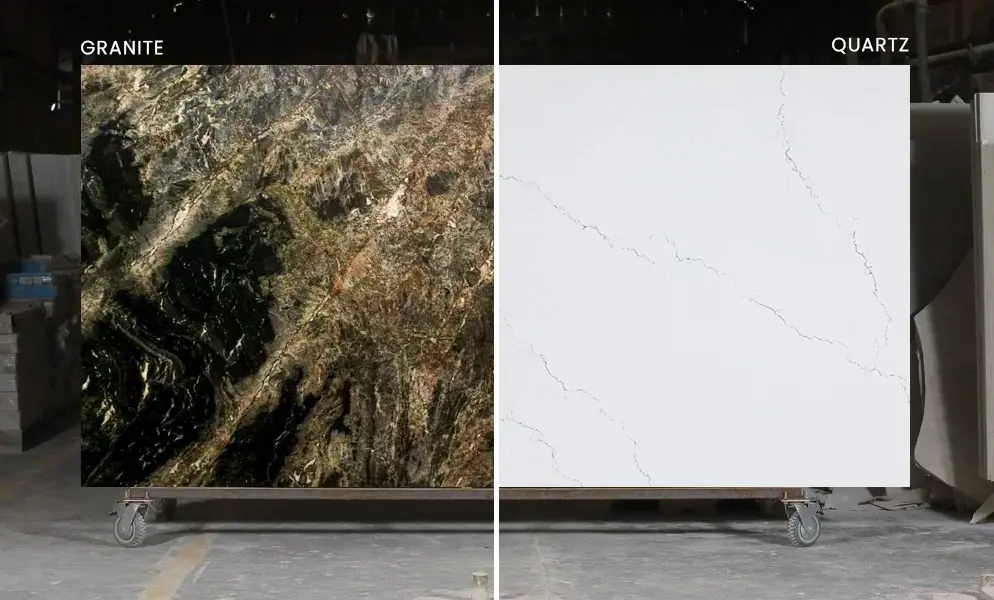
Quartz countertops are engineered surfaces manufactured from mineral particles, resin binders and pigments. The exact composition varies by manufacturer and product line.
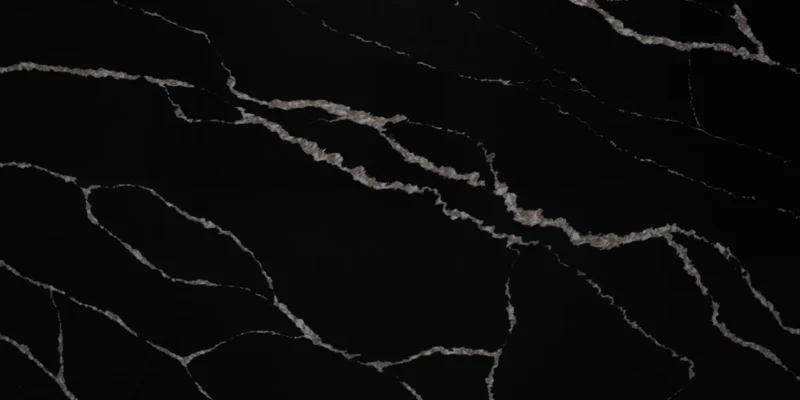
The manufacturing process allows quartz to provide more predictable colours and patterns than natural stone. Available designs range from nearly solid colours to marble-inspired veining and larger directional patterns.
Quartz should not be described as completely heat-proof, stain-proof or scratch-proof. Resin content makes heat protection necessary, and strongly coloured spills should still be cleaned promptly.
Quartz may be appropriate for:
Directional quartz patterns still require slab-layout planning. Veins may change direction around corners, seams, sink openings and waterfall panels if the pieces are not reviewed together.
Browse TecCorp Stone’s quartz countertop collection to compare pattern scale, background tone and potential layout requirements.
Granite is a natural stone quarried in blocks, cut into slabs and fabricated according to the kitchen layout. Each slab contains its own mineral distribution, movement and natural characteristics.
Unlike engineered quartz, granite does not provide exact pattern repetition. This variation is one of its main design advantages, but it also requires homeowners to review the full slab before fabrication.
Granite is hard but not immune to damage. Corners, edges and narrow areas around sink or cooktop openings may chip under concentrated impact.
The need for sealing should not be based on a fixed universal schedule. It depends on the granite variety, absorption, surface finish and existing treatment.
Granite may be appropriate for:
Browse available granite countertop options and review the actual slab rather than relying only on a small sample or digital image.
Solid surface is a manufactured countertop material generally composed of acrylic or polyester resins combined with mineral fillers and pigments. Its appearance is usually more uniform than granite and less mineral-like than quartz.
Corian is one recognized solid surface brand, but the terms are not interchangeable. Corian refers to a specific branded product family, while solid surface describes the wider material category.
Solid surface is softer than quartz and granite, so it may show scratches, abrasion and surface wear more easily. However, many marks can be reduced through sanding, polishing or localized refinishing.
This repairability can be valuable in applications where surface renewal matters more than maximum hardness.
Deeper burns, cracks, failed joints or extensive damage may still require a trained solid surface fabricator. The ability to repair the material should not be interpreted as complete immunity from permanent damage.
Some solid surface systems can be fabricated with:
These details can reduce visible transitions and simplify cleaning. However, the joints should not automatically be described as completely invisible. Their final appearance depends on colour, pattern, fabrication quality, lighting and normal surface wear.
Solid surface may be appropriate for:
It is generally less suitable where hot cookware, sharp tools and heavy abrasion are likely to contact the surface without protection.
Material Selection Rule
Do not compare these surfaces by appearance or starting price alone. Quartz prioritizes consistency, granite prioritizes natural performance and solid surface prioritizes repairability and integrated fabrication.
All three materials can provide long service when selected and installed correctly, but they fail in different ways.
Quartz generally performs well against ordinary household impact, staining and abrasion. However, narrow sections and exposed edges may still chip, and heavy concentrated impact can damage the surface.
Its resin content also means that damage caused by high heat may be difficult to repair without replacing or professionally modifying the affected section.
Granite is highly resistant to routine scratching and surface wear. Its main vulnerabilities are concentrated impact and insufficient support around edges, corners, cut-outs and overhangs.
Natural fissures and mineral characteristics should be evaluated during slab selection and fabrication planning rather than automatically treated as defects.
Solid surface is more likely to show scratches, abrasion and dents than quartz or granite. Its advantage is that many forms of visible wear can be renewed through professional sanding and refinishing.
The best durability choice therefore depends on the household’s priorities:
Heat performance is one of the clearest differences between quartz, granite and solid surface countertops. None of the three materials should be treated as a permanent substitute for trivets or heat-resistant pads.
Quartz countertops contain resin binders that can react to concentrated or prolonged heat. Hot cookware and countertop appliances may cause:
Trivets should be used beneath hot pots, pans and bakeware. Heat-producing appliances should also be operated according to their clearance requirements, especially when they release heat beneath or behind the unit.
Granite generally offers the strongest surface-heat tolerance of the three materials. However, hot cookware should still be placed on a trivet rather than directly on the countertop.
Heat protection helps reduce stress on:
Granite’s heat tolerance is a practical advantage for frequently used cooking areas, but it should not be described as completely immune to thermal damage.
Solid surface is more sensitive to heat than granite and may be more vulnerable than many quartz products depending on the exact formulation.
Direct heat can cause:
Some minor surface marks may be repairable, but severe heat damage can require professional cutting, patching or replacement of the affected section.
Heat Performance Summary
Granite generally provides the strongest heat tolerance. Quartz and solid surface require closer protection because their resin-based construction can be affected by concentrated heat.
Quartz and solid surface are manufactured as non-porous countertop materials. Granite is a natural stone whose absorption varies according to the selected slab and finish.
Quartz generally provides strong resistance to ordinary household staining because liquids do not absorb into the surface in the same way they may enter a porous natural stone.
However, strong colourants and unsuitable chemicals should still be removed promptly. Potential concerns include:
The surface may resist absorption while still being affected by chemical exposure, residue or prolonged contact with staining substances.
Granite absorption varies. Some slabs absorb very little, while others may benefit from an appropriate penetrating sealer.
The need for sealing should be determined by:
A fixed annual sealing schedule should not be applied to every granite countertop. Sealing may help reduce absorption, but it does not make the stone completely stain-proof.
Solid surface is non-porous and does not normally require sealing. It can perform well around sinks and other frequently cleaned areas when joints and integrated features are fabricated correctly.
Some substances may still leave surface marks or discolouration, particularly on lighter colours or older finishes. Many marks can be reduced through appropriate cleaning or professional refinishing.
All three materials may be used around kitchen sinks, but the complete installation should account for:
Quartz and granite typically use separately mounted sinks. Solid surface may allow integrated sink systems in selected product lines, creating smoother transitions and fewer visible edges.
Scratch resistance and repairability should be considered together. The hardest material is not always the easiest to restore after damage.
Quartz generally resists ordinary household scratching, but it is not scratch-proof. Abrasive minerals, dragged cookware and concentrated impact may leave marks or chip exposed edges.
Areas more vulnerable to damage include:
Localized repairs may be possible using colour-matched products, although the repair can remain visible depending on pattern, finish and lighting.
Granite generally provides the strongest resistance to routine scratching. However, severe impact may chip edges, corners or areas around openings.
Minor chips may be repaired professionally, but natural mineral movement can make exact colour and pattern matching difficult.
Broad sanding or refinishing is not typically performed in the same way as solid surface. Stone repairs require material-specific tools and expertise.
Solid surface is softer and more likely to show scratches, abrasion and surface wear. Dark colours and glossy finishes may reveal marks more clearly than lighter or matte surfaces.
Its main advantage is renewal potential. Depending on the product and damage, a trained fabricator may:
Homeowners should not perform aggressive sanding without knowing the product, finish sequence and approved repair method.



| Damage Type | Quartz | Granite | Solid Surface |
|---|---|---|---|
| Fine scratches | Uncommon in ordinary use but possible | Generally highly resistant | More common but often renewable |
| Edge chips | Possible under concentrated impact | Possible at corners and openings | May dent, crack or gouge rather than chip like stone |
| Surface refinishing | Limited and product-specific | Requires stone-specific professional work | Often the strongest repair option of the three |
| Repair visibility | Depends on colour and pattern | Depends on natural movement and repair location | Can often be blended effectively, but not always invisibly |
Seam appearance depends on material construction, countertop dimensions, colour, pattern and fabrication quality.
Quartz seams remain visible, particularly in solid colours, high-contrast designs and directional veining. Pattern planning can improve the visual relationship between connected pieces, but it cannot always make the seam disappear.
Large islands may require seams when slab dimensions, access or installation conditions prevent fabrication as one piece.
Granite seams are influenced by natural slab movement. Strong veins, mineral fields and colour transitions may make pattern alignment more complex.
Seam planning should consider:
A completed stone seam should not be expected to become completely invisible.
Solid surface joints may be bonded, sanded and blended more smoothly than quartz or granite seams. This makes the material useful for long counters, shaped layouts and integrated applications.
The final joint may still be detectable because of:
Solid surface may provide the broadest integrated design flexibility, including:
Quartz and granite can also support coordinated backsplashes, waterfall panels and custom edges, but these features are fabricated from separate pieces and require planned seams or joints.
Quartz and solid surface generally provide predictable routine maintenance because they do not normally require sealing. Granite care varies more according to the selected slab.
Quartz should generally be cleaned with mild soap, water and a soft cloth or a cleaner approved by the manufacturer.
Avoid:
Spills should still be removed promptly even though the surface is non-porous.
Granite should be cleaned with products suitable for natural stone. Acidic or abrasive cleaners may affect the finish or existing treatment.
Routine care may include:
Solid surface is generally easy to clean, but the appropriate method may depend on colour, finish and manufacturer instructions.
Darker surfaces can show scratches, water marks and uneven gloss more readily. Mild surface wear may sometimes be restored through approved refinishing methods.
Avoid placing hot cookware directly on the surface or using aggressive abrasive products without confirming that they are suitable for the selected finish.
Quartz typically provides the most predictable low-maintenance routine for residential kitchens. Solid surface also avoids sealing and offers strong repairability, but may show scratches more readily. Granite can be straightforward to maintain, although its sealing requirements vary by slab.
Maintenance Rule
Follow the care instructions for the exact product or slab. Quartz and solid surface should not be cleaned as natural stone, and granite should not be treated according to a universal sealing schedule.
The cost of quartz, granite and solid surface countertops depends on more than the material category. Brand, colour, slab or sheet dimensions, fabrication details, openings, edge construction, delivery access and installation conditions can all affect the final price.
Quartz pricing may vary according to:
Premium veined quartz and large-format products may cost substantially more than basic colours. Quartz should not automatically be treated as the mid-priced option.
Granite pricing depends on the exact slab rather than only the material name.
Main variables include:
Commonly available granite may cost less than premium quartz, while rare or strongly patterned slabs may cost considerably more.
For a detailed explanation of granite pricing, review the guide to granite countertop cost and material levels.
Solid surface pricing may vary according to:
Basic solid surface may be competitively priced, but custom shapes, integrated components and premium brands can increase the total substantially. It should not automatically be described as the least expensive material.
| Value Factor | Quartz | Granite | Solid Surface |
|---|---|---|---|
| Routine care | Predictable and generally low | Depends on the slab and finish | Low routine care but greater scratch visibility |
| Repair potential | Localized and product-specific | Professional stone repair may be possible | Strongest surface-renewal potential |
| Design value | Controlled patterns and broad consistency | Unique natural-slab character | Integrated features and custom shapes |
Long-term value depends on whether the material matches the household’s use and expectations. A low starting price may not represent better value when the surface performs poorly in the intended application.
Quartz provides the most controlled colour and pattern consistency of the three materials. It can support contemporary, transitional and marble-inspired designs without the degree of variation found in natural stone.
Directional quartz still requires careful layout planning. Strong veins may not align automatically across seams, corners and waterfall panels.
Granite provides natural mineral movement that cannot be reproduced exactly from one slab to another. This makes it appropriate for homeowners who want a unique material rather than precise pattern repetition.
The complete slab should be reviewed before fabrication, especially when the project includes a large island or prominent uninterrupted section.
Solid surface usually provides a quieter and more uniform appearance. It is available in solid colours, subtle particulate patterns and selected stone-inspired designs.
Its primary design advantage is not realistic natural-stone movement. It is the ability to create shaped sections, smoother transitions and integrated components.
Quartz and granite are heavy slab materials that require secure, level cabinets and professional handling. Solid surface is generally lighter, but it still requires skilled fabrication and installation.
Quartz installation may involve:
Manufactured consistency does not remove the need for professional fabrication or cabinet readiness.
Granite requires additional attention to natural variation, slab strength and movement through the property.
The installation plan should consider:
Solid surface sheets can be joined, shaped and refinished on site or in a fabrication shop depending on the project. Integrated details may require specialist tools and brand-specific fabrication methods.
Although the material is lighter than granite or quartz, poor joint preparation, inadequate support or incorrect heat treatment can affect the completed result.
For all three materials, confirm that:
TecCorp Stone’s countertop survey and measurement service supports stone-countertop planning by reviewing cabinets, openings, seams and access before fabrication.
Quartz is often the most predictable option for a busy household because it provides strong stain resistance, no routine sealing and consistent everyday care.
Granite may be preferred in kitchens where cooking heat and natural stone character are higher priorities. Solid surface may suit households that accept more visible scratching in exchange for easier surface renewal.
The best island material depends on the island’s function.
When the island includes a cooktop, heat protection becomes especially important for quartz and solid surface. When it includes a large overhang, the cabinet and support system must be evaluated for the selected material.
Review TecCorp Stone’s kitchen island countertop service when the project includes stone overhangs, sink openings, waterfall panels or feature slabs.
Quartz may provide the most straightforward maintenance expectations for rental kitchens. Granite can also perform well, but care requirements depend on the selected slab. Solid surface offers repairability but may show scratches and heat damage more readily if users do not follow care instructions.
Solid surface generally provides the strongest options for integrated sinks, coved backsplashes and smoother transitions between connected components.
Quartz and granite can support undermount sinks and coordinated backsplash pieces, but the components remain separately fabricated and joined.
Granite generally offers the strongest heat tolerance, although trivets should still be used. Quartz can perform well when direct heat is controlled. Solid surface requires the greatest caution around hot cookware and heat-producing appliances.
Selection Summary
Choose quartz for predictable care, granite for natural stone and stronger heat tolerance, or solid surface for integrated design and repairability.
Quartz is generally best for controlled appearance and predictable care. Granite is best for natural variation and stronger heat tolerance. Solid surface is best when repairability and integrated design are priorities.
No. Quartz contains mineral particles and resin, while solid surface is generally manufactured from acrylic or polyester resins with mineral fillers. Solid surface is softer and more repairable.
Corian is a recognized solid surface brand. It is not the generic name for every solid surface product.
Granite generally provides the strongest resistance to ordinary scratching, followed by quartz. Solid surface scratches more easily but offers better refinishing potential.
Granite generally has the strongest heat tolerance. Trivets should still be used on granite, quartz and solid surface.
Quartz usually provides the most predictable low-maintenance routine. Solid surface also requires no sealing but may show scratches more readily. Granite maintenance depends on the selected slab.
Many scratches and surface marks can be sanded or refinished. Deeper burns, cracks and failed joints may require a trained solid surface fabricator.
Yes, suitable products can support undermount sinks. Solid surface may also provide integrated sink options in selected systems.
TecCorp Stone specializes in the fabrication and installation of stone countertop materials. Solid surface is included in this guide for comparison. Product availability and service scope should be confirmed directly before planning a project.
Quartz, granite and solid surface serve different priorities. Quartz provides controlled patterns and simple routine care. Granite provides natural slab character and stronger heat performance. Solid surface provides smoother-looking joints, integrated details and greater surface-renewal potential.
The final decision should reflect kitchen use, maintenance expectations, design requirements, cabinet conditions and the complete installed cost.
Comparing Countertop Materials for Your Kitchen?
Share your kitchen dimensions, cabinet layout, preferred appearance and practical priorities to review suitable stone countertop options.
Discuss Your Countertop Project
Explore Kitchen Countertop Services