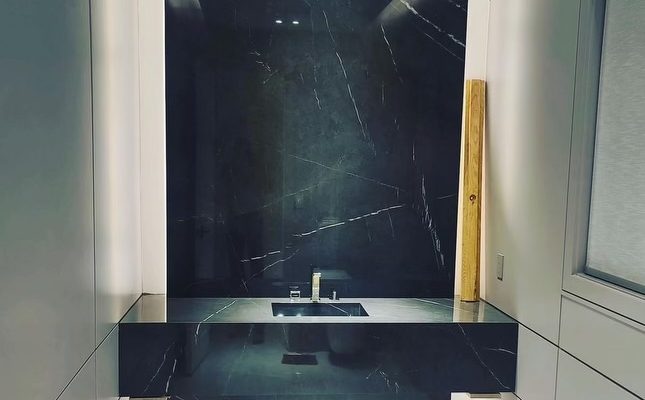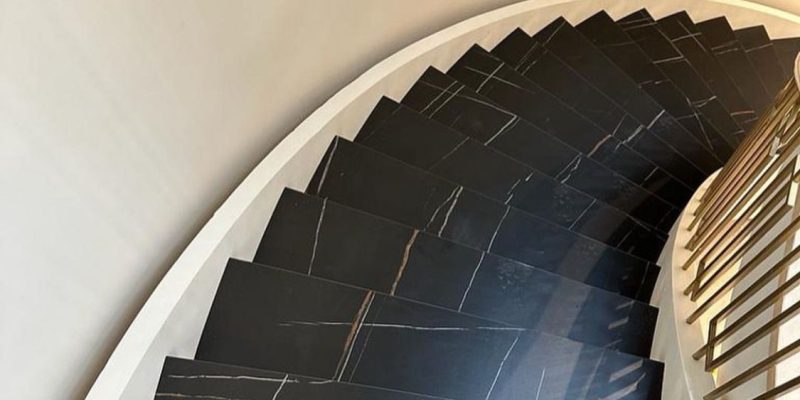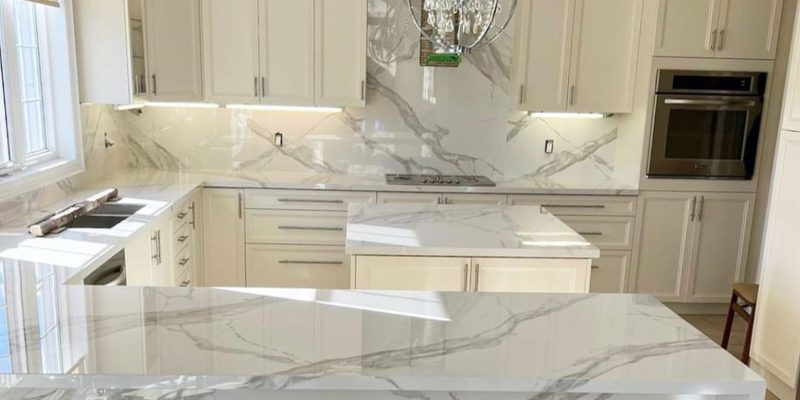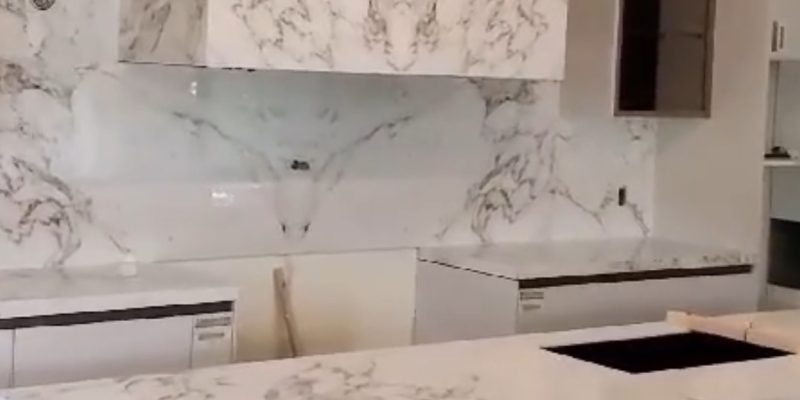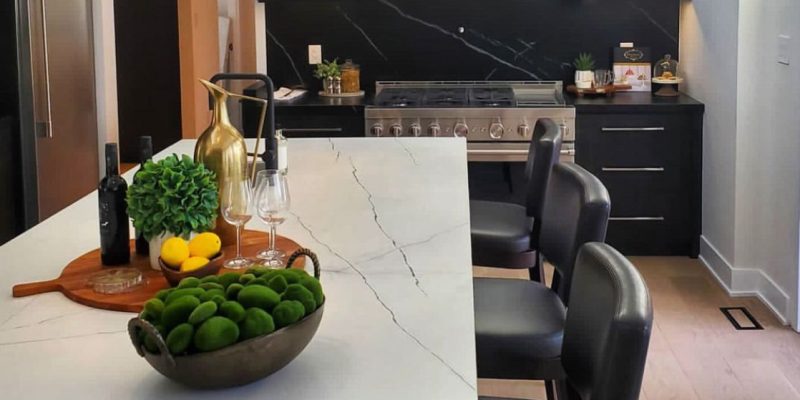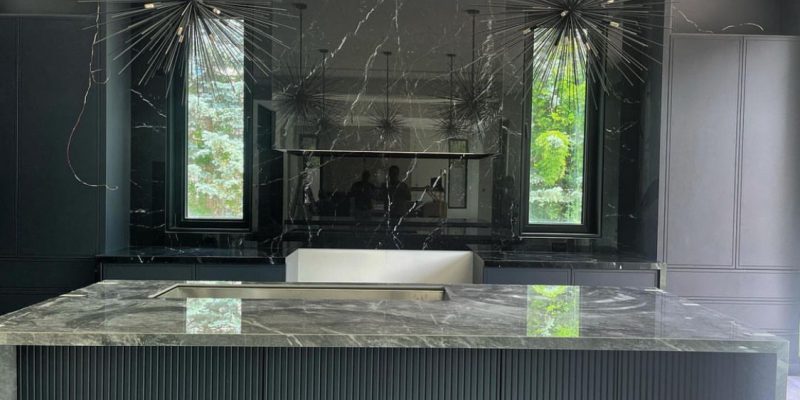
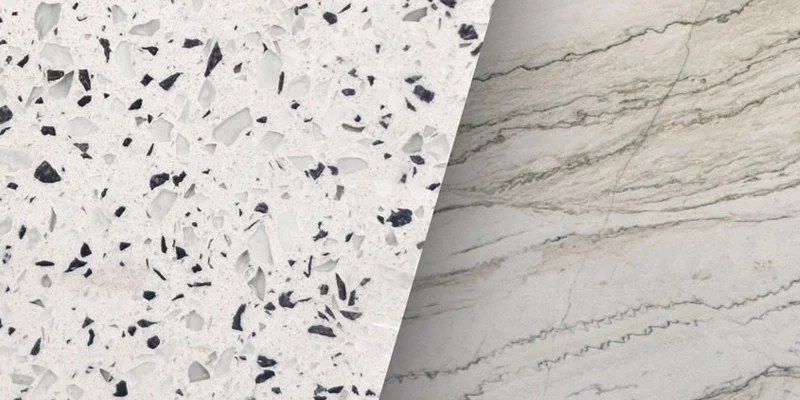
Quartz vs quartzite countertops is a common comparison for Toronto homeowners because the two materials have similar names and can produce a similar marble-inspired appearance. Despite those similarities, quartz and quartzite differ significantly in composition, pattern consistency, maintenance, heat resistance, fabrication requirements, and installed cost.
Quartz is an engineered surface designed to provide predictable colour, controlled veining, and low-maintenance performance. Quartzite is a natural stone valued for its distinctive slab movement, mineral depth, heat resistance, and one-of-a-kind appearance. Neither material is automatically better for every kitchen; the right choice depends on how the space will be used, the desired design, and the homeowner’s maintenance expectations.
At Teccorp Stone, we fabricate and install both quartz countertops and quartzite countertops for residential projects throughout Toronto and the Greater Toronto Area. Comparing actual slabs, fabrication details, and installation requirements before ordering helps homeowners select a material that fits both their kitchen design and long-term lifestyle.
Quick Comparison
Choose quartz when low maintenance, stain resistance, and consistent patterns are the priorities. Choose quartzite when natural stone character, stronger heat resistance, and unique slab movement are more important. Both materials require professional measurement, fabrication, and installation for the best result.
The following comparison highlights the practical differences Toronto homeowners should consider before choosing between quartz and quartzite.
| Comparison Factor | Quartz Countertops | Quartzite Countertops |
|---|---|---|
| Material Type | Engineered surface made with quartz minerals, resins, and pigments | Natural metamorphic stone quarried and cut into individual slabs |
| Appearance | Consistent colours and controlled patterns | Unique veining, mineral depth, and natural variation |
| Maintenance | Non-porous and does not require sealing | Usually requires periodic sealing |
| Heat Resistance | Heat-sensitive because of resin content; trivets are required | More heat-resistant, although trivets are still recommended |
| Stain Resistance | Excellent due to its non-porous surface | Good when properly sealed and maintained |
| Pattern Consistency | More predictable across multiple slabs and sections | Varies naturally from slab to slab |
| Fabrication | Predictable structure and generally straightforward fabrication | Requires careful slab inspection, cutting, seam planning, and polishing |
| Best Suited For | Busy households, condos, rental properties, and modern kitchens | Luxury kitchens, statement islands, frequent cooks, and natural-stone designs |
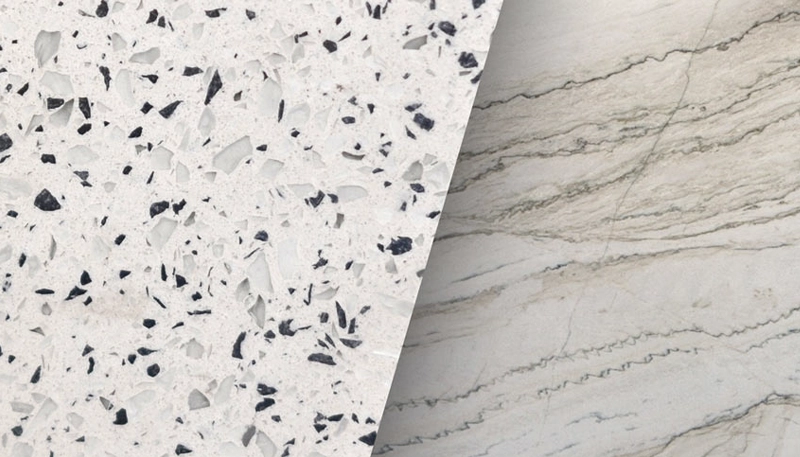
The most important difference is that quartz is manufactured while quartzite is formed naturally. This affects how each material looks, performs, is maintained, and is fabricated.
Quartz countertops are engineered surfaces manufactured from quartz minerals combined with resin binders, pigments, and other components. The production process creates a dense, non-porous slab with controlled colours and patterns.
Because the appearance is designed during manufacturing, quartz can reproduce styles inspired by marble, concrete, limestone, and other natural materials. This gives homeowners access to a broad selection of finishes while maintaining more consistency across separate countertop sections.
Quartz is particularly popular in Toronto condos, contemporary kitchens, rental properties, and busy family homes because it does not require sealing and is easy to clean. Its consistent structure also helps with planning long countertop runs, matching perimeter surfaces, and creating coordinated kitchen islands and backsplashes.
However, quartz contains resins that can be affected by direct or prolonged heat. Hot cookware and heat-producing appliances should not be placed directly on the surface without appropriate protection.
Quartzite is a natural metamorphic stone formed when sandstone is exposed to substantial heat and pressure beneath the Earth’s surface. This geological process produces a dense crystalline stone that is quarried in blocks and cut into slabs for fabrication.
Every quartzite slab has its own colour movement, veining, mineral characteristics, and natural variation. Many varieties resemble marble but offer greater hardness and stronger resistance to heat and scratching. These characteristics make quartzite especially desirable for statement islands and luxury kitchens where the slab itself becomes a prominent design feature.
As a natural stone, quartzite is generally porous and commonly requires sealing to help protect it from oils, wine, coffee, and other staining substances. The exact porosity and maintenance needs can vary between slabs, so material identification and professional slab inspection are important before fabrication begins.
Quartzite is also more demanding to cut and finish than many engineered surfaces. Accurate templating, appropriate tooling, careful handling, and experienced fabrication are necessary to preserve the stone and produce clean edges, cutouts, and seams.
Quartz and quartzite are both available in light, elegant designs commonly selected for Toronto kitchens, but they create different visual effects. Quartz provides control and predictability, while quartzite provides natural movement and individuality.
Quartz is available in a wide range of whites, warm neutrals, greys, concrete-inspired finishes, and marble-look patterns. Manufacturers can control the colour, scale, and direction of the pattern, making the final result more predictable than natural stone.
This consistency is helpful in kitchens with multiple countertop sections, waterfall panels, full-height backsplashes, or large islands. Although individual slab batches should still be reviewed, quartz generally makes it easier to coordinate separate surfaces throughout an open-concept kitchen.
Quartz works particularly well with modern cabinetry, minimalist interiors, compact condo layouts, and projects where the homeowner wants a clean appearance without dramatic variation between slabs.
Quartzite offers natural veining, crystalline texture, colour depth, and mineral movement that cannot be duplicated exactly by an engineered surface. Each slab must be evaluated individually because the pattern may change significantly across the stone.
This variation is often the main reason homeowners choose quartzite. A carefully selected slab can become the focal point of a kitchen island, waterfall installation, or full-height backsplash. Popular quartzite designs may feature soft white backgrounds, warm beige tones, grey movement, or dramatic veining inspired by marble.
Natural variation also requires more detailed planning. Vein direction, focal areas, seams, cutouts, and waterfall transitions should be reviewed before the slab is cut. For high-visibility projects, professional slab layout helps preserve the strongest areas of the pattern and maintain visual continuity across connected surfaces.
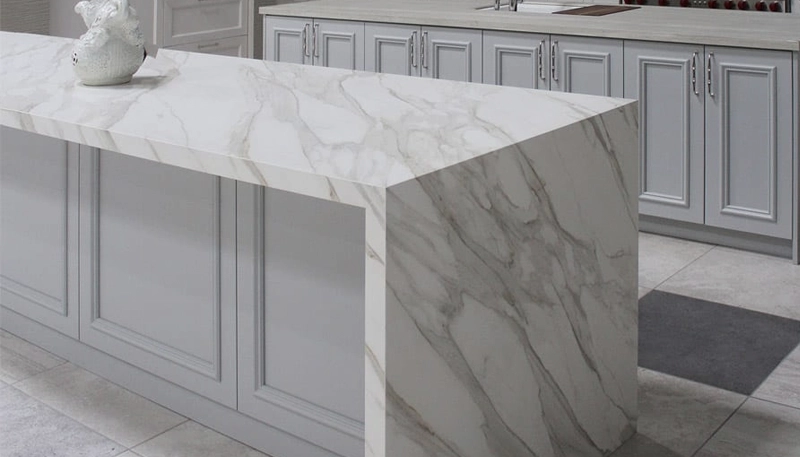
Homeowners can compare available surfaces through the quartz countertop collection and quartzite countertop collection. Viewing full slabs rather than relying only on small samples is especially important when selecting quartzite because natural movement can vary across the entire slab.
Both quartz and quartzite are durable countertop materials, but they respond differently to scratches, impacts, heat, moisture, and everyday kitchen use. The better option depends on cooking habits, maintenance expectations, and how heavily the countertop will be used.
Quartzite is one of the harder natural stones commonly used for countertops. Its dense crystalline structure provides strong resistance to scratches and surface wear, making it suitable for busy kitchens, food-preparation areas, and large islands.
Quartz is also highly durable in normal residential use. Its engineered composition provides a consistent structure that performs well against everyday impacts, spills, and general wear. However, sharp knives and abrasive objects can still damage the finish, so cutting boards should be used on both quartz and quartzite.
Edge damage is possible with either material. Sink openings, outside corners, narrow countertop strips, and decorative edges are more vulnerable to impacts than the centre of a slab. Proper fabrication, edge selection, support, and installation help reduce the risk of chipping.
Quartzite generally provides stronger heat resistance than engineered quartz because it is a natural stone without resin binders. This makes it attractive to homeowners who cook frequently or use countertop appliances that generate substantial heat.
Quartz contains resins that can be affected by direct or prolonged exposure to high temperatures. Hot cookware, electric skillets, air fryers, slow cookers, and similar appliances should be placed on trivets or heat-resistant pads.
Although quartzite tolerates heat better, trivets are still recommended. Sudden temperature changes can affect seams, sealers, adhesives, or surrounding finishes even when the stone itself is highly heat-resistant.
Quartz is non-porous and does not require sealing. Liquids remain on the surface rather than penetrating into the material, providing strong resistance to common kitchen stains from coffee, wine, oil, sauces, and food colouring.
Quartzite is a natural stone and may absorb liquids if it is not properly sealed. Porosity varies between slabs, so the selected material should be inspected and tested before installation. A suitable penetrating sealer helps reduce moisture absorption and staining without changing the natural appearance of the stone.
Spills should still be cleaned promptly on both materials. Quartz can be affected by certain chemicals and prolonged exposure to strongly coloured substances, while quartzite may stain if the sealer has worn or the stone is particularly porous.
Performance Summary
Quartz provides easier stain resistance and more predictable everyday care. Quartzite offers stronger natural hardness and heat resistance but requires greater attention to sealing, slab selection, and maintenance.
Maintenance is one of the clearest differences between quartz and quartzite countertops. Quartz is generally selected for convenience, while quartzite requires a natural-stone care routine to preserve its appearance and stain resistance.
Quartz usually requires only routine cleaning with warm water, mild soap, and a soft cloth. Because the surface is non-porous, it does not need periodic sealing.
Avoid abrasive pads, harsh chemicals, paint removers, strong solvents, and highly alkaline cleaning products. These products can dull the finish or affect the resin components used in the slab.
Homeowners should also avoid cutting directly on quartz and placing hot cookware or heat-producing appliances directly on the surface. Following these basic precautions helps preserve the finish and appearance over time.
Quartzite normally benefits from periodic sealing, although the appropriate schedule depends on the specific slab, finish, porosity, and level of kitchen use. Rather than relying on a fixed calendar, homeowners should follow the fabricator’s recommendation and monitor how quickly water is absorbed by the surface.
Daily cleaning should be completed with a pH-neutral stone cleaner or mild soap and water. Acidic, abrasive, or highly alkaline products should be avoided because they may affect the sealer or finish.
Oil, wine, coffee, citrus, and strongly coloured spills should be wiped up promptly. Proper sealing and routine care allow quartzite to perform well in heavily used kitchens while preserving its natural depth and veining.
The installed cost of quartz and quartzite countertops in Toronto depends on the selected slab, kitchen layout, countertop area, edge profile, cutouts, fabrication complexity, delivery conditions, and installation requirements.
| Material | Typical Installed Range | Common Cost Drivers |
|---|---|---|
| Quartz | Approximately $65–$150+ per sq.
Stone Surfaces
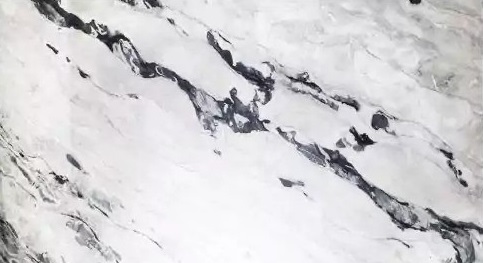
Quartzite Slab Arctic Ocean Leather
Price : Call For Price
Quartzite is a naturally occurring form of quartz that is found in the earth’s crust. This is a beautiful and durable material that is perfect
Stone Surfaces
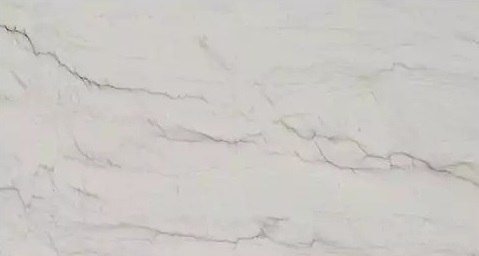
Quartzite Slab Everest Honed
Price : Call For Price
Quartzite is a naturally occurring form of quartz that is found in the earth’s crust. This is a beautiful and durable material that is perfect
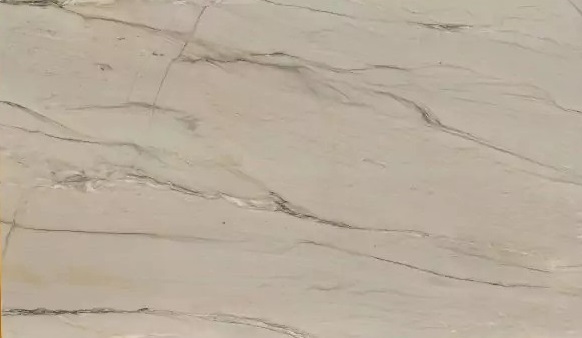
Stone Surfaces
Quartzite Slab Everest Leather
Price : Call For Price
Quartzite is a naturally occurring form of quartz that is found in the earth’s crust. This is a beautiful and durable material that is perfect
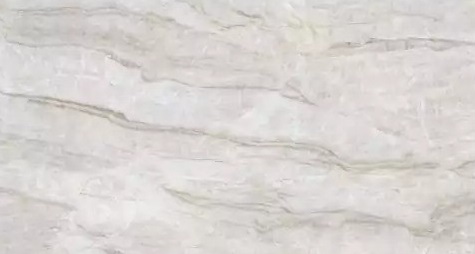
Stone Surfaces
Quartzite Slab Taj Mahal
Price : Call For Price
Quartzite is a naturally occurring form of quartz that is found in the earth’s crust. This is a beautiful and durable material that is perfect
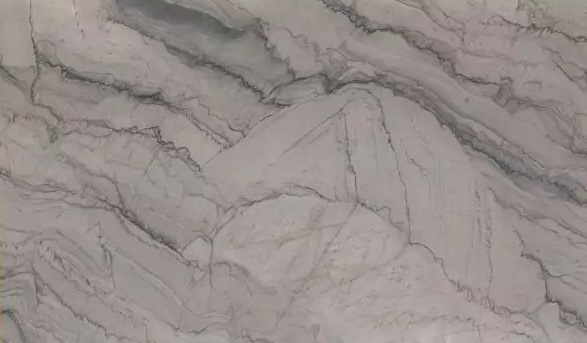
Stone Surfaces
Quartzite Slab Opus White Leather
Price : Call For Price
Quartzite is a naturally occurring form of quartz that is found in the earth’s crust. This is a beautiful and durable material that is perfect
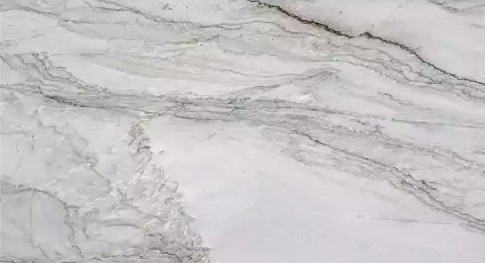
Stone Surfaces
Quartzite Slab Opus White
Price : Call For Price
Quartzite is a naturally occurring form of quartz that is found in the earth’s crust. This is a beautiful and durable material that is perfect
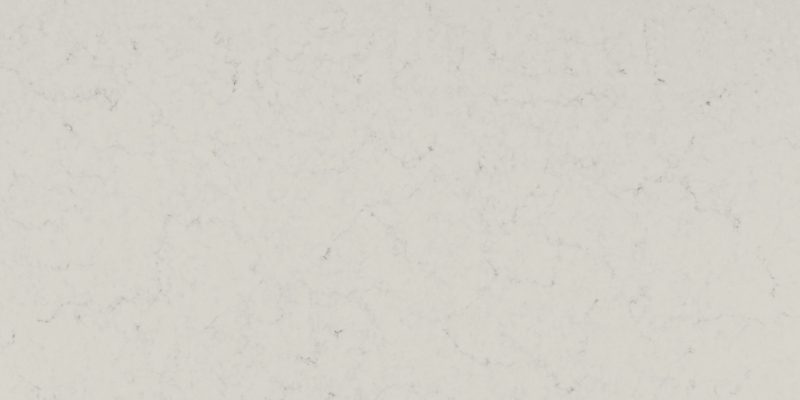
Stone Surfaces
Quartz Slab 5000 London Grey
Price : Call For Price
Quartz is our most common mineral that is made up of two abundant chemical elements on earth, oxygen and silicon. Unlike natural stone, quartz does
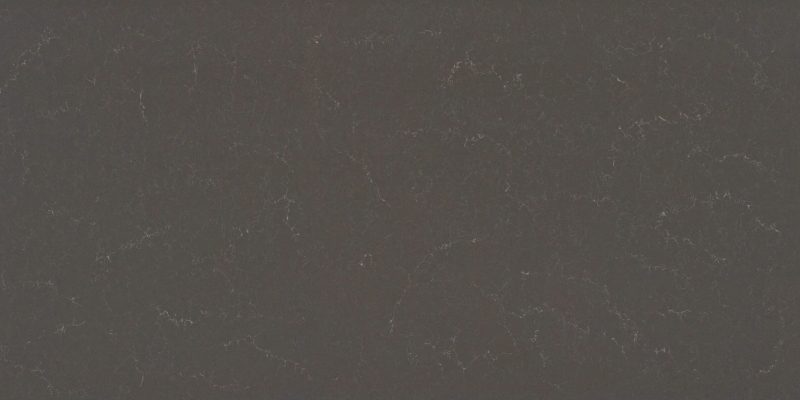
Stone Surfaces
Quartz Slab 5003 Pietra Grey
Price : Call For Price
Quartz is our most common mineral that is made up of two abundant chemical elements on earth, oxygen and silicon. Unlike natural stone, quartz does
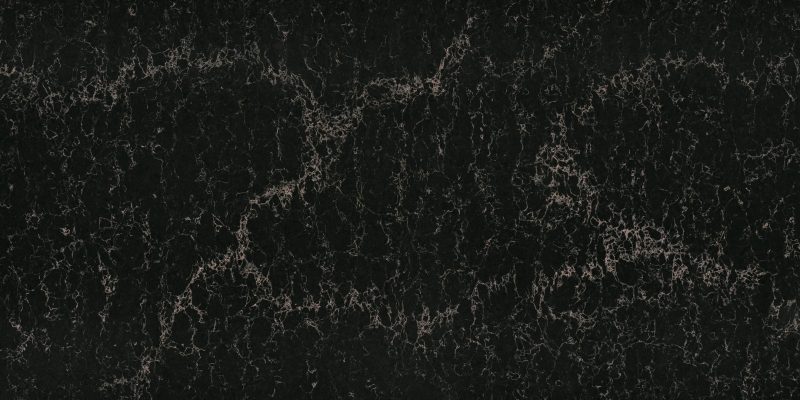
Stone Surfaces
Quartz Slab 5100 Vanilla Noir
Price : Call For Price
Quartz is our most common mineral that is made up of two abundant chemical elements on earth, oxygen and silicon. Unlike natural stone, quartz does

Stone Surfaces
Quartz Slab Alaska Bianca
Price : Call For Price
Alaska Bianca exudes a sense of purity and simplicity with its crisp white hues.

Stone Surfaces
Quartz Slab 5131 Calacatta Nuvo
Price : Call For Price
Calacatta with Grey Veins Quartz Countertop
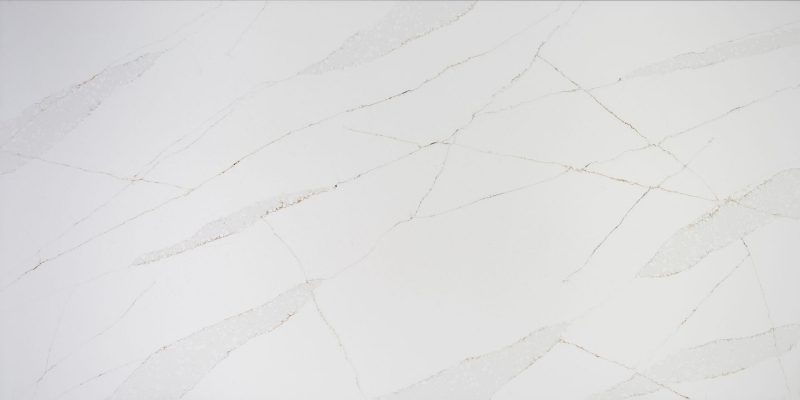
Stone Surfaces
Quartz Slab Calacatta Musk
Price : Call For Price
Calacatta Musk embodies the intricate gold streaks and elegant white creamy backdrop.
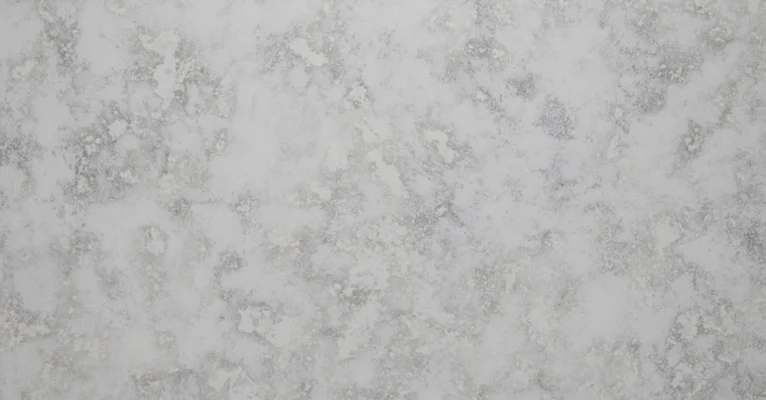
Stone Surfaces
Quartz Slab EM1000
Price : Call For Price
The products are widely used in construction, decoration, medical treatment, chemical industry and other fields.
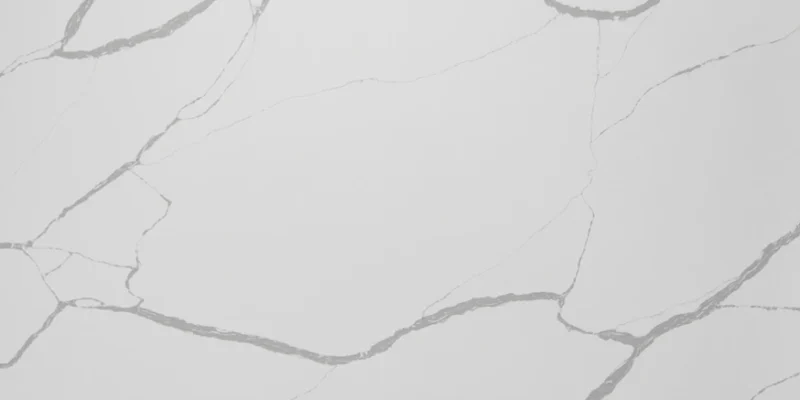
Stone Surfaces
Quartz Slab EM1001
Price : Call For Price
Quartz is our most common mineral that is made up of two abundant chemical elements on earth, oxygen and silicon. Unlike natural stone, quartz does not

Stone Surfaces
Quartz Slab EM1002
Price : Call For Price
Quartz is our most common mineral that is made up of two abundant chemical elements on earth, oxygen and silicon. Unlike natural stone, quartz does not

Stone Surfaces
Quartz Slab EM3043
Price : Call For Price
Quartz is our most common mineral that is made up of two abundant chemical elements on earth, oxygen and silicon. Unlike natural stone, quartz does not

Stone Surfaces
Quartz Slab EM3023
Price : Call For Price
Quartz is our most common mineral that is made up of two abundant chemical elements on earth, oxygen and silicon. Unlike natural stone, quartz does not
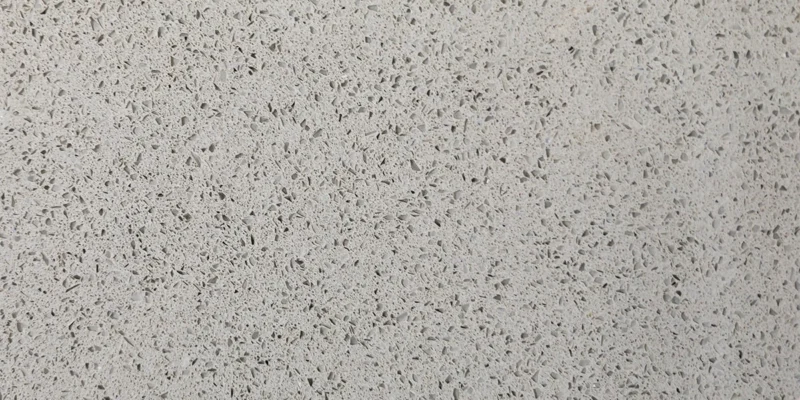
Stone Surfaces
Quartz Slab EM205
Price : Call For Price
The products are widely used in construction, decoration, medical treatment, chemical industry and other fields.


ft. |
Brand, colour collection, slab thickness, edge profile, cutouts, waterfall panels, and layout complexity |
| Quartzite | Approximately $100–$170+ per sq. ft. | Slab rarity, import costs, natural variation, vein layout, fabrication difficulty, sealing, and installation complexity |
These figures are general planning ranges rather than fixed prices. Premium quartz collections can cost more than some quartzite slabs, while rare or highly patterned quartzite can substantially exceed standard quartz pricing.
Material price is only one part of the total project cost. A straightforward perimeter layout with a standard edge and one sink opening generally costs less than a kitchen with a large island, multiple seams, waterfall panels, a full-height backsplash, or complex vein alignment.
Important cost factors include:
Professional measurement is necessary before a final quotation can be confirmed. Teccorp Stone’s countertop survey and measurement service records the final dimensions, appliance locations, wall conditions, overhangs, seams, and installation access before fabrication begins.
Quartz often provides better value for homeowners prioritizing predictable pricing, low maintenance, and broad resale appeal. Its non-porous surface reduces maintenance requirements and makes it practical for condos, rental properties, and busy family kitchens.
Quartzite may provide stronger value in luxury renovations where natural slab character, heat resistance, and visual exclusivity are central to the design. Although the initial investment and maintenance requirements can be higher, a carefully selected quartzite slab can become a distinctive architectural feature.
The better value is therefore not always the lower-priced material. It is the surface that best matches the homeowner’s intended use, maintenance tolerance, design objectives, and expected length of ownership.
Both quartz and quartzite require accurate measurement and professional fabrication. However, natural quartzite generally requires more slab inspection, cutting expertise, layout planning, and finishing work.
Quartz slabs are manufactured with relatively consistent thickness, structure, and pattern. This predictability helps fabricators plan seams, cutouts, edge profiles, and connected sections with fewer natural variations to manage.
Quartzite slabs must be inspected individually for veining, colour movement, fissures, mineral deposits, and structural characteristics. The fabricator must decide how the strongest and most visually appealing areas of the slab will be positioned across the island, perimeter countertops, backsplash, and waterfall panels.
Quartzite’s density can also make cutting, drilling, edge profiling, and polishing more demanding. Appropriate tooling and experienced fabrication reduce the risk of edge damage, uncontrolled chipping, or poor seam alignment.
For projects involving custom islands, waterfall panels, wall cladding, or other detailed stone elements, Teccorp Stone provides custom stone fabrication services using digital templating and in-house CNC equipment.
Installation planning is particularly important for Toronto condos and properties with limited access. Elevator dimensions, loading-dock schedules, building rules, narrow corridors, stairs, parking restrictions, and carrying distances can determine how large each countertop section can be.
Quartzite pieces may require additional handling because natural slabs can contain unique veins and structural characteristics. Large islands and waterfall sections must be planned around both the slab layout and the route through the building.
Quartz can also be difficult to transport when sections are oversized or contain narrow areas around sinks and cooktops. Regardless of material, identifying access restrictions before fabrication helps avoid delays, additional seams, or pieces that cannot be delivered safely.
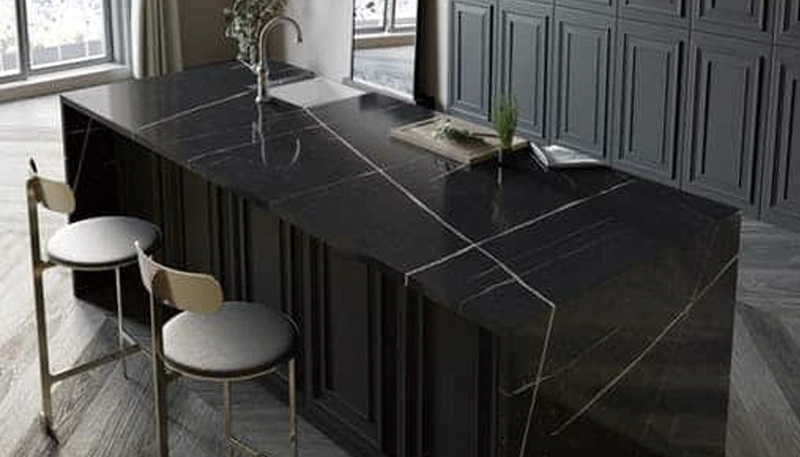
Homeowners planning a complete project can review Teccorp Stone’s kitchen countertop fabrication and installation services for Toronto and the Greater Toronto Area.
The better material depends on how the kitchen will be used, the desired appearance, the homeowner’s maintenance preferences, and the overall project budget. Quartz is usually the more practical option, while quartzite is often selected for natural beauty and premium visual impact.
Quartz is generally the better choice for homeowners who want a durable countertop with fewer ongoing maintenance requirements. It performs especially well in Toronto condos, high-traffic households, and kitchens where spills and everyday cleaning are major considerations.
Quartzite is often the stronger fit for homeowners who prioritize natural character, heat resistance, and visual exclusivity. It is especially effective in larger kitchens, custom homes, and high-end renovations where the slab becomes a central architectural element.
Yes. Quartz and quartzite can be combined within the same kitchen when the materials are selected carefully. A common approach is to use quartz on perimeter countertops for easier maintenance and quartzite on the island for natural movement and visual contrast.
This combination can work particularly well in open-concept kitchens where the island serves as a focal point. The colours, thicknesses, edge profiles, and veining should be reviewed together so the materials appear intentional rather than mismatched.
Homeowners planning a mixed-material layout can review Teccorp Stone’s kitchen island countertop service for design, fabrication, support, and installation considerations.
Quartz and quartzite can both be used for complete kitchen installations, but each material is particularly well suited to certain applications and homeowner priorities.
Quartz is often selected for waterfall islands because its controlled patterns make it easier to coordinate vertical panels with the horizontal countertop surface. Consistent colours and predictable veining can simplify visual matching across multiple sections.
Quartzite can create a more dramatic island because of its natural movement and mineral depth. However, waterfall transitions require detailed slab layout, mitred fabrication, and vein alignment. The fabricator must review the full slab before cutting to determine how the pattern will continue across each visible surface.
Large islands may also require additional slabs, structural support, or seams depending on the dimensions and available material. These requirements should be confirmed during professional measurement and slab planning.
Quartz is highly practical for perimeter countertops because it is easy to clean, resistant to staining, and available in coordinated designs for backsplashes and adjacent surfaces.
Quartzite can be used for both countertops and full-height backsplashes when the homeowner wants a continuous natural-stone installation. Pattern matching between the horizontal countertop and vertical wall surfaces can create a highly distinctive result, but it may increase slab requirements and fabrication complexity.
For homeowners considering a matching stone wall surface, Teccorp Stone also provides custom stone backsplash fabrication and installation.
Quartz is commonly used in Toronto condos because it combines low maintenance with a broad range of modern colours and patterns. Its predictable appearance also works well in compact kitchens where every visible surface contributes to the overall design.
For family homes, both materials can perform well. Quartz may be more practical for households prioritizing easy cleaning and stain resistance, while quartzite may be preferred by frequent cooks or homeowners seeking natural stone.
In luxury renovations and custom homes, quartzite is often chosen for islands, feature walls, and high-visibility surfaces. Quartz remains a strong option when the project requires consistent design across multiple rooms or a highly controlled contemporary aesthetic.
Simple Decision Rule
Choose quartz for easier maintenance, predictable design, and strong stain resistance. Choose quartzite for natural variation, stronger heat resistance, and a more distinctive luxury appearance.
Quartz is usually better for homeowners who want low maintenance, strong stain resistance, and consistent patterns. Quartzite may be better for homeowners who prefer natural stone, stronger heat resistance, and unique slab movement. Both materials can perform well when professionally fabricated and installed.
Quartzite is often more expensive because of slab rarity, import costs, natural variation, fabrication difficulty, and detailed layout requirements. However, premium quartz collections can cost more than some quartzite slabs. The final installed price depends on the exact material, slab quantity, kitchen layout, edges, cutouts, and installation conditions.
Most quartzite countertops benefit from sealing because natural stone can absorb oils and liquids. The exact maintenance schedule depends on the slab’s porosity, finish, sealer, and level of use. Homeowners should follow the fabricator’s recommendations rather than relying on a fixed schedule.
Quartzite is generally more heat-resistant than engineered quartz, but trivets are still recommended. Sudden or prolonged heat can affect sealers, seams, adhesives, and surrounding finishes even when the stone itself tolerates high temperatures.
Quartzite is more vulnerable to staining if it is not properly sealed because it is a natural porous stone. Quartz is non-porous and generally provides stronger resistance to common kitchen spills. Spills should still be cleaned promptly on both materials.
Quartz is often the more practical choice for Toronto condos because it requires less maintenance, is available in consistent designs, and works well in compact contemporary kitchens. Quartzite can also be used successfully when the homeowner prefers natural stone and the slab dimensions, delivery route, and building access are planned in advance.
Both materials can support resale value when they complement the kitchen design and are professionally installed. Quartz often appeals to a broader range of buyers because of its low maintenance and modern appearance. Quartzite may add stronger visual impact in luxury homes where natural materials and unique slab character are valued.
Quartz usually has more consistent colours and controlled patterns because it is manufactured. Quartzite typically shows natural mineral variation, deeper crystalline movement, and unique veining. Because some engineered quartz designs closely resemble natural stone, the most reliable approach is to confirm the product specification with the supplier or fabricator.
Both quartz and quartzite can provide excellent durability, appearance, and long-term value when the material is selected for the right application. Quartz is usually the stronger choice for homeowners prioritizing convenience, stain resistance, and consistent design. Quartzite is often preferred when natural beauty, heat resistance, and premium slab character are the main priorities.
Teccorp Stone helps homeowners across Toronto and the GTA compare quartz and quartzite slabs, review fabrication requirements, and select a material that fits the kitchen layout, lifestyle, maintenance expectations, and budget.
Compare Quartz and Quartzite for Your Kitchen
Send your kitchen dimensions, photographs, preferred colours, and project details to receive material guidance and a project-specific estimate.
Explore available options through the quartz countertop collection and quartzite countertop collection before requesting your estimate.