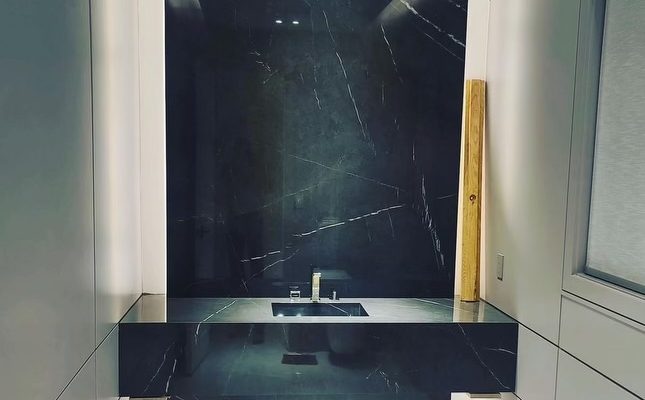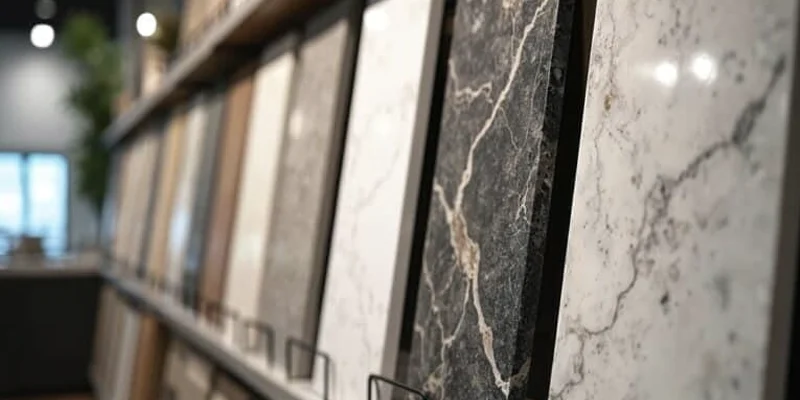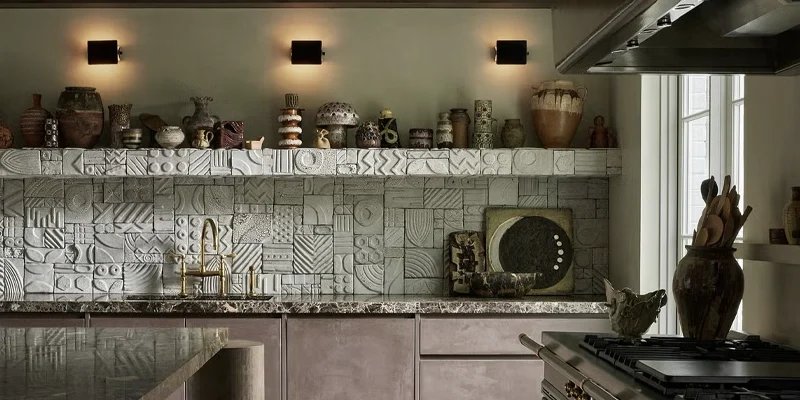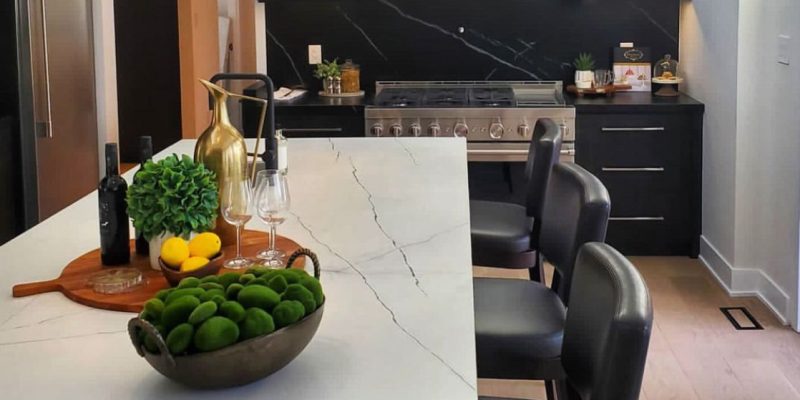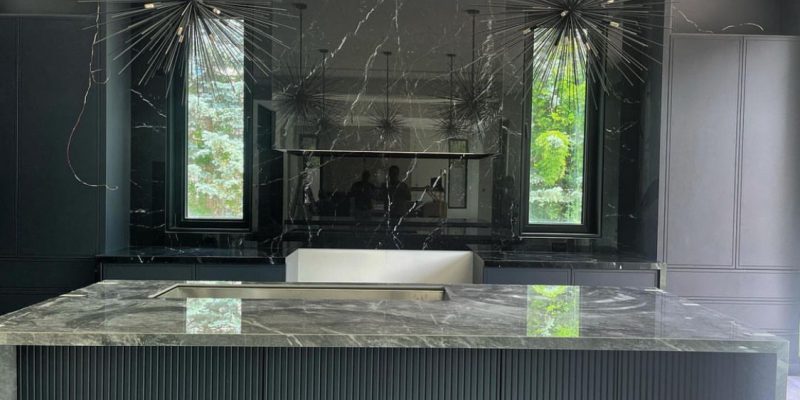
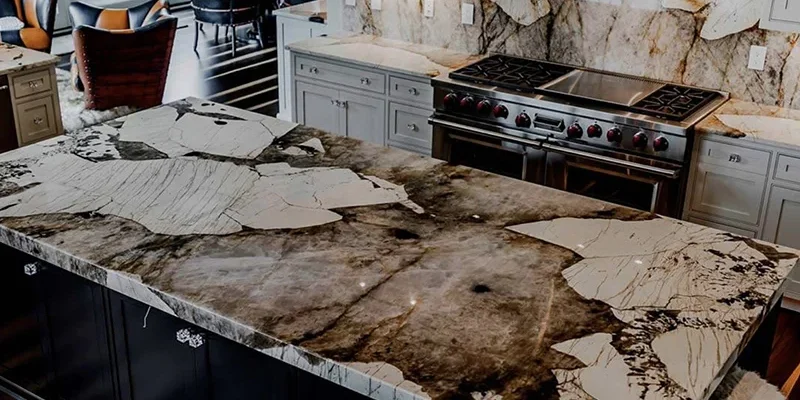
Stainless steel vs granite countertops is a comparison between two fundamentally different surface systems: fabricated metal designed for controlled performance and natural stone selected for its unique mineral character. Both can work in residential kitchens, but they respond differently to heat, scratches, impact, moisture, noise and everyday wear.
Stainless steel is non-porous, moisture-resistant and commonly associated with professional kitchens. It can support welded corners, raised backsplashes and integrated sink details in selected custom projects. However, it also develops scratches, fingerprints, water marks and a visible patina through normal use.
Granite provides stronger resistance to routine scratching, natural slab variation and excellent heat tolerance. It will not dent like sheet metal, but exposed edges and narrow sections around sink or cooktop openings may chip under concentrated impact.
The better option depends on whether the kitchen prioritizes commercial-style performance, natural-stone appearance, surface renewal, noise control or broad residential appeal.
Quick Answer
Choose stainless steel when moisture performance, easy sanitation, integrated fabrication and an industrial appearance are the priorities. Choose granite when natural slab character, stronger scratch resistance, lower noise and broad residential design compatibility matter more.
Stainless steel and granite can both provide long-term kitchen performance, but the materials should not be judged by durability alone. Their appearance, fabrication methods and visible aging are significantly different.
| Comparison Factor | Stainless Steel Countertops | Granite Countertops |
|---|---|---|
| Material Type | Fabricated metal sheet formed over or supported by an appropriate structure | Natural stone cut and fabricated from individual slabs |
| Appearance | Industrial, professional and visually uniform | Natural mineral movement with unique slab variation |
| Heat Performance | Strong at the metal surface, but heat can transfer to backing, joints and nearby components | Strong natural heat tolerance; trivets remain recommended |
| Scratches | Scratches readily and develops a visible patina | Generally highly resistant to ordinary scratching |
| Impact Damage | May dent, crease or deform under concentrated impact | Does not dent, but corners and cut-out edges may chip |
| Water Performance | Non-porous and highly suitable for wet work zones when fabricated correctly | Suitable for sink areas; absorption and sealing needs vary by slab |
| Cleaning | Easy to clean, but fingerprints and water marks may remain visible | Straightforward with natural-stone-safe products |
| Seams and Joints | May use welded or mechanically joined sections depending on fabrication | Uses fitted stone seams influenced by slab pattern and access |
| Noise | Can sound louder when cookware contacts the surface | Dense and generally quieter during ordinary use |
| Best Suited For | Dedicated prep zones, modern kitchens and professional-style applications | Residential kitchens, feature islands and natural-stone designs |
Stainless steel offers the clearest advantage where sanitation, moisture control and custom metal fabrication are central to the project. Granite offers the stronger balance of natural appearance, scratch resistance, lower noise and broad residential compatibility.
A stainless steel countertop is a fabricated metal surface formed from sheet material and installed over or around a supporting structure. Unlike granite, it is not a thick solid slab throughout the complete countertop depth.
The final performance depends on the complete fabrication system, including:
Two countertops described simply as “stainless steel” may perform very differently when these specifications are not the same.
Stainless steel contains alloying elements that improve corrosion resistance, but performance varies by grade and environment. A residential countertop should be selected according to its intended exposure, cleaning routine and fabrication system rather than appearance alone.
Fabrication quality affects:
Thin sheet material or insufficient backing may sound hollow and show deformation more easily than a properly supported custom counter.
Depending on the fabricator and selected system, stainless steel may support:
These features are not automatically included in every stainless steel countertop. They increase fabrication complexity and should be confirmed before pricing or measurement.
Stainless steel does not retain a perfectly untouched showroom appearance during normal use. Fine scratches, directional marks and changes in reflectivity gradually create a patina.
This aging may be acceptable—or even desirable—in a professional-style kitchen. Homeowners expecting a permanently flawless reflective surface may find the visible wear disappointing.
Stainless Steel Selection Rule
Do not compare stainless steel countertops by material name alone. Grade, gauge, finish, backing and fabrication details determine how the completed surface looks, sounds and performs.
Granite is a natural stone quarried in large blocks, cut into slabs and fabricated according to the kitchen layout. Each slab contains its own mineral distribution, colour movement and natural characteristics.
Unlike stainless steel, granite provides substantial thickness and rigidity as a stone component. It does not bend or dent, but this rigidity means that concentrated impact can damage vulnerable edges and narrow sections.
Granite should not be described as completely scratch-proof, stain-proof or chip-proof. Its performance depends on the selected slab, finish, fabrication details and support conditions.
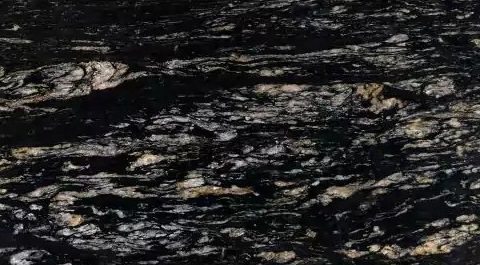
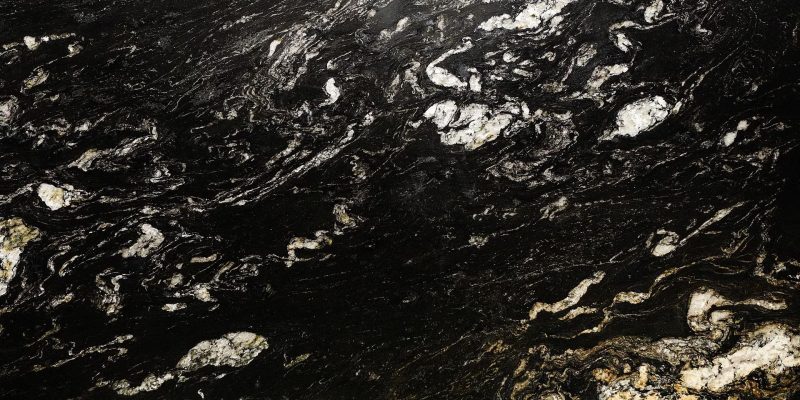
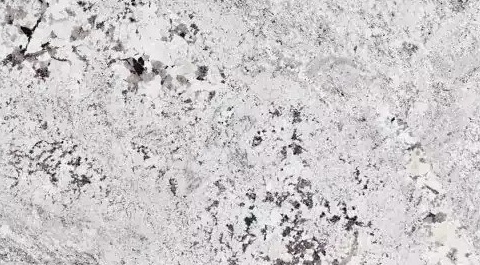
Granite does not provide the uniform appearance of fabricated stainless steel. Veining, mineral fields, colour transitions and natural characteristics may change across the slab.
The full slab should be reviewed before fabrication, especially when the project includes:
Pattern layout should direct the most visually important slab areas toward focal surfaces rather than removing them unnecessarily for openings.
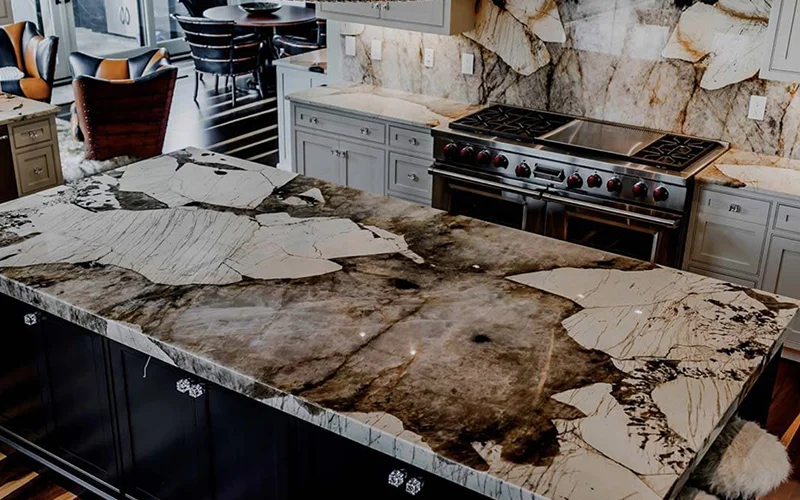
Some granite countertops may benefit from sealing, but the need and frequency depend on:
Sealer helps reduce liquid absorption. It does not create granite’s scratch resistance or make the stone completely immune to staining.
Browse TecCorp Stone’s granite countertop collection to compare full-slab movement, finish and suitability for the intended layout.
Neither material has one reliable universal price per square foot. Stainless steel cost is heavily influenced by fabrication details, while granite cost depends on the actual slab and complete stone-production scope.
A stainless steel quotation may be affected by:
A basic stainless steel sheet over a simple substrate should not be compared directly with a custom welded counter containing an integrated sink and backsplash.
Granite pricing may be affected by:
Common granite may cost less than highly customized stainless steel, while rare natural stone can cost more than a straightforward metal countertop. The material name alone does not determine the final project price.
For a more detailed explanation of natural-stone pricing, review the guide to granite countertop cost and material levels.
| Cost Component | Stainless Steel | Granite |
|---|---|---|
| Primary material variable | Grade, gauge and finish | Stone variety, slab level and availability |
| Fabrication complexity | Welding, bending, backing and integrated components | Cutting, polishing, edges, openings and seams |
| Sink integration | May be welded or separately installed | Usually a separate undermount or top-mount component |
| Long-term appearance | Patina and scratches become part of the surface | Natural pattern remains stable; chips may require stone repair |
TecCorp Stone fabricates and installs granite and other stone countertop surfaces. Stainless steel is discussed here as a comparison option, and its supply or custom fabrication scope should be confirmed separately.
Cost Comparison Rule
Compare the complete fabrication and installation system. Stainless steel pricing depends on metal specifications and custom details, while granite pricing depends on the selected slab and stone-fabrication scope.
Stainless steel and granite both tolerate kitchen heat better than many resin-based countertop materials, but their performance comes from different construction systems.
The metal surface itself can tolerate substantial heat, which is one reason stainless steel is widely used in professional food-preparation environments. However, a residential stainless steel countertop is usually more than a sheet of exposed metal.
Its complete construction may include:
Heat can transfer rapidly through the metal and affect these underlying or adjacent components. Direct contact with very hot cookware may also create temporary discolouration, distortion or stress depending on the sheet thickness, backing and fabrication method.
Trivets should therefore be used beneath hot pots, pans and heat-producing appliances even when the visible metal surface appears highly heat-resistant.
Granite generally provides excellent natural surface-heat tolerance. It is less vulnerable to resin-related heat damage than engineered quartz and does not transfer heat as rapidly as exposed metal.
However, trivets remain recommended to protect:
Granite’s heat performance is a practical advantage for cooking zones, but the complete installation should not be treated as indestructible.
Heat Performance Summary
Both materials tolerate kitchen heat well, but trivets remain appropriate. Stainless steel transfers heat quickly to its supporting system, while granite can place stress on seams, sealers and vulnerable sections.
The most important durability difference is how each material responds to impact and visible surface wear.
Stainless steel scratches more readily than granite. Fine lines may appear from cookware, utensils, cleaning pads and objects dragged across the surface.
On a brushed finish, scratches that follow the existing grain may be less noticeable. Marks running across the finish direction can appear more prominent.
Over time, repeated use creates a patina—a broader pattern of fine scratches and changes in reflectivity. This can produce a practical professional appearance, but it may disappoint homeowners expecting the countertop to remain visually untouched.
Concentrated impact may dent or deform stainless steel, particularly when the sheet is thin or inadequately supported.
Vulnerable areas may include:
Some shallow dents may be repairable, but access to the underside, sheet construction and finish can affect the result. A repaired area may not regain its exact original reflectivity.
Granite generally offers stronger resistance to routine scratching. Ordinary kitchen utensils are less likely to mark the surface, although abrasive minerals and improper tools can still cause damage.
Granite does not dent. Instead, concentrated impact may chip:
Minor chips may be repaired with stone-specific products, but visibility depends on the granite colour, mineral pattern and damage location.
Neither material wins every type of impact comparison:
The better choice depends on which form of visible wear the homeowner is more prepared to accept.
Stainless steel is non-porous and does not absorb water, oil or food liquids into the metal surface. This makes it suitable for wet preparation zones when the countertop is fabricated and installed correctly.
However, moisture-related performance still depends on:
Water entering beneath the metal through a failed joint or seal may affect the substrate even though the stainless steel itself remains non-porous.
Granite can perform well around sinks and preparation zones, but absorption varies by slab. Some granite varieties may benefit from an appropriate penetrating sealer.
Sealing may reduce liquid absorption, but it does not make the countertop completely stain-proof or remove the need to clean spills promptly.
Sink-area performance also depends on:
Stainless steel can be cleaned and disinfected effectively because the surface is non-porous and does not contain natural fissures. This does not mean it is automatically hygienic without proper cleaning.
Granite can also provide a suitable food-preparation surface when it is maintained, cleaned correctly and treated appropriately for the selected slab.
Hygiene depends more on:
Neither material should be marketed as inherently antibacterial without product-specific evidence.
Stainless steel requires homeowners to accept a more visible pattern of daily use than most granite surfaces.
Fingerprints, oils and cleaning streaks can be noticeable, especially on reflective or smooth metal finishes. Brushed finishes generally conceal some marks more effectively, but they do not eliminate them.
Repeated wiping may be necessary in highly visible areas such as:
Water droplets may leave visible mineral marks after drying. This is especially noticeable in areas with hard water or where the surface is not dried after cleaning.
Regular wiping with a soft cloth can reduce buildup.




Patina is the gradual visual change created by scratches, polishing marks and everyday contact. It is not necessarily a performance failure.
For some homeowners, patina gives the surface an authentic professional-kitchen character. For others, it creates an appearance that feels constantly marked or unfinished.
Granite usually conceals fingerprints and fine surface marks more effectively because of its colour, mineral movement and lower reflectivity.
Highly polished dark granite may still show dust, water spots and smudges, but the surface does not develop the same directional scratch pattern as stainless steel.
| Visible Condition | Stainless Steel | Granite |
|---|---|---|
| Fingerprints | Frequently visible | Depends on colour and finish |
| Fine scratches | Common and contribute to patina | Less common in ordinary use |
| Water spots | Often noticeable | More visible on dark polished stone |
| Long-term aging | Develops directional patina | Natural pattern remains visually dominant |
Stainless steel should generally be cleaned with a soft cloth, mild detergent and water. The surface should then be dried to reduce streaks and mineral marks.
For brushed finishes, wiping should follow the grain direction.
Avoid:
Rust-coloured marks do not always mean the stainless steel itself has failed. External iron particles from tools, steel wool or other objects may contaminate the surface and produce visible staining.
Granite should be cleaned with a soft cloth and a product suitable for natural stone. Mild soap and water may be appropriate for routine care when residue is removed properly.
Avoid:
Some granite may benefit from resealing, while other slabs absorb very little. The need should be assessed according to the actual material and finish.
Stainless steel does not require sealing and can be cleaned effectively, but it may require frequent wiping to maintain a uniform appearance.
Granite may need less cosmetic attention during daily use because it conceals fingerprints and fine marks more effectively, although selected slabs may require occasional sealing.
The distinction is therefore:
Stainless steel countertops may be formed from one sheet or several fabricated sections. Joint appearance depends on:
A well-finished weld may appear smooth and continuous, but it should not automatically be described as invisible. Changes in reflection, grain direction or polishing may reveal the joint.
One major advantage of custom stainless steel fabrication is the possibility of welding the sink to the countertop.
This can:
Integrated sinks increase fabrication complexity and may require specialist metalwork. Bowl dimensions, drainage, sound control and cabinet fit should be confirmed before production.
Granite pieces are joined with fitted stone seams. Their visibility depends on:
A granite seam should not be expected to become completely invisible, especially in strongly veined or high-contrast stone.
Granite commonly supports undermount and top-mount sinks. The sink remains a separate component and requires appropriate support, sealant and cut-out fabrication.
The exact sink model and template should be confirmed before countertop production.
Stainless steel can create a louder and more resonant work surface when cookware, utensils or appliances contact the counter.
Sound performance depends on:
A properly backed stainless steel countertop can sound substantially more solid than unsupported or poorly bonded sheet material.
Granite is dense and generally produces less vibration or metallic resonance. Impact sounds may still be sharp, but the surface usually feels and sounds more substantial during everyday residential use.
Sound-Control Rule
For stainless steel, evaluate the complete backing and insulation system—not only the visible metal. Sheet thickness alone does not determine noise performance.
Stainless steel and granite create very different visual effects in a residential kitchen. Stainless steel introduces a professional, industrial and highly reflective character. Granite adds natural movement, depth and a broader range of colours and finishes.
Stainless steel may work well in:
The metal surface should be coordinated carefully with appliances. A near-match in finish may still appear different because of grain direction, reflectivity and surrounding light.
Large areas of stainless steel can make a residential kitchen feel colder or more commercial. Wood cabinetry, warm flooring, textured backsplashes or softer lighting can help balance the appearance.
Granite supports a wider range of residential design styles, including traditional, transitional, contemporary and luxury kitchens.
It may be the stronger choice when:
Granite can appear quiet and restrained or highly dramatic depending on the slab. The full material should therefore be reviewed beside the cabinet, flooring and backsplash selections.
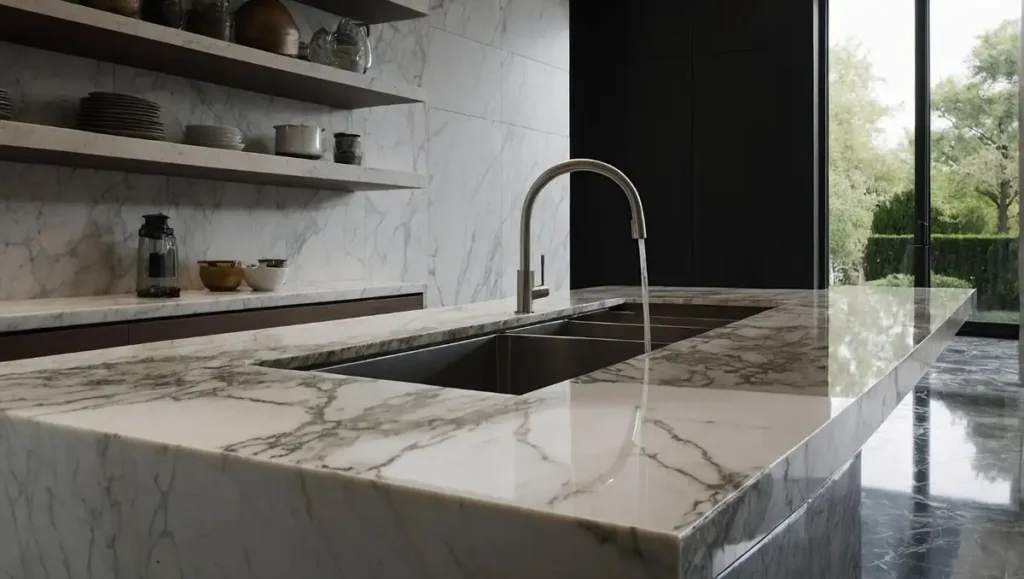
Granite generally has broader residential design compatibility because it is available in many colours, patterns and finishes. Stainless steel creates a more specialized appearance and works best when the industrial character is intentional.
Design Rule
Choose stainless steel because its professional appearance suits the complete kitchen—not only because it coordinates with stainless appliances.
Both materials require accurate measurement and specialized fabrication, but their installation systems are different.
A stainless steel countertop may be lighter than a full granite slab, but its performance depends heavily on the supporting system beneath the metal.
Installation planning should confirm:
Poor backing can allow vibration, denting or hollow sound even when the visible metal specification appears appropriate.
Granite is heavy and rigid. Cabinets should be secured, level and suitable for the selected slab, openings and overhangs before final measurement.
The installation plan should consider:
The countertop should not be expected to correct moving or uneven cabinets.
For both materials, the exact sink, faucet, cooktop and appliance specifications should be confirmed before fabrication.
Late changes may affect:
Review TecCorp Stone’s countertop survey and measurement service when planning granite surfaces, openings, seams and installation access.
A mixed-material kitchen can use stainless steel and granite in different locations rather than selecting one material for every surface.
Stainless steel may be appropriate for:
Limiting stainless steel to a specific work area can preserve its functional advantages without making the complete kitchen feel overly commercial.
Granite may be better for:
Granite generally provides a quieter and warmer-feeling surface for seating and social areas.
A successful mixed-material design should consider:
The two surfaces should serve different functional roles while remaining visually connected.
Granite is generally the more balanced option for a busy residential kitchen because it conceals everyday marks more effectively and provides broad design compatibility.
Stainless steel may still be valuable in a dedicated prep or sink zone where easy cleaning and moisture performance are the main priorities.
Both materials can perform well in active cooking areas. Stainless steel provides a professional work surface, while granite offers strong heat tolerance with lower visible scratching.
Trivets should still be used on both surfaces.
Stainless steel can support a highly controlled industrial or minimalist design. Granite may be preferred when the minimalist space still needs natural texture and visual depth.
Granite often has broader residential familiarity and may be easier to coordinate with different buyer preferences. Stainless steel is more design-specific and should be used where its professional appearance suits the architecture and target market.
Neither material should be assumed to guarantee a specific increase in property value. Cabinet quality, layout, colour selection and fabrication usually influence buyer response as much as the material name.
Not universally. Stainless steel is better for non-porous metal performance, integrated fabrication and professional-style work zones. Granite is better for natural appearance, stronger scratch resistance and broad residential use.
Yes. Fine scratches are common and gradually form a visible patina. Brushed finishes may conceal some marks better than reflective finishes.
They can dent or crease under concentrated impact, especially when the sheet is thin or inadequately supported.
Yes. Exposed corners, sink edges, cooktop openings and unsupported sections may chip under severe impact.
Stainless steel is non-porous and easy to sanitize, but fingerprints and water marks may require frequent wiping. Granite is also straightforward to clean with suitable natural-stone products and may conceal visible marks more effectively.
Both provide strong heat performance. Granite does not transfer heat as rapidly as metal, while stainless steel can conduct heat to backing and surrounding components. Trivets are recommended for both.
Yes, selected custom systems can include a welded sink or drainboard. Availability depends on the fabricator, dimensions and project scope.
Some granite may benefit from sealing, but the need depends on slab absorption, finish and existing treatment. A universal schedule should not be assumed.
Yes. Stainless steel can serve as a dedicated prep or sink zone, while granite can be used for the main island or residential perimeter counters.
TecCorp Stone specializes in granite and other stone countertop fabrication and installation. Stainless steel is included here as a comparison material, and its supply or fabrication scope should be confirmed separately.
Choose stainless steel when non-porous performance, integrated metalwork and professional-kitchen character are central to the design. Choose granite when natural slab variation, scratch resistance, lower noise and residential versatility are more important.
Some kitchens may benefit from combining the two materials, but each surface should be assigned according to its actual function, appearance and maintenance expectations.
Considering Granite for Your Kitchen?
Share your kitchen dimensions, cabinet layout and preferred slab style to review granite options for islands, perimeter counters and high-use residential surfaces.
Discuss Your Countertop Project
Explore Kitchen Countertop Services