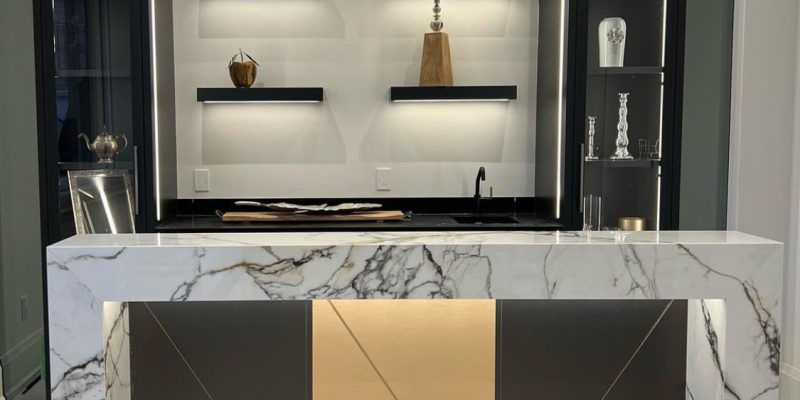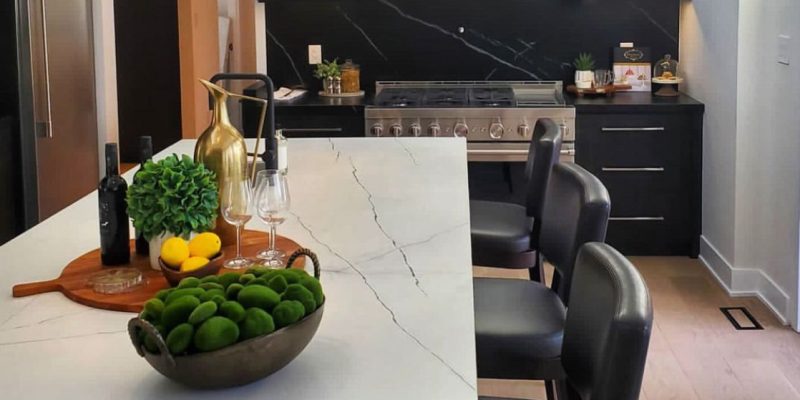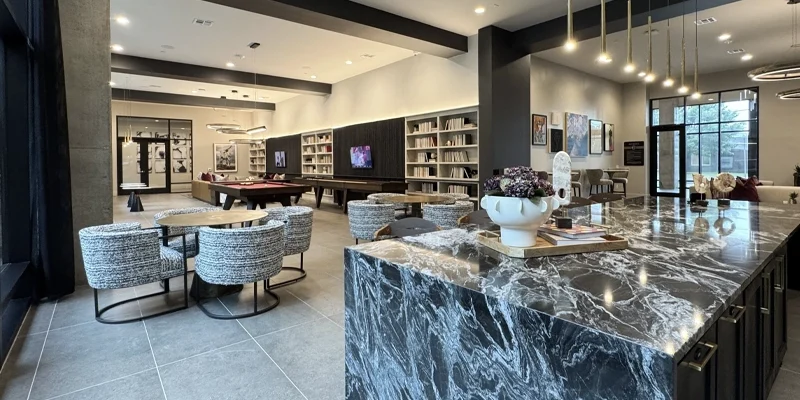
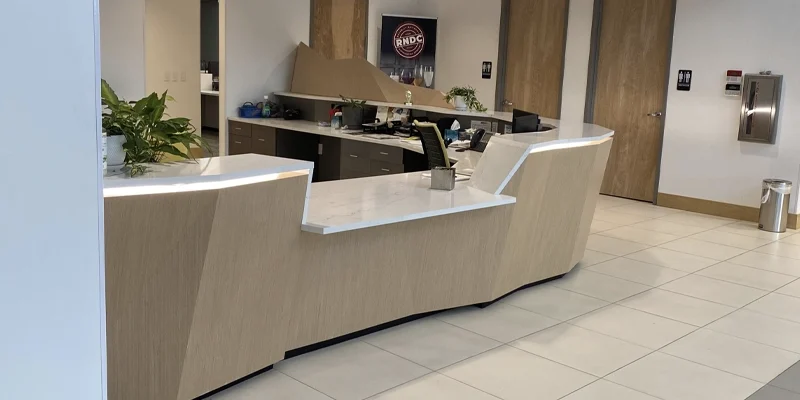
Choosing the best healthcare countertop materials is not simply a matter of ranking quartz, solid surface, porcelain or natural stone from best to worst. Hospitals, clinics, dental offices, medical practices and other healthcare environments can contain very different work zones, cleaning protocols and surface requirements.
A reception counter, exam-room work surface, staff kitchenette and clinical sink area may all require different combinations of cleanability, seam control, chemical compatibility, repairability and fabrication detail. The appropriate material should therefore be selected for the specific application rather than described as universally “medical grade.”
This guide compares the principal countertop materials used or considered for healthcare environments and explains where solid surface, quartz, porcelain, natural stone and alternative materials may fit within a facility specification.
Healthcare Surface Principle: Select the countertop according to the facility zone, cleaning and disinfection procedures, expected use, fabrication details and the technical guidance for the exact product. Material category alone does not establish suitability for every healthcare application.
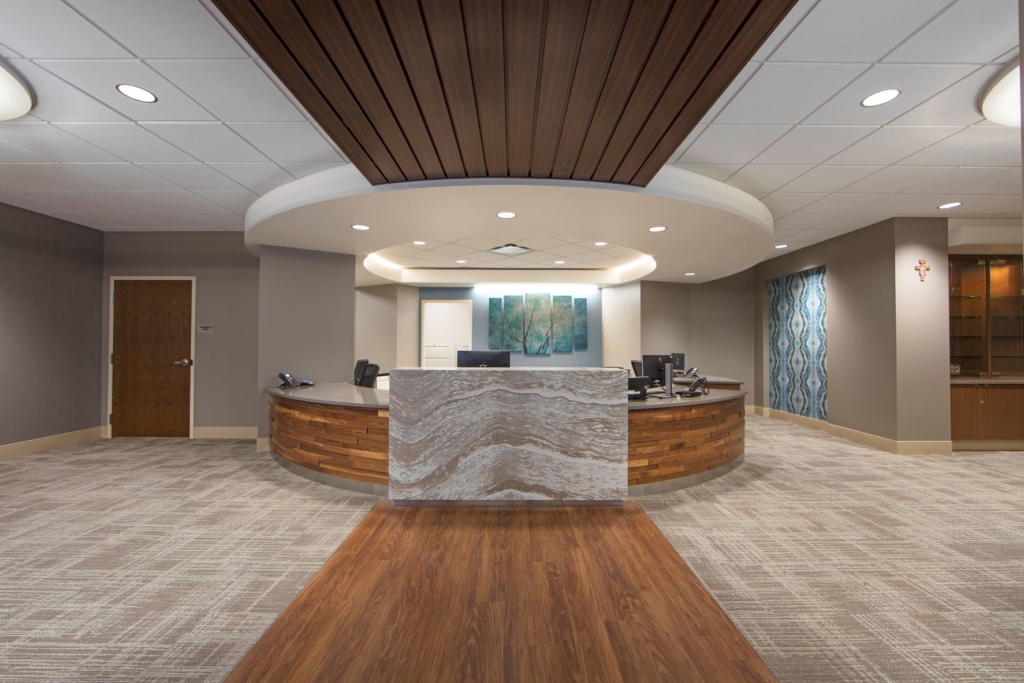
Healthcare surface selection starts with cleanability. Countertops can become frequently touched environmental surfaces, particularly at reception desks, charting stations, exam rooms and other active work areas. A surface that is difficult to clean, damaged, highly absorbent or interrupted by difficult-to-maintain details can complicate routine environmental cleaning.
The countertop should have a surface that can be cleaned and disinfected according to the healthcare facility’s procedures. This requires more than choosing a material marketed as hygienic.
The selected surface and its finished details should allow staff to reach and clean normal contact areas without unnecessary cracks, damaged edges or inaccessible transitions. The disinfectants used by the facility should also be compatible with the exact countertop product and finish.
Healthcare cleaning products vary in formulation and intended use. Manufacturer instructions for both the surface and the disinfectant should therefore be reviewed rather than assuming that every countertop tolerates every chemical or concentration.
Smooth, nonporous or low-absorption surfaces can simplify cleaning because liquids and contaminants are less likely to enter the material itself. However, porosity is only one part of the specification.
A low-absorption countertop can still become difficult to maintain if the installation has damaged joints, failing sealant, poorly detailed cutouts or inaccessible transitions. The complete finished surface should therefore be considered alongside the material characteristics.
Reducing unnecessary joints can make a healthcare work surface easier to maintain. This is one reason solid surface is frequently considered in healthcare applications: compatible products can be fabricated with visually inconspicuous seams and integrated components such as sinks or backsplashes.
That does not mean all healthcare countertops must be completely seamless. Quartz, porcelain and other slab materials may require planned seams according to slab size, geometry and installation access. The goal is to position and finish those joints appropriately for the intended environment rather than making unsupported “seamless” claims.
Healthcare counters may experience repeated contact with equipment, containers, paperwork, cleaning tools and daily facility activity. Surface durability should therefore reflect the actual use of each zone.
Repairability can also matter. A material that can be restored after certain types of surface damage may offer a different maintenance strategy from a slab product where a damaged edge or component requires another repair approach.
No material is immune to damage. Impact resistance, scratching, heat response and repair methods vary between products and should be reviewed according to the manufacturer’s technical information.
Terms such as “chemical resistant” should not be interpreted as resistance to every disinfectant indefinitely. Compatibility depends on the selected product, cleaner or disinfectant, concentration, contact time and cleaning procedure.
For healthcare projects, the specification team should compare the facility’s cleaning protocol with the technical guidance for the proposed countertop surface before final approval.
Specification Rule: Do not select a healthcare countertop from a generic claim such as “antibacterial,” “hospital-grade” or “chemical-proof.” Verify the exact surface, fabrication details and compatibility with the facility’s cleaning and disinfection procedures.
The phrase hospital-grade countertop is useful as a search and project-planning term, but it should not be treated as one universal certification that automatically applies to a particular countertop material.
In practice, a healthcare surface specification may consider characteristics such as:
The appropriate standard can also differ according to the healthcare zone. A patient-care work surface, public reception desk, staff room counter and specialized laboratory area should not automatically receive the same material specification.
For this reason, the question is better framed as:
“Which countertop system best meets the requirements of this healthcare application?”
That approach allows solid surface, quartz, porcelain and other materials to be compared on relevant project criteria instead of relying on a broad “hospital-grade” label.
| Material | Potential Healthcare Role | Key Advantage | Important Specification Check |
|---|---|---|---|
| Solid Surface | Clinical worktops, integrated sink areas, reception and other healthcare applications | Nonporous construction and ability to create inconspicuous seams and integrated details with suitable products | Exact product, disinfectant compatibility, heat and impact limitations |
| Quartz | Reception, medical offices, staff areas and selected clinical applications | Nonporous manufactured surface with broad design availability | Seams, heat limitations and compatibility with the required cleaners and disinfectants |
| Porcelain | Selected clinical, washroom, public and architectural applications | Low absorption and broad surface-design options | Exact product, edge fabrication, support and chemical compatibility |
| Natural Stone | Selected public-facing or lower-clinical-demand applications | Natural appearance and project-specific architectural character | Actual slab absorption, finish, sealing needs and cleaner compatibility |
| Stainless Steel | Specialized work areas and selected technical applications | Established use in demanding service environments | Application requirements, fabrication, scratches and maintenance expectations |
| Laminate | Selected administrative or lower-demand areas | Broad design availability and budget flexibility | Edges, joints, moisture exposure and compatibility with facility cleaning procedures |
No row in this table should be read as automatic approval for a healthcare facility. Final selection should reflect the exact product, the healthcare zone, fabrication details and the facility’s technical and infection-prevention requirements.
Solid surface deserves particular attention in healthcare because suitable products can combine a nonporous surface with inconspicuous bonded seams, coved transitions and integrated components such as sinks or backsplashes. These fabrication options can reduce difficult-to-clean transitions when they are properly designed and installed.
Potential applications include exam-room counters, nurse stations, dental work areas, handwashing zones, reception surfaces and other healthcare worktops where integrated fabrication is useful.
Important advantages can include:
Solid surface should still be specified product by product. Heat limits, impact behaviour, cleaning chemicals, disinfectants and repair procedures vary, so the technical documentation for the selected manufacturer should be reviewed against the facility’s actual cleaning protocol.
For a deeper look at this material category, see Solid Surface Countertops for Healthcare.
Solid Surface Principle: Its healthcare value comes from the complete fabricated system—not simply the material name. Joint design, integrated components, cleaning compatibility and workmanship all affect the finished result.
Quartz can be considered for medical offices, reception areas, staff spaces and selected healthcare work surfaces. Engineered quartz is nonporous and does not normally require routine sealing, which can simplify ongoing surface maintenance.
Quartz also provides relatively controlled colours and patterns compared with natural stone, which can be useful where several counters need to follow a coordinated interior specification.
However, quartz should not be described as automatically seamless, antimicrobial or resistant to every hospital disinfectant. Fabricated slab installations can contain seams, and the resins and other components within engineered quartz mean that chemical and heat limitations are product-specific.
Before specifying quartz for a healthcare zone, confirm:
Quartz can be a practical healthcare surface when those requirements align with the selected product, but its nonporous construction should not be interpreted as a substitute for routine cleaning and disinfection.
Porcelain slabs offer another low-absorption surface option for selected healthcare projects. Large-format porcelain can be used for counters, vanities and architectural surfaces where the chosen product, fabrication system and installation details are suitable for the application.
Porcelain should not be described generically as antibacterial. Unless the exact product carries a documented antimicrobial property supported by appropriate testing, its healthcare relevance should instead be evaluated through characteristics such as low absorption, cleanability and compatibility with the intended environment.
Specification should consider:
Porcelain can therefore be appropriate in certain washroom, public-facing, staff and clinical applications, but the complete fabricated system should be assessed rather than relying on the material category alone.
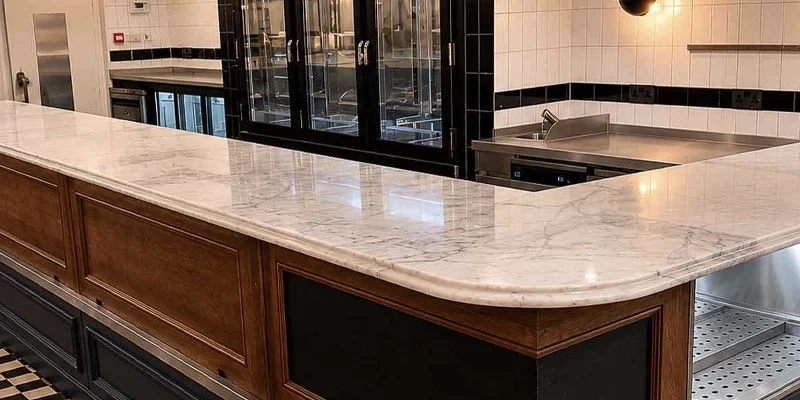
Natural stones such as granite, marble and quartzite may have a role in healthcare projects, particularly in reception areas, private offices and other architectural spaces where natural slab character is an important part of the design.
They require a more project-specific assessment for clinical work areas because absorption, fissures, finish and maintenance requirements vary between stones and even between individual slabs.
Granite can provide a durable architectural surface, but sealing requirements should not be assigned on a fixed schedule to every granite. The actual slab should be evaluated for absorption and maintenance requirements, and any sealer used should remain compatible with the facility’s cleaning procedures.
Marble can etch when exposed to acidic substances even when sealed, which can make it less suitable for some demanding work zones. Quartzite can provide greater hardness in many applications, but material sold under the quartzite category varies and the actual slab should be assessed for absorption, fissures and surface behaviour.
Natural stone is therefore better treated as a selective healthcare option rather than automatically grouped with nonporous manufactured materials.
Healthcare material comparison should also acknowledge surfaces outside Teccorp Stone’s principal slab categories.
Stainless steel is commonly evaluated for specialized technical, food-service and other demanding work areas where the relevant grade, fabrication and cleaning procedures suit the application.


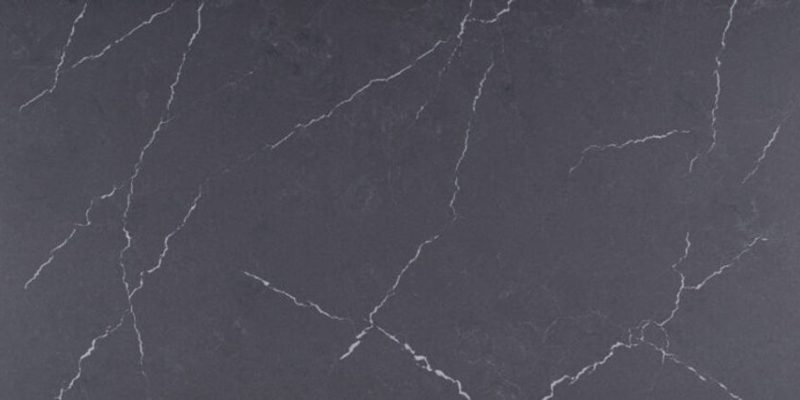


Laminate may be considered in administrative or other lower-demand areas where the facility specification allows it. Its performance depends heavily on the complete assembly, including substrate, exposed edges, joints, sinks and moisture conditions. A damaged edge or joint can create a different maintenance problem from an intact nonporous slab or solid surface.
Neither material should be selected or rejected solely by category. The healthcare zone and required cleaning protocol remain the deciding factors.
Rather than choosing one material for an entire facility, healthcare projects can evaluate surfaces by zone. The following table provides planning directions rather than automatic specifications.
| Healthcare Area | Possible Material Direction | Main Specification Priorities |
|---|---|---|
| Reception & Check-In | Solid surface, quartz, porcelain or selected natural stone | Cleanability, edge durability, accessibility and public-facing design |
| Exam & Treatment Rooms | Solid surface or another product verified for the facility protocol | Cleanability, joints, sink details, repairability and disinfectant compatibility |
| Nurse & Charting Stations | Solid surface, quartz or other approved commercial surface | Repeated contact, cleaning, equipment use, edges and cable/equipment cutouts |
| Washrooms & Vanity Areas | Solid surface, quartz or porcelain | Moisture, sink transitions, joints and cleaning access |
| Staff & Break Areas | Quartz, solid surface, porcelain or other suitable commercial surfaces | Food use, spills, heat exposure, maintenance and daily traffic |
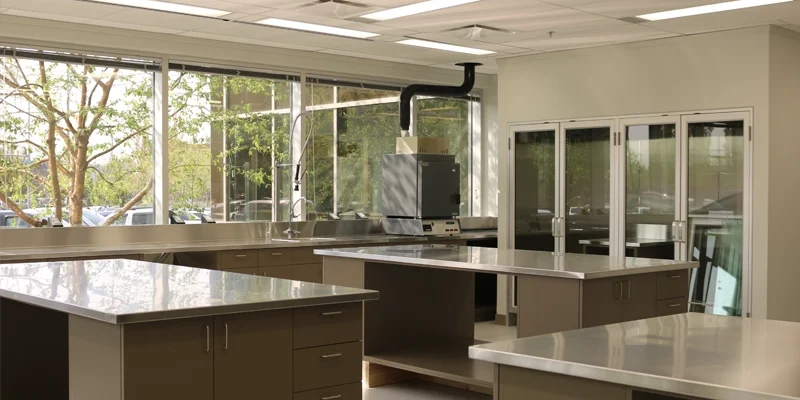
| Laboratory or Specialized Work Areas | Application-specific technical surface | Exact chemicals, equipment, heat, cleaning protocol and technical standards |
Laboratory and specialized clinical areas deserve particular caution. A surface suitable for a medical office or exam room should not automatically be specified for a laboratory where reagents, heat or specialized procedures create different exposure conditions.
When several zones are included in the same project, material selection can be coordinated through Teccorp Stone’s Healthcare Countertop Services while allowing each area to retain its own performance requirements.
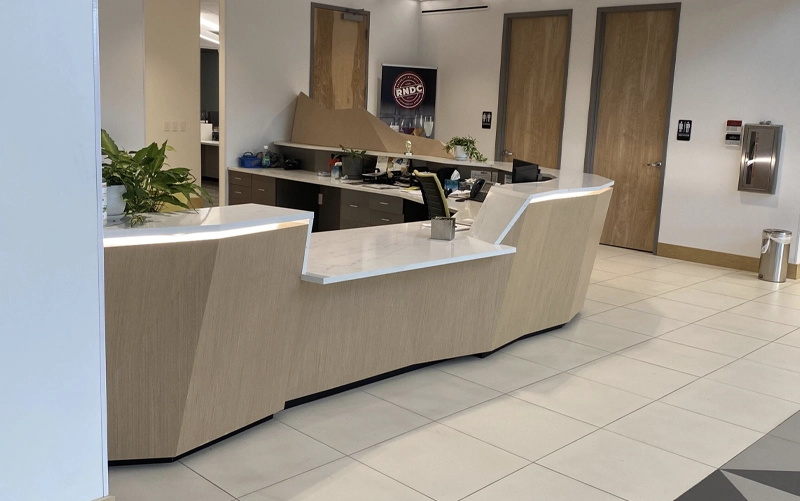
Zone-Based Selection Rule: A material that performs well at reception is not automatically appropriate for an exam room, sink area or laboratory. Select and document the surface requirements for each healthcare zone.
A countertop may be nonporous and easy to clean while still having limitations with specific chemicals. For healthcare projects, this distinction matters because cleaning and disinfection are repeated processes rather than occasional maintenance tasks.
Before a surface is approved, the project team should compare the facility’s cleaning and disinfection procedures with the technical guidance for the exact product. Relevant variables can include the disinfectant chemistry, concentration, contact time, frequency of use and the surface manufacturer’s care instructions.
This is more reliable than choosing a countertop because it is described generically as “antibacterial,” “hygienic” or “hospital-grade.” Unless an antimicrobial property is specifically documented for the selected product, nonporous construction should be discussed as a cleanability characteristic rather than an antimicrobial claim.
The same principle applies to natural stone. A sealer may reduce absorption in an appropriate stone, but it does not convert the surface into an antimicrobial material or make it compatible with every disinfectant.
Disinfection Compatibility Rule: Verify the selected countertop product against the facility’s actual cleaning and disinfection protocol. Do not infer chemical or antimicrobial performance from the material category alone.
Material selection is only part of a healthcare countertop specification. The way the surface is measured, fabricated and joined can affect how practical it is to clean, maintain and use within the finished space.
Unnecessary joints should be avoided where the material and project geometry allow, particularly around frequently cleaned work areas. Where seams are required, their position should reflect slab dimensions, support, access and the function of the healthcare zone.
Solid surface can offer inconspicuous bonded seams with compatible systems, while quartz, porcelain and natural-stone slab installations normally require different seam strategies. These materials should not be presented as identical simply because all can be fabricated into countertops.
Sink and backsplash details deserve particular attention because changes in level, exposed rims and difficult transitions can affect routine cleaning.
Depending on the selected system, healthcare fabrication may incorporate:
Solid surface can provide integrated sink and backsplash options with suitable products. Slab materials such as quartz and porcelain use different fabrication and installation methods, so the detail should be selected according to the material rather than copied from another surface system.
Medical worktops may need to coordinate with sinks, dispensers, cabinetry, equipment, electrical components or other built-in features. Cutouts should be planned before fabrication so clearances, support and cleaning access are understood.
Edge profiles should also reflect the application. Public counters, patient-facing areas and staff workstations may have different accessibility, impact and ergonomic requirements.
Project-specific fabrication can be coordinated through Teccorp Stone’s Custom Stone Fabrication service.
There is no universal winner for every healthcare facility. A more useful decision process is to begin with the application and eliminate materials that do not meet its requirements.
| If the Project Prioritizes… | Material to Evaluate | Still Confirm |
|---|---|---|
| Integrated sinks, coved details and inconspicuous seams | Solid surface | Exact product, disinfectants, heat, impact and fabrication system |
| Nonporous slab surface with broad colour and pattern options | Quartz | Seams, disinfectant compatibility, heat and edge conditions |
| Low-absorption architectural slab surface | Porcelain | Product specifications, edge fabrication, support, cutouts and cleaners |
In practice, larger medical facilities may use more than one material. The appropriate strategy is not necessarily to standardize every countertop, but to establish clear requirements for each healthcare zone and then select surfaces that meet them.
There is no single best material for every healthcare environment. Solid surface, quartz, porcelain and other surfaces should be compared according to the healthcare zone, cleaning procedures, fabrication requirements and technical documentation for the exact product.
It is better treated as a performance-oriented project term than as a universal countertop certification. Cleanability, nonporosity, durability, seams, repairability, chemical compatibility and facility-specific requirements should be evaluated separately.
Suitable solid surface products can work well in healthcare applications because they are nonporous and can support inconspicuous seams and integrated components. Product-specific cleaning, disinfectant, heat and impact requirements still need to be reviewed.
Quartz can be considered for reception areas, medical offices, staff spaces and selected healthcare work surfaces. Its suitability depends on the exact product, seam layout, cleaning protocol, heat exposure and other application requirements.
Not automatically. Nonporosity can make a surface easier to clean by limiting liquid absorption, but an antibacterial or antimicrobial claim requires product-specific evidence rather than an assumption based on porosity.
Yes, in selected applications. The actual slab, absorption, finish, sealing requirements and cleaning compatibility should be reviewed. Natural stone may be better suited to some public-facing or lower-clinical-demand areas than to applications requiring frequent aggressive cleaning.
The answer depends on the laboratory’s chemicals, equipment, heat exposure, cleaning procedures and technical requirements. A general healthcare material recommendation should not replace an application-specific laboratory specification.
The best healthcare countertop specification starts with the work being performed on the surface. Cleanability, disinfection procedures, seams, sinks, chemical exposure, repair requirements and daily use should be defined before one material is declared the preferred option.
For hospitals, clinics, dental practices, medical offices and other healthcare projects in Toronto and the GTA, Teccorp Stone can review material and fabrication requirements through its Healthcare Countertop Services.
Planning a Healthcare Countertop Project?
Share the facility type, countertop locations, drawings, preferred materials and cleaning requirements for a project-specific review.