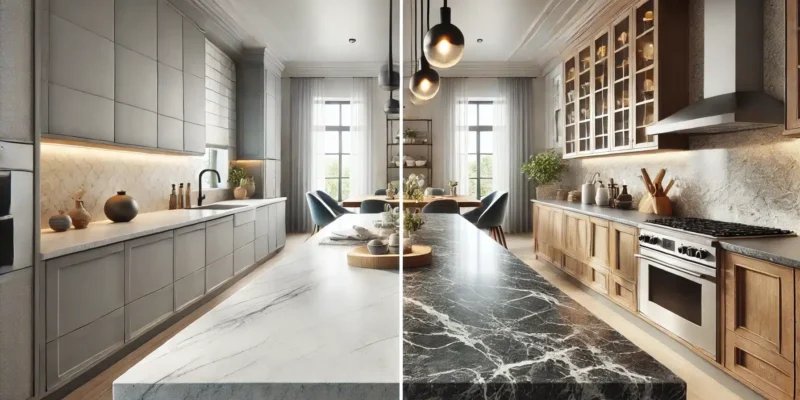
Engineered stone vs natural stone countertops is an important comparison for homeowners choosing between a manufactured surface with controlled designs and a naturally formed slab with individual mineral variation.
In residential countertop discussions, engineered stone most commonly refers to quartz-based surfaces manufactured from mineral components, binders and pigments. Natural stone includes materials such as granite, marble and quartzite, each with its own appearance, porosity, mineral structure and maintenance requirements.
The comparison should not be reduced to engineered stone being practical and natural stone being luxurious. Both categories include a wide range of products, and their performance depends on the specific material, finish, fabrication, installation and way the countertop will be used.
This guide compares engineered and natural stone countertops by appearance, consistency, staining, heat, maintenance, fabrication and everyday kitchen use. It also explains why granite, marble and quartzite should not be treated as though they provide identical performance.
Quick Comparison
Choose engineered stone when controlled pattern, relatively low absorption and no routine sealing are major priorities. Choose natural stone when individual slab variation, mineral depth and natural geological character matter more. Final performance depends on the exact product or slab rather than the category name alone.
The following table provides a general comparison. Natural stone performance varies significantly between granite, marble and quartzite, while engineered products vary by manufacturer, composition and finish.
| Comparison Factor | Engineered Stone | Natural Stone |
|---|---|---|
| Material Origin | Manufactured from mineral components, binders, pigments and other product-specific materials | Quarried geological material cut and finished into slabs |
| Appearance | Controlled colours and repeatable design families | Individual mineral patterns, veining and natural variation |
| Consistency | Generally more predictable between samples and slabs | Variation can be substantial within one slab and between slabs |
| Water Absorption | Quartz-based products generally have low absorption | Depends on the stone, mineral structure and finish |
| Routine Sealing | Quartz surfaces generally do not require routine sealing | Some slabs may benefit from sealing based on absorption and use |
| Heat | Binders and pigments can be vulnerable to concentrated heat | Stone body may tolerate heat well, but finish, seams and rapid temperature change still matter |
| Staining and Etching | Low absorption helps with many spills, but products can still mark or discolour | Granite, marble and quartzite respond differently; marble is particularly sensitive to acidic etching |
| Scratch Behaviour | Resistant to ordinary use but not scratch-proof | Varies by mineral hardness, finish and stone type |
| Slab Approval | Large samples or full slabs remain useful for reviewing pattern scale | Actual slab review is important because every slab is individual |
| Outdoor Use | Only when the exact product is approved for exterior applications | Depends on stone absorption, exposure, finish and installation conditions |
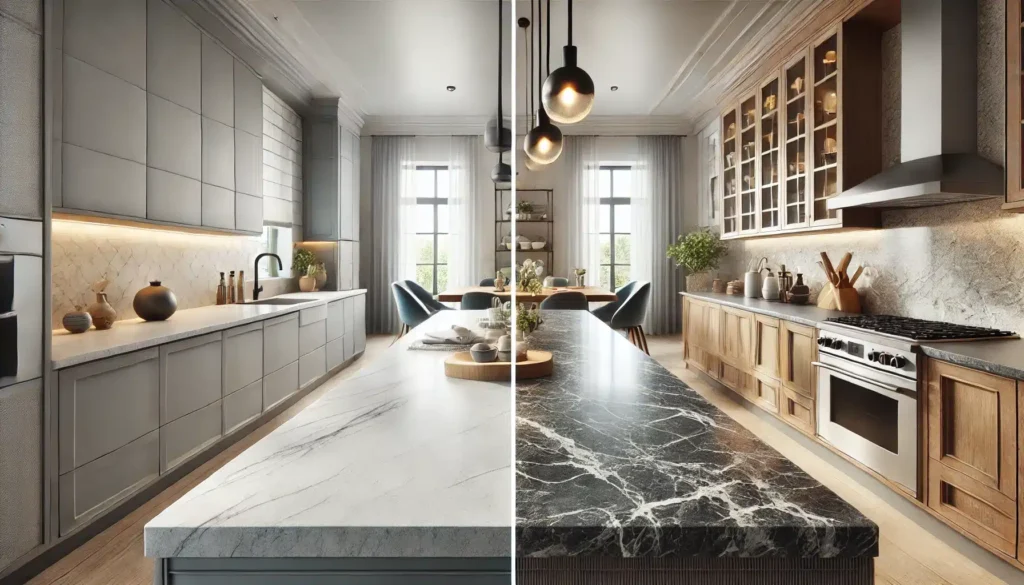
Engineered stone is a manufactured surface made from mineral components combined with binders, pigments and other product-specific materials. In residential countertop projects, the term most commonly refers to engineered quartz surfaces.
The exact composition varies by manufacturer and product line. Engineered stone should therefore not be described using one universal percentage, performance level or maintenance claim.
Engineered quartz surfaces are manufactured under controlled conditions to create slabs with selected colours, patterns and finishes. Designs may range from nearly solid colours to broad veining intended to resemble marble or other natural stones.
Manufacturing allows greater visual consistency than most natural slabs, although large-scale patterns can still vary between sections. Small samples may not show the full direction, spacing or repetition of the design.
Common characteristics include:
Engineered quartz is often described as non-porous, but that does not make the complete countertop installation immune to moisture. Seams, sink joints, wall connections and surrounding cabinets still require suitable detailing.
It is also not heat-proof or scratch-proof. Trivets, cutting boards and cleaning products approved for the surface should still be used.
Explore Engineered Quartz Options
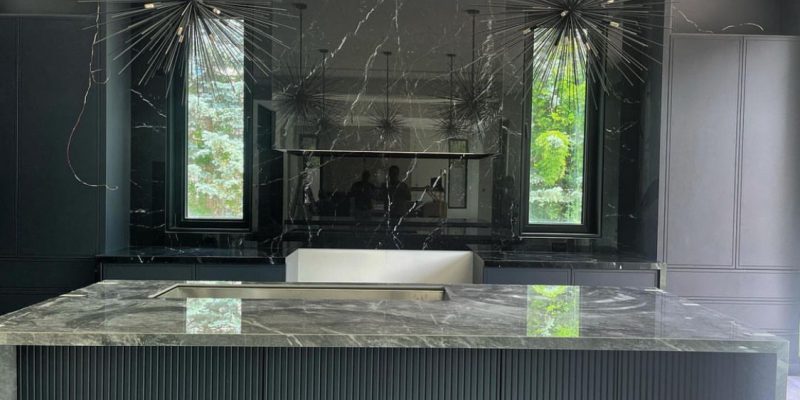
Natural stone countertops are cut from quarried geological material and fabricated into project-specific sections. Every slab contains natural mineral variation, and its appearance may include veins, crystals, colour changes, fissures and other geological features.
Natural stone is not one uniform performance category. Granite, marble and quartzite differ in mineral composition, hardness, porosity, reaction to acids and maintenance requirements.
Granite is commonly selected for kitchens because many slabs offer practical resistance to ordinary wear and cooking activity. Absorption, colour, mineral structure and sealing recommendations still vary between stones.
Granite can display fine mineral texture, broad movement or dramatic colour contrast. The actual slab should be reviewed before fabrication, especially for large islands or connected sections.
Marble is valued for veining, depth and a softer visual character. It is also sensitive to acidic substances that can alter the finish through etching.
Sealing may help manage absorption, but it does not prevent etching or all surface changes. Marble is best suited to homeowners who accept patina and understand its care requirements.
Quartzite is a natural stone that may provide pronounced movement and a harder mineral structure than marble. However, stones sold within the broader quartzite category can differ in porosity and composition.
Selection should be based on the actual slab and reliable material identification rather than assuming every quartzite performs identically.
Appearance is one of the clearest differences between engineered and natural stone. Engineered surfaces provide greater design control, while natural stone provides geological individuality.
Engineered stone is useful when the project requires a more predictable colour, repeated design language or coordination across several countertop sections.
Consistency does not mean every manufactured slab is visually identical. Pattern placement, slab batch and large-scale veining should still be reviewed before fabrication.
Natural stone should be selected with its variation rather than despite it. Vein direction, mineral concentrations, fissures and colour transitions can influence sink openings, seams, islands and waterfall panels.
Two slabs with the same commercial name may still differ visibly. When several slabs are required, they should be reviewed together before final layout planning.
Durability should be evaluated according to the exact engineered product or natural stone rather than by comparing two broad categories as though every surface behaves the same way.
Engineered quartz is generally suitable for frequent indoor kitchen use, but its binders, pigments and finish can still be affected by concentrated heat, harsh chemicals or excessive force. Natural stones vary more widely because granite, marble and quartzite have different mineral structures and surface characteristics.
Engineered quartz resists ordinary household use reasonably well, but it is not scratch-proof. Abrasive particles, ceramic objects, metal tools and direct knife use may leave marks or affect the finish.
Natural-stone scratch resistance depends on the material. Many granites and quartzites provide practical resistance to normal kitchen activity, while marble is softer and more likely to develop scratches or surface wear.
Cutting boards should be used with both engineered and natural stone. They protect the countertop, reduce knife wear and simplify food preparation.
Countertop slabs are strong across broad supported areas but can remain vulnerable around exposed corners, narrow sections and openings for sinks or cooktops.
Heavy impact may chip an engineered or natural-stone edge. The risk is influenced by:
A rounded or eased edge may be more forgiving in a heavily used kitchen than a sharply defined corner, although the final profile should also suit the material and design.
Engineered stone generally provides more predictable structural and visual characteristics within a product line. Natural stone can include veins, mineral concentrations, fissures and tonal changes that should be reviewed during slab layout.
A natural fissure is not automatically a crack or defect. Its significance depends on its location, stability and relationship to cut-outs, edges and support conditions.
Engineered surfaces can also contain design variation, and strongly veined patterns may require careful placement across seams, backsplashes or waterfall panels.
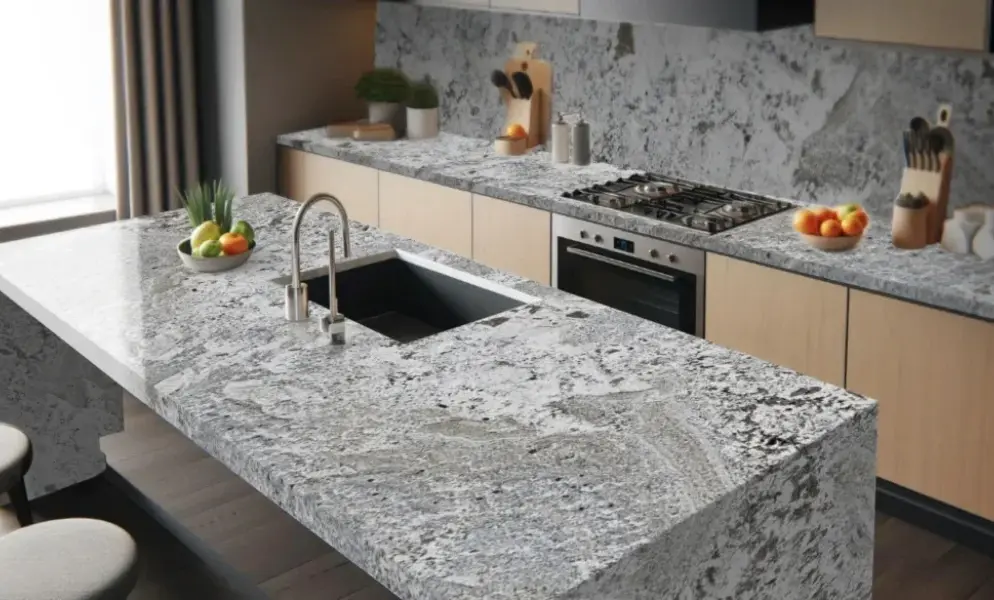
Engineered quartz generally has low water absorption and does not require routine sealing. This can simplify maintenance, but spills should still be cleaned promptly because pigments, oils, chemicals and prolonged residue may affect individual products.
Natural-stone absorption varies considerably.


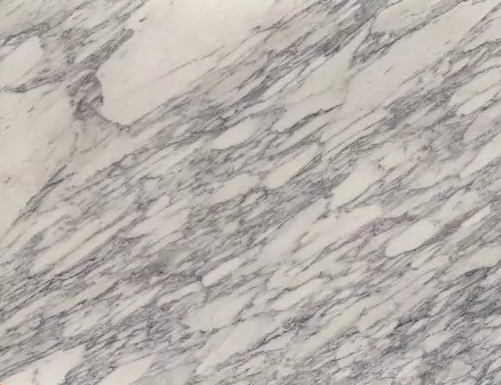

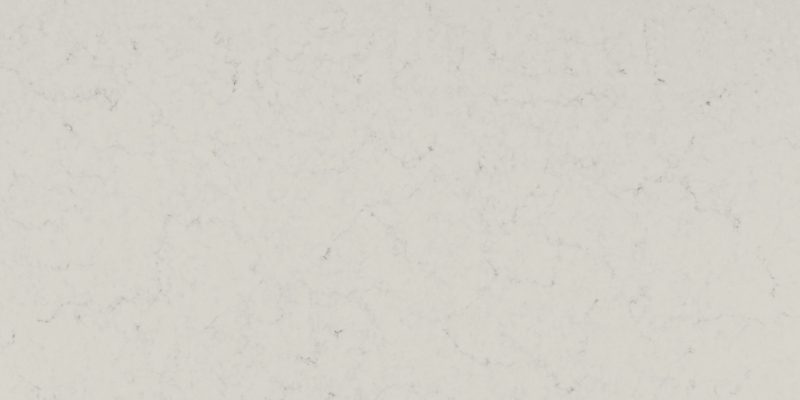
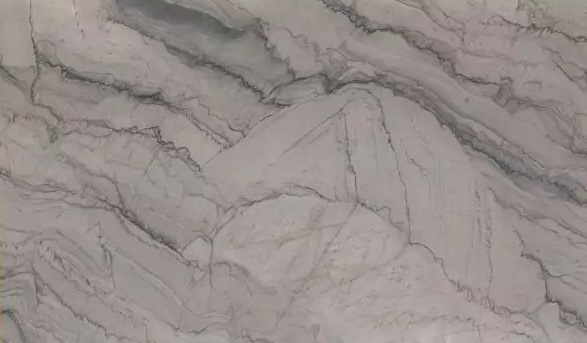



Most quartz countertop products do not require routine sealing because their manufactured structure has low absorption. Applying an unapproved sealer may alter the appearance or leave residue, so product-specific care instructions should be followed.
Although the slab itself may have low absorption, moisture can still affect:
There is no universal sealing schedule for every natural-stone countertop. The decision depends on the selected slab, absorption, finish, use and product recommended by the fabricator or stone supplier.
A sealer can help reduce liquid absorption, but it does not make stone stain-proof, scratch-proof or chemically resistant. It also does not prevent marble from etching when exposed to acidic substances.
Staining occurs when a substance penetrates or leaves colour within the surface. Etching is a chemical reaction that changes the finish, often creating a dull or lighter area.
Marble and other calcite-based stones are particularly vulnerable to etching from substances such as citrus, vinegar and certain cleaning products. A sealed marble surface can still etch because sealing primarily addresses absorption rather than chemical reaction.
Engineered quartz does not etch in the same way as marble, but strong chemicals, solvents or inappropriate cleaners may affect its binders, sheen or colour.
For most countertop surfaces, a soft cloth, warm water and a mild product approved for the material provide an appropriate starting point.
General care should include:
Natural stone and engineered quartz should not automatically be disinfected using the same chemical products. Manufacturer and fabricator guidance should determine which cleaners are compatible with the surface.
Natural stone generally contains no manufactured resin binder, but that does not make every stone countertop immune to heat damage. Rapid temperature changes, seams, sealants, adhesives and surrounding installation components can still be affected.
Engineered quartz contains binders that may discolour or become damaged when exposed to concentrated heat. Hot cookware and heat-producing countertop appliances should therefore be placed on a suitable trivet or protective pad.
Heat protection is recommended for both categories because it reduces risk to:
Small appliances that release heat downward should be used according to their instructions. A protective pad should not trap heat against the countertop or block required airflow.
Most engineered quartz countertops are designed primarily for indoor use. Exterior installation should only be considered when the manufacturer explicitly approves the exact product for the expected sunlight and weather exposure.
Natural stone may be considered for exterior applications, but suitability depends on the selected stone, water absorption, finish, freeze-thaw exposure, support, drainage and installation details.
For a detailed exterior comparison, review the guide to outdoor countertop materials.
Both engineered and natural stone require professional measurement, fabrication and handling for most custom slab projects. The differences appear mainly in pattern planning, slab characteristics, product limitations and finishing requirements.
Engineered stone provides more controlled slab dimensions and design families, but fabrication still requires planning around seams, openings, edge profiles and large-scale patterns.
Strongly veined quartz designs should be reviewed across the full slab because a small sample may not show the pattern spacing or direction. Bookmatching or continuous pattern alignment should not be assumed unless it is specifically planned and feasible with the selected slabs.
Natural-stone fabrication requires review of the actual slab. Veins, fissures, mineral concentrations and colour movement may influence where sinks, cooktops, seams and edges are positioned.
Layout decisions may include:
The presence of natural variation means substitutions should not be made without reviewing how the replacement slab affects the approved layout.
Cabinets should be stable, level and installed in their final position before the countertop is measured. Sink, faucet and appliance specifications should also be available when they affect openings or clearances.
Support requirements depend on slab thickness, overhangs, cabinet design, material characteristics and the location of openings. Neither engineered nor natural stone should be expected to correct unstable cabinets or unsupported spans.
For the complete workflow, review the countertop installation process in Ontario.
Engineered and natural stone countertops do not belong to one fixed price category. The final project cost depends on the selected product or slab, dimensions, layout, fabrication details, access and installation scope.
Engineered quartz pricing may be influenced by:
Natural-stone pricing may be influenced by:
A visually expensive-looking engineered surface may cost more than some natural stones, while a rare granite, marble or quartzite slab may exceed many quartz products. Material category alone is therefore not enough to predict the final price.
The complete quotation should also identify:
Quotes should be compared using the same project scope rather than only the material price or square-foot rate.
Engineered and natural stone can both work in kitchens, bathrooms, islands and other interior applications. The better choice depends on the desired appearance and the performance requirements of the specific area.
Engineered quartz may be a practical choice for:
Product-specific heat, cleaning and exterior-use limitations should still be reviewed before selection.
Granite may suit:
Marble may be appropriate for:
Marble should not be selected with the expectation that sealing will prevent all surface changes.
Quartzite may suit projects that require:
The stone should be identified and evaluated individually because materials sold as quartzite can differ in composition, absorption and maintenance requirements.
Choose engineered stone when design consistency, relatively low absorption and no routine sealing are among the highest priorities.
Choose natural stone when individual slab character, mineral depth and geological variation are central to the design.
Simple Decision Rule
Choose engineered stone for greater design control and relatively straightforward maintenance. Choose natural stone for individual slab character and geological variation, provided its specific care requirements suit the household.
Engineered stone is a broader manufactured-material category, but in residential countertop discussions it most commonly refers to engineered quartz. Composition and performance still vary between manufacturers and products.
Not universally. Granite, marble and quartzite behave differently, and engineered products also vary. Durability should be compared using the exact surface, finish and intended application.
Most engineered quartz countertop products do not require routine sealing. Care should follow the manufacturer’s instructions, and unapproved sealers should not be applied automatically.
No. Sealing recommendations depend on the actual stone, absorption, finish and use. There is no universal schedule that applies to every granite, marble or quartzite slab.
Natural stone does not contain the resin binders used in engineered quartz, but both surfaces should be protected with trivets. Heat can affect quartz binders, stone finishes, seams, adhesives and nearby installation components.
Engineered quartz generally has low absorption and practical resistance to many household spills. Natural-stone stain resistance varies by material, finish, absorption, sealing and spill response.
Engineered quartz is often selected for its relatively straightforward care. Granite or suitable quartzite can also work well when their slab-specific maintenance requirements align with the household.
Yes. Reviewing the actual slab helps confirm colour, veining, natural features and pattern placement around seams, sinks, islands and other openings.
The best countertop is not determined by whether the surface is manufactured or natural. It is determined by how well the exact product or slab matches the kitchen layout, design priorities, maintenance expectations and daily use.
Share the project dimensions, photographs, preferred colours, sink and appliance information and intended application to support a more accurate material comparison.
Compare Engineered and Natural Stone Countertops
Review full-size patterns, individual stone slabs, maintenance requirements and fabrication details before approving the final material.
Request a Project Quote
Browse Quartz Countertops
Browse Stone Materials