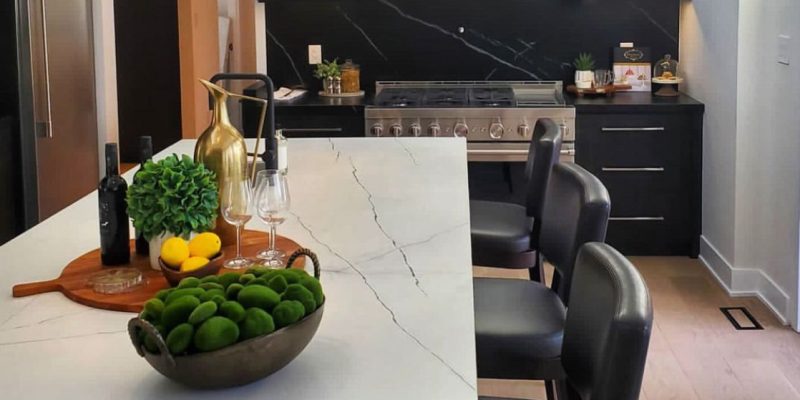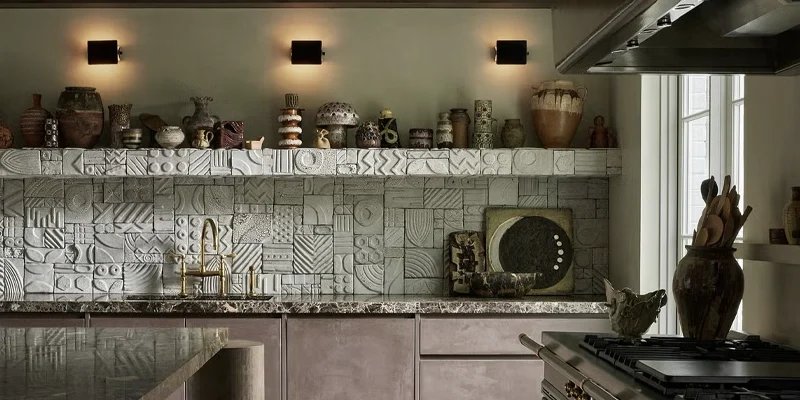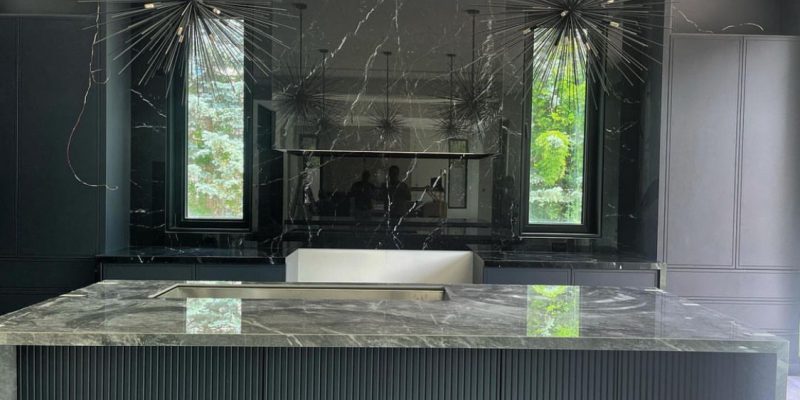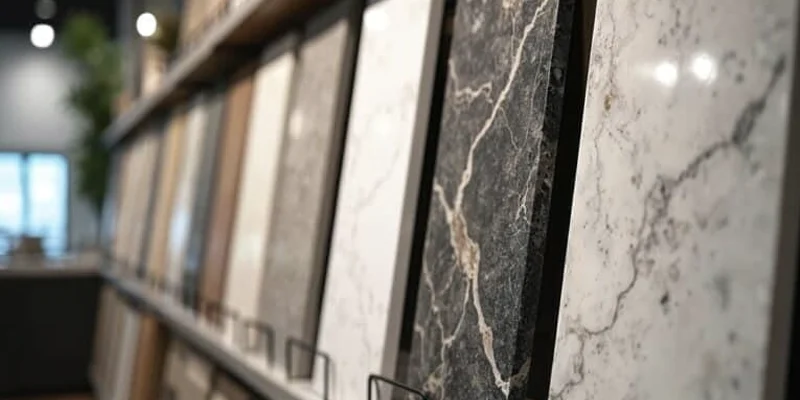
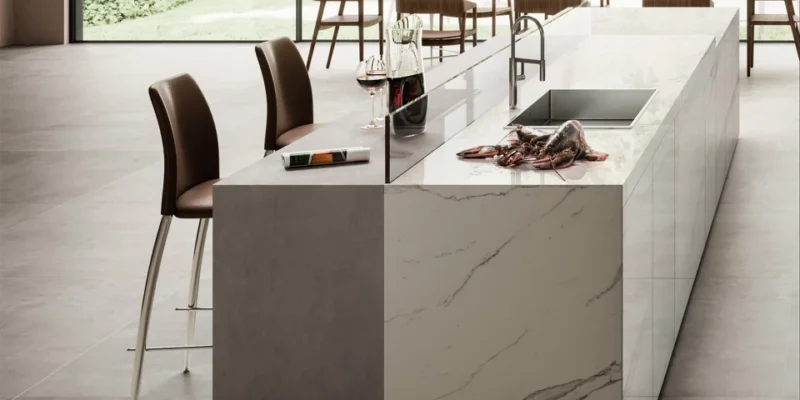
Porcelain vs. granite for kitchen islands is not a choice between one universally superior material and one inferior option. Both can perform well when the selected slab, edge design, cutouts, support and installation method suit the project.
Porcelain is often the stronger candidate for homeowners who want a contemporary appearance, low routine maintenance, resistance to stains and a thin-profile or waterfall design. Granite is often preferred by homeowners who want authentic natural variation, a substantial stone appearance and a surface with good heat tolerance.
The most important differences appear in their pattern construction, edge behaviour, maintenance requirements and fabrication process. This guide compares those differences so homeowners can choose a kitchen island surface based on actual use—not broad material claims.

The following comparison reflects general material characteristics. The actual product, natural slab and manufacturer requirements must still be reviewed before fabrication.
| Category | Porcelain | Granite | Practical Takeaway |
|---|---|---|---|
| Material type | Manufactured ceramic slab | Natural igneous stone | Porcelain offers controlled designs; granite provides natural variation. |
| Appearance | Stone-look, concrete-look, solid and other manufactured designs | Unique mineral patterns and colour movement | Choose porcelain for predictability and granite for individuality. |
| Heat | High resistance; follow product and appliance guidance | Good heat tolerance; concentrated heat can create thermal stress | Use sensible heat protection with either material. |
| Stains and moisture | Non-porous and does not require routine sealing | Absorption and sealing needs vary by slab | Porcelain has the more predictable low-maintenance profile. |
| Scratch resistance | Highly resistant but not scratch-proof | Generally strong resistance under ordinary use | Use a cutting board on both surfaces. |
| Edge impact | Thin exposed edges require protection from hard knocks | Exposed corners and edges can also chip under impact | Edge design and fabrication matter for both materials. |
| Sealing | Not routinely required | Depends on the exact stone and existing treatment | Do not apply one sealing schedule to every granite. |
| Visible profile | Often selected in 12mm or 20mm formats | Commonly supplied in thicker natural-stone formats | Thickness does not independently determine overhang capacity. |
| Waterfall design | Well suited to controlled patterns and modern profiles | Possible with careful slab selection and natural-pattern planning | Review the actual pieces before promising pattern continuity. |
| Fabrication | Requires product-specific cutting, handling and edge preparation | Requires natural-stone layout, cutting and edge finishing | Fabricator experience is important for either choice. |
| Relative cost | Often higher because of product and fabrication requirements | Ranges from accessible standard slabs to premium natural stone | Compare complete project quotes, not material rates alone. |
Quick Decision
Choose porcelain when controlled design, minimal routine maintenance and a contemporary profile lead the project. Choose granite when natural variation, tactile stone character and selection of a one-of-a-kind slab are higher priorities.
The primary difference is their origin and pattern construction. Porcelain is manufactured under controlled conditions, while granite is quarried as natural stone. This distinction affects appearance, consistency, slab review, fabrication and maintenance.
Porcelain countertop slabs are manufactured from refined mineral and ceramic materials formed and fired at high temperatures. Manufacturers can control surface colour, texture and printed design more closely than is possible with natural stone.
Product lines vary in:
These details should be confirmed for the exact porcelain product.
Granite is a natural igneous stone containing combinations of minerals such as quartz and feldspar. Its colour, grain and movement developed through geological processes rather than a controlled printing or manufacturing system.
As a result:
Homeowners should review the actual granite slab where pattern and natural variation are important.
Porcelain generally provides greater predictability between samples, catalogue images and installed pieces, although production lots and printed layouts can still vary.
Granite offers genuine mineral variation that cannot be exactly repeated. This individuality is a design advantage for some homeowners and a limitation for those who want controlled pattern placement.
Porcelain is available in designs inspired by marble, concrete, metal, limestone and other surfaces. This gives homeowners access to dramatic patterns without selecting an acid-sensitive marble.
Pattern construction must still be reviewed. Some porcelain designs are primarily surface-decorated, so the appearance at an exposed edge may differ from the face. A mitred edge can be used to create a thicker visual profile, but it adds fabrication complexity.
Granite provides natural crystals, deposits, movement and depth. Available designs range from relatively consistent fine-grain slabs to bold stones with significant colour changes.
This makes granite useful for:
Full-slab review is particularly important for granite, but it also benefits directional porcelain designs.
Review:
A small sample can help with colour coordination but cannot confirm the final island layout.
Some porcelain products carry their design mainly on the surface, while selected products offer more coordinated body and edge characteristics. Do not assume the face pattern will continue naturally through every exposed edge.
Granite’s mineral pattern extends through the stone, but cutting the slab in different directions can still change how the pattern appears on an edge or waterfall panel.
Design Review Principle
Porcelain should be reviewed for printed-pattern and edge behaviour. Granite should be reviewed for natural variation, fissures and usable slab layout. Neither material should be approved from colour alone.
A kitchen island is often the hardest-working surface in the room. Hot cookware, food preparation, spills, small appliances and daily traffic all influence how a countertop performs. Porcelain and granite can both provide durable island surfaces, but their strengths—and their vulnerable points—are not identical.
Porcelain slabs are manufactured at very high temperatures and generally offer strong resistance to heat. This makes porcelain suitable for islands near a cooktop or areas frequently used for serving hot food. However, heat tolerance can vary by product, finish, adhesive system and installation method. The slab manufacturer’s care instructions should always take priority.
Granite also performs well around normal kitchen heat. As a natural stone, it can tolerate temperatures encountered during everyday cooking, but intense heat concentrated in one small area may create thermal stress. This risk can increase when a cold surface is exposed to sudden, extreme heat.
Using a trivet remains sensible with either material. Heat-producing appliances that remain in one position—such as air fryers, toaster ovens and countertop grills—should be placed on a suitable insulated mat when recommended by the appliance or surface manufacturer.
Porcelain has very low water absorption and does not normally require a penetrating sealer. Coffee, wine, oil and food spills are generally easy to remove when cleaned promptly. Its low porosity is especially useful on an island containing a prep sink, beverage station or frequent food-service area.
Granite’s absorption rate depends on the specific stone. Many dense granite varieties offer excellent stain resistance, while some slabs may benefit from an appropriate penetrating sealer. Sealing can provide additional time to clean spills, but it does not make a natural-stone surface completely stain-proof.
The need for sealing should be determined by the selected slab, finish, fabricator’s assessment and sealer instructions—not by a fixed schedule applied to every granite countertop.
Both materials provide strong resistance to scratches under normal household use. Porcelain has a hard surface, while granite is also highly resistant to everyday abrasion. Neither surface should be treated as impossible to damage.
A cutting board protects the finish, keeps food preparation hygienic and prevents knives from becoming dull. It also reduces the chance of metal marks, localized wear or accidental impact around finished edges.
Porcelain’s surface hardness does not mean every part of the slab has equal impact resistance. Exposed edges and corners can chip when struck by a heavy pan, cast-iron cookware or another hard object. Edge fabrication, handling and installation quality are therefore particularly important.
Granite edges can chip as well, especially around sinks, dishwashers, tight corners and heavily used seating areas. A slightly eased or rounded profile may be more forgiving than an extremely sharp edge, although the best profile also depends on the design and available material thickness.
Performance Takeaway
Porcelain offers low absorption and predictable day-to-day care, while granite combines excellent practical durability with the character of natural stone. For both materials, the most vulnerable areas are normally fabricated edges, corners, cutouts and unsupported sections—not the centre of the slab.
Routine maintenance is straightforward for both porcelain and granite when the correct products are used. The difference is that porcelain normally requires fewer material-specific care decisions, while granite care can vary with the stone’s mineral composition, finish and absorption rate.
For routine porcelain cleaning, use warm water, a soft cloth and a mild soap or manufacturer-approved surface cleaner. Remove spills before they dry and wipe away cleaner residue to prevent streaks, particularly on dark or polished finishes.
Porcelain does not ordinarily need routine sealing. Nevertheless, grout, joints or other materials used around the installation may have separate maintenance requirements.
Clean granite with warm water, a soft cloth and a pH-neutral cleaner approved for natural stone.
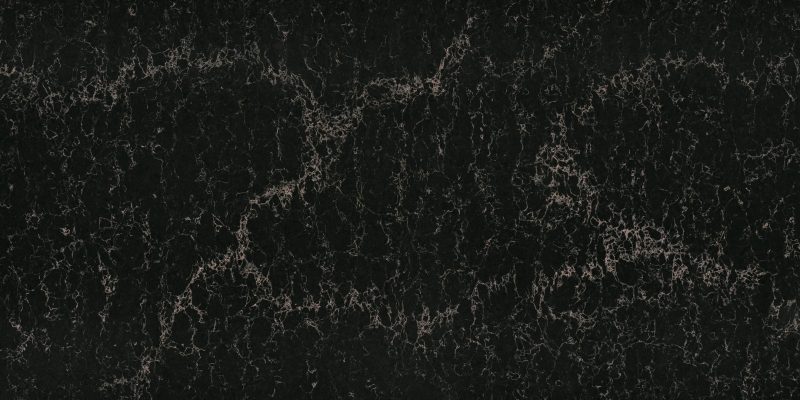


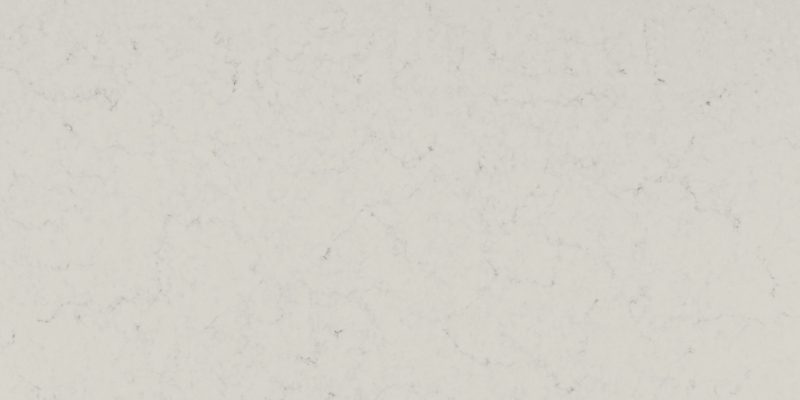
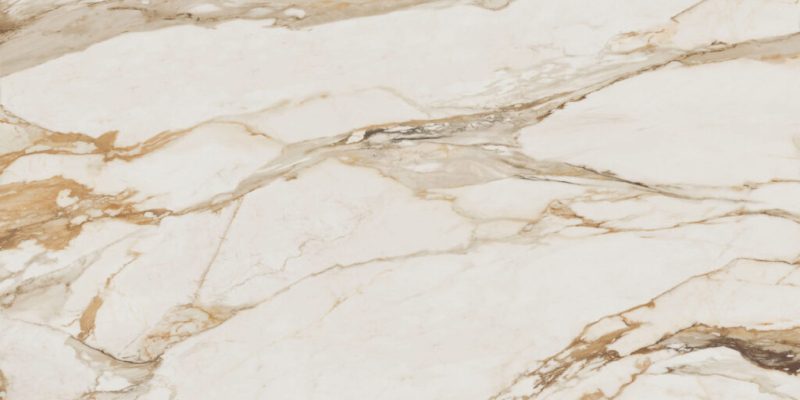


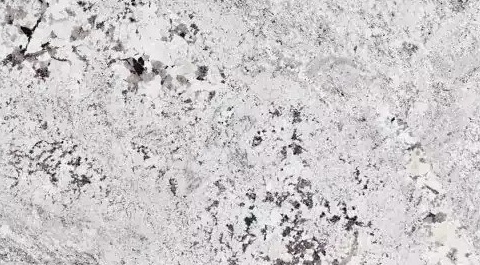


Some granite countertops may benefit from periodic sealing, while dense varieties may require it rarely or not at all. The correct interval cannot be determined solely by the word “granite.”
Porcelain provides greater visual consistency because its colour and pattern are produced under controlled conditions. This can simplify future coordination with cabinet panels, backsplashes and waterfall ends. Matte and dark porcelain surfaces may still show fingerprints, grease or streaks more readily than lighter patterns.
Granite develops its appearance naturally, so variation is part of the material rather than a defect. Mineral deposits, movement and colour changes can differ across one slab. Reviewing the full slab before fabrication is essential when the island occupies a visually prominent position.
Material selection should not be separated from fabrication planning. Island size, visible edge profile, sink or cooktop cutouts, waterfall panels and overhangs can materially affect which porcelain or granite product is suitable.
Porcelain slabs are available in different product-specific thicknesses, with 12 mm and 20 mm among the formats commonly considered for countertops. Availability and approved applications depend on the manufacturer and collection.
A mitred or built-up edge can create the appearance of a thicker countertop without requiring a solid slab of the same visible depth. The result depends heavily on accurate cutting, pattern alignment, joint quality and edge finishing. Printed movement on the face may not continue naturally through a cut edge, so an exposed edge must be reviewed before fabrication.
Granite is supplied in natural-stone slab formats that vary by supplier, quarry and inventory. Its thickness, slab dimensions and usable area should be confirmed from the actual material rather than assumed from a general online specification.
Granite can accommodate several edge profiles, including eased, bevelled, rounded and mitred designs. The selected profile must work with the slab thickness, cabinet style and level of daily use. Decorative edges can add fabrication time and cost.
Every opening removes material from the countertop and creates areas that require careful fabrication and support. This is particularly important around:
Appliance specifications should be available before the final template. Cutout dimensions, corner treatment, clearance and support must follow the appliance instructions and the slab manufacturer’s fabrication requirements.
Professional countertop measurement and site verification help identify cabinet-level issues, appliance conflicts and unsupported areas before fabrication begins.
A thicker-looking edge does not automatically create a stronger or self-supporting island. Safe overhang capacity depends on the exact material, actual thickness, span, cabinet construction, cutout locations, seam placement and support system.
Large seating overhangs may require concealed brackets, steel reinforcement or structural modifications. Support should be specified before the countertop is fabricated so that brackets do not interfere with drawers, cabinet hardware, seating positions or finished panels.
Both porcelain and granite can create a striking waterfall island, but they require different approaches to pattern selection and edge coordination.
Porcelain collections can offer controlled patterns and coordinating slabs, which may make it easier to plan a consistent modern design. However, a printed vein does not automatically continue across every adjoining panel. The fabricator must review slab orientation, mitred joints and the relationship between the horizontal top and vertical waterfall end.
The colour and pattern visible on the slab face may also differ from the material’s exposed body. This makes edge construction and joint placement especially important on light or strongly veined designs.
A granite waterfall showcases genuine geological movement. Each adjoining panel must be selected and laid out using the actual slabs. Strong veins or mineral formations may create a dramatic transition, while more uniform granites can provide a quieter and more forgiving joint.
True bookmatching requires compatible consecutive slabs and deliberate layout. Simply rotating two unrelated pieces does not guarantee a continuous or mirrored pattern.
For either material, approve the fabrication layout before cutting when pattern continuity is important. The layout should identify:
Waterfall ends, mitred edges and pattern matching consume additional material and fabrication time. They should therefore be included in the original estimate rather than treated as a minor finishing detail.
Waterfall Planning Principle
Choose porcelain or granite from the full slab—not from a small sample alone. Before cutting begins, confirm the top orientation, waterfall direction, edge construction, joint locations and how the visible pattern will move across the completed island.
Porcelain and granite are available across broad price ranges. A basic granite, an exotic natural-stone slab and a large-format porcelain with complex mitred edges should not be compared as if they were equivalent products.
For preliminary budgeting in Toronto and the GTA, the following installed ranges can be used as planning benchmarks:
| Material | Typical Installed Range | Main Cost Variables |
|---|---|---|
| Granite | Approximately $65–$160+ per sq. ft. | Slab rarity, grade, usable yield, edge profile and pattern layout |
| 12 mm Porcelain | Approximately $95–$145 per sq. ft. | Brand, reinforcement, mitred edges, handling and fabrication complexity |
| 20 mm Porcelain | Approximately $120–$180+ per sq. ft. | Product availability, slab design, fabrication, access and installation |
These figures are budgeting ranges rather than fixed quotations. They may not include demolition, plumbing, electrical work, cabinet reinforcement or extraordinary delivery conditions. Waterfall panels, vein matching, multiple cutouts, premium edge work and inefficient slab yield can increase the total.
Review the complete kitchen island countertop cost guide and the detailed 12 mm vs. 20 mm porcelain pricing guide for a closer look at GTA cost factors.
Compare Complete Installed Quotes
A lower square-foot rate does not always produce a lower project total. Compare slab quantity, cutouts, edges, waterfall panels, delivery, installation, supports and applicable taxes before deciding which proposal offers better value.
For a busy family kitchen, porcelain may offer a more predictable maintenance routine, but correctly selected and fabricated granite is also highly practical. For a statement island, the better choice is the slab that satisfies the design while also accommodating the required cutouts, overhang and edge details.
Neither is universally better. Porcelain is attractive for controlled designs, low absorption and simplified maintenance. Granite is ideal when natural variation and authentic stone character are priorities.
Porcelain often has a higher fabrication cost, particularly when the design includes mitred edges or waterfall panels. Premium and exotic granite can still cost more than some porcelain products.
No. Some dense granite varieties may not require routine sealing, while others benefit from an appropriate penetrating sealer. The fabricator should assess the exact slab and finish.
Both materials generally resist normal kitchen heat, but trivets remain recommended. They reduce the risk of thermal stress, protect the finish and prevent heat from affecting nearby joints or installation materials.
Porcelain is hard and durable, but exposed edges can chip after a heavy impact. Appropriate edge detailing, professional fabrication and careful handling reduce this risk.
Both can work beautifully. Porcelain offers controlled designs, while granite provides unique natural movement. Slab layout and joint alignment usually matter more than the material name alone.
Yes, when the selected product, cutout design, fabrication method and support system are suitable. Sink specifications must be confirmed before templating and fabrication.
Material selection can begin earlier, but final fabrication dimensions should come from an approved site measurement after cabinets are installed, level and structurally ready.
The final decision should be based on the actual slab or porcelain product, island dimensions, edge treatment, cutouts, overhang and installation conditions—not on a material comparison alone.
Planning a Custom Kitchen Island in Toronto or the GTA?
Teccorp Stone can help you compare porcelain and granite slabs, plan seams and waterfall panels, verify cabinet conditions and prepare a project-specific fabrication and installation quote.
Request a Free Quote
Kitchen Island Countertops
Browse Stone Materials