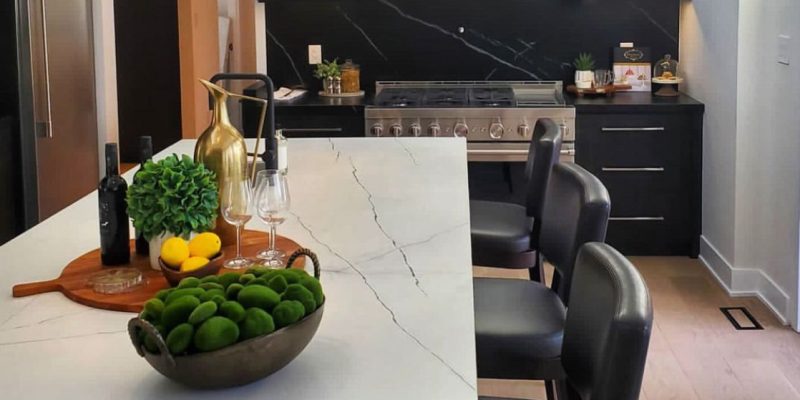
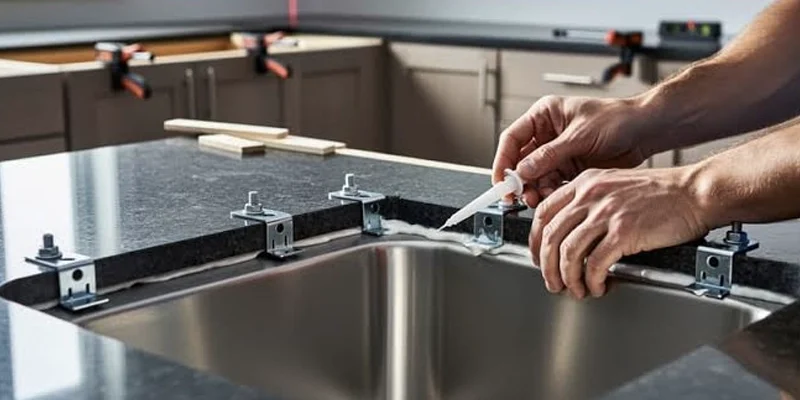
Choosing the right countertop fabricator in Toronto involves more than finding a company that can cut a stone slab. Custom countertop fabrication connects accurate project measurements, material selection, slab planning, sink and appliance specifications, edge details, cutouts and installation requirements into finished components designed for the actual space.
That process can vary significantly depending on whether the project uses quartz, granite, quartzite, marble, porcelain or another slab surface. A straightforward countertop may require relatively simple geometry, while a large island, waterfall edge, full-height backsplash or strongly veined natural stone can require more detailed planning before fabrication begins.
Teccorp Stone’s custom stone services cover project-specific stone fabrication and related installation applications across Toronto and the GTA. This guide focuses specifically on countertop fabrication: what a fabricator does, which materials and components can affect the process, and what homeowners should understand before production begins.
Custom Countertop Fabrication | Quartz, Granite & Porcelain | Project-Specific Measurement | Toronto & GTA Service
A countertop fabricator converts a slab or manufactured surface into components made for the dimensions and specifications of a particular project. The work takes place between material selection and final installation, although the exact responsibilities can vary between companies and project types.
Depending on the scope, countertop fabrication can involve:
Even sophisticated fabrication equipment depends on correct dimensions and specifications. Before stone is cut, the production information should reflect the project conditions that affect the finished countertop.
For a kitchen, this can include cabinet dimensions and position, sink information, cooktop specifications, edge profile, overhangs and backsplash requirements. A change to one of these items may affect the geometry of the fabricated pieces.
This is why professional countertop fabrication is not simply a cutting service. It is a coordinated process that turns approved project information into physical components.
A slab supplier and a countertop fabricator perform different functions. The supplier provides the stone or manufactured surface, while the fabricator converts that material into project-specific components.
Some companies may provide both services, while other projects use separate suppliers, fabricators and installers. Homeowners should understand which company is responsible for each stage rather than assuming that purchasing the slab automatically includes fabrication or installation.
The countertop must be fabricated for the installation conditions, but producing the pieces and installing them are still distinct stages. Accurate fabrication supports installation, while site readiness and installation quality influence how those components ultimately perform in the finished space.
This distinction becomes particularly important when projects involve multiple pieces, waterfall panels, difficult access or other conditions that require coordination before delivery.
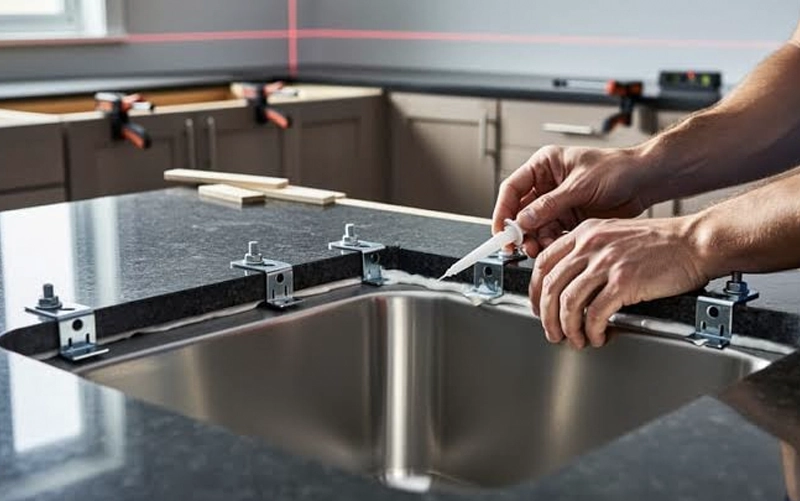
Custom countertop fabrication becomes especially valuable when a project cannot be resolved with standard dimensions or prefabricated pieces. Kitchens and bathrooms often include walls, cabinetry, fixtures and design details that require components produced for the specific space.
Custom fabrication can support both relatively simple countertops and more complex architectural details.
Kitchen fabrication typically requires coordination between the countertop and several fixed or selected components. Sinks, faucets, cooktops, cabinetry and backsplash conditions can all affect the finished geometry.
For islands and perimeter runs, the fabricator may also need to consider how the available slab dimensions relate to seams, visible patterns and the overall layout.
Large islands often become highly visible elements within the kitchen, making slab layout particularly important when natural stone or strongly directional manufactured patterns are used.
Where stone continues vertically down one or both ends of an island, the relationship between the horizontal countertop and waterfall panel becomes another fabrication consideration. Pattern direction, edge treatment and adjoining geometry should be planned before cutting.
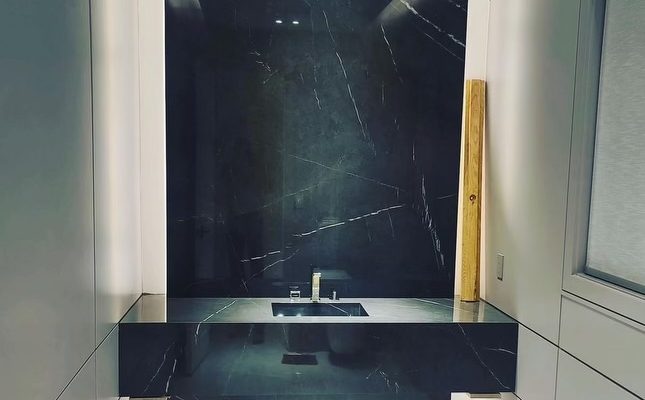
Vanity countertops are often smaller than kitchen surfaces, but they can still require precise coordination with sink configurations, faucets, cabinetry and wall conditions.
Bathroom-specific material selection and design considerations are covered more deeply within Teccorp Stone’s custom vanity countertop services, allowing this page to remain focused on broader countertop fabrication.
A countertop project may also include full-height backsplash pieces or other vertical stone components. These can require additional planning where outlets, windows, cabinets or directional slab patterns interrupt the surface.
When the countertop and backsplash use the same slab material, their visual relationship can be considered during layout rather than treating each component independently.
Project Planning: Custom fabrication is most effective when the countertop, fixtures and related stone components are considered as one coordinated project before the slab is cut.
Different countertop materials can require different fabrication decisions. Natural stone varies from slab to slab, engineered surfaces follow product-specific requirements, and large-format porcelain has its own handling and edge considerations.
Homeowners who are still selecting a surface can explore Teccorp Stone’s broader stone surfaces collection before narrowing the project to a specific material.
Engineered quartz provides a wide range of colours and manufactured patterns, but individual products can differ in available thicknesses, design direction and fabrication guidance.
Cutouts, edges and other project details should therefore reflect the specifications of the selected product rather than assumptions about quartz as a single uniform material category.
Available options can be reviewed in Teccorp Stone’s quartz collection.
Granite is a natural stone with slab-specific variation in colour, mineral structure and pattern. For visible islands and larger countertop runs, reviewing the selected slab can help determine how its natural features should be distributed across the fabricated components.
Homeowners considering this material can browse Teccorp Stone’s granite slab selection. Because GSC already shows this page appearing for granite-fabrication searches, granite fabrication receives additional detail later in this guide.
Quartzite offers natural slab variation and can display strong directional movement. The selected slab should be evaluated individually because visual and material characteristics can differ considerably between stones sold within the category.
Current options can be explored through the quartzite collection.
Marble can create highly distinctive countertop surfaces because veining and natural movement vary between slabs. Layout can become particularly important where several visible pieces need to relate across an island, backsplash or adjoining countertop run.
Teccorp Stone’s marble slab collection provides material options that can be considered for project-specific countertop applications.
Porcelain should be treated as a distinct fabrication category rather than as another form of engineered quartz or natural stone. Product thickness, cutting, edge treatment, handling and manufacturer requirements can affect how porcelain countertop components are planned and produced.
Available surfaces can be reviewed through Teccorp Stone’s porcelain slab collection. The fabrication considerations for porcelain are addressed in greater detail in a dedicated section below.
Granite fabrication requires more than cutting a slab to the overall dimensions of a countertop. Because granite is a natural stone, the selected slab can contain variations in mineral structure, colour, movement and pattern that affect how individual countertop pieces should be positioned.
This is particularly relevant for large islands, long countertop runs and projects where several fabricated pieces remain visible together.
Before cutting, the fabricator should consider how the slab will be divided across the project. Important areas can include:
The objective is not to eliminate natural variation. Instead, the layout should use the selected slab intentionally so that the fabricated components relate appropriately to one another.
Sink openings, cooktop cutouts, faucet holes and edge profiles should be produced according to the approved project specifications. The appropriate fabrication approach depends on the selected slab, component geometry and intended design.
Because GSC already shows this page appearing for searches such as granite fabricators and fabricating granite, the topic belongs naturally on this page—but only in the context of countertop fabrication rather than as a separate general granite guide.
Porcelain slab fabrication requires a different approach from conventional granite, marble or engineered quartz. Large-format porcelain products can vary in thickness, structure, pattern and manufacturer requirements, making product-specific planning important before fabrication begins.
This topic deserves dedicated coverage on this page because current search data already shows visibility for queries such as porcelain slab fabrication Toronto and porcelain slab fabricator Toronto.
Porcelain should not be treated as one uniform fabrication system. Before cutting, the fabricator should understand the characteristics and requirements of the selected product, including:
Porcelain countertop designs can involve exposed edges, mitered details, sink openings and other fabricated components. These decisions should be resolved before production so that the selected edge treatment and component geometry are appropriate for the material and project.
Homeowners considering this surface can review Teccorp Stone’s porcelain slab collection before confirming the product and fabrication scope.
Material Note: Granite, quartz, quartzite and porcelain should not be fabricated according to one universal set of assumptions. The selected slab or product should guide the production decisions.
Countertop fabrication should be based on project information that reflects the conditions where the finished components will be installed. Accurate measurement is therefore one of the most important stages before cutting begins.
Depending on the project, measurement may need to account for:
If cabinetry is repositioned, walls are altered or project dimensions change after measurement, the approved fabrication information may no longer match the site.








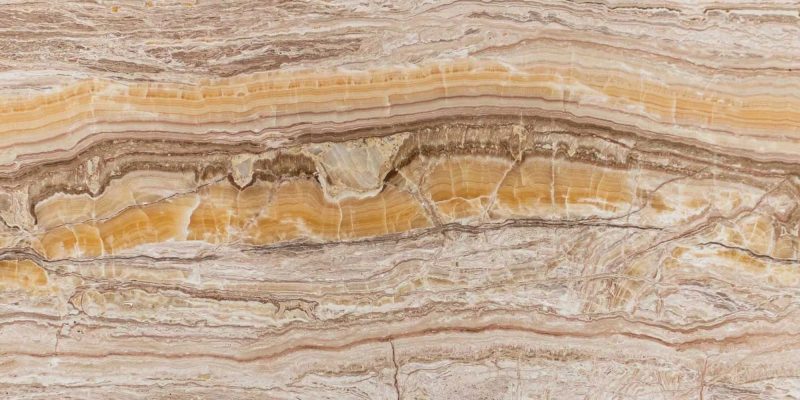



Teccorp Stone’s Countertop Survey & Measurement service covers the measurement stage in greater detail.
Whether measurements are captured digitally or through another appropriate method, the goal is to document the geometry that affects fabrication. This can include wall irregularities, corners, fixture locations and other conditions that cannot be understood from simple nominal dimensions alone.
This page intentionally does not turn templating into a full technical tutorial. Digital templating and laser measurement can support more detailed standalone guides without competing with the commercial fabrication intent of this URL.
Once measurements and specifications are approved, fabrication decisions determine how the selected material is converted into individual countertop components.
Slab layout is particularly important for natural stone and manufactured surfaces with strong directional patterns. Large islands, waterfall details and full-height backsplashes can make the relationship between pieces highly visible.
A layout may consider:
Openings should reflect the approved sink, cooktop and other relevant specifications. Fabricating from assumed dimensions can create avoidable conflicts later in the project.
Faucet and accessory holes should also be coordinated before fabrication where they pass through the countertop.
Edge design affects both appearance and fabrication. Simple eased edges, more decorative profiles and mitered or built-up details require different production decisions.
The selected profile should be appropriate for the material, countertop design and approved project specifications rather than chosen only because it appears more elaborate.
Seams may be required because of slab dimensions, project geometry, transportation, access or installation conditions. Their existence does not automatically indicate poor fabrication.
What matters is how seam placement relates to the layout, adjoining pieces, visible patterns and nearby fixtures.
For a more technical explanation of how these details influence workmanship, see Teccorp Stone’s guide to high-quality stone fabrication.
Modern countertop fabrication can use CNC equipment and digital production data to support accurate, repeatable cutting and machining. Depending on the equipment and project, these systems may be used for perimeter cutting, sink openings, fixture holes, selected edge work and complex geometries.

CNC machinery can reproduce approved geometry consistently, but it cannot determine whether the project information itself is correct. Incorrect measurements, outdated fixture specifications or poor slab planning can still produce incorrect results even when the equipment performs precisely.
Strong fabrication combines technology with:
For this reason, machinery should be considered one part of the fabrication workflow rather than a stand-alone guarantee of countertop quality.
Countertop fabrication and countertop installation are closely connected, but they are not the same stage of the project. Fabrication produces the countertop components from approved measurements and specifications. Installation places those fabricated pieces in the finished space and coordinates their final position with the site conditions.
Fabrication can include slab layout, perimeter cutting, sink and appliance openings, edge preparation, seam-related component preparation and other project-specific machining or finishing.
The objective is to produce components that correspond to the approved countertop design before they arrive at the project site.
Installation focuses on placing and aligning the fabricated pieces within the actual kitchen, bathroom or other application. Depending on the project, this can involve positioning adjoining sections, completing stone-related joints and coordinating the countertop with the prepared site.
Other work associated with a renovation—such as plumbing, electrical, cabinetry modification or structural work—should not automatically be assumed to be part of the stone installation scope. Responsibilities should be confirmed before the project begins.
A well-fabricated countertop still depends on appropriate site conditions, while skilled installation cannot fully compensate for pieces produced from incorrect measurements or specifications.
This is why fabrication and installation should remain connected through clear project information even when different teams or companies are responsible for each stage.
Scope Check: Before approving a countertop project, confirm which company is responsible for measurement, fabrication, delivery, installation and any work that belongs to other trades.
Homeowners can reduce avoidable project changes by confirming the information that directly affects fabrication before production begins.
Countertop dimensions depend on the surfaces and structures they relate to. Cabinet position, wall conditions and other relevant site elements should reflect the conditions used for final measurement.
Sinks and cooktops can determine major openings in the countertop. The approved model and configuration should therefore be available before the corresponding cutouts are fabricated.
Faucets, soap dispensers and other countertop-mounted accessories may require additional holes. Their location should be coordinated with the sink, cabinetry and available countertop space.
The selected edge should be confirmed before the corresponding pieces are completed. The appropriate detail depends on the material, desired appearance and countertop design.
Full-height backsplashes and waterfall panels can affect slab allocation and pattern planning. When these elements are part of the project, they should be identified early enough to be considered with the main countertops.
Changes can still occur during a renovation, but there should be a clear process for updating fabrication information when they do.
When comparing countertop fabricators, homeowners should evaluate more than the slab selection or total quotation. The ability to explain measurement, material-specific fabrication, slab layout, project documentation and installation responsibilities provides more useful information about how the project will be managed.
Relevant questions include:
For a detailed hiring framework—including evaluation criteria, quote scope and warning signs—see Teccorp Stone’s guide to choosing a stone fabricator.
Countertop projects across Toronto and the GTA can range from straightforward replacement surfaces to custom kitchens, islands, vanity tops and multi-component stone installations. The fabrication requirements should be determined by the individual project rather than by location alone.
For local projects, practical considerations may include site access, building requirements, component dimensions and coordination between measurement, fabrication and installation. These factors can affect how a project is planned without changing the fundamental standards used to evaluate fabrication quality.
Teccorp Stone’s broader custom stone fabrication services provide additional information for projects that extend beyond conventional countertops into architectural stone applications.
A countertop fabricator converts slabs or manufactured surfaces into custom pieces based on approved project dimensions and specifications. This can include cutting, openings, edges, slab layout and preparation of adjoining components.
The fabricator produces the countertop components, while the installer places and aligns them at the project site. Some companies provide both services, while others separate the responsibilities.
Yes. Granite countertops can be fabricated to project-specific dimensions, including sink and appliance openings, edge profiles and multi-piece layouts. The selected slab should be evaluated because natural pattern and mineral variation can influence layout decisions.
Yes, when the selected porcelain product is appropriate for the application. Fabrication should reflect the product’s thickness, edge requirements, cutting considerations and manufacturer guidance.
The approved sink information should be available before the corresponding countertop opening is fabricated. Different sink models and mounting configurations can require different cutout geometry.
Custom fabrication should be based on reliable project measurements that reflect the relevant installation conditions. The exact measurement or templating method can vary by project.
No. Seams may be necessary because of slab dimensions, countertop geometry, access or installation requirements. Their quality should be evaluated by placement, alignment and execution rather than by their existence alone.
Compare providers based on measurement procedures, material knowledge, fabrication capability, project documentation, installation scope and quote inclusions rather than relying only on price or promotional claims.
A successful countertop project begins before the slab is cut. Accurate measurements, confirmed fixtures, material-specific planning and clearly defined responsibilities help connect the design concept with the finished countertop components.
Quartz, granite, quartzite, marble and porcelain can all require different fabrication considerations, while islands, waterfalls, full-height backsplashes and other custom details increase the importance of coordinated planning.
For homeowners searching for a countertop fabricator in Toronto, the most useful comparison is therefore not simply who can cut the material, but who can clearly explain how project information, fabrication decisions and installation requirements will be managed from the outset.
Start Your Custom Countertop Project
Share your project dimensions, photographs, preferred materials and location with Teccorp Stone to discuss countertop fabrication requirements and the appropriate next steps for your project.