Knowing how to clean bathroom vanity countertops starts with identifying the exact surface rather than applying the same cleaner and maintenance routine to every material. Quartz, granite, marble, quartzite and porcelain can all be used for bathroom vanities, but their care requirements are not identical.
Bathroom countertops are regularly exposed to water, soap, toothpaste, cosmetics, skincare products and cleaning products. Residue can build up around sinks and faucets, while the wrong cleaner can be unsuitable for certain natural stones or manufactured surfaces.
This guide explains practical care principles for the most common bathroom vanity countertop materials while emphasizing product-specific guidance where requirements differ.
Homeowners still choosing a surface can compare the main options in Best Materials for Bathroom Vanity Countertops. For custom vanity fabrication and installation information, see Teccorp Stone’s main Vanity Countertops service.
| Material | Routine Cleaning Approach | Sealing Consideration | Important Caution |
|---|---|---|---|
| Quartz | Soft cloth and cleaner approved for the selected product | Routine surface sealing generally not required | Follow manufacturer guidance for chemicals and heat |
| Granite | Non-abrasive cleaning appropriate for natural stone | Depends on the individual stone and finish | Do not assume every granite has the same absorption characteristics |
| Marble | Gentle cleaning suitable for acid-sensitive natural stone | Depends on the stone and finish | Avoid acidic cleaners and products unsuitable for marble |
| Quartzite | Stone-appropriate non-abrasive cleaning | Evaluate the specific stone | Properties should not be generalized across all quartzites |
| Porcelain | Routine cleaning according to product guidance | Routine sealing of the slab surface generally not required | Follow guidance for the exact porcelain product and finished details |
This table is a starting point. The individual slab, finish or manufactured product should always take priority over a generic material-category rule.
Consistent routine cleaning is generally more useful than waiting for heavy residue to accumulate around the sink and then relying on stronger cleaning products.
Useful everyday practices include:
Bathroom vanities are expected to encounter water, but repeatedly allowing water and dissolved product residue to remain around faucets or sink edges can leave visible deposits and make routine cleaning more difficult.
Wiping these areas as part of regular bathroom use can reduce buildup without requiring unnecessarily aggressive cleaning later.
A bathroom countertop does not generally need aggressive scrubbing for routine care. Abrasive pads or powders can be inappropriate for certain finishes and manufactured surfaces.
A soft cloth or non-abrasive sponge combined with a cleaner suitable for the actual countertop is a more appropriate starting point.
Do not choose a cleaner by material name alone. “Quartz cleaner” or “stone cleaner” on a label does not replace the care guidance for the exact product, slab and finish installed in the bathroom.
Bathroom surfaces encounter a different mix of products from kitchen countertops. Understanding what remains on the vanity helps determine why regular cleaning matters.
Soap residue can collect near the sink and faucet, particularly where water repeatedly dries on the surface. Routine wiping helps prevent layers of residue from building up.
Toothpaste can dry on the countertop and around sink edges. Removing it before it hardens is generally easier than attempting to scrub dried residue later.
Foundations, creams, oils, serums and other personal-care products can contain different ingredients. Spills should be removed promptly, particularly on natural stone where product composition may matter.
Sprays, gels, colouring products and styling products can leave residue on the surface. The appropriate cleaning method should depend on both the residue and countertop material.
Where water repeatedly evaporates around fixtures, visible deposits can develop. Treatment should be appropriate for the countertop because a cleaner used for mineral buildup on another bathroom surface may not be suitable for natural stone or a particular manufactured surface.
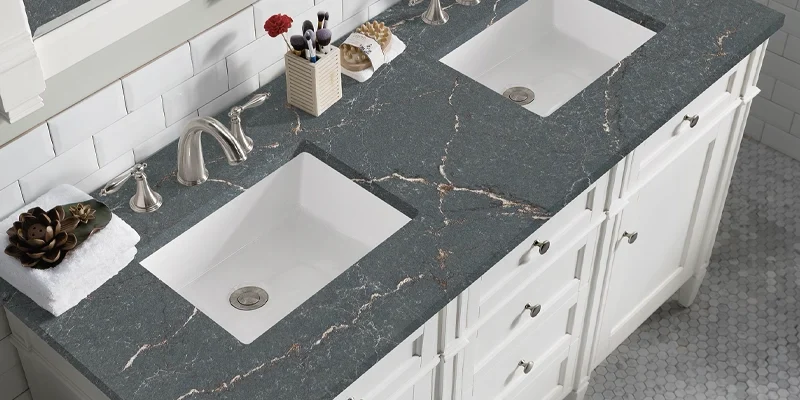
Quartz is an engineered surface, and many quartz products are non-porous and do not require routine sealing. However, cleaning recommendations can differ between manufacturers and product lines.
For everyday cleaning, use a soft cloth or non-abrasive sponge together with a cleaner permitted by the manufacturer of the installed quartz.
Routine care should focus on removing:
Engineered quartz surfaces generally do not require routine surface sealing. This is one of the reasons quartz is frequently considered where relatively straightforward vanity maintenance is a priority.
That does not mean every care rule can be ignored. Manufacturer instructions still apply to cleaning chemicals and other exposure.
Hair straighteners, curling tools and other heated styling equipment should not automatically be placed directly on a quartz vanity.
Follow the heat-exposure guidance for the selected quartz product and use an appropriate protective surface where required.
Bathroom residue does not automatically require aggressive chemicals. The manufacturer’s recommended cleaning method should be the first reference rather than experimenting with increasingly strong products.
Granite is natural stone, and its absorption characteristics can vary between individual stones and finishes.
Routine granite care should therefore combine gentle cleaning with attention to the characteristics of the actual installed stone.
Use a soft, non-abrasive cleaning tool and a cleaning product appropriate for the particular natural-stone surface.
Water, soap and cosmetic residue should be removed regularly rather than allowing repeated buildup around the sink area.
No universal annual sealing rule applies to all granite countertops.
Whether sealing is appropriate, and when the surface should be evaluated again, depends on factors such as:
A fixed calendar schedule should therefore not replace evaluation of the actual countertop.
A product that is appropriate for ceramic tile, glass or another bathroom surface should not automatically be used on granite. Check whether the cleaner is suitable for the actual natural stone before applying it to the vanity.
Mineral structure, colour variation and natural pattern are characteristics of granite. Cleaning cannot and should not make a natural slab appear completely uniform.
Marble requires more material-specific care than many manufactured vanity surfaces because it is a calcium-based natural stone and can react with acidic substances.
For routine maintenance, the objective should be to remove water, soap and personal-care residue with cleaning methods appropriate for the actual marble and finish rather than using aggressive general-purpose bathroom cleaners.
Use a soft cloth or non-abrasive sponge with a cleaner confirmed to be suitable for marble or the specific natural-stone surface.
Regularly remove:
Prompt cleaning is particularly useful because it reduces the need to use stronger products after residue has dried or accumulated.
Acidic substances can react with marble and affect the surface. Products used elsewhere in the bathroom for mineral deposits, tile or glass should therefore not automatically be used on a marble vanity.
The fact that a product is marketed as a bathroom cleaner does not establish that it is appropriate for natural marble.
Not every visible mark on marble has the same cause. A substance may leave discolouration, while acidic exposure can affect the surface finish itself. These conditions may require different responses.
Before repeatedly applying stronger cleaners to a persistent mark, it is useful to determine what type of surface change has actually occurred.
Sealing requirements depend on the individual marble, finish, previous treatment and current condition. A universal schedule such as “seal every year” should not be applied automatically to every marble vanity.
Where a sealer is appropriate, the product instructions and characteristics of the actual stone should guide its use.
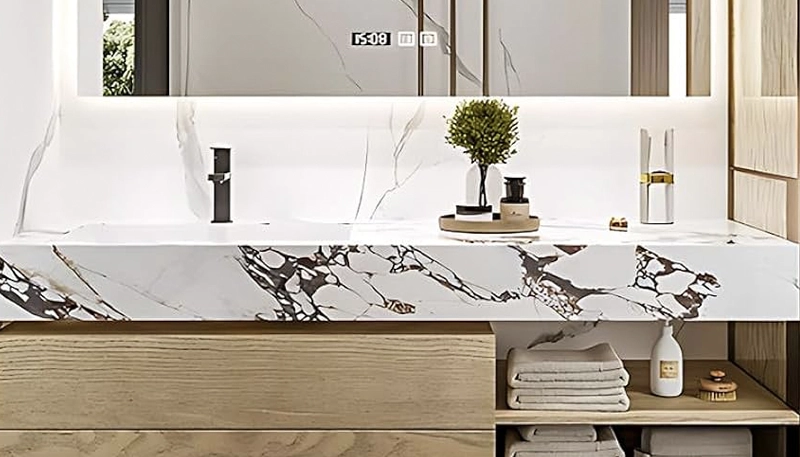
Quartzite is natural stone, and care recommendations should be based on the actual material rather than broad assumptions about every stone sold within the quartzite category.
For regular care, use a non-abrasive cloth or sponge and a cleaner appropriate for the specific natural-stone surface.
Water, toothpaste, soap and cosmetic residue should be removed regularly, particularly around sink and faucet areas where products can repeatedly accumulate.
Quartzites can vary in absorption characteristics, mineral composition and finish. Statements such as “quartzite never needs sealing” or one fixed sealing schedule for every quartzite vanity are therefore too broad to guide maintenance reliably.
The installed stone should be evaluated individually.
If the countertop was supplied with stone-specific care guidance, that information should take priority over generic online recommendations for the entire material category.
Porcelain slab countertops are manufactured surfaces, and routine care should follow the guidance for the specific product installed on the vanity.
Use non-abrasive cleaning tools and products that are appropriate for the selected porcelain surface.
Regular cleaning should remove common bathroom residue such as:
The porcelain slab surface itself generally is not maintained through routine surface sealing in the same way as some natural stones. However, the complete vanity can contain joints, edges or other materials with their own care requirements.
Product-specific guidance should therefore still be followed rather than assuming that every component of a porcelain vanity is maintained identically.
Routine cleaning should account for the entire fabricated vanity, including exposed edges, sink openings and backsplash transitions. Avoid using abrasive tools simply because the main porcelain surface is easy to clean.
Bathroom countertops are regularly exposed to products that would not normally appear on a kitchen surface. Foundation, creams, oils, serums, makeup removers and other cosmetics can contain very different ingredients.
The safest general approach is to remove spills promptly using a cleaning method approved for the countertop rather than allowing concentrated product residue to remain on the surface.
Containers can develop residue around their bases or occasionally leak. Keeping frequently used cosmetics and skincare products on a suitable tray can reduce prolonged direct contact with the countertop and simplify routine cleaning.
A product intended for skin should not automatically be considered safe for a stone or manufactured vanity surface. Wipe accidental spills using the care method appropriate for the countertop.
Soap and toothpaste are easier to remove before repeated drying creates visible buildup around sinks and faucets.
Routine wiping with an approved cleaning method is preferable to allowing residue to accumulate and then attempting to remove it with abrasive tools or aggressive chemicals.
Residue can collect where the sink and countertop meet or around exposed undermount openings. These areas should be included in routine cleaning rather than focusing only on the large flat surface.
Bathroom countertops are designed to function around sinks, but that does not mean standing water should routinely remain on the surface.
Wiping water around faucets and sink edges can help limit visible deposits and the combination of water with soap or cosmetic residue.
A visible water mark may result from dried mineral residue, product buildup or another surface condition.





Do not automatically apply an acidic descaling product to a stone vanity simply because it removes mineral deposits effectively from glass or plumbing fixtures.
Match the cleaner to the countertop, not just the stain. A product that removes mineral deposits from a faucet or shower screen may be inappropriate for the vanity surface immediately beside it.
Hair straighteners, curling irons and other heated styling tools are a common bathroom-specific consideration that should not be overlooked when caring for a vanity countertop.
Direct heat tolerance varies by material and manufactured product. A countertop should therefore not be treated as a resting surface for hot styling tools unless the applicable product guidance permits that exposure.
Where hot styling tools are regularly used at the vanity, placing them on an appropriate heat-protective surface rather than directly on the countertop provides a simple way to reduce unnecessary thermal exposure.
This is particularly important for manufactured surfaces where the manufacturer provides specific heat limitations.
Some natural-stone countertops may benefit from an appropriate sealer, but sealing should not be treated as an identical routine for every granite, marble or quartzite vanity.
Relevant factors can include:
Applying a sealer simply because a calendar date has arrived is not a substitute for understanding the countertop’s actual condition and the instructions for the product being used.
Unnecessary or unsuitable treatments can create their own surface issues. The specific stone and sealer guidance should determine the appropriate approach.
A sealer should not be interpreted as making a natural-stone vanity completely resistant to every spill, cleaner or cosmetic product.
Routine cleaning, appropriate product selection and prompt removal of spills remain important even where a stone has been treated.
The edges and transitions around a vanity often collect more residue than the open countertop surface. Routine maintenance should therefore include the details surrounding sinks and walls.
Pay attention to:
The appropriate cleaning products should still be selected according to the surfaces involved, particularly where the vanity combines stone, sink materials, metal fixtures and other finishes within a small area.
Not every visible mark on a bathroom vanity should be treated in the same way. A dried cosmetic product, mineral deposit, surface stain and natural-stone etching are different conditions and may require different responses.
Before using a stronger cleaner, first determine:
Starting with the least aggressive approved cleaning method reduces the risk of creating additional surface damage while trying to remove a mark.
Cosmetics, skincare products, toothpaste, hair products and other bathroom substances are generally easier to remove before they dry or remain on the countertop for an extended period.
Blot or wipe the product using a suitable soft cloth and then clean the area according to the care guidance for the installed surface.
Abrasive pads, powders or aggressive scraping can affect certain surface finishes. If ordinary approved cleaning does not remove the mark, first identify the material and likely cause rather than automatically increasing abrasion.
Combining household cleaning products can create unsafe chemical reactions and is not an appropriate method for treating stubborn countertop residue.
Use one cleaning approach that is suitable for the installed surface and follow its instructions.
The exact restrictions depend on the surface, but several common cleaning mistakes are worth avoiding unless the manufacturer or stone-care guidance specifically permits them.
Highly abrasive cleaning tools can affect polished or otherwise finished surfaces. Routine bathroom residue generally does not justify aggressive abrasion.
Marble and other acid-sensitive calcium-based stones can react with acidic substances. Products containing acids should therefore not be used simply because they are effective on another bathroom surface.
A cleaner designed for tile, toilets, glass or another bathroom component should not automatically be applied to a vanity countertop.
The countertop manufacturer’s instructions or material-specific care guidance should be checked first.
Curling irons, straighteners and other styling tools can become significantly hotter than normal bathroom conditions. They should not automatically be placed directly on the countertop.
Follow the surface manufacturer’s heat guidance and use an appropriate protective barrier where required.
Leaking cosmetics, oils, hair products and cleaning products can remain concentrated beneath bottles or containers. Trays or organizers can help keep these products from sitting directly on the vanity for extended periods.
A useful maintenance routine does not need to rely on rigid daily, weekly or annual rules for every material. Instead, care can be organized according to what the countertop actually needs.
As part of normal bathroom use:
Periodically clean the full countertop rather than only the most visible areas around the sink.
Pay attention to:
Natural-stone countertops can be evaluated periodically for changes in condition, absorption behaviour or other signs that professional care or resealing may need to be considered.
This is more useful than assuming every granite, marble or quartzite vanity should be resealed on the same fixed calendar.
Maintenance should respond to the actual surface. Routine cleaning can be consistent, but sealing, stain treatment and corrective care should be based on the installed material and its current condition.
The product used on glass, ceramic tile or plumbing fixtures may not be appropriate for quartz or natural stone. Countertop care should be material-specific.
Routine wiping is generally preferable to allowing soap, toothpaste and cosmetics to accumulate and then relying on more aggressive cleaning.
Natural stones differ in absorption characteristics, finish and previous treatment. Sealing decisions should be based on the actual countertop rather than a universal annual schedule.
Quartz may require relatively straightforward routine care and generally does not require sealing, but it still needs appropriate cleaning and should be used according to the selected manufacturer’s guidance.
On acid-sensitive natural stone, a dull or altered area may represent a change to the surface rather than residue sitting on top of it. Repeated cleaning will not necessarily correct that condition.
A persistent mark may require identification rather than stronger chemistry. Increasing cleaner strength without understanding the material or condition can make the problem worse.
Routine cleaning can address ordinary bathroom residue, but some conditions may justify evaluation by an appropriate stone or countertop professional.
Examples can include:
Corrective treatment depends on what caused the issue and which material is installed. A procedure suitable for one stone or manufactured surface should not automatically be transferred to another.
There is no single cleaner that is best for every vanity surface. The appropriate product depends on whether the countertop is quartz, granite, marble, quartzite, porcelain or another material and on the manufacturer or stone-care guidance for that surface.
Vinegar is acidic and should not be used on acid-sensitive natural stones such as marble. For other surfaces, follow the specific manufacturer’s cleaning instructions rather than assuming that a household cleaning mixture is universally appropriate.
Spills and visible residue should be removed as they occur, while the overall countertop can be cleaned regularly according to use. A rigid schedule is less important than preventing repeated buildup and using the correct cleaning method.
Engineered quartz surfaces generally do not require routine surface sealing. The manufacturer’s care instructions should still be followed.
There is no universal interval for all granite. The need for sealing depends on the individual stone, finish, previous treatment and current condition.
Use a gentle cleaning approach suitable for acid-sensitive natural stone and avoid acidic products. The exact cleaner should be appropriate for the installed marble and finish.
Direct heat should not automatically be considered safe for any vanity surface. Follow the manufacturer or material guidance and use an appropriate heat-protective barrier where required.
The treatment should be selected according to the countertop material. Products commonly used for mineral deposits on glass or plumbing fixtures may contain ingredients unsuitable for natural stone or certain manufactured surfaces.
Not every visible mark is the same. Some conditions may be surface residue, others may involve staining, and acid-sensitive stone can also develop etching. The appropriate treatment depends on the material and cause.
Do not assume bleach is suitable for the installed surface. Check the manufacturer’s or material-specific care guidance before using strong cleaning chemicals.
Bathroom vanity maintenance is most effective when routine cleaning is simple, consistent and appropriate for the installed surface. Water, soap, toothpaste and cosmetics should be removed before they build up, while stronger products should only be used when they are suitable for the countertop.
Quartz, granite, marble, quartzite and porcelain all have different characteristics. Understanding those differences helps avoid unnecessary damage and makes it easier to choose the right cleaning approach when a problem occurs.
Homeowners comparing surfaces for a future project can review Best Materials for Bathroom Vanity Countertops, while Teccorp Stone’s Vanity Countertops service covers custom measurement, fabrication and stone-related installation across Toronto and the GTA.