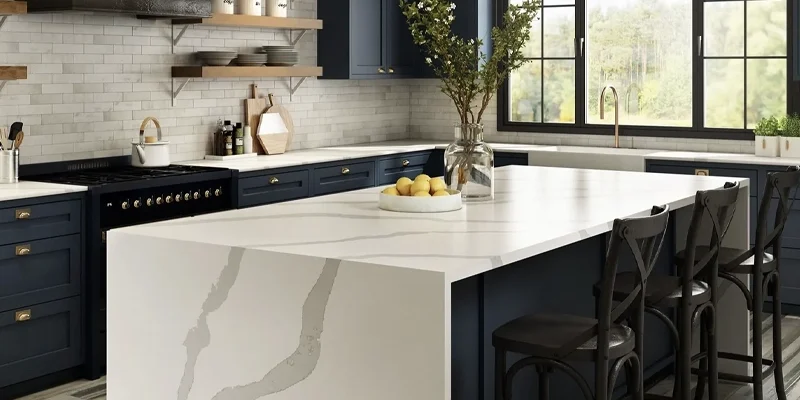
Kitchen countertops in Oshawa should be selected as part of a complete working system—not as a colour or material decision alone. The countertop must fit the cabinets, accommodate sinks and appliances, provide safe support at overhangs and withstand the way the kitchen is used every day.
Teccorp Stone provides custom countertop measurement, fabrication and installation for homeowners, contractors and renovation professionals in Oshawa. Projects can include replacement countertops, surfaces for newly installed cabinetry, custom kitchen islands and coordinating slab backsplashes. This guide explains how to compare materials, plan the project and prepare for an accurate installation.
Request a Free Quote
Explore Kitchen Countertop Services
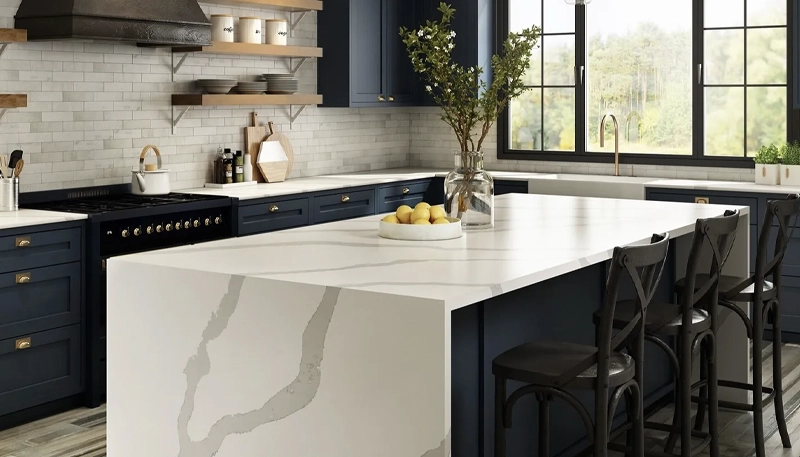
Every countertop is fabricated to a specific set of cabinets, walls and appliances. Even two kitchens with similar dimensions may require different seam locations, edge details, cutouts or support. Custom fabrication allows these conditions to be addressed before the slab is cut.
Countertop projects in Oshawa may involve replacing an existing surface while retaining the cabinets, fitting stone to newly installed cabinetry or creating an island as part of a larger kitchen renovation. Each situation requires a different approach to measurement and site preparation.
A properly planned fabrication scope may include:
The written quote should identify which of these items are included. Plumbing, electrical work, appliance connections, cabinet modifications and removal of existing surfaces may be separate unless specifically listed.
When existing cabinets are retained, they should be inspected for level, stability and damage before measurement. A new stone surface should not be expected to correct structurally weak or significantly uneven cabinets.
For a new kitchen, base cabinets, finished panels and appliance openings should be installed in their final positions before the countertop template is completed. The sink, faucet, cooktop and other countertop-mounted fixtures should also be selected early enough for their specifications to guide fabrication.
Before Countertop Measurement
Confirm that the base cabinets are secured and level, finished panels are installed, appliance openings are finalized and specifications are available for every sink, cooktop, faucet or accessory requiring a cutout.
The best countertop material depends on daily use, maintenance expectations, preferred appearance and fabrication details. Colour is important, but it should be considered alongside heat exposure, edge vulnerability, staining, cutouts and long-term care.
Quartz countertops offer consistent colours and patterns that coordinate easily with cabinets, floors and backsplashes. Their nonporous surface does not ordinarily require sealing, making quartz a practical option for frequently used family kitchens.
Quartz should not be treated as heat-proof. Trivets should be used beneath hot cookware and constant-heat countertop appliances. Exact care and temperature guidance depend on the manufacturer and product warranty.
Granite countertops provide natural colour, mineral movement and slab-to-slab variation. Each piece should be reviewed as a full slab because a small sample cannot show every vein, inclusion or transition that may appear across an island or long countertop run.
Granite generally performs well in active kitchens, but absorption varies between stones. Some slabs may benefit from an appropriate penetrating sealer, while dense varieties may require sealing infrequently or not at all. The decision should be based on the selected slab and finish—not a universal annual schedule.
Porcelain countertops provide low water absorption, strong resistance to everyday stains and a wide range of stone-, concrete- and solid-colour designs. Thin profiles and mitred edge construction can suit contemporary kitchens and waterfall islands.
Porcelain is hard but not impossible to damage. Exposed edges can chip after a heavy impact, and fabrication requires suitable equipment and experienced handling. The pattern visible on the surface may also differ from the slab body at an exposed cut edge.
Quartzite is a natural stone selected for its distinctive movement and premium appearance. Its performance, absorption and care requirements vary by slab, so the exact material should be verified rather than judged by its trade name alone.
Marble provides a classic natural-stone appearance but is more vulnerable to acid etching and visible wear. It can work for homeowners who value natural patina and understand that the surface will require more attentive care than quartz or porcelain.
| Material | Appearance | Routine Sealing | Strong Fit | Main Consideration |
|---|---|---|---|---|
| Quartz | Controlled colour and pattern | Normally not required | Busy kitchens and predictable coordination | Protect from concentrated heat |
| Granite | Unique natural variation | Depends on the slab | Natural-stone character and everyday durability | Full-slab review is important |
| Porcelain | Modern and highly controlled designs | Normally not required | Thin profiles and coordinated slab features | Edges require careful fabrication and use |
| Quartzite | Distinctive natural movement | Product-specific | Premium natural-stone islands | Verify the exact stone and care requirements |
| Marble | Classic natural veining | Often beneficial | Design-led kitchens where natural patina is accepted | Susceptible to acid etching and visible wear |
Material Selection Principle
Compare the actual slab or product—not material names alone. Confirm the finish, thickness, visible edge, maintenance instructions, warranty and suitability for the planned cutouts and overhangs before approving fabrication.
The cost of kitchen countertops in Oshawa depends on the selected slab, total material required, fabrication details and installation conditions. Two kitchens with the same visible countertop area can have different totals if one requires an additional slab, complex seams, multiple cutouts or difficult delivery access.
The following figures are preliminary installed-price ranges in Canadian dollars. They can help with early budgeting but should not replace a project-specific quotation based on the selected material and verified dimensions.
| Material | Preliminary Installed Range | Main Price Variables |
|---|---|---|
| Quartz | Approximately $75–$140+ per sq. ft. | Brand, pattern, thickness, slab yield and edge details |
| Granite | Approximately $55–$140+ per sq. ft. | Availability, rarity, natural movement, finish and usable slab area |
| 12 mm Porcelain | Approximately $95–$145 per sq. ft. | Brand, reinforcement, mitred edges and specialized fabrication |
| 20 mm Porcelain | Approximately $120–$180+ per sq. ft. | Product availability, pattern, handling, fabrication and installation |
| Quartzite | Approximately $90–$150+ per sq. ft. | Slab classification, rarity, fissures, layout and fabrication requirements |
| Marble | Approximately $90–$200+ per sq. ft. | Stone variety, veining, slab grade, finish and pattern placement |
Applicable taxes and work performed by plumbers, electricians, cabinetmakers or general contractors may be additional. Removal of existing countertops, full-height backsplashes, premium edges and unusual access conditions should also be confirmed separately.
A comparable quotation should identify the material, thickness, finish, slab quantity, measurement, fabrication, edge profile, cutouts, seams, delivery and installation. It should also state which items are excluded.
Reviewing only a square-foot rate can be misleading. For a more complete breakdown, see the kitchen countertop installation cost guide.
Budgeting Principle
Compare complete installed scopes rather than material rates alone. A quotation with templating, fabrication, cutouts, delivery and installation clearly identified is more useful than a lower rate with unclear exclusions.
Accurate fabrication begins after the kitchen is ready for a reliable template. Countertops should not be cut from preliminary cabinet drawings when finished site conditions could change the dimensions.
Base cabinets should be secured, level and arranged in their final positions. Finished end panels, fillers and island panels that affect countertop dimensions should also be installed. Appliance specifications must be confirmed for cooktops, ranges, sinks and any equipment fitted beneath or through the countertop.
During the countertop survey and measurement, the technician can record wall conditions, cabinet dimensions, cutout locations, overhangs and access limitations.




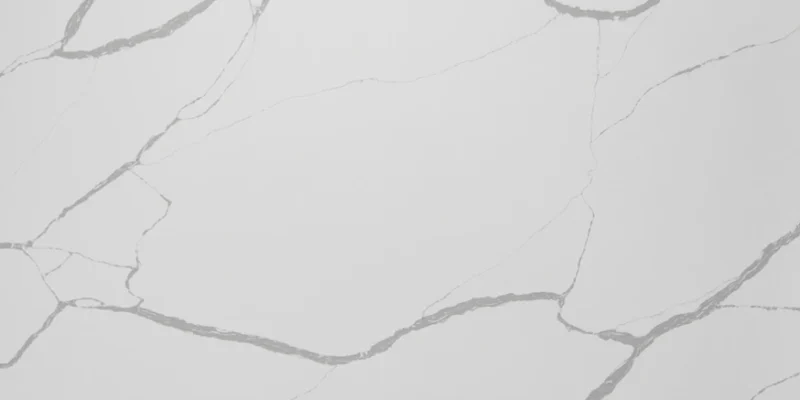


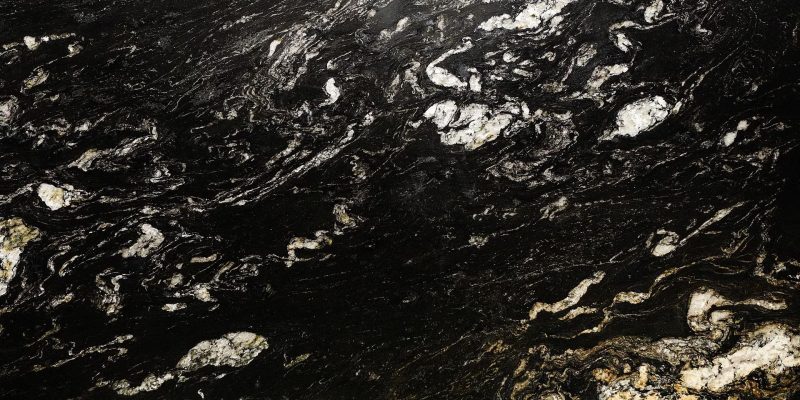


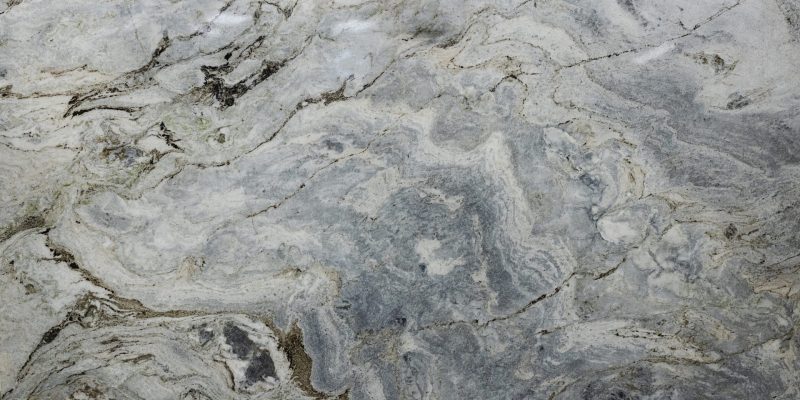


The approved measurements are used to plan parts, seams and cutouts. For strongly veined quartz, granite, porcelain, quartzite or marble, slab layout should be reviewed before cutting when the direction of movement is important.
Fabrication may include CNC cutting, sink and cooktop openings, edge finishing, mitred components and seam preparation. The appropriate method depends on the selected material and design—not every detail is suitable for every slab.
Before delivery, the route from the vehicle to the kitchen should be clear and large enough for the fabricated sections. During installation, the team positions the pieces, completes planned seams, verifies support and prepares sink mounting where included in the scope.
Plumbing and electrical reconnections should be handled by the appropriate trade. The countertop installation should be inspected before those final connections conceal access to cutouts or supports.
A kitchen island often requires more planning than a perimeter countertop because it can include seating, storage, electrical outlets, a sink, a cooktop or waterfall panels. These details affect slab selection, support and fabrication.
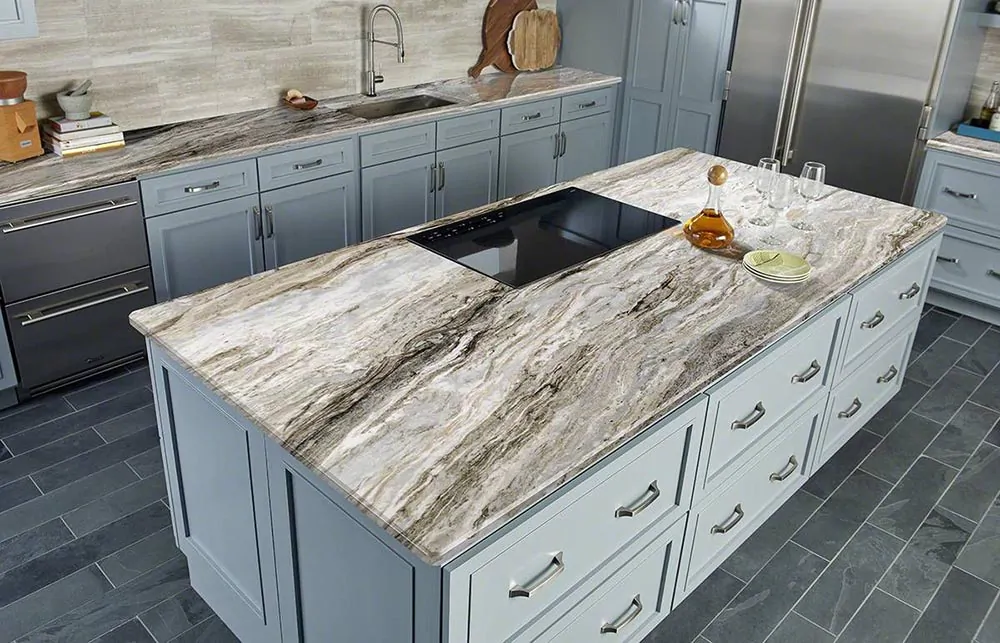
The desired island dimensions should be checked against available slab sizes and the safe delivery route. A large island is not automatically seamless. Material dimensions, pattern direction, cutouts and access may require a planned seam or a different layout.
Homeowners planning a custom island can review the dedicated kitchen island countertop service for additional guidance on materials, dimensions and fabrication.
The safe unsupported overhang cannot be determined from the material name alone. It depends on the exact product, thickness, span, cabinet construction, cutouts and expected use. Concealed brackets or steel reinforcement may be needed for deeper seating areas.
Support should be planned before templating so that brackets do not interfere with drawers, cabinet hardware, finished panels or legroom.
A waterfall island extends the countertop material vertically toward the floor. Its success depends on accurate mitred joints, slab orientation and deliberate pattern placement.
With natural stone, the actual slabs determine whether movement can continue around the edge. With porcelain or engineered patterns, the surface design may not continue through the slab body. Pattern alignment should therefore be approved using the planned pieces rather than assumed from a small sample.
Island Planning Check
Before approving an island, confirm the finished dimensions, seating depth, support, appliance or sink cutouts, slab quantity, seam location, edge construction and delivery route.
Kitchen layout affects slab usage, seam placement, installation access and material selection. A practical design should respond to the actual room and cabinet conditions instead of relying only on standard kitchen dimensions.
Existing cabinets may be retained when they are structurally sound, securely fastened and sufficiently level for the selected surface. Before measurement, inspect areas near sinks, dishwashers and cabinet joints for water damage, movement or unsupported sections.
The old countertop should not be removed until the removal responsibility and project schedule are confirmed. Early removal can leave the kitchen unusable longer than necessary, while late removal may prevent accurate inspection or templating.
Smaller kitchens can benefit from controlled seam placement, appropriately scaled patterns and simple edge profiles. Light surfaces may improve visual brightness, but colour alone should not determine the material.
Wall irregularities, appliance clearances and installation access can have a greater effect on the result than the total square footage. A well-planned seam is often preferable to an oversized fabricated piece that cannot be carried safely into the room.
In an open layout, the countertop is visible from adjoining living and dining areas. Slab movement, island orientation, cabinet colour and backsplash selection should therefore be reviewed together.
Strong veins may create an effective focal point on the island, while quieter perimeter countertops can keep the room balanced. Using different materials or colours is possible, but their thicknesses, finishes and edge details should be coordinated.
Large islands require early confirmation of slab dimensions, delivery access, seating clearances and structural support. Sinks and cooktops should be positioned with enough remaining material around their cutouts and enough working space for safe daily use.
If the island cannot be fabricated or delivered as one piece, the seam should be planned intentionally. Its position should account for pattern movement, cabinet support and high-use areas.
Providing complete information helps the fabricator prepare a more useful estimate and reduces unexpected changes later. Before requesting pricing, confirm as many of the following items as possible:
A preliminary estimate may be prepared from drawings or approximate dimensions, but final fabrication pricing should be based on the selected material, confirmed scope and approved site measurements.
Quote Comparison Tip
Ask each provider to identify the material, slab quantity, fabrication, standard and optional edges, cutouts, delivery, installation and exclusions. Similar-looking totals may represent very different scopes.
Yes. Teccorp Stone provides measurement, custom fabrication and countertop installation services for qualifying residential and renovation projects in Oshawa. Project availability and scheduling should be confirmed when requesting a quote.
Quartz is frequently selected for its nonporous surface and predictable maintenance. Porcelain can also provide low absorption and strong everyday performance. The best choice still depends on heat exposure, edge details, design preferences and budget.
Installed pricing varies by material, slab quantity, layout, edge profile, cutouts and access. The price ranges in this guide are suitable for preliminary planning, but final pricing requires a defined scope and verified dimensions.
Often, yes—provided the cabinets are secure, level and capable of supporting the selected countertop. Weak, damaged or uneven cabinets should be corrected before final measurement.
Not necessarily. Some granite slabs benefit from an appropriate sealer, while dense varieties may require it infrequently or not at all. Care should be based on the exact stone, finish and sealer guidance.
Possibly. The answer depends on island dimensions, available slab size, pattern layout, cutouts, fabrication limitations and delivery access. When a seam is necessary, it should be planned before cutting.
Final measurement should normally occur after the base cabinets, finished panels and appliance openings are installed in their final positions. Sink and appliance specifications should also be available.
The schedule depends on material availability, project complexity, approved measurements and current production capacity. The anticipated fabrication and installation dates should be confirmed in writing for the specific project.
They should not be assumed. Disconnecting or reconnecting sinks, faucets, cooktops and outlets may require qualified trades unless those services are specifically included in the written scope.
A successful countertop project begins with clear material specifications, accurate measurements and a fabrication plan that accounts for cabinets, appliances, seams, overhangs and installation access.
Planning New Kitchen Countertops in Oshawa?
Share your approximate dimensions, cabinet plan, preferred material and project requirements with Teccorp Stone. The team can help you compare slabs, define the fabrication scope and prepare a project-specific quotation.
Request a Free Quote
Kitchen Countertop Services
Browse Stone Materials