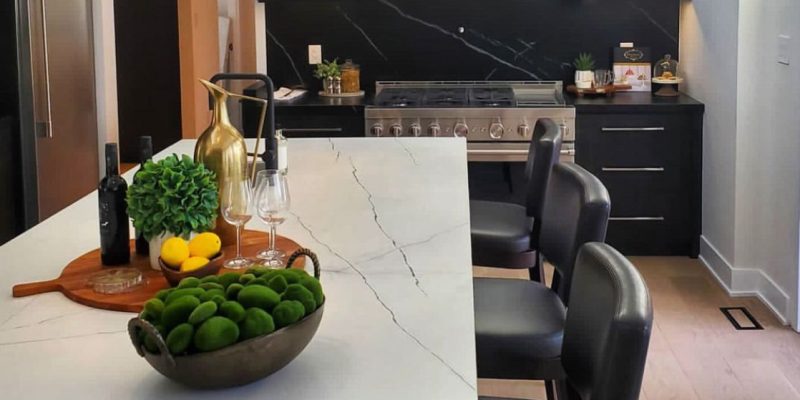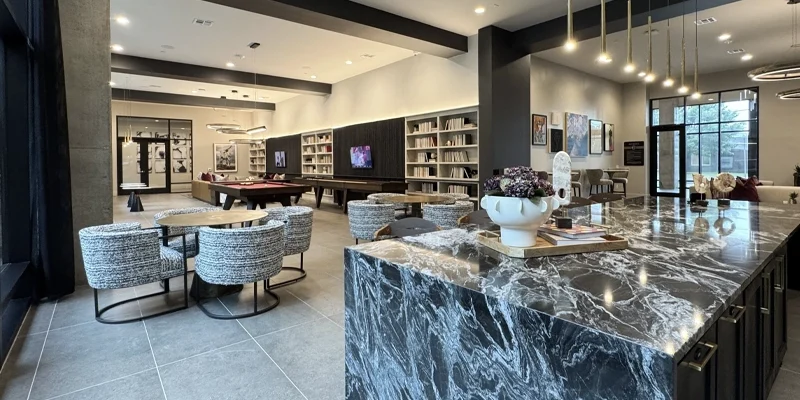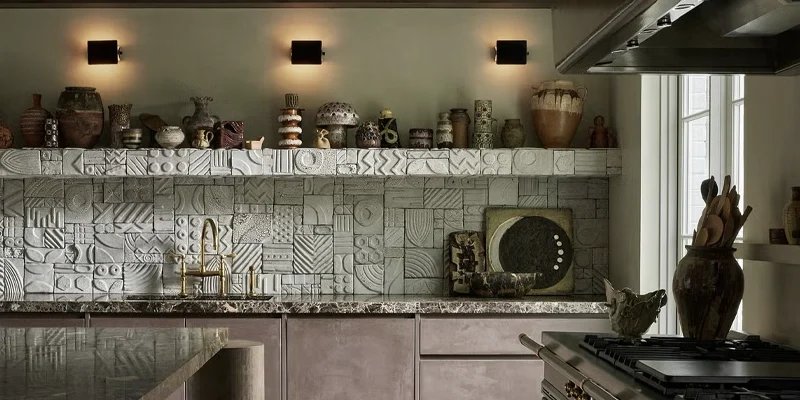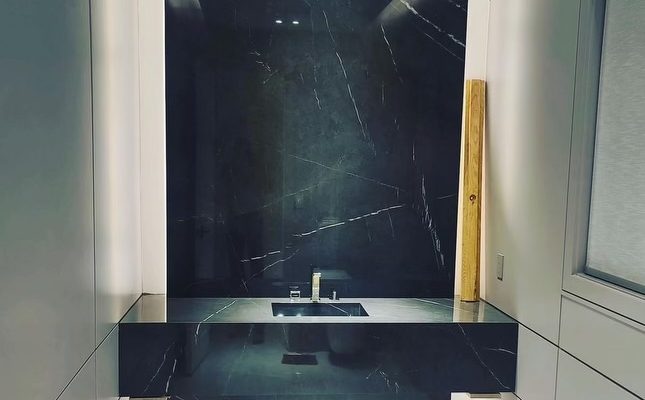
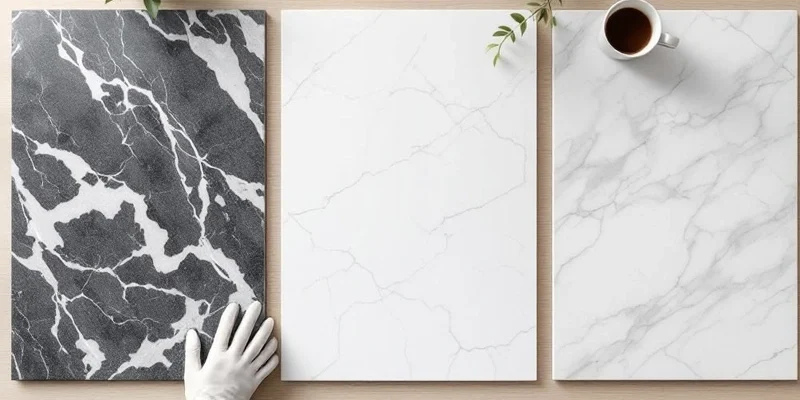
Marble vs quartz vs porcelain countertops is an important comparison for Ontario homeowners because these three premium surfaces differ significantly in composition, appearance, maintenance, heat resistance, fabrication requirements, and long-term performance.
Marble is a natural stone valued for unique veining and mineral character. Quartz is an engineered surface designed for consistent patterns, low porosity, and easier maintenance. Porcelain is a high-fired ceramic slab known for a hard, very low-porosity surface, strong heat resistance, and suitability for a wide range of horizontal and vertical applications.
The right material depends on how the kitchen will be used. Cooking habits, exposure to heat and acidic foods, design preferences, tolerance for maintenance, edge details, installation access, and project budget can all affect the final decision.
Teccorp Stone fabricates and installs premium countertop surfaces for kitchens throughout Toronto and Ontario. Comparing actual slabs, material thickness, edge construction, seam placement, cutouts, and installation requirements before ordering helps homeowners select a surface that fits both the design and daily demands of the space.
Quick Comparison
Choose marble when natural veining and luxury character are the priorities. Choose quartz when low maintenance, stain resistance, and predictable patterns matter most. Choose porcelain when high heat and UV resistance, a hard, very low-porosity surface, and thin-format design flexibility are important—and specialist fabrication is available.
The following table summarizes the main differences Ontario homeowners should evaluate before choosing among marble, quartz, and porcelain countertops.
| Comparison Factor | Marble Countertops | Quartz Countertops | Porcelain Countertops |
|---|---|---|---|
| Material Type | Natural metamorphic stone cut from individual slabs | Engineered surface made with quartz minerals, resins, pigments, and other components | High-fired ceramic slab made from refined mineral and clay-based materials |
| Appearance | Natural veining, mineral depth, translucency, and unique variation | Controlled colours, predictable patterns, and broad design selection | Printed stone, concrete, metal, solid-colour, and other high-definition designs |
| Pattern Consistency | Varies naturally within and between slabs | Generally more consistent across slabs and sections | Controlled surface design, although pattern placement and slab variation should still be reviewed |
| Scratch Resistance | Moderate; softer and more vulnerable to visible wear | Strong under normal residential use | Very strong surface resistance, but not completely scratch-proof |
| Chip and Edge Resistance | Edges can chip under concentrated impact | Corners and cutout edges remain vulnerable to heavy impact | Hard surface, but thin edges and corners may chip if struck or poorly fabricated |
| Stain Resistance | Depends on porosity, sealing, and spill response | Strong because the surface is non-porous | Strong due to very low water absorption and low surface porosity |
| Heat Resistance | Generally good, but trivets are still recommended | More sensitive to direct or prolonged heat because of resin content | High material heat resistance, although trivets still protect seams, edges, adhesives, and finishes |
| Etching Risk | Sensitive to acids such as lemon juice, vinegar, wine, and tomatoes | Does not etch like calcite-based marble, but unsuitable chemicals can damage the surface | Does not etch like marble, although manufacturer-approved cleaning products should be used |
| UV Resistance | Natural stone can be used in some sun-exposed applications with appropriate selection and detailing | Many standard products are intended primarily for interior use and may change under prolonged UV exposure | Generally strong, subject to the product manufacturer’s exterior-use approval |
| Moisture Resistance | Improved with an appropriate penetrating sealer | Strong because the surface is non-porous | Strong because of very low water absorption |
| Maintenance | Higher; careful cleaning and periodic sealing may be required | Low; no sealing required | Low; routine cleaning with compatible products |
| Sealing | Commonly recommended depending on the slab and finish | Not required | Generally not required |
| Repairability | Some scratches, chips, stains, and finish damage may be professionally treated or refinished | Small chips may be repaired, but colour and pattern matching can be difficult | Repairs can be difficult to conceal, particularly on printed patterns and exposed edges |
| Fabrication Complexity | Requires natural-stone handling, slab inspection, and detailed vein planning | Professional slab fabrication with manufacturer-appropriate tooling and handling | Specialized cutting, drilling, handling, edge fabrication, and installation are especially important |
| Relative Cost | Mid-range to luxury, depending on variety, origin, and rarity | Mid-range to premium, depending on brand and design collection | Mid-range to premium, with final cost strongly affected by specialist fabrication |
| Expected Service Life | Long-lasting with appropriate care and acceptance of natural patina | Long-lasting under normal residential use and proper heat protection | Long-lasting when properly fabricated, supported, installed, and protected from edge impact |
| Best Suited For | Luxury kitchens, statement islands, baking areas, and feature surfaces | Busy kitchens, condos, rental properties, and low-maintenance renovations | Contemporary kitchens, thin-format details, backsplashes, wall panels, and approved exterior applications |
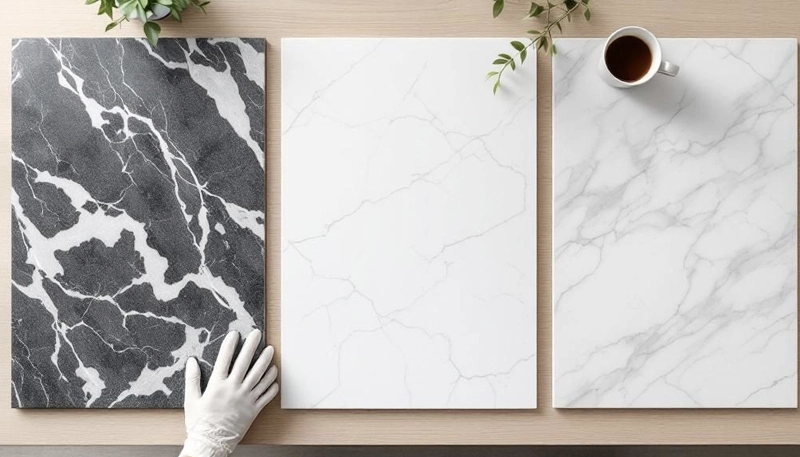
Marble, quartz, and porcelain are produced in fundamentally different ways. Marble is quarried natural stone, quartz is an engineered mineral-and-resin surface, and porcelain is a high-fired ceramic material manufactured in slab form.
These differences influence not only appearance but also thickness, edge design, heat response, maintenance, repairability, fabrication methods, and suitability for horizontal or vertical applications.
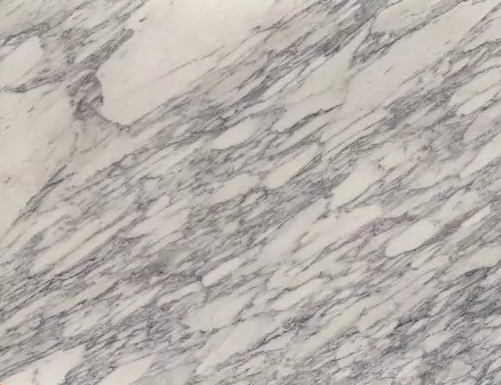
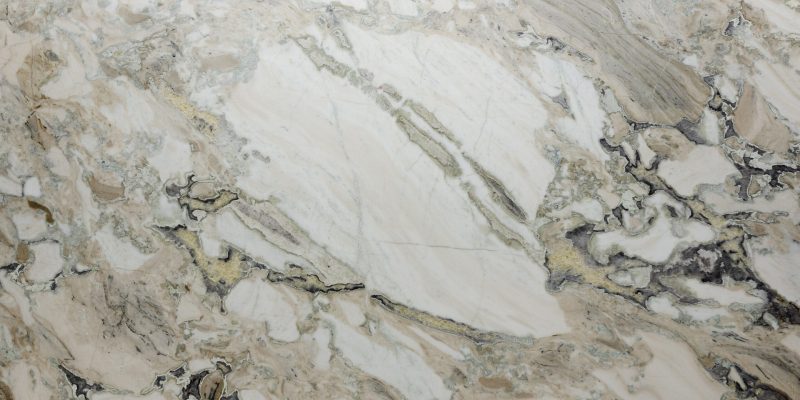
Marble is a natural metamorphic stone formed when limestone is transformed by heat and pressure beneath the Earth’s surface. It is quarried in blocks and cut into slabs, with each slab displaying unique veining, mineral deposits, colour movement, and natural variation.
Marble is primarily composed of calcite. This composition creates its characteristic depth and softness but also makes the stone sensitive to acidic foods and cleaning products.
Lemon juice, vinegar, wine, tomatoes, and similar substances can chemically react with marble and leave dull marks known as etching. Etching is different from staining and cannot be prevented by sealing.
Marble is also porous and may absorb liquids if it is not appropriately sealed. A suitable penetrating sealer helps reduce staining, but spills should still be cleaned promptly.
The material is best suited to homeowners who value authentic natural variation and accept that patina, light scratches, etching, and other signs of use may develop over time.
Quartz countertops are engineered surfaces manufactured from quartz minerals combined with resin binders, pigments, and other components. The production process creates a dense, non-porous slab with controlled colour and pattern.
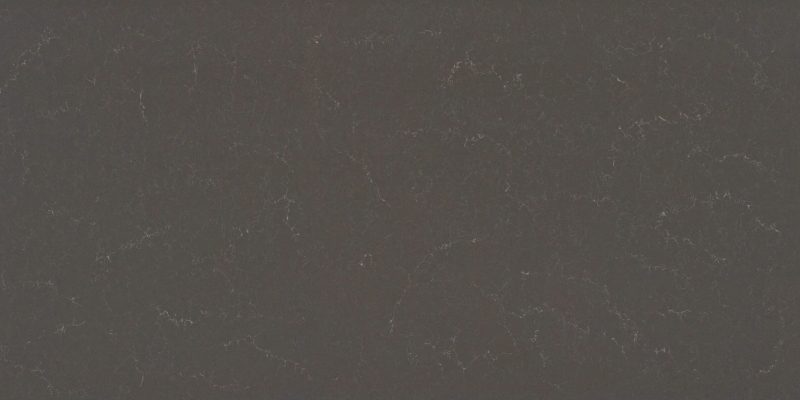
Quartz is available in solid colours, fine-grained patterns, concrete-inspired finishes, terrazzo-style designs, and surfaces that recreate the visual character of marble or other natural stones.
Because the material is engineered, quartz usually provides greater consistency across separate countertop sections and multiple slabs. This can simplify coordination between perimeter countertops, islands, waterfall panels, and full-height backsplashes.
The non-porous surface does not require sealing and offers strong resistance to common kitchen spills. Quartz is therefore well suited to busy family kitchens, condos, rental properties, and homeowners who prefer predictable maintenance.
Quartz is not heat-proof or universally suitable for exterior use. Direct heat can affect its resin components, and prolonged UV exposure may affect products that are designed primarily for interior applications.
Porcelain countertops are manufactured from refined clay-based and mineral materials that are compacted and fired at very high temperatures. The result is a dense ceramic slab with very low water absorption and a hard, low-porosity surface.
Some porcelain products may be marketed as ultra-compact, sintered, or similar high-performance surfaces, but product composition and manufacturing processes vary. The manufacturer’s technical information should be reviewed rather than treating all porcelain slabs as identical.
Porcelain offers strong resistance to staining, heat, moisture, and UV exposure. These characteristics make approved products suitable for kitchens, backsplashes, wall cladding, fireplace surrounds, and certain exterior applications.
The material’s hard surface does not eliminate damage risk. Porcelain edges and corners can chip under concentrated impact, and thin slabs require careful transport, cutting, support, and installation.
Porcelain fabrication also requires appropriate blades, drilling methods, handling techniques, and experienced installers. Material selection should therefore consider both the slab itself and the fabricator’s ability to work with the selected product.
Marble, quartz, and porcelain can all create high-end interiors, but their visual character is different. Marble provides natural geological variation, quartz provides engineered consistency, and porcelain uses advanced surface design to reproduce stone, concrete, metal, and other finishes.
Marble is selected for natural veining, mineral depth, translucency, and one-of-a-kind variation. No two slabs are identical, and separate areas of the same slab may look substantially different.
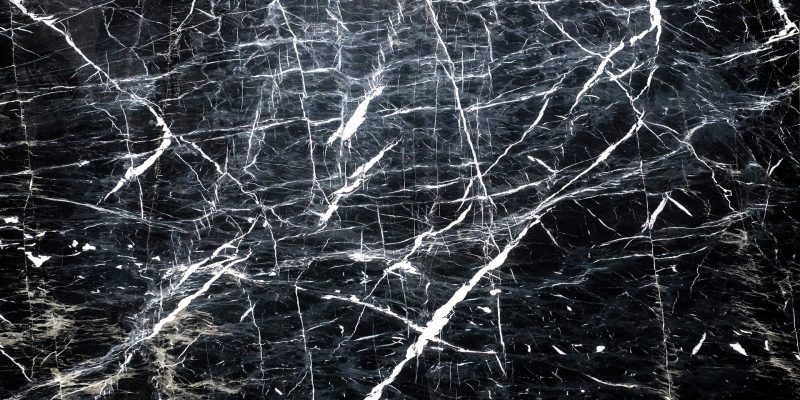
White and light-grey marble can create a refined and timeless appearance, while darker, green, beige, brown, and richly veined varieties can produce more dramatic feature surfaces.
Marble is especially effective for statement islands, baking areas, bookmatched backsplashes, waterfall panels, fireplace surrounds, and other high-visibility applications where the stone becomes a central design element.
Detailed slab planning is essential. Vein direction, focal areas, seams, sink and cooktop cutouts, edge details, and connected vertical panels should be reviewed before fabrication.
Quartz offers a broad range of whites, greys, warm neutrals, dark colours, concrete-inspired finishes, subtle patterns, and dramatic marble-look designs.
The engineered manufacturing process provides greater control over colour, pattern scale, and overall consistency. This is useful in kitchens where multiple countertop sections must maintain a coordinated appearance.
Quartz can support modern eased edges, mitred profiles, waterfall panels, and full-height backsplashes. Designs with large or directional veining still require pattern and seam planning.
Although quartz is more predictable than natural marble, slabs and production batches may still vary. Actual slabs should be reviewed when a project requires several pieces or continuous pattern movement.
Porcelain slabs are available in marble-look, stone-look, concrete, metal, wood-inspired, solid-colour, textured, polished, and matte designs. High-resolution printing allows manufacturers to reproduce complex patterns across large-format surfaces.
Many porcelain designs are applied primarily to the visible surface. As a result, the pattern may not continue through a cut edge in the same way as natural stone. This distinction becomes important for exposed edges, grooves, sink cutouts, and mitred details.
Some porcelain products are manufactured with colour or pattern extending further through the slab. These through-body or full-body products may create more consistent exposed-edge details, but this characteristic should be confirmed for the specific collection.
Porcelain’s availability in thinner formats can make it useful for wall panels, full-height backsplashes, cabinet cladding, fireplace surrounds, and other applications where lower weight or a slim profile is desirable.
The final appearance depends on print scale, finish, slab thickness, pattern repetition, edge construction, seam placement, lighting, and installation quality. Full-slab viewing remains important, particularly for large-vein designs.
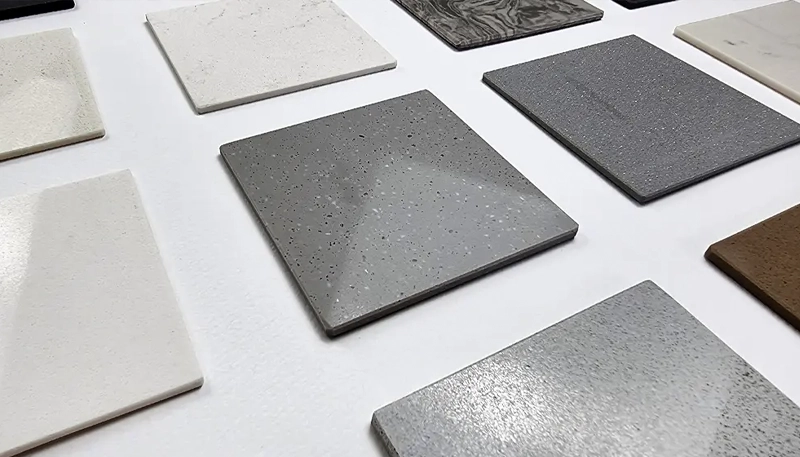
Homeowners comparing premium stone options can review the marble countertop collection and quartz countertop collection.
Marble, quartz, and porcelain can all perform well in residential kitchens, but they respond differently to scratches, impacts, stains, heat, acidic foods, UV exposure, and edge damage. Porcelain has a very hard surface, quartz offers balanced everyday durability, and marble requires the most acceptance of visible wear and natural aging.
Porcelain provides very strong resistance to everyday surface scratching because it is fired at high temperatures and has a hard ceramic surface. However, it should not be described as completely scratch-proof. Abrasive debris, unsuitable tools, or concentrated force may still affect the finish.
Quartz also offers strong scratch resistance under normal residential use. Sharp knives, abrasive pads, heavy cookware, and dragging rough objects can still damage or dull the surface.
Marble is softer and more vulnerable to scratching, abrasion, and visible wear. Cutting directly on the stone, dragging cookware, or using abrasive cleaning products can leave marks. Honed marble may make minor scratches and patina less noticeable than polished marble.
Cutting boards should be used on all three materials. This protects the countertop and prevents unnecessary damage to knives, finishes, and exposed edges.
Surface hardness and edge durability are not the same. Porcelain has a hard wear surface, but exposed edges, corners, sink cutouts, and thin sections can chip under concentrated impact.
Proper fabrication is especially important with porcelain. Incorrect cutting speeds, unsuitable blades, unsupported cutouts, sharp internal corners, or poor handling can increase the risk of cracking and edge damage.
Quartz edges and corners can also chip when struck by heavy cookware or appliances. Narrow sections around sinks and cooktops require appropriate support and careful fabrication.
Marble is softer and can chip at exposed edges, corners, cutouts, and decorative profiles. Some minor damage may be professionally repaired, but colour and vein matching are not always invisible.
Important Porcelain Distinction
Porcelain combines a hard, scratch-resistant surface with more vulnerable edges and corners. Fabrication quality and edge protection are therefore central to long-term performance.
Quartz is non-porous and provides strong resistance to common kitchen spills such as coffee, wine, oils, sauces, and food colouring. It does not require sealing, although spills should still be cleaned promptly.
Porcelain has very low water absorption and strong resistance to staining. Routine kitchen spills usually remain on the surface rather than penetrating the material.
Marble is naturally porous and may absorb liquids if it is not appropriately sealed. Oil, wine, coffee, spices, and strongly coloured foods should be wiped up promptly.
A penetrating sealer can help reduce marble staining but does not make the stone completely stain-proof. Moisture performance also depends on seams, sink cutouts, caulking, adhesives, and installation quality.
Porcelain has high material heat resistance and generally performs better than quartz when exposed to elevated temperatures. However, hot cookware should still be placed on trivets to protect seams, adhesives, edge details, finishes, and surrounding cabinetry.
Marble also tolerates heat relatively well as a natural mineral surface. Direct placement of hot pans is still not recommended because sudden temperature changes may affect the stone, sealer, seams, or installation components.
Quartz is more sensitive to direct and prolonged heat because of the resin binders used in its manufacture. Hot pans, electric skillets, air fryers, slow cookers, and other heat-producing appliances should be placed on protective pads.
Heat Protection Rule
Porcelain and marble generally tolerate heat better than quartz, but trivets should be used on all three materials. Heat resistance does not eliminate risks to seams, adhesives, edges, sealers, or nearby finishes.
Marble is primarily composed of calcite and reacts chemically with acidic foods and cleaners. Lemon juice, vinegar, wine, tomatoes, and similar substances can leave dull marks known as etching.
Etching is different from staining. Staining changes the colour of the stone through absorption, while etching changes the surface finish through a chemical reaction. Sealing helps reduce staining but does not prevent etching.
Quartz does not etch in the same way as calcite-based marble, but strong solvents, highly alkaline cleaners, paint removers, and abrasive products can damage or dull the surface.
Porcelain is generally resistant to common household acids and cleaning agents, but manufacturer-approved products should still be used. Harsh abrasives or unsuitable chemicals may affect polished finishes, decorative treatments, grout, seams, or surrounding materials.
Porcelain generally provides strong UV resistance and can be suitable for exterior kitchens, balconies, patios, and sun-exposed applications when the specific product is approved for outdoor use.
The complete installation must also be suitable for exterior conditions. Adhesives, support systems, substrate preparation, joints, edge details, freeze-thaw exposure, drainage, and installation methods all matter.
Many standard quartz products are intended primarily for interior use. Prolonged UV exposure may affect colour or resin performance, so exterior suitability must be confirmed with the manufacturer.
Marble may be used in some exterior applications, but the correct stone, finish, thickness, installation system, and exposure conditions must be evaluated. Weathering, staining, surface changes, and freeze-thaw conditions may affect long-term appearance.
Quartz and porcelain are both low-maintenance surfaces, while marble requires more careful cleaning and periodic evaluation of its sealer. The correct care routine should always reflect the selected product, finish, and manufacturer or fabricator guidance.
Marble commonly benefits from periodic sealing, although the appropriate schedule depends on the slab, finish, porosity, sealer, and level of kitchen use. A fixed annual schedule should not be applied to every marble countertop.
Daily cleaning should be completed with warm water, mild soap, or a pH-neutral stone cleaner. Vinegar-based cleaners, acidic products, abrasive powders, and harsh chemicals should be avoided.
Spills involving citrus, wine, coffee, oil, tomatoes, and strongly coloured ingredients should be cleaned promptly. Cutting boards, coasters, trivets, and protective mats help reduce staining, etching, and visible wear.
Honed marble may conceal light etching and scratches more effectively than polished marble. The finish should be selected based on the homeowner’s expectations for aging and patina.
Quartz can normally be cleaned with warm water, mild soap, and a soft cloth. Because it is non-porous, it does not require sealing.
Abrasive pads, highly alkaline cleaners, strong solvents, paint removers, and direct heat should be avoided. Cutting boards and trivets help protect the surface and resin components.
Care instructions can vary by quartz brand, so the manufacturer’s recommendations should be followed for cleaning products, stain treatment, and heat exposure.
Porcelain generally requires routine cleaning with warm water, mild soap, and a soft cloth. It does not usually require sealing because of its low water absorption.
Manufacturer-approved cleaners should be used for the selected finish.


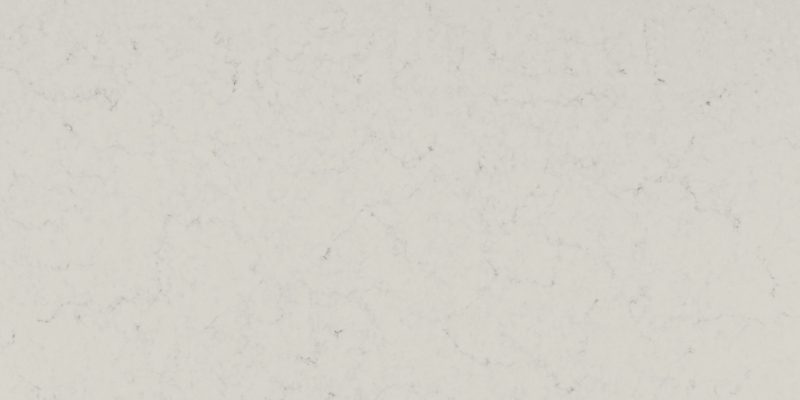


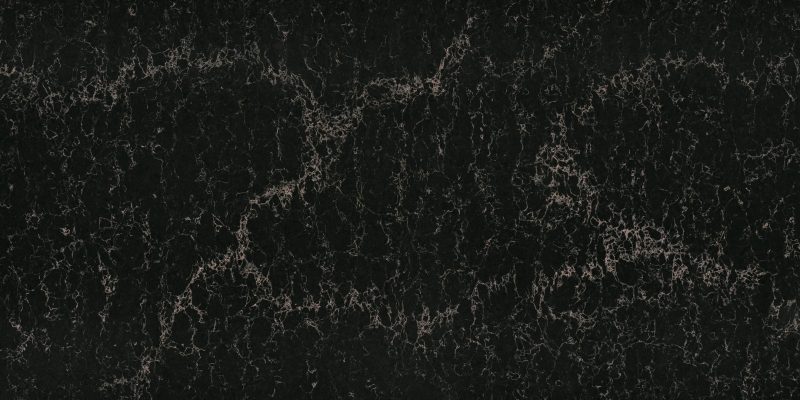





Special attention should be given to exposed edges, mitred corners, sink cutouts, and narrow sections. Avoid striking these areas with heavy cookware or appliances.
Damage to a porcelain edge or printed pattern can be difficult to conceal. Preventive handling is therefore more effective than relying on local repair.
The installed cost of marble, quartz, and porcelain countertops in Ontario depends on material selection, slab size, thickness, kitchen dimensions, fabrication complexity, edge details, cutouts, installation access, and the experience required to work with the chosen product.
| Material | General Price Position | Main Cost Drivers | Ongoing Maintenance | Installation Considerations |
|---|---|---|---|---|
| Quartz | Mid-range to premium | Brand, collection, colour, pattern, slab size, thickness, and fabrication details | Low; no sealing required | Professional slab fabrication, support, transport, and installation |
| Marble | Mid-range to luxury | Variety, origin, rarity, veining, slab quality, finish, and layout complexity | Moderate to high, depending on sealing and care expectations | Natural-stone inspection, vein planning, careful handling, and sealing |
| Porcelain | Mid-range to premium | Brand, thickness, finish, pattern, slab format, edge design, and specialist fabrication | Low; generally no sealing required | Specialized cutting, drilling, handling, edge fabrication, transport, and installation |
This table compares relative price positions rather than fixed rates. Final quotations vary according to the selected product, project dimensions, fabrication requirements, removal work, property access, and regional labour conditions.
Quartz and porcelain often overlap in price, but their cost structures are different. Quartz pricing is usually organized by brand and design collection, while porcelain cost can be affected heavily by slab thickness, specialist tooling, edge construction, and installation complexity.
A porcelain slab may appear competitively priced as a material, but detailed mitred edges, sink fabrication, drilling, large panels, or specialist handling can increase the final installed cost.
Quartz may provide more predictable fabrication for standard kitchen layouts, while porcelain may offer additional value for thin profiles, full-height wall panels, UV-exposed areas, and high-heat applications.
Marble pricing varies widely according to variety, origin, rarity, veining, slab quality, and finish. Common marble may overlap with porcelain pricing, while rare or highly distinctive slabs can cost substantially more.
Porcelain pricing is generally driven by brand, slab format, finish, thickness, pattern, and specialist fabrication. Large-format panels and complex edge details may increase labour requirements.
The better value depends on whether the homeowner prioritizes authentic natural stone and repairable patina or lower maintenance, UV resistance, and thin-format design flexibility.
Quartz usually has more predictable pricing, while marble varies substantially by stone type and slab characteristics. Premium quartz can exceed the price of common marble, while rare marble may cost significantly more than most quartz collections.
For a complete two-material comparison covering appearance, durability, maintenance, fabrication, and value, read our marble vs quartz countertops in Ontario guide.
The total project price may be influenced by:
Professional measurement is required before a final quotation can be confirmed. Teccorp Stone’s countertop survey and measurement service records dimensions, wall conditions, appliance locations, overhangs, seams, support requirements, and installation access before fabrication begins.
Quartz generally has low ongoing maintenance costs, but visible chips or heat damage may be difficult to repair perfectly because colour and pattern matching can be challenging.
Marble requires more maintenance, but some scratches, stains, and finish damage may be professionally treated or refinished. Homeowners who accept patina may keep the same surface in service for many years.
Porcelain requires little routine maintenance, but edge chips or damage to a printed surface may be difficult to conceal. Replacement risk depends heavily on fabrication quality, edge design, installation support, and protection from concentrated impact.
The best long-term value depends on initial fabrication quality, expected ownership period, kitchen use, maintenance tolerance, repair expectations, and whether the selected material suits the application.
Marble, quartz, and porcelain all require professional fabrication, but porcelain presents different tooling, handling, edge, and support requirements. Material thickness and edge construction should be considered before the visual design is finalized.
Marble and quartz countertops are commonly fabricated from thicker slabs that provide visible material depth at exposed edges. Their weight requires strong cabinets, controlled transport, and careful installation.
Porcelain is available in thinner formats that can reduce material weight and support vertical applications. Thinness does not mean the slab is easy to handle. Large porcelain panels can flex during transport and may crack if handled or supported incorrectly.
Large sections with sink or cooktop cutouts are vulnerable across all three materials. Handling plans should account for slab size, openings, narrow strips, carrying routes, and installation access.
Porcelain requires blades, drilling methods, cutting speeds, support systems, and handling procedures that are suitable for the selected product.
Improper fabrication can cause edge chipping, hairline cracking, rough cutouts, or breakage during transport. Internal corners and cutouts should be designed to reduce concentrated stress.
Experienced porcelain fabrication is especially important for undermount sinks, mitred edges, waterfall panels, integrated grooves, and large-format wall installations.
The selected manufacturer’s fabrication manual should be followed because product thickness, reinforcement, mesh backing, edge requirements, and approved tooling may vary.
Marble requires detailed vein planning because each slab is unique. Focal sections, seams, waterfall panels, backsplashes, and connected surfaces should be reviewed before cutting.
Quartz is more consistent, but large or directional patterns still require thoughtful alignment across seams, islands, and vertical panels.
Porcelain designs are often printed across the visible surface. Pattern repetition, slab orientation, edge appearance, and the relationship between connected panels should be reviewed before fabrication.
Bookmatching or continuous pattern effects depend on the manufacturer’s available slab faces and the project layout. These effects should not be assumed without confirming the actual slabs.
Marble and quartz can support eased edges, bevels, decorative profiles, mitred details, undermount sinks, polished cutouts, and waterfall panels.
Porcelain is often used with simple eased edges or mitred edge construction that creates the appearance of a thicker slab. The printed surface may not continue naturally through an exposed cut edge unless the selected product has through-body colour or pattern.
Porcelain sink cutouts require careful corner design, support, and polishing. Sharp internal corners or unsupported narrow sections may increase cracking risk.
Seams can be positioned and colour-matched to reduce visibility, but they do not disappear completely. Material variation, pattern direction, edge construction, lighting, and installation quality all affect the final appearance.
Cabinets must be level, stable, and capable of supporting the selected countertop system. Large overhangs, unsupported spans, islands, wall panels, and waterfall sections may require additional reinforcement.
Thin porcelain slabs may require a specific substrate or support system depending on the product and application. Installation requirements should be confirmed before cabinetry and countertop fabrication are finalized.
Toronto and GTA properties may also present access restrictions. Elevators, loading schedules, hallway dimensions, stairs, parking limitations, and carrying distances can affect section size and seam placement.
These conditions should be recorded before fabrication so large marble, quartz, or porcelain pieces can be transported and installed safely.
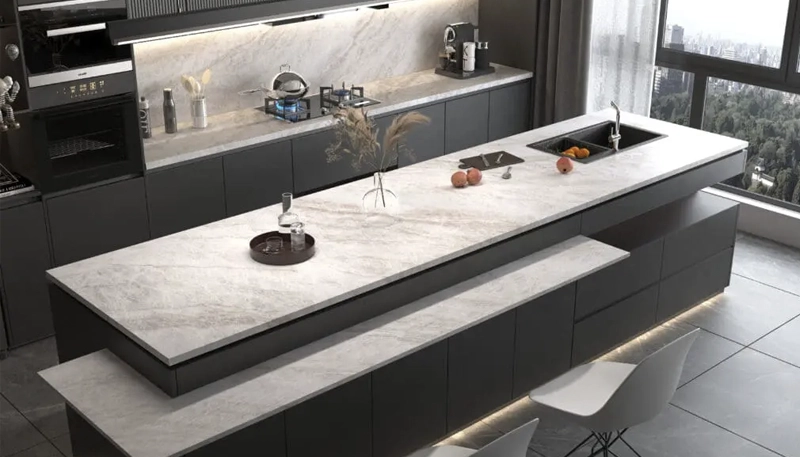
For custom islands, backsplashes, waterfall panels, wall cladding, and detailed slab work, homeowners can review Teccorp Stone’s custom stone fabrication services and kitchen countertop services.
The best countertop depends on how the kitchen is used, the desired appearance, the homeowner’s maintenance tolerance, installation conditions, and overall budget. Quartz is usually the most balanced option for everyday use, marble is best suited to design-led projects that prioritize natural character, and porcelain is especially useful when heat resistance, UV stability, thin formats, or vertical applications are important.
Marble is generally the best fit for homeowners who value authentic natural beauty and understand its maintenance requirements. Its strongest applications are luxury kitchens, feature islands, baking areas, backsplashes, and other surfaces where visual character is more important than low-maintenance performance.
Quartz is usually the strongest all-around choice for homeowners who want a balance of durability, design flexibility, maintenance, and long-term usability. It performs particularly well in family kitchens, condos, rental properties, and resale-focused renovations.
Porcelain is a strong option for contemporary kitchens, high-heat areas, vertical applications, and projects that benefit from thin slab formats. Its performance depends heavily on correct product selection, specialist fabrication, edge design, support, and installation quality.
Simple Decision Rule
Choose marble for natural luxury, quartz for balanced low-maintenance performance, and porcelain for heat, UV, thin-format, and vertical-surface flexibility.
Each material performs best in different applications. Matching the countertop to the space, level of use, exposure conditions, and design goal is more useful than selecting one material as the universal winner.
Quartz is usually the most practical choice for busy family kitchens because it is non-porous, stain-resistant, and does not require sealing. It works well around sinks, food-preparation areas, coffee stations, and islands used for dining or homework.
Porcelain can also perform very well in active kitchens because of its hard surface, low water absorption, and heat resistance. However, edge details, sink cutouts, and exposed corners must be fabricated and protected carefully.
Marble can still be used in a family kitchen, but it requires faster spill cleanup and greater protection from acidic foods, scratches, and heavy impacts.
Quartz is often the safest option for Toronto condos because it combines low maintenance, predictable appearance, and broad buyer appeal. Its consistent patterns also work well in compact open-concept kitchens.
Porcelain may suit condos where thin profiles, large-format backsplashes, or contemporary wall applications are part of the design. Building access and transport routes should be evaluated before large panels are fabricated.
Marble is less common in standard rental properties because of its care requirements, but it can be appropriate for luxury condos where natural stone and premium detailing are expected.
Marble is especially effective for statement islands, waterfall panels, bookmatched backsplashes, and other feature surfaces where natural veining becomes the central design element.
Quartz can create a luxury appearance with lower maintenance, particularly when the selected design includes large-format veining, mitred edges, or coordinated full-height backsplashes.
Porcelain can support contemporary statement islands, slim profiles, mitred edge construction, and large-format surfaces. Its printed pattern and edge treatment should be reviewed carefully before fabrication.
Homeowners planning a feature island can review Teccorp Stone’s kitchen island countertop fabrication and installation service.
Porcelain is particularly useful for full-height backsplashes, wall panels, fireplace surrounds, cabinet cladding, and other vertical applications because thin slabs can reduce weight while providing a continuous decorative surface.
Quartz is also widely used for full-height backsplashes and waterfall panels when the project requires coordinated colour and pattern across horizontal and vertical surfaces.
Marble can create highly distinctive backsplashes and feature walls, especially when vein matching or bookmatching is part of the design. Natural fissures, slab weight, and anchoring requirements must be considered.
For coordinated vertical applications, Teccorp Stone provides kitchen stone backsplash fabrication and installation.
Porcelain is generally the strongest candidate for outdoor or highly sun-exposed applications because many products offer strong UV, heat, moisture, and weather resistance.
Exterior suitability must be confirmed for the exact product. The installation system, substrate, adhesives, joints, drainage, edge details, support, and freeze-thaw exposure must also be appropriate for Ontario conditions.
Many standard quartz products are intended primarily for interior use and may change under prolonged UV exposure. Exterior use should not be assumed without written manufacturer approval.
Marble may be used outdoors in selected applications, but weathering, staining, surface changes, moisture, and freeze-thaw cycles can affect its appearance and performance.
Long-term value depends on more than the initial material price. Maintenance, fabrication quality, repairability, expected ownership period, resale perception, and suitability for the application all affect the final result.
Quartz generally provides predictable ownership costs because it does not require sealing and only needs routine cleaning with compatible products.
Marble may require sealing, professional refinishing, stain treatment, or other natural-stone care. Its value is strongest when the homeowner appreciates patina and accepts that the surface will age naturally.
Porcelain usually requires little routine maintenance, but specialist fabrication can increase the initial installed cost. A lower-priced slab does not necessarily produce a lower project cost when edge construction, cutouts, handling, and installation are complex.
Marble offers the greatest potential for professional refinishing of surface wear, light scratches, and some finish damage. Stain removal and local chip repair may also be possible, although results vary.
Quartz chips can sometimes be repaired, but colour and pattern matching may remain visible. Heat damage and large cracks can be difficult to correct without replacing a section.
Porcelain surface repairs and edge-chip repairs can be difficult to conceal, especially on printed patterns or exposed mitred edges. Proper fabrication and impact prevention are therefore critical.
Quartz usually has the broadest resale appeal because buyers associate it with low maintenance, stain resistance, and contemporary design.
Marble can create stronger perceived value in luxury properties where natural stone, custom fabrication, and distinctive veining are expected. Some buyers may still view etching and maintenance as disadvantages.
Porcelain can add value in contemporary and design-led properties, particularly when used for large-format surfaces, slim profiles, full-height backsplashes, or approved exterior applications. Buyer familiarity may vary by market and product type.
Yes. Different materials can be combined when their colours, patterns, thicknesses, edge details, finishes, and intended functions are coordinated carefully.
Examples include:
Mixed-material kitchens should look intentional. Cabinetry, flooring, backsplash, lighting, edge profiles, pattern direction, and slab thickness should be reviewed together before fabrication begins.
There is no universal winner. Quartz is usually the most balanced low-maintenance option, marble provides the strongest natural-stone character, and porcelain offers high heat and UV resistance with thin-format design flexibility.
Porcelain has a harder and more heat-resistant surface, while quartz may be less vulnerable to visible edge chipping in some installations. Overall durability depends on fabrication, edge design, support, and daily use.
Porcelain does not necessarily chip easily under normal use, but exposed edges, corners, narrow sections, and sink cutouts can be vulnerable to concentrated impact or poor fabrication.
Yes. Large porcelain slabs can crack if they are fabricated, transported, supported, or installed incorrectly. Proper tooling, cutout design, substrate preparation, and handling are essential.
Porcelain generally provides the strongest material heat resistance, followed by marble. Quartz is more sensitive to direct or prolonged heat because of its resin content.
Direct placement of hot cookware is not recommended on any of the three materials. Trivets protect seams, adhesives, sealers, edge details, finishes, and surrounding cabinetry.
Porcelain generally has the hardest wear surface, followed by quartz. Marble is softer and more likely to show scratches or abrasion. Cutting boards should still be used on all three materials.
Porcelain has very low water absorption and strong stain resistance. Spills should still be cleaned promptly, particularly on textured or polished finishes and around seams or grout.
Porcelain slabs generally do not require sealing. Some installation components, grout, joints, or surrounding materials may have separate sealing requirements.
No. Quartz is non-porous and does not require sealing.
Most marble countertops benefit from sealing, although the correct schedule depends on the slab, finish, porosity, sealer, and level of use.
Marble can etch when exposed to acidic foods and cleaners such as lemon juice, vinegar, wine, and tomatoes. Sealing does not prevent etching.
Not always. Material prices may overlap, but specialist porcelain fabrication, mitred edges, drilling, large panels, and complex installation can increase the final project cost.
Some marble and porcelain products overlap in price. Rare marble can cost substantially more, while complex porcelain fabrication can make the installed cost higher than the slab price suggests.
Quartz is usually the safest all-around choice because it is non-porous, stain-resistant, and does not require sealing. Porcelain can also perform very well when fabricated and installed correctly.
Quartz is often the most practical option for standard condo kitchens. Porcelain may be useful for slim profiles and large-format vertical surfaces, while marble is best suited to luxury and design-focused units.
Many porcelain products can be used outdoors because of their UV, heat, and moisture resistance. Exterior suitability must be confirmed for the specific product and installation system.
Service life depends on fabrication, installation, support, maintenance, and damage exposure. All three can remain in service for many years or decades under appropriate conditions.
Quartz is usually the strongest all-around option for a primary kitchen, marble is best for homeowners who value natural luxury, and porcelain is especially useful when heat resistance, UV stability, thin formats, or vertical applications are important.
Teccorp Stone helps homeowners across Toronto and Ontario compare materials, review slab formats, plan edges and seams, assess installation access, and select countertop surfaces that match the project’s design, maintenance expectations, and budget.
Compare Marble, Quartz and Porcelain for Your Kitchen
Send your kitchen dimensions, photos, preferred colours, and project details to receive material guidance and a project-specific estimate.
Explore available stone options through the marble countertop collection and quartz countertop collection, or review Teccorp Stone’s kitchen countertop services before requesting an estimate.