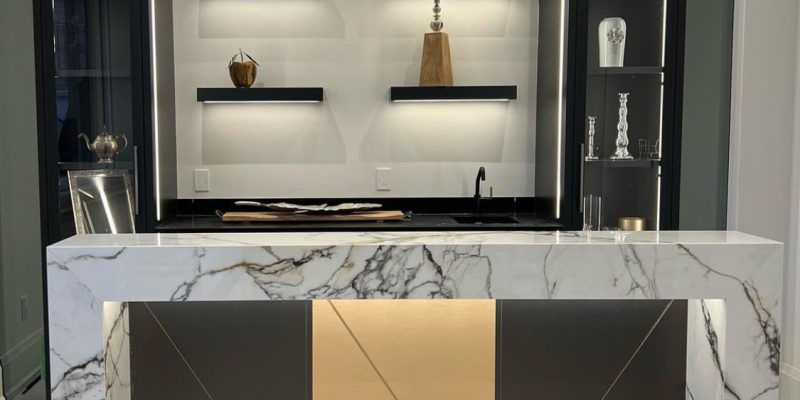
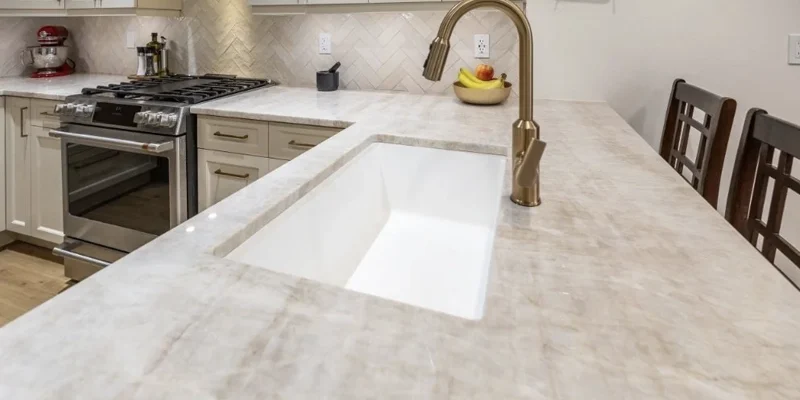
Knowing how to choose a quartz slab requires more than finding a colour that looks suitable in a sample. The selected material must also work with the cabinet layout, island dimensions, countertop sections, fixtures and fabrication requirements of the kitchen.
TecCorp Stone supports quartz countertop projects across Toronto and the GTA involving existing cabinets, new kitchens, large islands, waterfall panels and slab backsplashes. In each case, the quartz should be reviewed as part of the complete countertop scope rather than as an isolated decorative product.
This guide explains how to move from an initial quartz preference to an approved slab and production plan. It focuses specifically on the decisions that should be completed before material is reserved and fabrication begins.
Before Comparing Quartz Designs
Confirm which surfaces require quartz, whether the cabinets are existing or new, and which sink, appliance, island and backsplash details affect the countertop layout.
The right quartz slab depends on the type of kitchen project. Replacing an existing countertop involves different conditions from producing quartz for a new kitchen with an oversized island, waterfall panels or a full-height backsplash.
Before comparing slabs, identify the complete countertop scope:
These components should be planned together because each one affects the required quantity and allocation of the material.
A project that initially appears to require one slab may need additional material once an island panel or slab backsplash is added. Conversely, ordering slabs before the fabrication layout is reviewed may result in unnecessary material.
When the cabinets will remain, their condition should be assessed before the quartz is released for fabrication. The base cabinets must be stable, adequately supported and reasonably level.
The replacement plan should also confirm:
Quartz should not be expected to correct movement or significant unevenness in the cabinet structure beneath it.
For a new kitchen, the quartz can be shortlisted during the design stage, but production dimensions should be based on the installed cabinetry.
The sink model, cooktop specifications, faucet holes, finished panels, island components and overhangs should be confirmed before final measurement.
A professional countertop survey and measurement allows these installed conditions to be translated into production-ready dimensions.
Large or vertical quartz components should be included from the beginning. They often require substantial rectangular sections and cannot always be produced efficiently from leftover countertop material.
Before reserving slabs, confirm:
Review the kitchen island countertop service when the project includes oversized sections, seating overhangs or vertical slab panels.
A small quartz sample can help narrow the options, but it should not automatically be treated as a complete representation of the slab.
A sample may not show:
This is particularly important for quartz with broad marble-inspired movement. A sample taken from a quiet area may not reveal the more prominent sections elsewhere in the slab.
Online product images have similar limitations. Screen settings, photography and surrounding colours may change the apparent undertone or contrast of the surface.
Inspect the material close enough to review the finish and background, but also step back to assess the complete composition.
From a normal room-viewing distance, consider:
This stage determines whether the slab is suitable enough to proceed to fabrication planning. It is not the point at which detailed seam or vein-matching decisions should be finalized.
Those decisions belong to the dedicated layout stage and should not be assumed from a showroom display.
Determine whether the slab being inspected is the exact material available for the project or only a display example from the same collection.
The final order should later identify the product code, dimensions, thickness, finish and available quantity. For projects requiring several slabs, the complete material package should be checked before any slab is released for cutting.
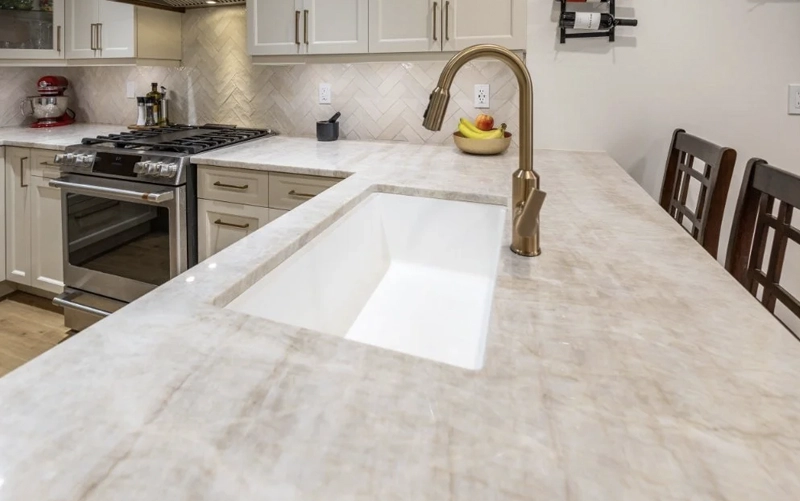
Quartz should be compared with the actual materials surrounding it. A surface that looks neutral in isolation may reveal warm, cool, grey or cream undertones beside the cabinets and flooring.
Whenever possible, review the quartz with:
The objective is not to make every finish identical. The materials should relate intentionally through undertone, contrast and visual weight.
Natural daylight, warm interior lighting and cool showroom lights may produce noticeably different results.
Samples should be checked inside the kitchen during both daytime and evening conditions when practical. Under-cabinet lighting should also be considered because it illuminates the surface at close range.
This is particularly important when both the quartz and cabinets are described as white. Slightly different undertones may become more visible once the materials are installed beside one another.
Decide whether the quartz should act as a restrained background or the primary feature of the kitchen.
A quieter surface may work well when the cabinets, flooring or backsplash already carry strong detail. A more expressive quartz may suit a kitchen where the island or slab backsplash is intended to become the main visual focus.
This article does not compare individual quartz colours or pattern categories in detail. Those decisions belong to the dedicated quartz colour-and-pattern guide and should remain separate from the technical process of approving a slab.
After a quartz design has passed the visual review, the next step is to verify the exact product that can be supplied for the project.
A commercial colour name alone is not enough. Similar-looking quartz products may be offered in different slab formats, finishes or thicknesses, and a showroom display may not represent the inventory currently available for fabrication.
The written material specification should identify:
Recording this information creates one shared reference for the homeowner, supplier and fabricator.
This article does not rank quartz brands or define general quality levels. Those comparisons require a separate review of manufacturers, product documentation, warranties and fabrication experience. At this stage, the objective is to confirm the identity and availability of the exact material being considered.
The required quantity should be calculated from the preliminary cutting plan—not from countertop square footage alone.
Two kitchens with similar measured areas may require different slab quantities because one includes a large island, waterfall panels, wide backsplash sections or countertop pieces that do not fit efficiently beside one another.
The quantity review should include:
A large amount of unused area around an island cut-out does not necessarily mean that the remaining material can produce another required piece. The leftover sections may be too narrow, interrupted by openings or positioned in the wrong direction.
All required slabs should ideally be identified together before the first piece is released for cutting.
Manufactured quartz is designed for greater consistency than natural stone, but material from separate production batches should not automatically be assumed to match perfectly.
When more than one slab is required, confirm whether the available material comes from the same batch or coordinated inventory. The slabs should also be reviewed together when practical.
Ask what would happen if:
These questions help the homeowner understand whether the complete project can be produced from the currently available material.
Square Footage Does Not Determine Slab Count by Itself
Slab quantity depends on the dimensions and arrangement of the fabricated pieces, not only the total countertop area.
Quartz products are available in different slab dimensions. Some collections use standard formats, while others may be offered in larger or jumbo slabs.
The better format is the one that supports the measured countertop layout with practical fabrication and installation—not automatically the largest slab available.
The island or longest countertop run often determines whether a particular slab format is suitable.
The fabricator should compare the usable slab dimensions with:
A nominal slab dimension should not be treated as fully usable cutting space.











A larger slab may reduce the need to divide an oversized island or long counter, but it does not guarantee a completely seamless installation.
A seam may still be required because of:
The appropriate objective is not to avoid every seam at any cost. It is to produce pieces that can be fabricated, transported, supported and installed safely.
Detailed seam placement and vein alignment belong to the dedicated quartz seam-and-matching guide. At this stage, only the practical need for separate pieces should be identified.
A quartz slab should not be ordered only because it fits the visual design. The fabricator should first confirm that the product and available slab format suit the project conditions.
Sink, cooktop and faucet details can influence how the slab is allocated.
Before the final layout is prepared, confirm:
Large openings may limit where a countertop piece can be positioned within the slab. They can also affect handling and the practical location of joints.
A countertop section may fit within a jumbo slab but still be impractical to deliver as one piece.
The route from the loading area to the kitchen should be checked for:
For condominium or restricted-access projects, delivery conditions should be reviewed before the final piece sizes are approved.
A planned division created during layout review is preferable to discovering after fabrication that a completed section cannot enter the property.
The selected finish and thickness should be documented, but this article does not attempt to replace the dedicated guides for countertop thickness or edge profiles.
Those details affect appearance, material use and fabrication, but they should be finalized as part of the complete project specification.
Review the countertop thickness guide and the guide to countertop edge profiles when approving the visual construction of the countertop.
Selecting the quartz product confirms the material direction. It does not authorize fabrication by itself.
After final measurement, the fabricator should prepare or explain how the required pieces will be allocated across the reserved slabs.
The layout review should confirm:
This review should focus on the complete composition rather than one countertop piece at a time.
The island, long open countertop runs and surfaces viewed from adjoining rooms usually have the greatest visual impact.
These areas should be considered first when the slab is allocated. Smaller sections near walls, appliances or compact work zones may then be positioned within the remaining usable material.
This does not mean that every prominent feature must be centred or matched in one fixed way. The allocation should respond to the actual slab and kitchen layout.
Before cutting begins, the approval record should identify:
Written approval gives the homeowner and fabricator one reference before irreversible production begins.
The Final Slab Decision
A quartz slab is ready for fabrication only after the exact material, complete quantity, measured layout and proposed allocation have all been confirmed.
Quartz is commonly selected for its controlled appearance and practical routine care, but the final decision should still be based on the instructions for the exact product being ordered.
The supplier or fabricator should provide the available product documentation before approval. This may include guidance relating to cleaning, heat exposure, approved applications and warranty conditions.
Quartz should not be treated as an indestructible surface. Concentrated heat, heavy impact and unsuitable cleaning products may affect the installed countertop.
Before selecting the slab, confirm that the intended kitchen use is compatible with the product guidance. Particular attention should be given to:
Trivets, cutting boards and suitable cleaning products should remain part of normal kitchen use.
This article does not provide a complete quartz maintenance routine. For broader cleaning guidance, review the stone countertop cleaning guide and follow the instructions supplied for the exact installed product.
A product warranty and a fabrication or installation warranty do not necessarily cover the same conditions.
Before approving the project, clarify:
Cabinet movement, inadequate support, impact damage or misuse may fall outside the product warranty. Responsibilities should therefore be documented as part of the complete countertop scope.
Two proposals may refer to the same quartz colour while including different material quantities, slab formats, fabrication details or installation responsibilities.
A useful comparison should identify whether each proposal includes:
The lowest total does not necessarily represent the same project scope. One proposal may exclude measurement, removal, feature panels or access-related work that another includes.
Cost should be reviewed only after the material specification and responsibilities have been aligned. The quartz countertop cost guide explains the main factors that influence installed pricing without replacing the need for a project-specific proposal.
Compare Scope before Price
Confirm that the proposed material, slab quantity, fabrication details, delivery conditions and installation responsibilities are equivalent before comparing the final amounts.
Before authorizing fabrication, confirm that the slab has been reviewed as part of the complete measured project.
Project Scope
Every countertop, island, waterfall and backsplash section has been identified.
Exact Material
The product name, code, finish, thickness and available slabs have been confirmed.
Visual Review
The full slab has been reviewed rather than relying only on a small sample or online image.
Kitchen Context
The quartz has been compared with the cabinets, flooring, backsplash and lighting.
Measured Layout
The slab format and quantity support the final countertop dimensions and access conditions.
Fabrication Approval
The allocation, cut-outs, overhangs and major production details have been approved in writing.
Yes, particularly when the design contains large-scale movement. A small sample may not show the full pattern, direction or balance of the slab.
Minor differences may occur. When several slabs are required, the available material should ideally be identified and reserved as one coordinated package.
No. A larger slab may support an oversized island or long run, but the measured layout, delivery route, handling requirements and usable slab area must also be considered.
The quantity depends on the size and arrangement of the fabricated pieces, including islands, cut-outs, waterfall panels and backsplashes. Countertop square footage alone does not determine the final slab count.
Quartz can be shortlisted during design planning. Final slab quantity and fabrication approval should generally be based on the confirmed cabinet installation and production measurements.
Yes. A sample may represent only a quiet or active section of the full design. Lighting and surrounding finishes can also change how the colour appears.
The homeowner or authorized project representative should review the proposed allocation with the fabricator before cutting begins.
No. Material selection confirms the product. The measured layout, required quantity, piece allocation, cut-outs and fabrication details still require approval.
A successful quartz selection connects the appearance of the slab with the actual kitchen layout, available inventory, fabrication requirements and installation conditions.
Before production begins, confirm the exact product, complete quantity, measured dimensions, slab allocation, fixtures, overhangs and responsibilities included in the project.
Choosing a Quartz Slab for Your Kitchen?
Share your kitchen layout, cabinet status, island dimensions and shortlisted quartz products to review the material and fabrication scope together.