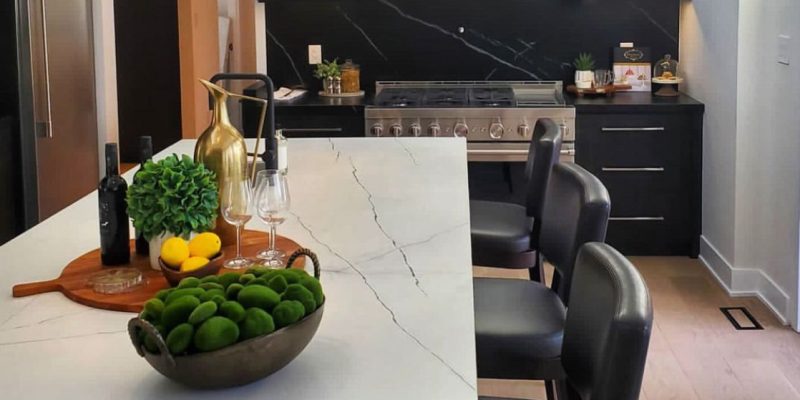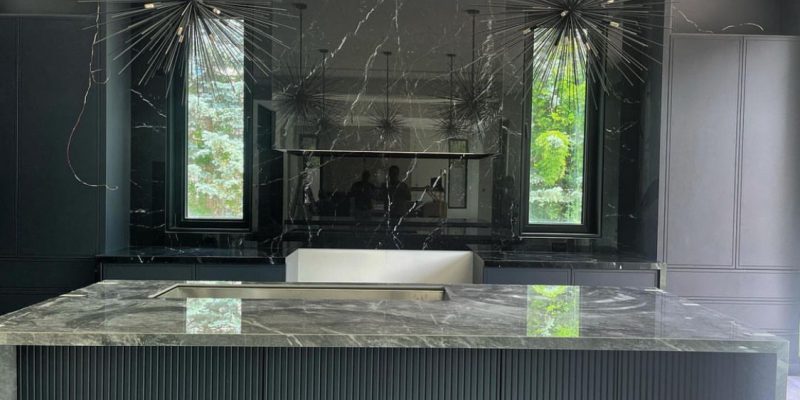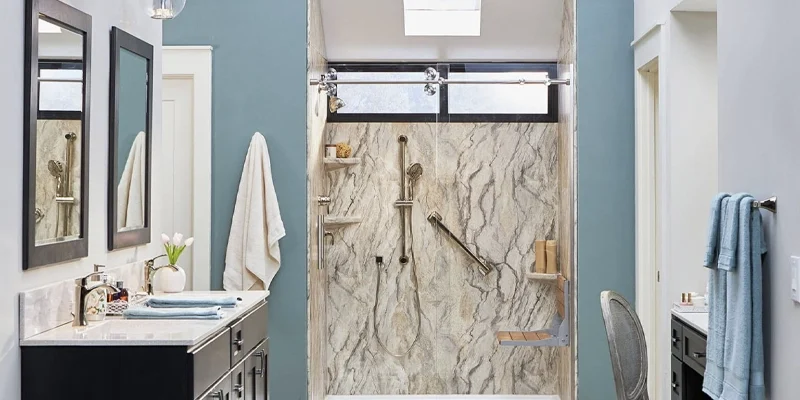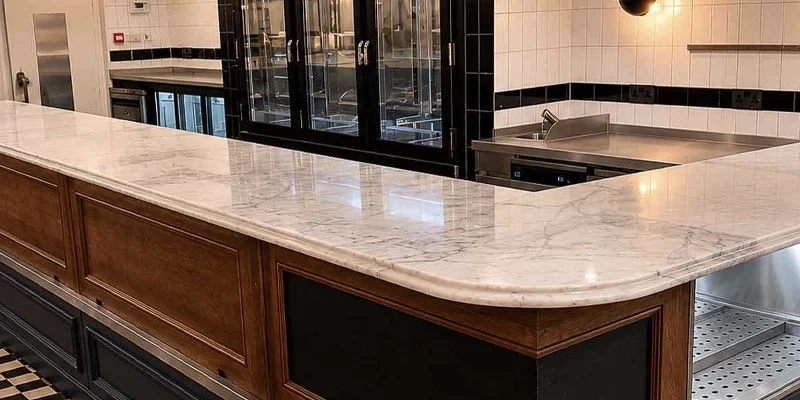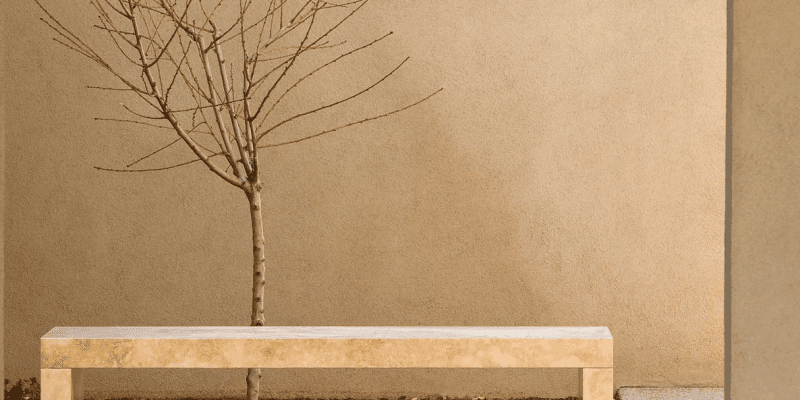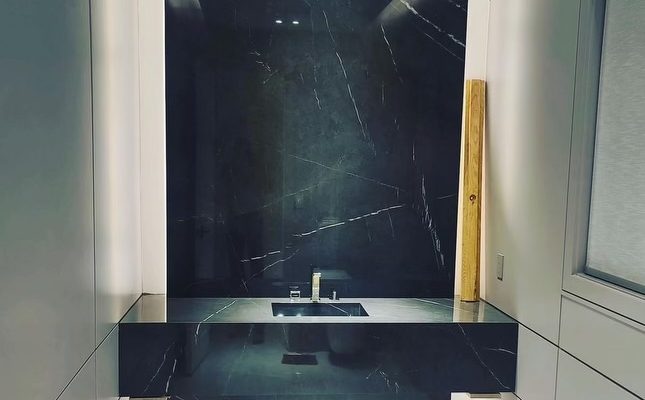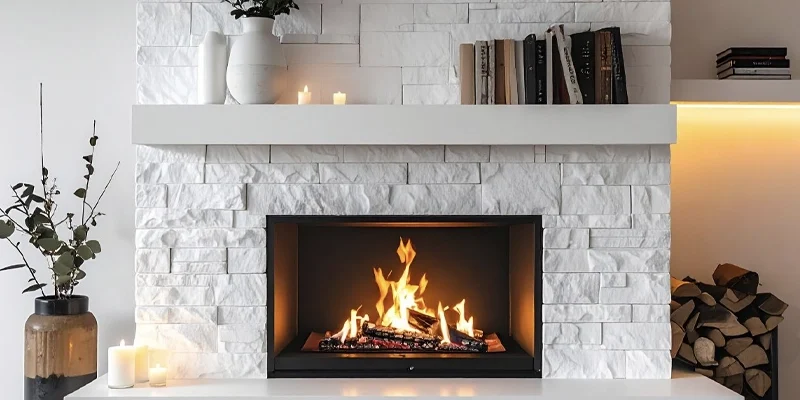
The best materials for slab backsplashes depend on the wall location, desired pattern, available panel dimensions, appliance conditions, maintenance expectations and fabrication scope. Quartz, porcelain and natural-stone slabs can all create large-format kitchen wall surfaces, but they should not be treated as technically or visually identical.
A material that works well for a quiet counter-to-cabinet backsplash may not be the strongest choice for a dramatic counter-to-ceiling range wall. Similarly, a surface selected for countertop continuity may require different planning from a material chosen primarily for thin panels, natural veining or predictable pattern.
This guide compares quartz, large-format porcelain, granite, quartzite, marble and soapstone as slab backsplash materials. It focuses on practical selection criteria rather than naming one universal winner.
Material Selection Principle
The best slab backsplash material is the product approved for the proposed wall application, available in suitable panel dimensions and compatible with the kitchen’s design, appliance layout, care expectations and fabrication requirements.
| Material | Visual Character | Main Strength | Main Consideration | Often Suits |
|---|---|---|---|---|
| Quartz | Controlled colour and printed movement | Coordination with matching countertops | Product-specific heat and chemical limits | Consistent, coordinated kitchens |
| Large-format porcelain | Printed stone, concrete or solid patterns | Broad wall panels and thin visual profiles | Edge, handling and face-sequencing details | Full-height and modern wall applications |
| Granite | Granular, directional or varied natural movement | Individual natural-slab appearance | Stone-specific finish and care requirements | Natural kitchens and coordinated countertops |
| Quartzite | Expressive natural veining and variation | Distinct feature-wall potential | Slab variation, availability and identification | Statement walls and natural focal surfaces |
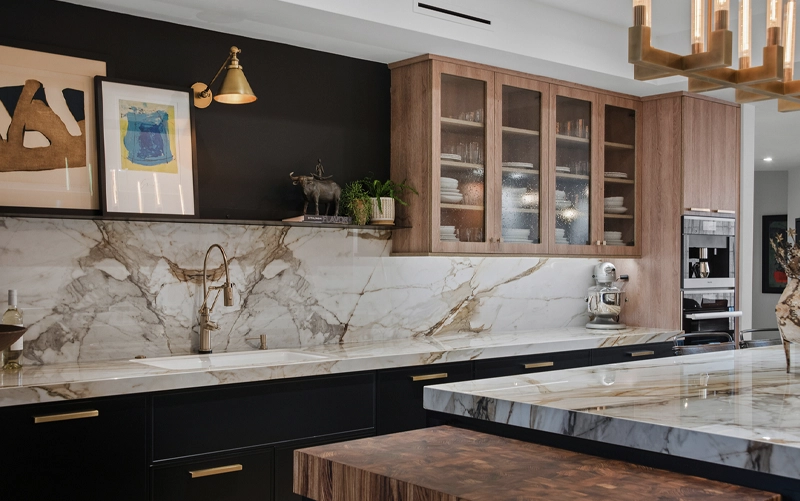
| Marble | Architectural veining and broad movement | Strong visual impact and bookmatching potential | Acid sensitivity, etching and natural change | Design-led feature walls |
| Soapstone | Quiet, dark and often matte appearance | Distinct restrained natural character | Patina, availability and material-specific care | Minimal and lower-contrast kitchens |
The table provides a general comparison only. The exact product, slab, finish and proposed wall application should be reviewed before a final selection is made.
Material selection should begin with the complete wall and project conditions rather than colour alone.
Establish whether the backsplash will cover a short range feature, the counter-to-cabinet area, a full-height range wall or several kitchen walls. Larger applications make panel dimensions, pattern repetition and visual weight more important.
The proposed surface should be evaluated with the exact appliance model, required clearances, ventilation and manufacturer instructions. A material suitable for one wall location should not automatically be assumed suitable directly behind every range or cooktop.
Natural stone, quartz, porcelain and other engineered products do not have identical heat-related characteristics.
Compare the wall height and width with the usable slab or panel dimensions. A counter-to-ceiling wall may require multiple sections even when the material is marketed in a large format.
Panel planning should also account for:
Natural stone provides individual slab movement, while quartz and porcelain may offer more controlled or repeatable designs. Neither approach is universally better.
A strongly veined surface may work well on one feature wall but feel excessive when repeated across the countertop, island and complete kitchen perimeter.
Care depends on the exact surface and finish. Some natural stones may require sealing or greater caution with acidic substances, while quartz and porcelain products have their own manufacturer-specific cleaning, heat and chemical guidance.
No slab backsplash should be described as maintenance-free.
Cutouts, visible edges, panel thickness and window returns can affect which material is practical. Thin porcelain panels, thicker countertop slabs and natural-stone pieces may require different fabrication and edge solutions.
Quartz backsplashes can provide consistent colour, controlled printed movement and direct coordination with a countertop from the same collection. Some manufacturers offer thinner products intended for vertical wall applications, but availability and specifications vary.
Quartz may suit kitchens that require predictable colour or a coordinated countertop-and-backsplash composition. Printed marble-inspired patterns can create broad wall movement without relying on the natural variation of individual stone slabs.
The complete panel layout should still be reviewed because repeated patterns, directional movement and seams can become more visible across a large wall.
Using the same quartz collection for both surfaces can simplify undertone and finish coordination. It does not guarantee uninterrupted vein continuity because the horizontal countertop pieces and vertical wall panels may require different slab sections.
Many quartz products are maintained without conventional penetrating stone sealer, but this should be confirmed for the exact manufacturer and collection. Cleaning products should also follow the product instructions rather than generic natural-stone guidance.
Quartz should not be described as universally heat-proof or approved behind every range. Resin content, appliance configuration, ventilation and required clearances can affect whether a particular product is suitable for the proposed location.
Quartz may be considered when:
Large-format porcelain and other sintered surfaces are separate product categories, but both may be available as broad panels for vertical kitchen applications. Their exact composition, thickness, edge details and technical requirements should be confirmed individually.
These surfaces may support counter-to-cabinet or full-height walls with fewer visible panel divisions than small-format finishes. Actual panel dimensions and usable fabrication areas vary by collection.
Available designs may include marble-inspired veining, concrete effects, solid colours and restrained textures. For patterned collections, face sequencing and repetition should be reviewed before several panels are placed next to each other.
Some porcelain and sintered products are available in thinner formats than conventional countertop slabs. A thin panel can create a refined wall profile, but it does not automatically mean the project is easier or less expensive to fabricate and install.
Exposed edges beside windows, cabinet ends and open walls require deliberate detailing. The printed face, core appearance and available matching edge solutions should be reviewed before fabrication.
Large thin panels require product-appropriate handling, cutting and installation procedures. Outlet openings, narrow sections and transportation access can influence the final panel layout.
These materials may be considered when:
Available collections can be reviewed through Teccorp’s porcelain surface category.
Granite provides natural mineral variation that can range from fine, relatively consistent movement to bold directional patterns. Its suitability for a backsplash depends on the exact slab, finish, panel dimensions and proposed wall location.
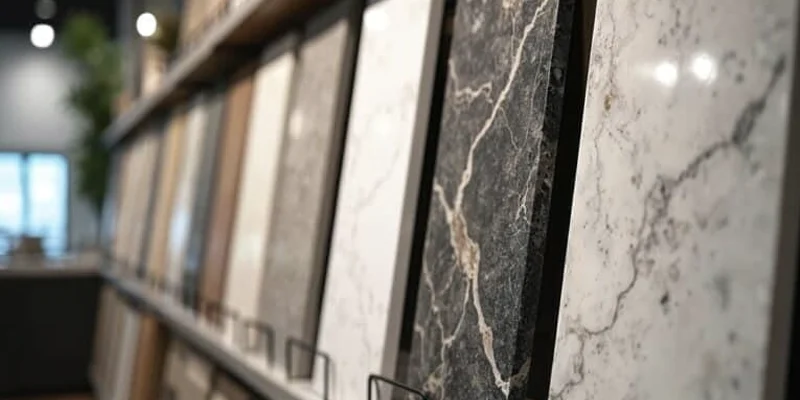
Each granite slab is different. A small sample may confirm general colour and mineral character, but it cannot show how the complete pattern will appear across a range wall or full-height panel.
The actual slab should be reviewed when:
Granite may continue from the countertop onto the backsplash or provide a contrasting natural surface. Using the same material can create continuity, but exact pattern alignment depends on slab yield and panel allocation.
Polished, honed, leathered and textured finishes can create different visual and maintenance conditions. Cleaning and sealing requirements should follow the exact granite, finish and care products rather than a universal natural-stone schedule.
Granite may be considered when:
Quartzite can provide expressive natural movement and broad veining that works well on feature walls. Because commercial naming and appearance can vary, the exact slab and supplier information should be reviewed carefully.
Quartzite may create a strong range-wall or counter-to-ceiling feature when the slab contains large-scale movement that remains visible around cabinets, appliances and outlets.
The most dramatic slab area should not automatically be centred without considering how much of it will be concealed or interrupted.
Colour, veining, fissures and usable areas may vary significantly between slabs sold under the same commercial name. Projects requiring several panels should review adjoining pieces together.
Commercial stone names do not always communicate complete geological or performance information. Care, fabrication and sealing decisions should be based on the actual supplied material rather than the name alone.
Quartzite may be considered when:
Marble can create strong architectural movement through broad veins, soft tonal variation and bookmatched layouts. Its selection should also account for acid sensitivity, etching and the possibility of visible natural change.
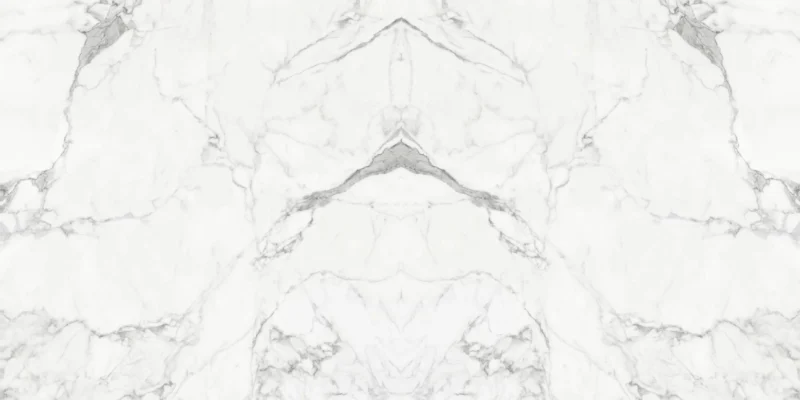
Marble is often selected for full-height range walls because adjoining slabs can create mirrored or continuous compositions. Bookmatching requires compatible slab faces, sufficient material and a wall with enough uninterrupted area for the pattern to remain visible.
A polished finish may create stronger reflection and contrast, while a honed finish can produce a softer wall appearance. Finish selection also affects how etching, fingerprints, grease and cleaning marks may appear.
Acid-sensitive marble can develop dull areas when exposed to acidic substances. Etching is a surface reaction rather than ordinary dirt and may require professional refinishing.
Homeowners selecting marble should understand that sealing may help manage some absorption risks but does not make the stone resistant to every stain, acid or surface change.
Marble may be considered when:
Soapstone generally provides a quieter, darker and more matte natural appearance than strongly veined marble or quartzite. Its visual character may suit kitchens that need a restrained backsplash rather than a highly reflective feature wall.
Soapstone can change in appearance as it develops a patina or receives material-specific care treatments.
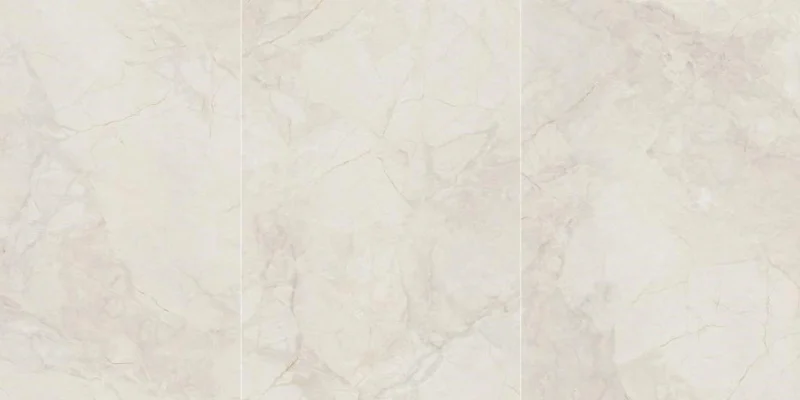
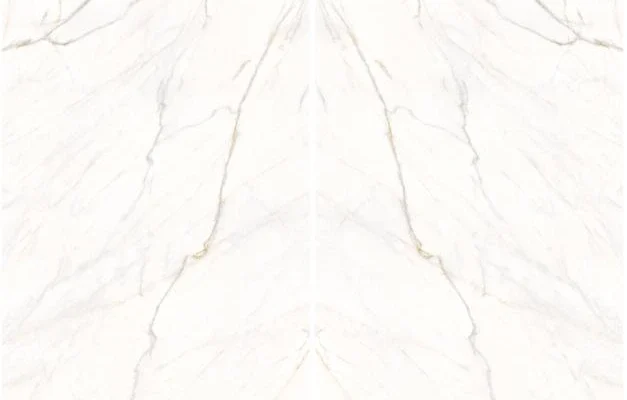
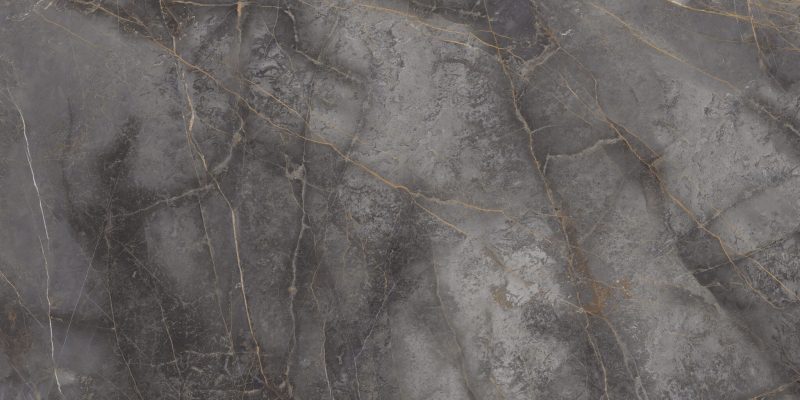
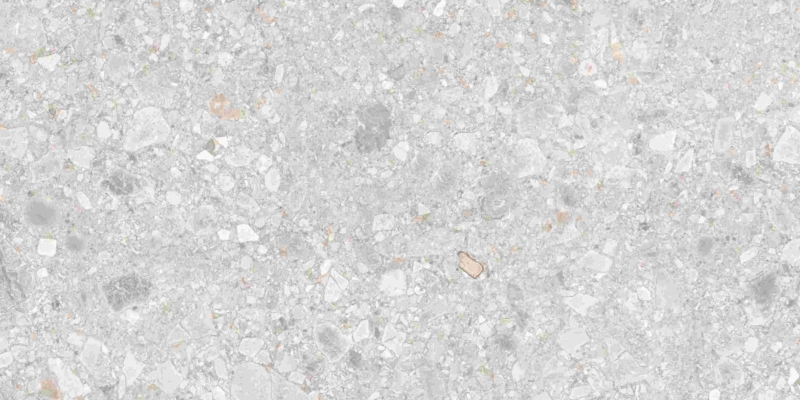


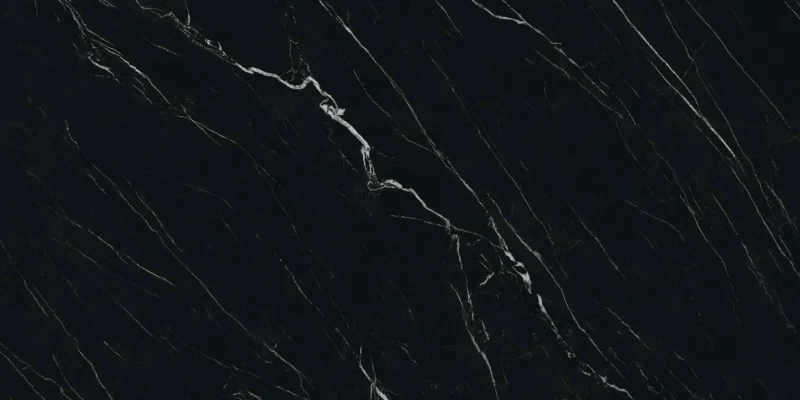


Many soapstone slabs contain subtle veins or mineral movement. This can support a calm countertop-to-backsplash composition without introducing another dominant pattern.
Soapstone may be available in fewer collections or slab sizes than more common quartz and porcelain products. The actual material dimensions and usable areas should be confirmed early.
Soapstone may be considered when:
Natural Stone Selection: Granite, quartzite, marble and soapstone should be selected from the actual slab whenever possible. Samples cannot fully represent large-scale movement, variation or usable panel areas.
The most appropriate slab backsplash material changes according to the project objective. The categories below identify likely candidates, not universal winners.
The same countertop material may provide the strongest continuity when sufficient usable slab area remains and the product is approved for the wall application.
Quartz, porcelain and natural stone can all support a coordinated design. The deciding factors are slab yield, panel dimensions, pattern direction and product suitability.
Large-format porcelain, sintered surfaces and manufacturer-approved thin quartz products may suit projects seeking a reduced wall profile.
Thin panels still require appropriate fabrication, edge treatment, wall preparation and handling. Thickness alone should not determine the selection.
Quartzite, marble, granite and soapstone provide individual natural variation. The strongest option depends on whether the design requires dramatic veining, granular movement or a quieter matte character.
Quartz, porcelain and other printed surfaces may offer more controlled colour and movement than natural stone. Large walls should still be reviewed for pattern repetition, face sequencing and seam relationships.
Some manufacturer-approved quartz and porcelain products may reduce conventional sealing requirements. Natural-stone care varies according to the stone, finish and sealer.
Lower routine care does not mean maintenance-free. Joints, exposed edges, appliance conditions and approved cleaning methods remain relevant for every system.
No material should be declared universally best behind a range. The final decision depends on:
Quartz, porcelain, granite, quartzite, marble and soapstone should not be assumed to have identical heat-related performance.
Marble and quartzite can provide broad natural veining, while printed porcelain or quartz may offer more controlled interpretations of similar movement. The best choice depends on whether the project values unique natural variation or greater pattern predictability.
Restrained quartz, concrete-look porcelain, subtle granite and soapstone may support a kitchen where the island, cabinetry or flooring is already visually dominant.
The backsplash should strengthen the material hierarchy rather than compete with every other feature in the room.
The backsplash may use the same material as the countertop, a coordinated alternative or a deliberate contrast. The strongest approach depends on pattern scale, available slab dimensions and the number of other visually active surfaces in the kitchen.
Continuing the countertop material onto the wall can create direct visual continuity. Quartz, porcelain and natural stone may all support this approach when sufficient material is available and the exact product is suitable for the proposed wall application.
Using the same material does not guarantee continuous veining. Countertop pieces and backsplash panels may require different slab sections, orientations or seams.
A backsplash can relate to the countertop through background colour, undertone, finish or pattern scale without matching it exactly. This approach may be useful when the countertop is visually dominant or when another product is more practical for the wall dimensions.
Contrast can help separate the wall from the work surface, particularly when a quiet countertop is paired with a stronger backsplash or a dramatic island is supported by a restrained wall panel.
The countertop, backsplash, cabinetry and flooring should be reviewed together rather than selecting the wall material in isolation.
For more detailed design coordination, review how to match countertop and backsplash materials.
Material appearance alone does not determine whether a slab is practical for the proposed backsplash. Available panel dimensions, thickness, openings, exposed edges and installation access can affect the final selection.
The usable material area should be compared with the complete wall elevation. A product described as large format may still require several panels across a wide or counter-to-ceiling wall.
Panel planning should account for:
Quartz, natural stone, porcelain and sintered products may be available in different thicknesses. A thinner panel can reduce the visible wall profile, while a thicker slab may coordinate more directly with countertop fabrication.
Thickness should not be considered independently from product approval, panel size, edge treatment and installation requirements.
Outlets, switches and wall-mounted fixtures create openings that can affect both appearance and fabrication feasibility. Closely spaced cutouts or openings near panel edges may leave narrow material sections.
The final positions should be confirmed before fabrication, and the selected material should be reviewed for the proposed cutout arrangement.
Visible edges may occur beside windows, cabinet ends, shelves and open walls. Natural stone, quartz and printed porcelain may require different edge or return solutions.
The surface face, core appearance, thickness and available fabricated details should be reviewed before choosing a material for a wall with several exposed boundaries.
A panel must reach the kitchen safely after fabrication. Doorways, stairs, elevators, corridors and available turning space may require the wall to be divided into smaller sections.
Installation feasibility and wall preparation are covered in the stone slab backsplash installation guide.
The material category alone does not determine the total backsplash cost. Quartz, porcelain and natural-stone products are available across different price levels, while slab yield, fabrication and site conditions can significantly affect the complete scope.
Special-order products, limited natural-stone slabs and uncommon finishes may affect both price and scheduling. Locally available materials or products already allocated to the countertop project may provide a more efficient scope.
A backsplash may require more material than its visible wall area suggests. Directional patterns, full-height panels, bookmatching, unusable slab sections and several separate walls can reduce material efficiency.
A suitable remnant may reduce material requirements for a small panel, but it must have sufficient dimensions, appropriate pattern direction and enough usable area for required openings.
Several small remnants may create more seams and fabrication work than one coordinated slab section.
Material cost should be considered alongside:
For a complete budget review, see the stone slab backsplash cost guide.
There is no universal best material. The strongest choice depends on the wall dimensions, appliance conditions, design goals, care expectations, product approval and fabrication requirements.
Quartz may provide close countertop coordination and controlled pattern, while porcelain may offer thin large-format panels and a broad range of printed designs. The exact product specifications and wall conditions should determine the choice.
Granite, quartzite, marble and soapstone provide different visual and care characteristics. The best option depends on whether the project prioritizes granular movement, dramatic veining, a quiet matte surface or another specific natural appearance.
Yes, when sufficient material is available and the product is suitable for the wall application. Exact vein continuity should be planned through the slab layout rather than assumed.
Suitability depends on the exact surface product, appliance model, clearances, ventilation and manufacturer instructions. No slab material should be treated as universally suitable behind every range.
No. Sealing requirements depend on the exact stone, finish, exposure and selected sealer. A universal sealing schedule should not be applied to every natural-stone backsplash.
Quartz, porcelain, granite, quartzite, marble and soapstone can all support successful slab backsplash designs when selected for the correct application. The decision should consider more than appearance or a generic material label.
Review the exact slab or panel, confirm its available dimensions, compare care and appliance requirements and evaluate how the material will be fabricated around cabinets, outlets, windows and visible edges.
Homeowners deciding between a large-format slab and a conventional tiled wall can also compare slab and tile backsplash systems.