Bathroom vanity sink options can change both the appearance and function of a custom countertop. Undermount, vessel and integrated sinks create different relationships with the vanity surface, and each configuration introduces its own considerations for countertop space, fabrication, faucet placement and everyday use.
There is no single sink style that is automatically best for every bathroom. An undermount basin may suit a vanity where a clean countertop transition is preferred, while a vessel sink can create a stronger visual feature. Integrated sink systems can produce a more continuous appearance, but their availability depends on the selected material and fabrication system.
This guide compares the three configurations so homeowners can evaluate the sink together with the vanity countertop rather than treating the basin as a separate decision.
For a broader comparison of countertop surfaces, see Best Materials for Bathroom Vanity Countertops. For the installation process itself, Teccorp’s Bathroom Vanity Countertop Installation Guide covers measurement, fabrication preparation and installation in greater detail.
| Sink Type | Position | Visual Effect | Countertop Consideration | Best Considered When |
|---|---|---|---|---|
| Undermount | Below the countertop | Clean, continuous surface | Visible finished sink cutout | A streamlined countertop transition is preferred |
| Vessel | Above the countertop | More visually prominent basin | Drain and faucet arrangement must suit basin height and position | The sink is intended to contribute strongly to the design |
| Integrated | Designed as part of a coordinated surface or basin system | Continuous or architectural appearance | Material and fabrication system are critical | A more unified vanity design is required |
This table provides a starting point rather than a universal ranking. The appropriate sink depends on the vanity dimensions, selected countertop surface, faucet configuration and intended bathroom design.
The sink should ideally be selected before final countertop fabrication because its size and configuration can directly affect the countertop opening and surrounding usable surface.
A basin that is well proportioned for a wide primary-bathroom vanity may occupy too much visual or usable space on a compact powder-room cabinet.
Before choosing a sink, consider the available countertop width and depth together with the amount of surface that should remain around the basin.
Double vanities introduce additional spacing requirements because two basins and their faucets need to fit comfortably within the cabinet and countertop dimensions.
The appropriate sink size should therefore be evaluated within the complete double-vanity layout rather than choosing two basins independently and attempting to fit them later.
Sink configuration interacts directly with fabrication. Undermount sinks require a finished countertop opening, vessel sinks use a different type of opening, and integrated systems may depend heavily on the selected surface or manufacturer.
The exact countertop product should therefore be considered together with the sink rather than assuming that every configuration is equally suitable for every material.
The sink and faucet need to function as a coordinated system. A deck-mounted single-hole faucet, widespread faucet and wall-mounted faucet create different countertop requirements.
Faucet dimensions and reach should also suit the selected basin rather than being chosen only for appearance.
The shape and position of a sink influence how the surrounding countertop is cleaned. Areas around vessel basins, exposed sink cutouts and integrated transitions can each require different access and cleaning habits.
Rather than assuming that one sink type is universally easier to maintain, homeowners should evaluate the actual basin shape, countertop interface and bathroom usage.
Some vanities are designed to emphasize the countertop material, while others make the sink itself a focal point.
An undermount basin can allow more of the stone or manufactured surface to remain visually dominant. A vessel sink can create a stronger sculptural feature. An integrated system can make the basin and surrounding vanity read as a more unified composition.
Choose the sink and countertop together. Basin dimensions, mounting style, faucet arrangement and countertop fabrication all interact. Selecting the sink too late can limit fabrication options or require changes to an already approved vanity layout.
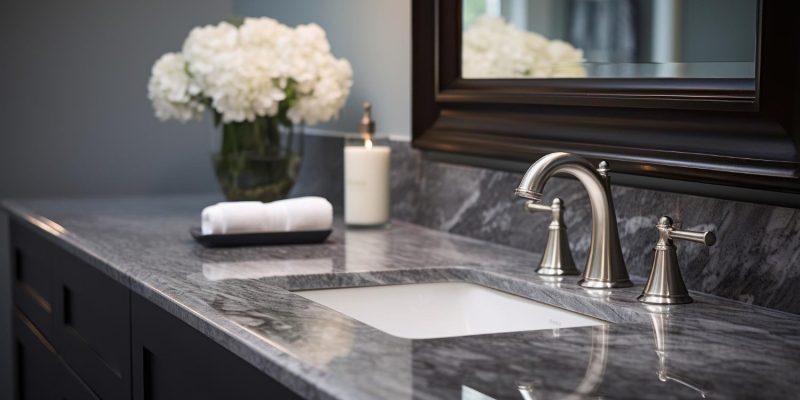
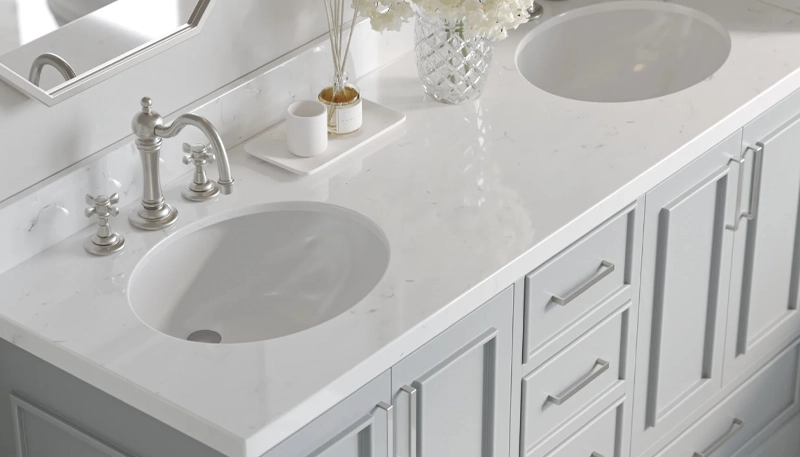
An undermount sink is positioned below the vanity countertop rather than resting on top of it. The countertop opening remains visible, creating a direct visual transition from the surface into the basin.
This configuration is commonly considered where homeowners want the countertop material to remain prominent and prefer a relatively clean transition around the sink area.
Potential advantages include:
The absence of an above-counter rim can also allow water or small debris on the countertop to be moved toward the sink without crossing a raised sink edge, although the actual ease of cleaning still depends on the cutout and basin design.
An undermount configuration places greater visual importance on the fabricated sink opening because the cutout edge remains exposed.
The sink model should be confirmed before fabrication so that the opening can be produced for the approved basin. Changing the sink after the countertop has been cut can create compatibility problems.
The support and attachment system must also suit the sink, countertop material and project configuration rather than relying on one universal mounting method.
The sink opening becomes part of the finished vanity surface, which means several details should be established before fabrication:
For double vanities, the two openings also need to be coordinated with each other and with the cabinet divisions below.
Undermount configurations can be used with a range of custom slab surfaces when the selected material, product and fabrication details are appropriate for the application.
Quartz, granite and marble are commonly considered for fabricated undermount openings. Other materials, including quartzite and selected porcelain systems, should be evaluated according to the specific product and required fabrication details.
Material compatibility should therefore be confirmed for the actual countertop rather than assuming that every slab product supports every sink detail in the same way.
Undermount basins can work effectively in double-vanity layouts because the countertop remains visually continuous across both sink areas.
However, the basin size should leave adequate material between the two openings and at the outer countertop edges. Faucet positions, cabinet divisions and available surface area should all be considered before the layout is approved.
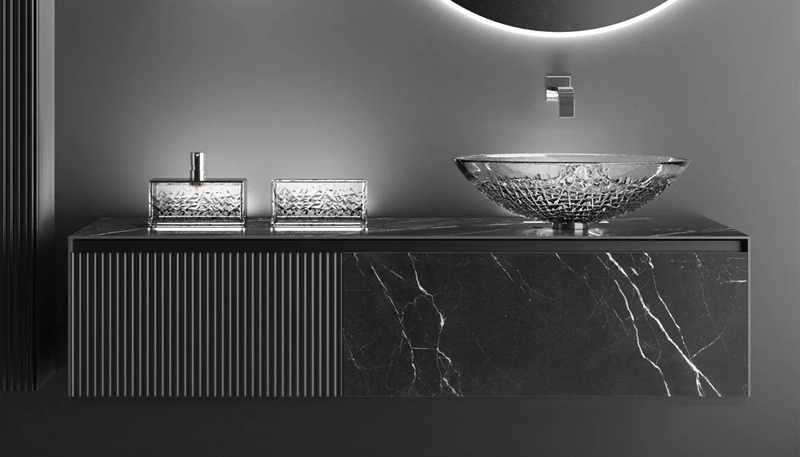
A vessel sink sits above the vanity countertop rather than below it. Because the basin remains visually exposed, it becomes a more prominent part of the vanity composition and can influence countertop height, faucet selection and the amount of usable surface around the sink.
Vessel sinks are available in many shapes and materials, but the basin should be selected as part of the complete vanity design rather than treated as a decorative object added after the countertop has been planned.
Potential advantages include:
Because more of the sink remains above the countertop, the basin itself becomes a significant design element. This can work particularly well where the vanity uses relatively simple cabinetry or a restrained countertop pattern.
The additional height of a vessel basin changes the overall proportions of the vanity. Cabinet height, countertop thickness and basin height should therefore be considered together rather than assuming that a standard vanity height will work with every vessel sink.
The area where the basin meets the countertop can also require more deliberate cleaning access than an open countertop around an undermount sink, depending on the basin shape and installation detail.
Faucet selection is another important consideration. The faucet needs to provide appropriate height, reach and positioning for the selected vessel sink without creating an awkward relationship with the basin.
A vessel sink commonly requires a drain opening through the countertop, while the faucet may be countertop-mounted, wall-mounted or incorporated into another fixture arrangement.
Before fabrication, the project should establish:
These details should be based on the actual fixture specifications rather than approximate dimensions.
Vessel sinks can be worth considering where the basin is intended to contribute visibly to the room, including:
This does not make vessel sinks exclusively decorative. They can be functional bathroom fixtures, but their dimensions and relationship with the countertop deserve more attention because the basin sits above the working surface.

An integrated vanity sink creates a more continuous relationship between the basin and surrounding surface. The exact construction varies by product and fabrication system, so “integrated sink” should be understood as a category of coordinated basin-and-surface solutions rather than one universal method.
Some systems create a visually continuous basin area, while others use specialized fabricated or manufactured components designed to work together.
Potential advantages can include:
Integrated designs depend heavily on the selected material and fabrication system. A concept that is possible with one product should not automatically be assumed to be available with another.
Important considerations include:
Because the sink is more closely tied to the overall vanity system, changing the basin independently may be less straightforward than replacing a separate conventional sink.
The term “integrated” can describe different construction approaches. Homeowners should confirm how the actual product is fabricated and assembled rather than assuming that every integrated sink has no visible joints or transitions.
Confirm the system, not just the style name. Integrated sink options are highly product- and fabrication-specific. The exact surface, basin design and fabrication method should be reviewed before the vanity is finalized.
Custom quartz countertops can commonly be fabricated for undermount and vessel sink configurations where the selected product and project details are appropriate.
For undermount sinks, the fabricated opening becomes a visible countertop detail. For vessel sinks, the countertop typically requires a different opening and faucet arrangement.
Integrated configurations should be evaluated according to the particular quartz product and fabrication system rather than assumed to be available with every engineered quartz surface.
Granite can support custom undermount and vessel sink layouts when the slab, dimensions and fabrication details are suitable for the project.
An undermount configuration allows the natural stone to remain visible around the basin, while a vessel sink can create more contrast between the stone and the fixture above it.
Because granite is natural stone, the location of veining, mineral variation and sink openings can be considered together when the slab layout is planned.
Marble can be used with different custom sink configurations where the stone and fabrication requirements are appropriate.
Undermount sinks can keep the stone visually prominent around the basin, while vessel sinks can create a more decorative contrast between the fixture and natural veining.
Material care remains a separate consideration. Sink type does not remove marble’s sensitivity to acidic substances, so the stone’s characteristics should still be evaluated independently of the basin style.
Porcelain slab vanity projects can support different sink concepts depending on the exact product, slab thickness and fabrication system.
Vessel sinks may require relatively limited surface openings, while undermount or more integrated configurations can introduce additional fabrication considerations around cut edges and supporting details.
The intended sink type should therefore be discussed before the porcelain product and vanity details are finalized.
The amount of usable countertop area depends on both the sink dimensions and how the basin interacts with the surface.
An undermount sink removes an opening from the countertop but does not place a visible basin rim or bowl above the surrounding surface. This can preserve a relatively open visual plane around the sink.
A vessel basin occupies physical space above the countertop. Although its drain opening may be smaller than a conventional undermount cutout, the footprint of the basin still affects which parts of the surface are practical to use.
For compact vanities, basin diameter or width should therefore be compared with the actual countertop dimensions rather than assuming that a smaller cutout automatically means more usable space.
Integrated designs can create a more continuous basin-and-countertop composition. The usable surface area depends on the basin geometry and overall system rather than a universal integrated-sink layout.
A double vanity introduces additional planning because two basins must fit comfortably within the cabinet and countertop while leaving appropriate space between them and at the outer edges.
Important considerations include:
Two undermount basins can maintain a visually continuous countertop across a longer vanity. The layout still needs enough material around and between the openings for the selected countertop and fabrication design.
Two vessel sinks create a stronger visual rhythm across the vanity.











Integrated double-basin concepts can create a unified contemporary appearance, but their availability and dimensions are dependent on the specific surface and fabrication system.
The sink and faucet should be selected as a coordinated pair. Choosing a basin without considering the faucet can create problems with height, reach, drilling locations or backsplash clearance.
Deck-mounted faucets require countertop space behind or beside the basin and may require one or more fabricated holes depending on the fixture.
Wall-mounted faucets remove the need for faucet holes in the vanity surface but introduce coordination with the wall, basin position and backsplash design.
Some vessel basins require taller faucet configurations because the basin sits above the countertop. The fixture should have appropriate height and reach for the selected sink rather than simply being labelled as a vessel-sink faucet.
Final dimensions should be confirmed from the actual basin and faucet specifications.
A sink can change how large or visually heavy a vanity appears. The same countertop can feel very different with a low-profile undermount basin, a prominent vessel sink or an integrated basin design.
For a balanced result, consider:
The goal is not to maximize or minimize the sink but to choose proportions that make sense for the complete vanity.
The most appropriate sink configuration depends partly on how the bathroom is used, how much countertop space is available and how prominent the basin should be within the overall design.
For a frequently used family bathroom, an undermount sink is often one of the first configurations worth considering. It keeps the basin below the countertop and allows the surrounding surface to remain relatively open and straightforward to access.
A vessel sink can also work, but basin height, countertop footprint and cleaning access around the sink should be considered carefully in a bathroom used by several people.
Integrated systems may be suitable where the selected surface and fabrication method support the intended design, but they should be evaluated as a complete product system rather than selected only for appearance.
Powder rooms can provide more flexibility for visually expressive sink designs because the vanity is often compact and may function as a stronger design feature within the room.
A vessel sink can work particularly well where the basin itself is intended to become a focal point. An undermount sink may be preferable where the countertop material should remain the dominant visual element.
Integrated designs can support a more architectural or minimalist powder-room vanity where the selected material and fabrication system allow the required basin configuration.
Primary bathrooms often need to balance everyday usability with a more considered design. Undermount sinks can work well where a continuous stone surface is preferred, while vessel sinks can create stronger visual definition in a single-vanity layout.
Integrated systems may be considered for more minimalist or highly coordinated bathrooms where the basin and countertop are intended to read as one composition.
For double vanities, undermount sinks can provide a relatively continuous countertop plane and are often straightforward to coordinate visually across two basin positions.
Two vessel sinks can also create a strong symmetrical design, but their physical footprint and height should be evaluated carefully so the countertop does not become crowded.
Integrated double-basin solutions depend more heavily on the selected product and fabrication system and should be confirmed before the vanity design is finalized.
| Priority | Sink Type to Consider First | Why |
|---|---|---|
| Continuous countertop appearance | Undermount | The basin remains below the countertop, leaving more of the surface visually uninterrupted. |
| Sink as a design feature | Vessel | The basin remains visible above the surface and can become a focal point. |
| Minimal architectural appearance | Integrated | A coordinated basin-and-surface system can create a more unified visual composition. |
| Double vanity planning | Undermount or appropriately sized vessel sinks | Both can work when basin dimensions, spacing and cabinetry are planned together. |
| Countertop as the visual focus | Undermount | Less of the sink remains above the surface to compete visually with the countertop. |
| Highly customized vanity system | Integrated | The basin can be developed as part of the overall surface system where the material and fabrication method permit it. |
This comparison is intended to narrow the options rather than establish a universal ranking. The final sink should still be selected from the actual basin dimensions, countertop material and vanity configuration.
Neither configuration is universally better.
Choose an undermount sink first when the design benefits from a cleaner countertop transition, more visible countertop surface and a basin that does not project above the vanity.
Choose a vessel sink first when the basin itself should contribute strongly to the design and the vanity dimensions can accommodate its height and footprint.
The choice becomes less about which sink is “better” and more about whether the sink should visually recede into the vanity or become one of its main design elements.
An integrated sink is worth considering when the design calls for a more unified or architectural vanity and when the selected material or product system supports the intended basin configuration.
Before choosing this approach, confirm:
An integrated sink should therefore be selected as a complete technical and design solution rather than simply because the appearance is minimal.
Decision rule: choose an undermount sink when the countertop should remain visually dominant, a vessel sink when the basin should become more prominent, and an integrated system when the surface and sink are intended to function as a more unified design.
Start with the actual or planned cabinet width and countertop depth. The basin should leave enough surrounding space for the intended faucet arrangement and everyday use.
If the selected stone has strong veining or visual movement, an undermount sink may allow more of the material to remain visible. If the countertop is relatively quiet, a vessel basin can provide a stronger focal point.
The selected surface affects which cutouts and fabrication details are appropriate. Review the sink configuration together with the actual quartz, granite, marble, porcelain or other surface being considered.
For a deeper material comparison, see Best Materials for Bathroom Vanity Countertops.
Basin height, faucet reach and drilling requirements need to work together. This is especially important for vessel sinks and wall-mounted faucet layouts.
Final sink specifications should be established before the relevant countertop opening is fabricated. The detailed project sequence is covered in the Bathroom Vanity Countertop Installation Guide.
A basin can look appropriate in isolation but still be too large, too tall or poorly proportioned for the actual vanity.
Faucet configuration can affect countertop drilling and sink usability. Basin and faucet specifications should be coordinated before fabrication where they interact with the surface.
A smaller countertop opening does not necessarily mean more usable surface. The physical footprint of the vessel basin still occupies space above the countertop.
An oversized basin can leave limited usable countertop area and may create poor proportions between the cabinet, sink and faucet.
Integrated sink configurations can be highly dependent on the selected product and fabrication system. Availability should be confirmed before the design is finalized.
A different sink model may require a different cutout or position. Fixture changes after countertop fabrication can therefore create compatibility problems.
Neither is universally better. Undermount sinks can provide a cleaner countertop transition, while vessel sinks make the basin more visually prominent. Vanity dimensions, material, faucet configuration and design goals should determine the choice.
They can be used with many engineered quartz products when the specific surface and fabrication details are suitable for the required opening.
Yes, custom natural-stone countertops can commonly be fabricated for undermount configurations where the slab and project details are appropriate.
They can be, provided the basin height, countertop dimensions, faucet and cleaning access suit the way the bathroom will be used.
An integrated sink uses a coordinated basin-and-surface approach that creates a more continuous visual relationship between the sink and vanity. The exact construction varies by material and fabrication system.
The answer depends more on basin dimensions than mounting style alone. A compact undermount sink can preserve an open countertop appearance, while a properly sized vessel sink can also work where its height and footprint suit the vanity.
Two undermount sinks are often considered where a continuous countertop appearance is preferred. Vessel and integrated configurations can also work when the vanity dimensions and fabrication system support the layout.
Yes, where the sink affects the countertop cutout. The approved model and configuration should be confirmed before the corresponding opening is produced.
Yes, depending on the sink and bathroom design. Wall-mounted faucets require coordination between the basin position, wall construction and backsplash or surrounding finishes.
The best bathroom vanity sink is not determined by mounting style alone. The basin should work with the countertop material, vanity dimensions, faucet configuration and overall design of the bathroom.
Undermount sinks can keep the countertop visually continuous, vessel sinks can make the basin a stronger feature, and integrated systems can create a more unified architectural appearance where the selected material and fabrication method support the design.
For custom bathroom vanity projects across Toronto and the GTA, Teccorp Stone can review countertop materials, sink requirements and fabrication details around the documented project conditions.