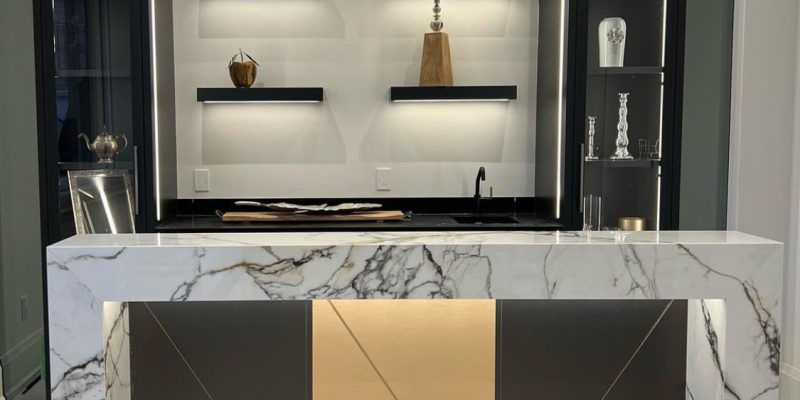
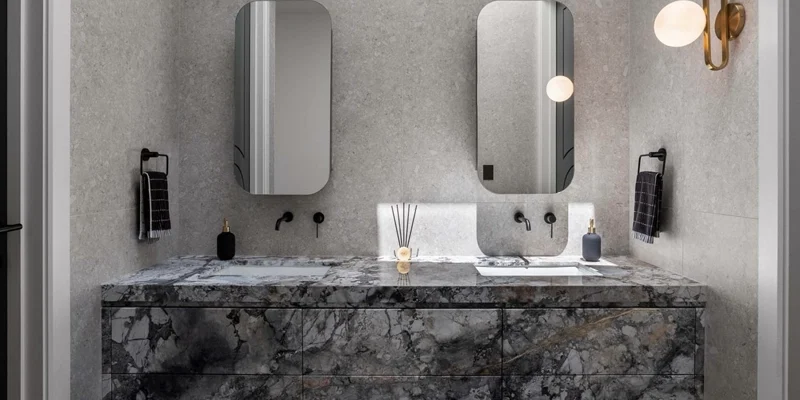
Bathroom vanity countertop cost depends on much more than the number of square feet in the vanity. Material selection, countertop dimensions, sink openings, edge fabrication, backsplash pieces, removal requirements and installation conditions can all change the final project price.
This is particularly important for bathroom vanities because they are often relatively small custom fabrication projects. Two countertops with similar surface area can have very different fabrication requirements if one uses a single sink and simple edge while the other includes two sink cutouts, additional backsplash pieces and more complex stone detailing.
This guide explains the main factors that affect the cost of a custom bathroom vanity countertop so homeowners can compare quotations based on the complete project scope rather than a single headline price.
Homeowners still deciding between surfaces can also review Best Materials for Bathroom Vanity Countertops. For information about the project sequence itself, see the Bathroom Vanity Countertop Installation Guide.
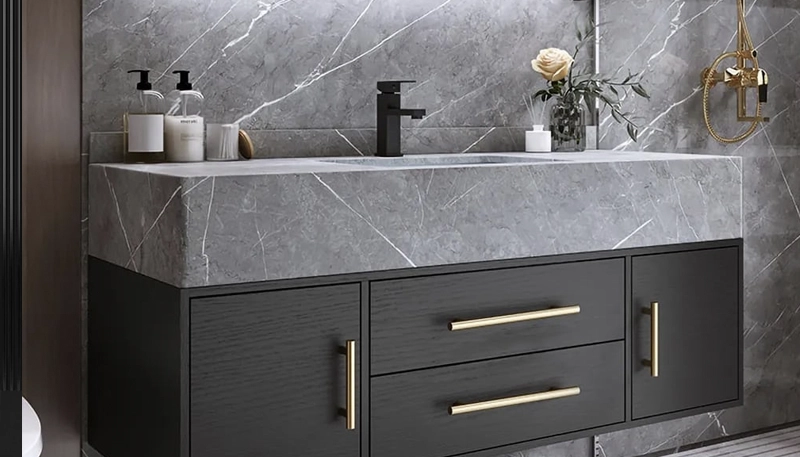
A useful vanity countertop quotation should reflect the complete project rather than material name alone.
The main cost variables can include:
This is why two bathroom vanities of similar width do not necessarily have similar project costs.
Price per square foot can be useful for comparing certain countertop materials, but it does not automatically represent the complete cost of a custom bathroom vanity project.
A vanity countertop may have relatively little surface area while still requiring several fabrication operations, including a sink opening, faucet holes, polished edges and backsplash pieces.
For example, consider two countertops with approximately similar surface area:
The second project can require substantially more fabrication even though the difference in countertop square footage is limited.
Certain parts of a countertop project do not shrink proportionally with square footage. Measurement, fabrication setup, transportation, handling and installation all involve project-level work.
For this reason, multiplying a small vanity area by a generic countertop price per square foot may produce an unrealistic expectation of the final project cost.
Compare complete project scope, not only square-foot price. A useful quotation should make clear which material, fabrication details, cutouts, backsplash components and installation services are included.
The selected surface is one of the main pricing variables, but broad material names do not establish a single price. Different quartz collections, granite slabs, marbles, quartzites and porcelain products can sit at very different price levels within the same material category.
The material also affects fabrication requirements, available slab dimensions and how efficiently the vanity components can be produced from the selected surface.
Quartz is available across a wide range of manufacturers, collections, colours and patterns. The selected product therefore matters more than simply stating that the vanity will use quartz.
Quartz pricing can be influenced by:
A simple quartz vanity using an available surface should not automatically be compared with a highly patterned or premium product requiring additional fabrication details.
Granite is natural stone, and individual slabs can differ in availability, appearance and price.
Relevant pricing considerations can include:
The fact that two countertops are both granite does not mean their material or fabrication costs will be identical.
Marble can range from relatively restrained stones to highly distinctive slabs selected primarily for their veining and visual character.
The specific marble, slab availability and desired pattern placement can all influence the project.
Where the vanity is intended to display a particular section of veining, material layout may become part of the fabrication planning rather than simply cutting the smallest possible rectangle from the slab.
Quartzite is another natural-stone category in which individual materials can vary considerably.
Cost can be influenced by the selected stone, slab availability, fabrication characteristics, visible pattern requirements and the specific details of the vanity.
Broad statements such as “quartzite always costs more than granite” are not reliable enough for an individual project. The actual slabs and fabrication requirements should be compared.
Porcelain slabs introduce a different set of product and fabrication considerations.
Pricing can depend on:
A porcelain vanity should therefore be priced from the actual product and design rather than treated as one fixed-price material category.
Not necessarily.
Material price is only one part of the project. A relatively straightforward vanity using a higher-priced surface can sometimes involve less fabrication than a more complicated vanity using a lower-priced material.
For example, fabrication requirements can increase when a project includes:
The total quotation should therefore be evaluated as a combination of material + fabrication + project requirements, not as material cost alone.
Countertop dimensions influence how much material is required, but width alone does not tell the full story.
Relevant dimensions can include:
A compact vanity uses less surface material, but the project may still require measurement, a sink cutout, faucet drilling, edge finishing and installation.
That is why the cost of a small custom vanity should not necessarily be calculated by simply applying the same square-foot logic used for a much larger countertop project.
A wider countertop requires more material and can make slab dimensions and pattern layout more important.
On strongly patterned natural stone or manufactured slabs, the visible section selected for a longer vanity can also influence how the material is used.
The amount of material required for fabrication can differ from the finished visible square footage. Slab dimensions, pattern orientation, cutouts and additional components can affect material usage.
This is another reason a complete project quotation is generally more informative than estimating cost from visible vanity dimensions alone.
The number of sinks can affect vanity countertop cost even when two projects use the same material and have similar overall dimensions. A second sink usually introduces additional fabrication requirements rather than simply reducing the amount of visible countertop surface.
A single-sink vanity typically requires one basin opening together with any faucet or accessory holes specified for the project.
Cost variables can include:
A compact single-sink vanity can therefore have a relatively simple fabrication scope, but its cost should still be evaluated as a complete custom project rather than material area alone.
A double vanity requires two basin locations and often two faucet arrangements. This can increase the number of cutouts, drilling operations and layout decisions involved in fabrication.
Additional considerations can include:
A double vanity should therefore not be priced by simply doubling the cost of a smaller single vanity. The actual dimensions and fabrication scope should determine the quotation.

Sink openings require fabrication, and the amount and type of work involved depend on the basin configuration.
With an undermount sink, the fabricated opening remains visible after installation. The cutout therefore requires a finished edge appropriate for the approved basin and countertop design.
Relevant factors can include:
A vessel sink generally requires a different countertop opening because the basin sits above the surface. The drain opening and faucet arrangement should be based on the actual fixture specifications.
A smaller opening does not automatically mean that the complete vanity project will cost less, because basin configuration is only one component of the overall fabrication scope.
Integrated or more specialized sink systems can require product-specific fabrication and should be priced from the actual material and basin configuration rather than a generic sink-cutout allowance.
For a deeper comparison of these configurations, see Bathroom Vanity Sink Options: Undermount, Vessel & Integrated Sinks.
Faucet and accessory drilling forms part of the fabrication requirements when openings need to be made through the countertop.
Different fixture systems can require:
The final quotation should reflect the approved fixture configuration rather than an assumed standard drilling pattern.
Edge fabrication influences both the appearance and production requirements of a vanity countertop. The appropriate edge should be selected for the material, countertop dimensions and design rather than chosen solely as a price upgrade.
Restrained profiles can provide a clean finished edge without adding unnecessary visual complexity. Their exact fabrication requirements still depend on the selected material and exposed edge length.
More detailed edge treatments can involve additional fabrication compared with a simple profile. The effect on cost depends on the material, edge length and specific detail requested.
A mitered detail can create the appearance of a thicker countertop edge through additional fabrication. This can affect material use and production complexity and should therefore be included explicitly in the project quotation where required.
Do not compare quotes without comparing edge details. Two countertops using the same slab can have different fabrication scopes if their visible edge treatments are different.
Stone or porcelain backsplash pieces add material and fabrication beyond the main vanity countertop.
A project may include:
A short backsplash generally uses less material than a full-height treatment but still requires fabrication and installation as a separate component of the project.
Side splashes can add additional pieces where the vanity meets one or more adjacent walls. Their dimensions and number should be included when comparing project scopes.
A full-height backsplash can significantly change the material requirements of a vanity project. It may also involve coordination around mirrors, outlets, lighting or wall-mounted fixtures.
A quotation that includes a full-height slab treatment should therefore not be compared directly with one covering only the vanity countertop.
Because bathroom vanities are often smaller than kitchen countertops, some projects may be suitable for available remnant material. A remnant is a usable piece remaining from a larger slab rather than material selected from a complete new slab specifically for the project.
Where an appropriate remnant is available, it may reduce the amount of new material that needs to be purchased for a small vanity project.
However, remnant suitability depends on more than surface area.
The material must accommodate the required countertop dimensions together with sink openings, finished edges and any backsplash components.
Strongly veined or directional materials may not provide the desired visual layout simply because a remnant is technically large enough.
Remnants depend on current inventory. A particular material, colour or pattern may not be available in a suitable size when the project is quoted.
A full slab or larger material allocation may become necessary when:
The amount of purchased material should therefore not be assumed from the visible finished countertop area alone.
Replacement projects can involve additional work before the new vanity countertop is installed. Whether removal is included should be clarified in the quotation rather than assumed.
Existing countertop considerations can include:
Once an old countertop is removed, previously hidden cabinet damage, wall irregularities or earlier modifications may become visible.
Corrective cabinet, structural, plumbing or wall work should not automatically be treated as part of the stone countertop quotation unless specifically included.
Custom fabrication requires reliable dimensions. Depending on the project and quotation structure, site measurement or templating may form part of the overall countertop scope.
Measurement can document:
For more information about this stage, see Teccorp’s countertop survey and measurement service.
Fabrication converts the selected slab or manufactured surface into the finished vanity components. The amount of fabrication is therefore a major part of the complete project cost.
Depending on the design, fabrication can involve:
A quotation that includes more fabrication work should not be compared only on the raw material price with one that includes a simpler countertop.
Installation is another component that should be identified clearly when comparing quotations. A material-only price is not equivalent to a fabricated-and-installed countertop price.
Installation requirements can be influenced by:
The detailed installation process is covered separately in Teccorp’s Bathroom Vanity Countertop Installation Guide.
A vanity countertop must be transported from the delivery point to the bathroom.









Potential considerations include:
These conditions are project-specific. They should be identified when relevant rather than converted into a universal surcharge or assumption for every vanity installation.
Two contractors can appear to quote the same bathroom vanity while actually pricing different scopes.
For example, one quotation may cover:
while another may include:
Comparing the final numbers without comparing these inclusions can make one quote appear cheaper even when the underlying projects are not equivalent.
The most useful comparison therefore begins by standardizing the project scope before comparing the price.
The cost structure can differ between a vanity countertop installed as part of a new bathroom project and a replacement countertop installed over existing cabinetry.
With new cabinetry, the countertop project can often be planned around a defined cabinet layout, selected sinks and approved fixture specifications before final measurement.
Relevant cost components can include:
Other bathroom work, such as cabinet installation, plumbing and electrical work, should be treated separately unless specifically included in the documented project scope.
Replacing an existing countertop can introduce additional variables because the current vanity, sink, backsplash and surrounding conditions need to be evaluated.
Potential cost considerations include:
A replacement project should therefore not be assumed to cost less simply because the cabinet is being retained.
A useful quotation should make the project scope understandable enough that the homeowner can determine what is included, what is excluded and which decisions could change the final price.
Depending on the project, the quotation should clarify items such as:
A lower headline price is not automatically a lower project cost. First compare whether the quotations include the same material, fabrication details, cutouts, backsplash components and installation scope.
Do not compare one quotation for a specific quartz collection with another quotation that simply states “quartz.” Brand, product line, slab or colour selection can affect the material being priced.
The same principle applies to granite, marble, quartzite and porcelain.
Make sure both quotations are based on the same countertop width, depth and additional stone components.
A quote that excludes a backsplash or side splash is not directly comparable with one that includes those pieces.
Confirm how many sink openings and faucet holes are included and whether the sink configuration is the same in each quotation.
A single undermount sink and a double vanity with two fabricated openings are different scopes.
Simple exposed edges and more complex fabricated profiles can involve different production requirements. Both quotations should reflect the same approved edge treatment before price becomes a meaningful comparison.
A material-only or fabrication-only price should not be compared directly with a quotation that includes installation.
For replacement projects, confirm whether removal of the existing vanity top and any associated disposal are included or excluded.
Plumbing reconnection, electrical work, cabinet modification and structural correction should not be assumed to be part of the countertop quotation unless specifically documented.
Managing the budget does not necessarily require selecting the cheapest material. A better approach is to simplify the project in areas that matter less to the homeowner while protecting the features that matter most.
Establish the required vanity size, number of sinks and practical backsplash needs before adding optional design details.
Instead of selecting one exact surface before understanding the budget, compare several products that meet the intended appearance and maintenance requirements.
The Best Materials for Bathroom Vanity Countertops guide can help narrow the material shortlist before requesting a project-specific quotation.
Where inventory allows, a suitable remnant may be worth considering for a compact vanity. The material still needs to meet the required dimensions, pattern direction and fabrication needs.
A complex edge treatment is not automatically necessary for a successful vanity. A simpler edge can be visually appropriate while reducing unnecessary fabrication complexity.
A short backsplash, full-height slab and separate wall finish create different material requirements. Select the backsplash based on the design rather than assuming more stone automatically produces a better result.
Late changes to sinks or faucet configurations can affect countertop openings and may create additional work. Confirming fixtures at the appropriate stage helps avoid preventable changes after fabrication planning has begun.
Square-foot pricing may exclude fabrication, cutouts, backsplashes, installation or project-level costs. Compare the complete scope instead.
Material categories contain many different products and slabs. The specific surface being quoted matters.
A vanity is not simply a flat rectangle of material. Fixture openings form part of the fabrication scope.
Additional stone behind or beside the vanity can change both material requirements and fabrication.
Replacement projects should state clearly whether the existing countertop is being removed and who is responsible for that work.
Stone installation and plumbing connection are separate scopes unless the project documentation explicitly states otherwise.
A quotation that initially appears cheaper may simply exclude services or fabrication details included elsewhere.
Before accepting a quotation, consider asking:
A clear answer to these questions makes it easier to compare competing quotes and reduces the chance of comparing incomplete scopes.
There is no single reliable price for every custom vanity countertop. Cost depends on the exact material, dimensions, fabrication details, sink openings, backsplash components, removal requirements and installation scope.
Not necessarily. Both quartz and granite are available across different product and price levels. The specific quartz product or granite slab and the required fabrication should be compared rather than relying on the material category alone.
A double vanity can involve more material and additional sink and faucet fabrication, but the exact difference depends on the dimensions, selected surface and overall project scope.
Sink openings are part of the fabrication requirements. Their number, configuration and finished details can affect the overall scope of the project.
It may help in some smaller projects where a suitable piece is available. The remnant still needs to accommodate the vanity dimensions, sink opening, pattern and other fabrication requirements.
Not automatically. Plumbing disconnection or reconnection should be identified separately unless specifically included in the documented project scope.
Retaining suitable cabinetry can avoid purchasing new cabinets, but countertop replacement still involves material, fabrication and installation. Existing countertop removal and conditions discovered underneath can also affect the project.
The quotations may include different materials, sink cutouts, edge details, backsplash pieces, removal or installation services. Compare the scope line by line before comparing the final total.
The most reliable way to understand bathroom vanity countertop cost is to define the actual project: material, dimensions, sink configuration, fabrication details, backsplash requirements and installation scope.
A quotation based on those details provides more useful information than applying a generic square-foot price to every bathroom vanity.
Teccorp Stone can review custom vanity countertop requirements for projects across Toronto and the GTA and provide pricing based on the documented material and project scope.