Laminate vs quartz countertops is a practical comparison for Ontario homeowners deciding between a lower upfront project cost and a more substantial engineered-stone surface. Both materials can create an attractive kitchen, but they differ considerably in construction, fabrication, heat tolerance, moisture vulnerability, repair options and long-term ownership expectations.
Laminate is generally selected when budget control, lighter weight and a straightforward cosmetic update are the main priorities. Quartz is usually considered when homeowners want a denser surface, greater resistance to common spills, more substantial edge options and a countertop designed for a primary kitchen.
Neither material is automatically correct for every project. A rental unit, basement kitchen or short-term renovation may justify a different decision from a heavily used family kitchen or a prominent open-concept island.
This guide compares laminate and quartz without treating either as universally superior. It explains where each material performs well, what limitations require planning and how to compare complete project quotations rather than relying on surface appearance or initial price alone.
Choose laminate when: Minimizing upfront cost is the primary objective and the project can accept more caution around heat, moisture and surface damage.
Choose quartz when: The countertop will serve a frequently used primary kitchen and the project prioritizes stain resistance, substantial fabrication and relatively straightforward routine care.
Do not decide from appearance alone: Modern laminate can reproduce many stone-inspired designs, but its core, seams and edge construction remain different from quartz.
Most important comparison: Evaluate the complete installed scope, expected use and replacement tolerance—not only the initial material price.
Laminate usually provides the lower initial cost. Quartz normally requires a larger project budget because it involves slab material, specialized fabrication, transportation and professional installation.
That does not mean quartz always provides the better financial outcome. A low-use or short-term project may not benefit from paying for performance features the household does not require. Conversely, choosing laminate only because it costs less may result in dissatisfaction when the countertop is exposed regularly to heat, water or heavy kitchen use.
The following table compares the materials at a practical level. Exact performance depends on the selected product, construction, fabrication and installation.
| Comparison Factor | Laminate | Quartz | Decision Impact |
|---|---|---|---|
| Initial project cost | Generally lower | Generally higher | Important for rentals, secondary spaces and restricted budgets |
| Heat exposure | Requires strict protection | Also requires trivets because binders can be affected by concentrated heat | Both materials require safe cookware and appliance habits |
| Moisture | Surface performs differently from vulnerable seams and core material | Most products have low absorption; seams and openings still require correct installation | Sink areas require careful detailing with either material |
| Surface damage | More vulnerable to cutting, burns and edge damage | More resistant to routine abrasion, but edges can chip under impact | Cutting boards and appropriate handling remain necessary |
| Repair options | Damage can be difficult to disguise; partial component replacement may sometimes be possible | Selected chips or seams may be professionally repaired, but restoration is not always invisible | Repair expectations should be discussed before purchase |
| Visual construction | Printed decorative surface over a core | Engineered slab with more substantial edge and opening fabrication | The difference is often most visible at edges, seams and sink details |
| Typical project fit | Budget renovations, rentals and secondary kitchens | Primary kitchens, islands and higher-use work surfaces | The expected use should determine which advantages matter |
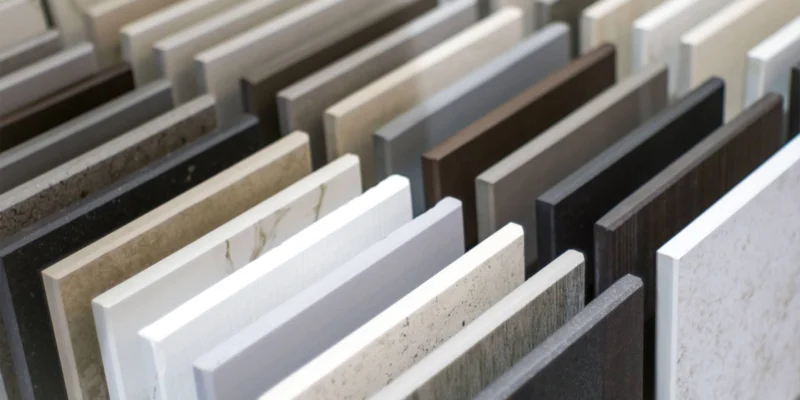
A laminate countertop typically uses a decorative surface bonded to an engineered wood-based core. The visible layer provides colour and pattern, while the core establishes the countertop’s shape and structure.
Modern laminate products are available in solid colours and designs inspired by stone, wood, concrete and other materials. Their lower weight and comparatively straightforward construction can support faster or lower-budget renovations.
The decorative surface does not make the underlying core waterproof or heat-resistant. Moisture entering unfinished edges, joints or damaged areas can affect the core, while direct heat may permanently mark the visible surface.
Scratches, cuts and burns can also be difficult to repair without leaving a visible difference. These limitations do not make laminate unsuitable, but they should be accepted before it is selected for a heavily used work area.
Quartz countertops are manufactured slab surfaces made using quartz minerals, pigments and binders. Exact composition and performance vary by product and manufacturer.
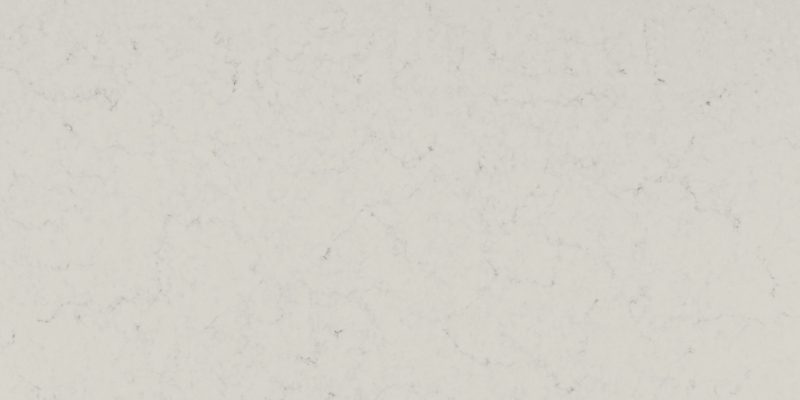
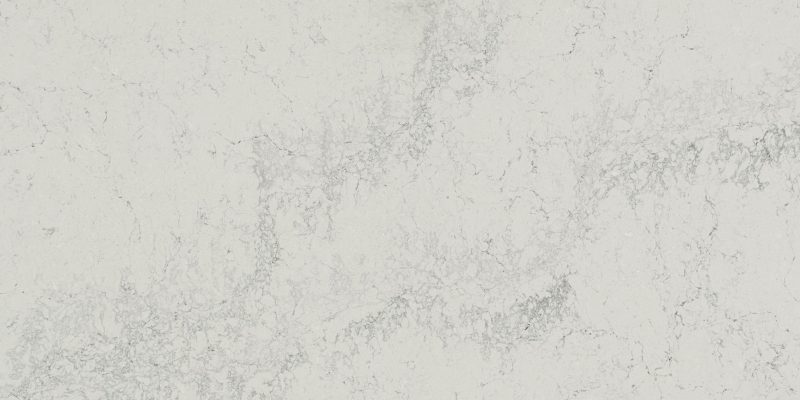
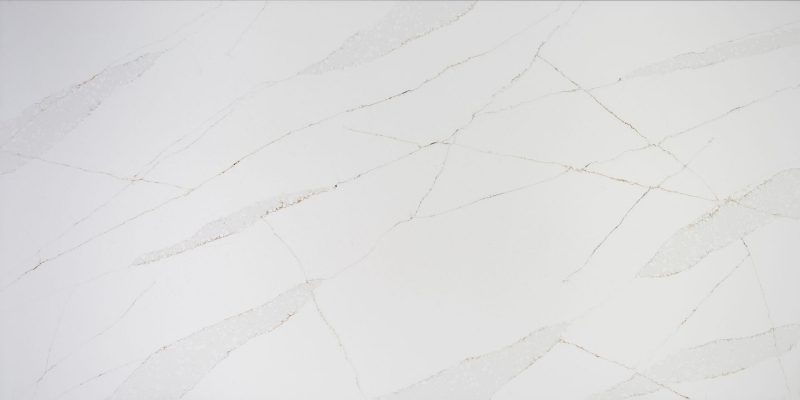
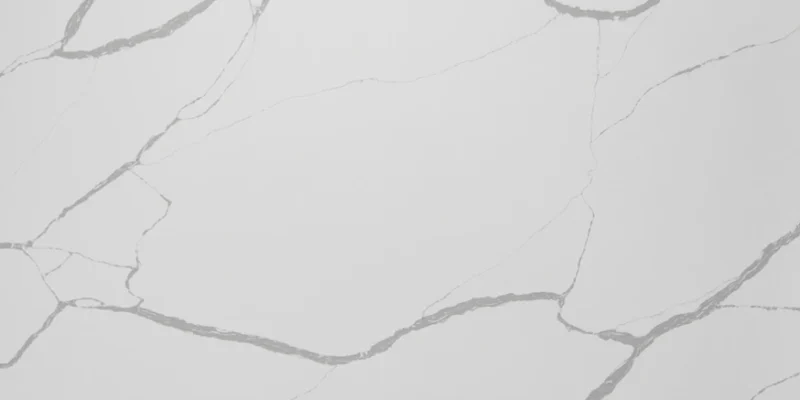
Most engineered quartz products offer low absorption and do not require routine sealing. They are available in controlled colours and patterns ranging from restrained designs to large-scale stone-inspired movement.
Quartz is not heat-proof, scratch-proof or impact-proof. Concentrated heat may affect its binders, while exposed edges and narrow sections around openings can chip if struck by heavy objects.
Professional fabrication and suitable cabinet support are required because quartz is considerably heavier and more rigid than laminate.
Explore available quartz countertop options and review the care requirements for the exact product being considered.
Service Scope Note
This guide compares both materials for decision-making. TecCorp’s linked collection and project services relate to quartz and stone countertops. Availability and installation of laminate should be confirmed with an appropriate laminate supplier or installer.
Cost is usually the clearest difference between laminate and quartz countertops. Laminate generally requires a smaller initial investment because the material is lighter, its construction is less complex and it does not require the same slab-fabrication process as quartz.
Quartz normally involves a higher project cost because the exact slab must be selected, measured pieces must be fabricated and the finished sections require specialized transportation and installation.
However, the lowest material price does not necessarily represent the complete installed cost. Quotes for either material should identify the countertop area, edge treatment, sink and cooktop openings, removal of existing surfaces, delivery, installation and any work required before the new countertop can be fitted.
Quartz pricing is particularly sensitive to slab yield. A small change in island size, pattern direction or countertop length can require an additional slab even when the finished square footage changes only slightly.
For a detailed explanation of quartz-specific pricing, review the quartz countertop cost guide for Toronto.
| Cost Question | Laminate | Quartz |
|---|---|---|
| Which usually has the lower initial cost? | Laminate generally provides the lower-cost starting point. | Quartz generally requires a larger material, fabrication and installation budget. |
| What can create additional charges? | Custom edges, unusual shapes, openings, backsplash details and removal work. | Additional slabs, pattern layout, complex edges, openings, waterfalls and access restrictions. |
| How should quotations be compared? | Confirm the exact product, core construction, edges, openings and installation scope. | Confirm the exact slab, quantity, fabrication, seams, delivery and installation scope. |
| Which is better for a restricted budget? | Often suitable when reducing the initial renovation cost is essential. | May be appropriate when the budget can support stone-style fabrication and higher-use performance. |
Cost Comparison Rule
Compare equivalent installed scopes. A material promotion cannot be compared directly with a quotation that includes measurement, fabrication, delivery and installation.
Durability should be evaluated according to how the countertop may be damaged. Heat, scratches, moisture, impact, edge wear and opening details affect laminate and quartz differently.
Laminate can perform effectively in a carefully used kitchen, but its decorative surface and wood-based core create specific vulnerabilities. Quartz provides a harder and more substantial work surface, although its exposed edges and narrow sections are not immune to damage.
Laminate may be sufficient for a basement suite, rental unit, office kitchen or secondary food-preparation area where the countertop receives controlled use. In these applications, its lower initial cost may carry more weight than maximum resistance to damage.
Quartz is often better aligned with kitchens used frequently for cooking, food preparation and entertaining. Its low-absorption surface can simplify routine cleaning, while its harder construction offers greater resistance to common abrasion than laminate.
This does not eliminate the need for cutting boards, trivets or responsible use. The practical advantage is greater tolerance for normal activity, not immunity from damage.
Laminate requires strict protection from hot cookware and heat-producing appliances. Direct contact with high temperatures can discolour the surface, weaken the adhesive or cause bubbling and permanent deformation.
Heat exposure from portable appliances should also be considered. Air fryers, toaster ovens, slow cookers and similar devices may concentrate heat in a limited area. Appliance instructions and protective-clearance requirements should be followed.
Quartz generally tolerates routine kitchen conditions better than laminate, but it is not heat-proof. Concentrated heat or rapid temperature change may affect the binders used within the material. Trivets and heat-resistant pads should therefore be used on quartz as well.
Laminate can be scratched by knives, abrasive tools, dragged cookware and rough cleaning materials. Damage that penetrates the decorative layer may expose the core and can be difficult to disguise.
Quartz offers stronger resistance to routine abrasion but should not be used as a cutting surface. Cutting directly on quartz may affect the countertop, damage knives or leave marks from transferred materials.
Laminate edges may chip, separate or become damaged when struck. The outcome depends on the edge construction and the position of the impact.
Quartz is harder but more rigid. A heavy object dropped near an exposed corner, sink opening or narrow section can cause a chip. The edge profile and fabrication around openings therefore influence practical durability.
Moisture performance is not determined only by the visible countertop surface. Seams, edges, sink openings, faucet holes and the material beneath the surface all affect how a countertop responds to water.
The laminate surface itself can be easy to wipe clean, but water entering a joint, damaged edge or poorly protected opening may reach the wood-based core. The core can swell or distort, and that change may not be reversible.
Particular attention should be given to:
Water should be removed promptly from vulnerable joints, and deteriorating caulk or sealant should be addressed before moisture reaches the core.
Most engineered quartz products have low absorption, but sink areas still depend on correct fabrication and installation. The sink opening, support, adhesive, seam placement and faucet holes must be planned for the exact fixture.
Quartz will not protect the cabinet below from plumbing leaks. Water can still enter cabinet joints, wall connections or the area beneath the sink if the fixture or plumbing is not sealed and maintained correctly.
Laminate seams may reveal the transition between countertop components and can become vulnerable if water reaches the joint. Quartz seams are also normally visible to some degree, although colour selection, pattern placement and professional joining can reduce their visual prominence.
A material should not be selected based on a promise of universally invisible seams.



Sink-Area Rule
Laminate requires protection of the core from water intrusion. Quartz offers lower material absorption, but sink support, cut-outs, sealant and plumbing conditions remain essential.
Repairability is frequently oversimplified in countertop comparisons. Neither laminate nor quartz can always be restored invisibly after significant damage.
Minor surface marks may sometimes be reduced, but burns, deep cuts, swelling and delamination are difficult to reverse. Local repair products may make damage less noticeable without fully restoring the original appearance.
Depending on how the countertop was constructed, it may be possible to replace one component or section. Matching an older colour, finish or pattern can be difficult if the original product is no longer available.
Selected chips, seams or limited areas of damage may be assessed by a professional. Repairs can use colour-matched materials, but the result may remain visible under certain lighting or viewing angles.
Major cracking, extensive heat damage or movement caused by inadequate support may require more substantial intervention. Repair feasibility depends on the location and cause of the damage rather than the material name alone.
Laminate may be less expensive to replace, but replacement can still affect sinks, backsplashes, plumbing and retained cabinets. Quartz replacement involves heavier fabricated pieces and may also affect adjacent finishes.
Before selecting either material, consider not only whether damage is possible but how disruptive and costly replacement would be within the complete kitchen.
Laminate and quartz can both support a wide range of kitchen styles, but they achieve their finished appearance through different construction methods. The distinction is often most noticeable at seams, exposed edges, sink openings and island details.
Laminate is available in solid colours and printed designs inspired by wood, concrete, marble, granite and other surfaces. This variety can provide an effective visual update without the material and fabrication cost associated with quartz.
The selected product should be reviewed beyond a small sample. Large patterns, repeated motifs and the transition between horizontal surfaces and finished edges may appear different across a complete countertop.
Laminate edge options can include:
Availability depends on the product, manufacturer and fabrication method. Not every laminate pattern can be combined with every edge construction.
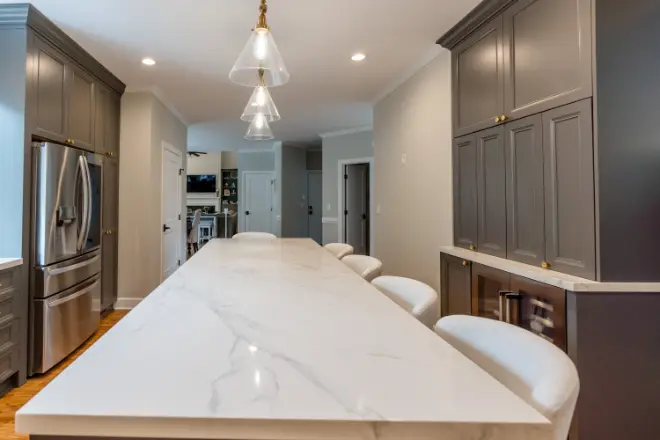
Quartz is manufactured in slab form and is available in controlled colours, subtle patterns and larger-scale stone-inspired movement. Its thickness and fabrication allow it to create a more substantial appearance at exposed edges, islands and sink openings.
Quartz edge options may include eased, bevelled, bullnose, ogee and mitred constructions, depending on the exact material and fabrication requirements.
Review the practical implications of different profiles in the countertop edge profile guide.
Both materials can require seams. Laminate seams may be more noticeable where printed patterns meet or where countertop sections join. They also require protection from water exposure, particularly near sinks and backsplashes.
Quartz seams depend on slab dimensions, countertop lengths, access and pattern direction. A restrained quartz design may make a seam less visually prominent, while a large directional pattern requires more deliberate layout planning.
Neither material should be selected based on an assumption that every joint will be invisible.
Laminate can create an attractive island surface, especially when the project prioritizes affordability and a straightforward edge treatment. More elaborate waterfall-style construction may be possible through specific laminate fabrication systems, but it does not reproduce the same joint, thickness or material continuity as a quartz slab installation.
Quartz is generally better suited to substantial mitred edges and fabricated waterfall panels. These features increase material use and fabrication complexity and should be evaluated as part of the complete island design.
Countertop installation requirements differ because laminate is lighter and typically supported by a built-up core, while quartz is heavier, rigid and fabricated as individual slab sections.
Laminate components may be fabricated in a shop or assembled using prefabricated sections. Their lighter weight can simplify handling, but accurate cabinet dimensions and wall conditions are still important.
Installation quality influences:
Uneven cabinets or poorly protected cut-outs can reduce the serviceability of an otherwise suitable laminate product.
Quartz requires professional measurement, fabrication, delivery and placement. Cabinetry should be secured, appropriately supported and ready before final countertop dimensions are established.
The project should confirm:
Quartz does not correct cabinet problems. Movement, uneven support or incomplete cabinetry can affect seam alignment, fixture fit and long-term countertop performance.
For projects involving cabinet and countertop coordination, review why countertop planning should account for cabinet design.
Installation Rule
A stronger material cannot compensate for inaccurate dimensions, unstable cabinets or poorly planned openings. Installation conditions affect both laminate and quartz.
The better material depends on the role of the countertop rather than on a universal ranking. The following table identifies situations where each option may provide a practical fit.
| Project Type | Potential Fit | Reason |
|---|---|---|
| Budget-focused kitchen refresh | Laminate | Provides a lower-cost visual update when the existing layout remains largely unchanged |
| Rental property | Depends on budget and tenant use | Laminate reduces initial cost; quartz may provide greater tolerance for spills and routine wear |
| Basement or secondary kitchen | Often laminate | Lower use may not justify the additional cost of slab fabrication |
| Frequently used family kitchen | Often quartz | Offers a harder surface, low absorption and substantial fabrication for daily use |
| Large statement island | Often quartz | Supports slab-based patterns, substantial edges and fabricated waterfall details |
| Short-term renovation | Often laminate | Limits initial expenditure when long-term ownership is not the main objective |
| Long-term primary residence | Often quartz | May better match expectations for daily performance and substantial construction |
These are planning directions rather than rigid rules. A carefully maintained laminate countertop can remain suitable in a primary kitchen, while an expensive quartz surface can still be damaged by heat, impact or inadequate support.
The financial comparison between laminate and quartz should not be reduced to a claim that one always provides better value. Value depends on the renovation objective, expected use, ownership period and tolerance for future replacement.
Laminate may provide better project value when the objective is to refresh a kitchen without committing a large portion of the renovation budget to countertops.
This can be appropriate when:
Quartz may provide stronger practical value when the countertop is expected to remain through a long-term kitchen renovation and receive regular use.
The justification may come from:
Quartz may be recognized by some buyers as a desirable kitchen feature, while laminate is commonly associated with budget-oriented construction. However, countertop material alone does not guarantee a higher sale price or financial return.
Cabinet condition, layout, workmanship, colour choices and the overall renovation quality influence buyer perception together. Homeowners renovating primarily for resale should avoid spending more on the countertop than the complete property and market position reasonably support.
For a broader discussion, review whether stone countertops are worth the investment.
Final Decision Rule
Choose laminate when its cost advantage and limitations align with the project. Choose quartz when its fabrication, performance and visual characteristics justify the additional investment.
Quartz generally provides greater resistance to routine abrasion, spills and moisture-related material damage. Laminate may still be the better choice when minimizing initial cost is more important than maximum performance.
Laminate usually has a lower initial material and installation cost. The actual difference depends on the selected products, countertop layout, edges, openings, removal work and installation scope.
Many laminate products use quartz- or stone-inspired printed designs. They can create a similar colour direction, but their surface construction, edge details, seams and depth of pattern remain different.
Most engineered quartz products do not require routine sealing. Care instructions should still be confirmed for the exact product.
Direct hot cookware should be avoided on both. Laminate can burn or deform, while concentrated heat may affect the binders within quartz. Use trivets or heat-resistant pads.
Quartz generally offers lower material absorption, but the sink cut-out and installation still require proper support and sealing. Laminate can also work around a sink when cut edges and seams are protected carefully from water intrusion.
Some limited damage may be assessed or reduced, but invisible restoration is not guaranteed. Laminate burns and swelling are particularly difficult to reverse, while quartz chips or seams may sometimes be repaired professionally.
Yes, particularly when controlling the initial renovation budget is the main priority. The decision should account for tenant use, replacement tolerance and the risk of heat or moisture damage.
Quartz may contribute to stronger buyer perception in some homes, but it does not guarantee a financial return. Overall kitchen condition, design and workmanship remain important.
Yes. One material may be used for a prominent or heavily used island and another in a secondary area. The transition should be planned through colour, thickness, edge design and functional purpose.
The decision between laminate and quartz should reflect the actual kitchen, not a generic ranking. Consider how frequently the surface will be used, which areas are exposed to heat or water, how long the renovation is expected to remain and whether the design requires slab-based edges or island details.
TecCorp’s countertop collection and project services focus on quartz and stone surfaces. Homeowners selecting laminate should confirm product availability, fabrication and installation with a qualified laminate provider.
Considering Quartz for Your Kitchen?
Share your layout, approximate dimensions, sink details, island requirements and preferred quartz styles for an initial project discussion.
Discuss Your Quartz Project
Explore Quartz Countertops
Explore Kitchen Countertop Services