Welcome to the Tec Corp Stone Inc. Shop! Explore our extensive selection of premium stones, from elegant marble to durable granite. Whether you’re planning a renovation or a new build, find the perfect materials to elevate your space. Shop now for high-quality stones and bring your design dreams to life.
Onyx countertops in Toronto are chosen for their translucency, layered colour and ability to become a dramatic architectural feature. Unlike granite, quartzite or engineered quartz, onyx is usually selected for visual impact rather than heavy everyday performance. It can be fabricated for illuminated bars, statement islands, powder-room vanities, reception desks, fireplace surrounds and feature walls where the stone’s natural depth can be fully appreciated.
TecCorp Stone supplies and fabricates onyx slabs for custom residential and commercial projects across Toronto and the GTA. Because every slab varies in translucency, veining, reinforcement and colour distribution, successful results depend on reviewing the actual material and coordinating the design before fabrication begins.
This page explains what onyx is, how to evaluate available slabs, which applications suit the material and what should be confirmed before requesting fabrication and installation.
Quick Answer
Onyx is best for design-led, controlled-use surfaces where translucency and natural colour are more important than maximum resistance to acids, scratches and impact. Choose the slab according to the complete installation—including lighting, support, seams, cutouts and intended use—not from a small sample alone.
Decorative onyx is a calcite-based natural stone formed through mineral deposition. The slab material used in interiors is often described as onyx or onyx marble, and it should not be confused with the harder silica-based gemstone that carries the same name.
Architectural onyx is known for flowing bands, crystalline areas and layered colours that can range from white and cream to amber, gold, green, pink, red, brown and grey. Many slabs contain several tones, along with natural fissures, filled areas and reinforcement that become part of the finished design.
The defining quality of many onyx slabs is their ability to transmit light. When illumination is placed behind the stone, internal layers and mineral movement become more visible, producing an effect that cannot be replicated by ordinary surface lighting.
Translucency is not uniform. Dense veins, darker sections and reinforced areas may transmit less light than surrounding portions of the slab. For this reason, a backlit project should be designed around the actual material rather than a catalogue image or small showroom sample.
Two slabs sold under the same colour name may have noticeably different movement, opacity and vein direction. Even consecutive slabs from the same block can display variations that affect layout and bookmatching.
Before fabrication, review the full slab and consider:
This review is especially important for bars, islands and wall features where a large uninterrupted area becomes the focal point of the room.
A polished finish reflects more light and emphasizes colour depth, making it a common choice for decorative and backlit surfaces. It can also make etching, scratches and uneven wear more visible.
A honed finish has a softer, lower-sheen appearance. It may suit some contemporary designs, but it does not eliminate the stone’s sensitivity to acids, staining or impact. Finish selection should therefore be based on the intended visual result and use conditions rather than the assumption that one finish requires no care.
Onyx is appropriate when the project needs a focal material with more depth and light interaction than a standard countertop surface. It can turn a bar front, wall panel or island into a central design element even when used in a limited area.
A project does not need a full room of onyx to achieve a strong result. Using one carefully selected slab on a reception desk, vanity, bar or vertical island panel can provide greater visual impact than extending the material across every work surface.
This selective approach also allows more durable materials to be used where food preparation, impact and frequent cleaning are expected.
Onyx works particularly well in interiors where lighting is part of the design concept. The stone can respond differently during the day and evening, appearing more subtle under ambient light and more dramatic when backlighting is activated.
The colour temperature and spacing of the light source influence the final appearance. Warm illumination may strengthen cream, amber and gold tones, while cooler lighting can emphasize white, grey or green areas.
Onyx can be fabricated as a countertop, but it should not automatically be used wherever a countertop is required. It is softer and more acid-sensitive than many conventional work surfaces, so the application must match the owner’s expectations and daily habits.
For busy preparation zones, a mixed-material design is often more practical. Onyx can be reserved for an illuminated panel, raised bar or low-use section while granite, quartzite, porcelain or engineered quartz handles heavier daily activity.
Selection Principle
Choose onyx because its translucency, colour and natural movement support the design—not because it is expected to perform like a low-maintenance kitchen surface. The best application is one that protects the stone while keeping its visual qualities prominent.
The next step is matching the slab to the right application and confirming how layout, lighting, support and fabrication will work together.
Onyx is most effective when it is used deliberately rather than across every available surface. The application should give the slab enough visual space to display its colour and movement while limiting unnecessary exposure to acids, abrasion, impact and heavy daily use.
For a more detailed suitability review, see where onyx countertops work best.
Backlit bars are among the most recognizable onyx applications. A bar top or illuminated front panel can reveal the stone’s internal layers while creating a focal point for residential entertainment rooms, restaurants, hotels and hospitality spaces.
The design should account for sinks, faucets, equipment and service access. Wine, citrus, coffee and other acidic or pigmented liquids can mark the surface, so coasters, trays and prompt cleaning remain important even when the stone has been sealed.
An onyx island can be designed as a low-use serving surface, illuminated seating area or decorative structure paired with a more practical worktop. Vertical waterfall ends and front panels often provide strong visual impact with less exposure than a full preparation surface.
Where onyx is used horizontally, the layout should minimize unnecessary cutouts and unsupported overhangs. Sink, cooktop and seating requirements need to be resolved before cutting.
Powder-room vanities provide a smaller surface where distinctive colour and translucency can become part of the lighting scheme. Sink openings, faucet holes and edge details still require careful planning.
Soap, cosmetics and standing water should be removed promptly, and cleaning products must be compatible with calcite-based stone.
Vertical panels, lobby walls and reception desks allow large sections of the slab to remain visible. These applications suit bookmatching, directional vein layouts and backlighting because the stone is less exposed to food preparation and cookware.
Commercial projects should also consider impact from luggage, carts, cleaning equipment and customer traffic. Protective details or more durable materials may be appropriate at floor level and along exposed corners.
Onyx may be used as decorative fireplace cladding when the assembly satisfies the fireplace manufacturer’s clearances and the requirements of the substrate, adhesive and support system. It should not be assumed suitable for direct flame or every high-temperature condition.
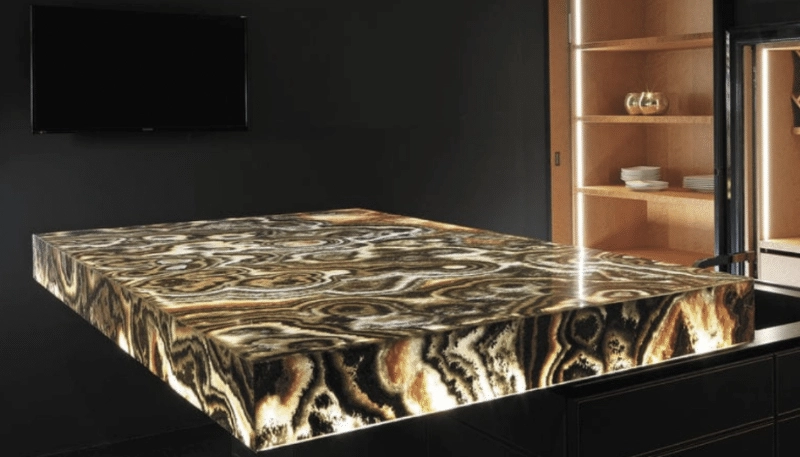
Onyx selection should be based on the actual slab and intended installation. A sample can confirm the general colour family, but it cannot show how movement, opacity and natural features will appear across a large countertop or wall.
Inspect the slab from several distances and under neutral lighting. Identify the areas you want to feature, sections that should be kept away from cutouts and any natural fissures, filled zones or reinforcement that may remain visible.
For multi-slab projects, review the slabs together and confirm their sequence before pieces are assigned to islands, walls, returns or waterfall panels.
If backlighting is planned, illuminate the actual slab before approving the layout. Testing can reveal opaque bands, colour shifts, repaired areas and differences in light transmission that may not be obvious under showroom lighting.
It also helps determine where seams, framing or equipment shadows will be least disruptive.
Directional veins can continue across adjoining pieces or be mirrored to create a bookmatched composition. Both approaches require accurate slab photography, sequencing and layout approval.
Bookmatching is a design option rather than a guarantee of perfect symmetry. Natural variation, trimming and seam requirements influence the final pattern.
The finish affects reflectivity and colour depth, while thickness, backing and reinforcement affect fabrication and support. These specifications should be confirmed for the selected slab rather than based on a general rule for all onyx.
Some slabs contain mesh backing, resin or reinforced areas. The fabricator should evaluate how these features interact with edges, cutouts, adhesives and backlighting.
Onyx fabrication requires the design, slab and site conditions to be coordinated before production. Changes made after cutting may be difficult because of the stone’s natural variation and sensitivity.
Accurate measurements are needed for walls, cabinets, appliances, sinks and fixtures. Cutouts should be positioned with the vein structure and support requirements in mind, particularly where narrow stone sections would remain.
Seam locations should balance slab size, site access, vein continuity and structural practicality. Edge profiles must suit the material without removing unnecessary strength from delicate areas.
Cabinetry, framing and substrates must be level, stable and suitable for the planned load. Sealer cannot correct inadequate support or movement.
Lighting panels, diffusion, wiring, drivers and controls should be coordinated before final fabrication. The system needs enough distance to distribute light without obvious hot spots, shadows or visible hardware.
Electrical components should remain accessible for future inspection or replacement without dismantling the complete stone feature.
Stairs, elevators, narrow passages and restricted turning space can affect the maximum practical panel size. Access should be checked before slab layout and seam decisions are finalized.
Cabinets, framing, electrical work and surrounding finishes should be ready before installation to reduce repeated handling and exposure to unfinished construction work.
Before Fabrication Begins
Approve the exact slab, layout, finish, seams, cutouts, support and lighting plan as one coordinated package. Onyx projects are most successful when these decisions are resolved before the material is cut.
The cost of an onyx project depends on more than the size of the finished surface. Slab availability, translucency, layout, reinforcement, backlighting, edge details, site access and installation requirements can all affect the scope of work.
Because onyx varies significantly from slab to slab, a reliable quotation should be based on the selected material and an approved project plan rather than a generic price per square foot.
Colour, movement, translucency and slab dimensions influence material selection. A project that requires consecutive slabs, strong bookmatching or a specific colour range may involve more limited inventory and additional layout planning.
The usable yield also matters. Natural fissures, reinforced areas, edge damage or sections reserved for visual continuity can reduce the amount of material available for finished pieces.
Backlit projects require coordination between stone fabrication, lighting, electrical work and support construction. Cost may be affected by:
A simple decorative panel and a fully illuminated bar with sinks, seams and wrapped edges are different fabrication projects even when their visible dimensions are similar.
Panel size, seam placement, building access and installation conditions can influence labour and handling. Elevators, stairs, narrow corridors and restricted turning space may require smaller pieces or additional seams.
Cabinetry, framing, electrical rough-ins and substrates should be completed and verified before installation. Delays or site changes after fabrication can create additional work and may affect the approved slab layout.
For an Accurate Onyx Quote
Provide the intended application, approximate dimensions, drawings or site photos, preferred slab style, edge details and whether backlighting is required. Final pricing should follow material selection, measurement and fabrication review.
Onyx requires more careful use than many conventional countertop materials. It is sensitive to acidic substances, abrasion and impact, so maintenance should focus on prompt cleaning and damage prevention rather than frequent polishing.
Use a soft microfiber cloth with warm water and a pH-neutral cleaner suitable for calcite-based natural stone. Remove acidic, oily and strongly coloured spills promptly, then dry areas around sinks, faucets and beverage equipment.
Avoid vinegar, lemon-based cleaners, abrasive powders, rough pads and generic polishing products. These may etch the stone, scratch the finish or leave an uneven coating.
A compatible penetrating sealer may reduce absorption and provide more time to clean staining liquids. It does not make onyx stain-proof and cannot prevent acidic substances from etching the surface.
There is no universal annual sealing schedule for every slab. The need for treatment depends on the material, finish, previous sealer and level of exposure.
Dull marks that remain after cleaning may be etching, scratches or wear rather than surface dirt. Professional honing and polishing may be required to restore a consistent finish.
For detailed guidance, read the complete guide to cleaning, sealing and polishing onyx countertops.
TecCorp Stone works with homeowners, designers, contractors and commercial teams planning custom onyx features in Toronto and the Greater Toronto Area. Onyx can be incorporated selectively into custom kitchen countertops in Toronto, decorative islands, bars and other design-led installations. The process can include slab review, layout planning, templating, fabrication and installation coordination according to the project requirements.
Residential applications may include backlit bars, decorative islands, powder-room vanities, fireplace surrounds and feature walls. The design should balance visual impact with the way the space will be used every day.
Onyx can be used for reception desks, restaurant bars, lobby walls, boutique displays and other design-led commercial installations. Traffic, cleaning procedures, impact exposure and access to lighting components should be considered before fabrication.
A successful project begins with the actual slab. Colour distribution, translucency, reinforcement and vein direction should be reviewed before the final layout is approved.
Measurements, cutouts, seams, support and lighting details are then coordinated so the stone can be fabricated for the intended location. Final installation requirements depend on the site, panel dimensions and surrounding construction.
Onyx can be used selectively in kitchens, but it is generally better for low-use islands, bars and decorative panels than primary food-preparation surfaces.
Many onyx slabs can transmit light, but translucency varies across the material. The actual slab should be tested before the lighting and support system are finalized.
No. Dense veins, colour bands, resin-filled sections and reinforcement can affect how light passes through the slab. Backlighting may reveal features that are less visible under normal room lighting.
Some installations may benefit from a compatible penetrating sealer, but the need depends on the slab, finish and application. Sealing helps manage absorption and does not prevent etching.
Yes. Powder-room vanities and decorative wall panels are common applications. Wet-area installations also require appropriate waterproofing, joints, ventilation and cleaning practices.
It can be effective in reception areas, bars, hotels, restaurants and boutiques when used in controlled locations and protected from repeated impact or aggressive cleaning.
Review the complete slab, not only a sample. Confirm its colour, vein direction, translucency, natural features, reinforcement and suitability for the planned cutouts, seams and lighting.
Share the project location, intended application, approximate dimensions, drawings or photographs, preferred finish and whether backlighting is planned. A final quotation can be prepared after the scope and material requirements are reviewed.
Onyx is most successful when the slab, application, fabrication and lighting strategy are planned together. It can create a distinctive focal point, but the final design must respect the stone’s translucency, natural variation and maintenance requirements.
Explore onyx for a backlit bar, island, vanity, reception desk, fireplace surround or feature wall, then review the actual slab and technical requirements before fabrication begins.

At Tec Corp Stone Inc., we pride ourselves on delivering exceptional craftsmanship and unmatched quality. With years of experience in stone fabrication, our dedicated team ensures every project is executed with precision and care. We offer personalized service, innovative solutions, and a commitment to customer satisfaction. Choose us for your stone needs and experience the Tec Corp Stone Inc. difference.