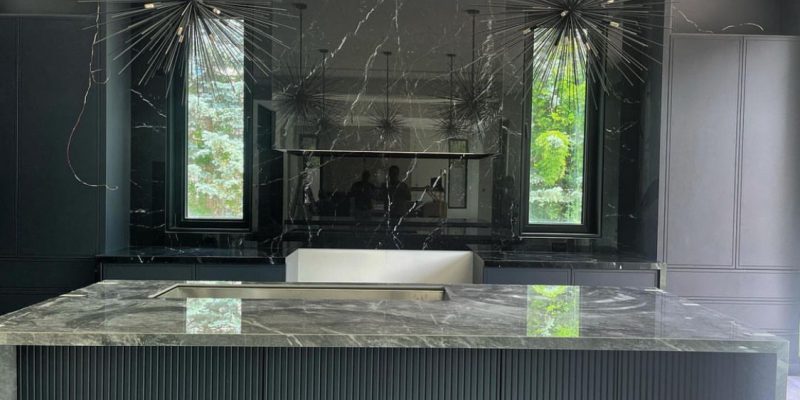
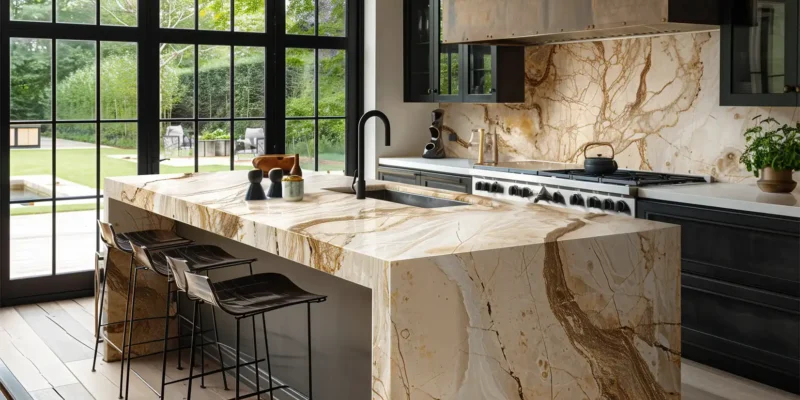
Custom stonework in modern Canadian homes has moved far beyond the idea of stone as a purely structural or traditional building material. Today, stone can appear as a precisely fabricated kitchen countertop, a waterfall island, a bathroom vanity, a fireplace surround, a full-height feature wall or a smaller architectural detail designed specifically for the dimensions of a space.
The change is not simply about style. Modern fabrication methods have expanded what can be produced from natural and manufactured slab materials, while contemporary residential design increasingly treats surfaces, cabinetry and architectural features as connected parts of the same interior composition.
This evolution has also changed the role of custom stonework. Instead of selecting a material and adapting the room around a standard component, many projects begin with the actual dimensions, functions and visual relationships of the space. Stone can then be measured, planned and fabricated for that particular application.
Understanding this evolution helps homeowners see custom stonework as more than a material choice. It is a combination of surface selection, design planning, fabrication and application—each of which influences how the finished stone relates to the rest of the home.
Residential Stone Applications | Project-Specific Fabrication | Natural & Manufactured Surfaces | Toronto & GTA Projects
Stone has been used in residential architecture for centuries, traditionally appearing in structural masonry, exterior walls, floors, hearths and other durable building elements. In contemporary interiors, its role can be considerably more precise.
Slabs of granite, marble, quartzite, engineered quartz and porcelain can now be fabricated into components shaped around cabinetry, fixtures, appliances and architectural dimensions. This allows stone to move from a general construction material into highly specific interior applications.
Traditional stone construction often emphasized mass, structure and durability. Modern residential stonework can still benefit from those material qualities, but the stone itself may be much thinner and more closely integrated with other interior elements.
A kitchen island, for example, may combine a horizontal countertop with vertical waterfall panels. A fireplace may use large-format fabricated pieces rather than small individual tiles. A feature wall can be planned around slab pattern, openings and adjoining surfaces rather than assembled as a generic wall finish.
The underlying principle has shifted from simply using stone to determining how a particular stone component should fit, align and visually interact with a specific space.
Accurate measurement, digital project information and modern cutting equipment have expanded the geometries that can be produced from slab materials. Sink openings, cooktop cutouts, mitered details, edge profiles, large islands and coordinated vertical panels can all be planned before fabrication begins.
Technology itself does not guarantee a successful result. Material knowledge, slab planning, accurate specifications and finishing remain important. But modern fabrication allows designers and homeowners to consider stone applications that would be difficult to achieve with standard prefabricated components.
Teccorp Stone’s broader custom stone services illustrate how this project-specific approach can extend across countertops, architectural surfaces and other fabricated stone components.
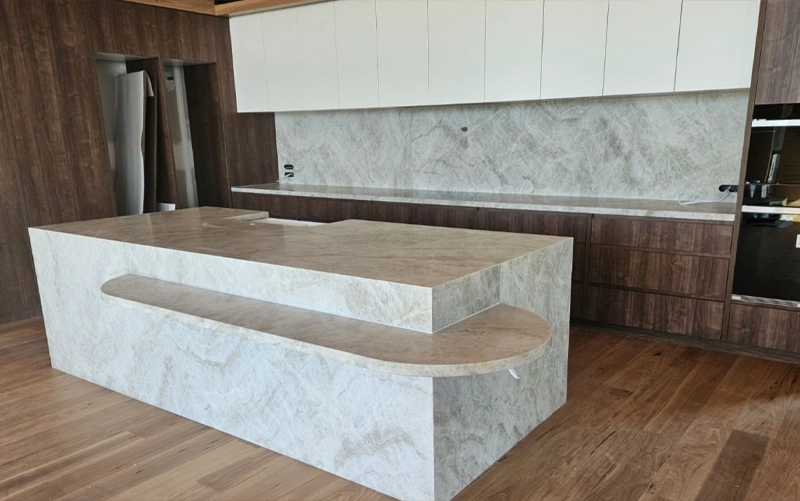
Custom stonework describes components that are planned and fabricated for the requirements of an individual project rather than supplied only in standard dimensions. The degree of customization can range from a simple countertop made to fit existing cabinetry to a multi-piece installation involving islands, backsplashes, walls and other architectural elements.
A custom project considers the actual conditions that affect the finished stone. Depending on the application, these may include:
This does not mean every project needs complex detailing. In many interiors, the most successful custom work is visually simple. The value of customization is that dimensions, material and detailing are resolved for the actual project rather than forcing the room to accommodate a standard component.
Countertops remain one of the most familiar residential stone applications, but custom fabrication can also support fireplaces, wall surfaces, vanities, backsplashes, benches and other architectural features.
This wider range of applications has made stone relevant to several rooms within the same home, creating opportunities to either repeat a material or intentionally vary surfaces according to their function.
Design Principle: Custom does not necessarily mean decorative or complex. A precisely sized, well-planned stone component with restrained detailing can be just as project-specific as a dramatic architectural feature.
The evolution of residential stonework is easiest to see in the variety of applications now possible within a single interior. Each application places different demands on the material and fabrication plan.
Kitchens remain a major application for fabricated stone because countertops must coordinate with cabinetry, sinks, cooktops and circulation around the room. Large islands can also turn the slab itself into a prominent visual element.
Waterfall panels, full-height backsplashes and strongly patterned slabs can increase the importance of layout planning because several pieces may need to read as part of one composition.
Homeowners planning this type of project can explore Teccorp Stone’s kitchen countertop services for a more application-specific overview.
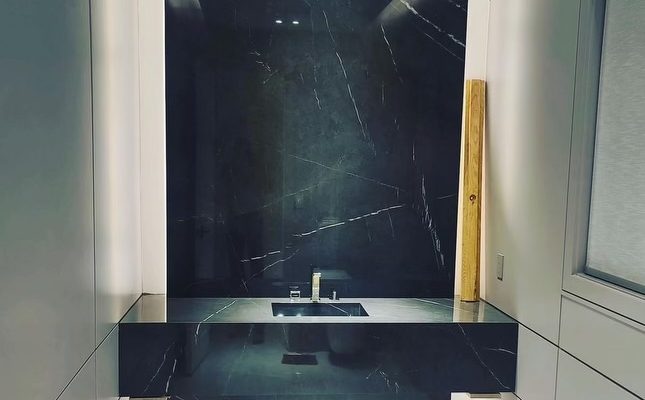
Bathroom stonework typically operates at a smaller scale but still requires coordination with cabinetry, sinks, faucets and walls. Custom vanity tops can also incorporate backsplashes or other stone details where the design calls for a more continuous surface.
Material selection should account for the actual bathroom application and expected care rather than assuming every natural or manufactured surface behaves in the same way.
More detailed bathroom-specific information is available through the custom vanity countertops section.
Fireplaces offer another example of how stone has moved from traditional masonry toward more varied architectural treatments. Contemporary designs may use stone as a surround, hearth, full-height wall or coordinated feature extending beyond the fireplace opening.
Material suitability should be evaluated according to the fireplace type, heat conditions and installation requirements rather than appearance alone.
For application-specific planning, see Teccorp Stone’s fireplace stone work service.
Feature walls allow stone to function primarily as an architectural and visual surface rather than a worktop. Large slabs can emphasize veining, colour and scale, while the design may need to accommodate fireplaces, media components, shelving or other openings.
Because the wall is viewed vertically and often from a distance, slab composition and the relationship between adjoining pieces can become especially noticeable.
For a deeper look at this application, see the guide to stone feature walls and custom applications.
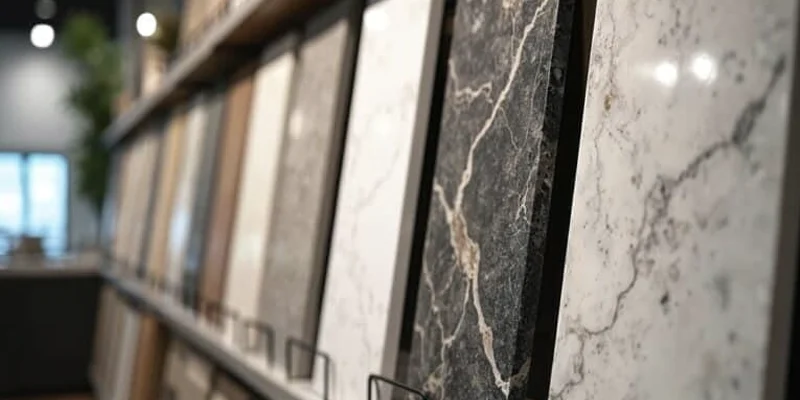
The expansion of custom stonework has been supported not only by fabrication technology but also by the range of slab materials available for residential projects. Natural stones such as marble, granite and quartzite remain important choices, while engineered quartz and porcelain provide additional design directions.
The right material depends on the application, desired appearance, fabrication requirements and care expectations. Rather than choosing a surface because it is broadly labelled “premium” or “low maintenance,” homeowners should compare the characteristics of the specific slab or product being considered.
Marble remains closely associated with expressive veining and natural movement. In contemporary homes, it can be used for countertops, vanity tops, fireplace surrounds, feature walls and other applications where the stone itself becomes a visible part of the design.
Because every slab can differ, the actual material should be reviewed when vein direction and composition are important. Marble also has material-specific care considerations, including potential sensitivity to acidic substances on some finishes.
Available options can be explored through Teccorp Stone’s marble collection.
Granite can range from relatively restrained patterns to highly expressive mineral structures. This versatility allows it to work in both understated and visually prominent applications.
For larger fabricated pieces, reviewing the actual slab can help determine how colour variation, mineral concentrations and pattern movement should be distributed across the finished components.
Homeowners considering this material can browse the granite slab collection.
Quartzite is a natural stone that can provide pronounced movement and distinctive slab character. In modern interiors, it can be particularly effective where a large island, backsplash or wall surface is intended to display the natural pattern of the stone.
Individual quartzites can vary, so material selection should be based on the actual stone rather than broad assumptions applied to the entire category.
Current surfaces are available through Teccorp Stone’s quartzite collection.
Engineered quartz provides a different design approach. Manufactured patterns can offer greater visual predictability, which may be useful where several fabricated pieces need to maintain a controlled colour and pattern relationship.
Individual products can still differ in appearance, dimensions and technical requirements, so fabrication and care should follow the guidance relevant to the selected surface.
Teccorp Stone’s quartz collection provides a range of manufactured countertop surfaces.
Large-format porcelain has expanded the material vocabulary of modern stone and slab-based interiors. It can be used for selected horizontal and vertical applications, but it should not be treated as simply another version of engineered quartz.
Thickness, edge construction, handling, cutouts and fabrication requirements can differ by porcelain product and system.
Available designs can be reviewed through the porcelain slab collection.
Material Check: Modern custom stonework is not limited to one “best” surface. Material selection should begin with the actual application, design priorities, specific slab or product and its technical requirements.
The growth of engineered surfaces has not replaced natural stone.

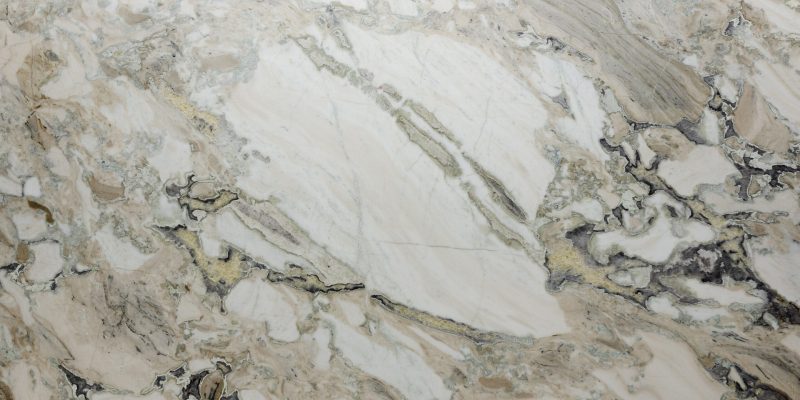
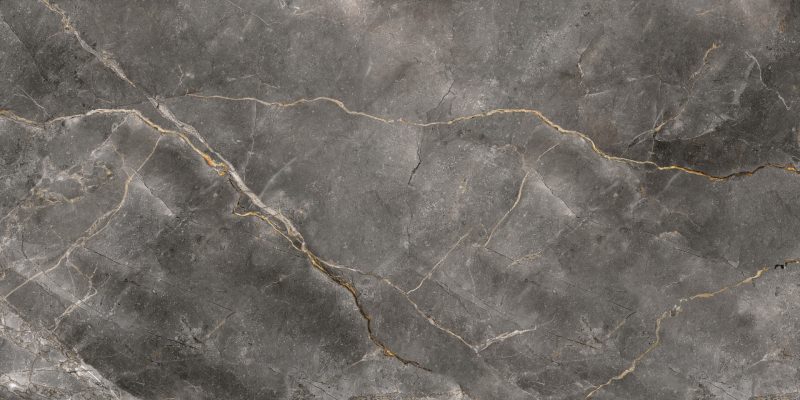
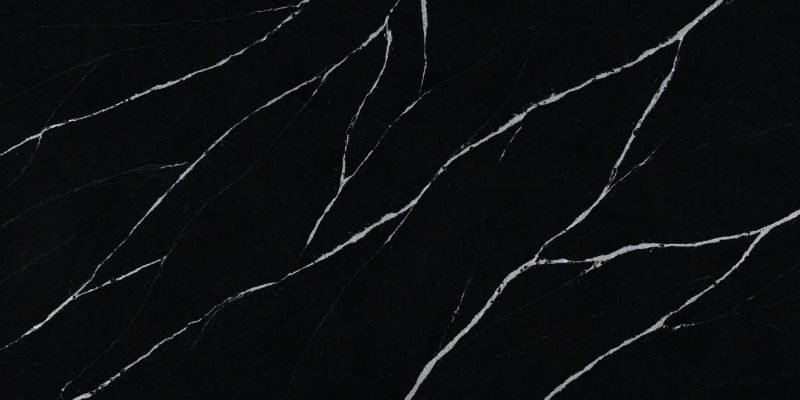



Natural stone is particularly relevant when the uniqueness of the slab is part of the design concept. A large marble or quartzite island, for example, may be selected specifically because of the way veins travel across the surface.
In these projects, slab layout becomes a design decision. The location of a cutout, seam or waterfall transition can change how the natural pattern is experienced once the stone is installed.
Manufactured surfaces can be useful where the design depends on a more predictable palette or repeated visual language across several components.
This does not mean engineered surfaces eliminate planning. Large-scale patterns, directional movement and transitions between pieces can still require careful layout, particularly for islands, waterfalls and full-height backsplashes.
For homeowners comparing the two categories in a countertop application, the guide to natural stone vs engineered stone countertops provides a more detailed comparison of appearance, care and fabrication considerations.
The evolution of custom stonework is closely connected to the ability to translate accurate project information into precisely fabricated components. Digital measurement, production software and CNC equipment can support complex geometries and repeatable machining, while skilled planning and finishing remain essential to the finished result.
Custom stone components depend on the conditions of the actual space. Cabinet positions, walls, fixtures, openings and adjoining surfaces can all influence the geometry that reaches fabrication.
As residential designs have become more integrated, this information has become increasingly important. A countertop may need to align with cabinetry, continue into a backsplash and connect visually with a waterfall panel—all within the same material layout.
Large islands and full-height stone installations expose more of the slab than traditional small-format applications. That makes the distribution of veins, colour and pattern across individual pieces more noticeable.
For natural stone, layout may involve positioning distinctive areas of the slab within the most visible portions of the project. Manufactured surfaces with strong directional designs can require similar consideration.
Modern fabrication allows countertop edges, mitered details, adjoining panels and other transitions to become deliberate visual elements rather than purely functional terminations.
The appropriate detail still depends on the chosen material and project. More complex fabrication does not automatically create a better design; in many interiors, simple geometry and carefully resolved transitions produce a more coherent result.
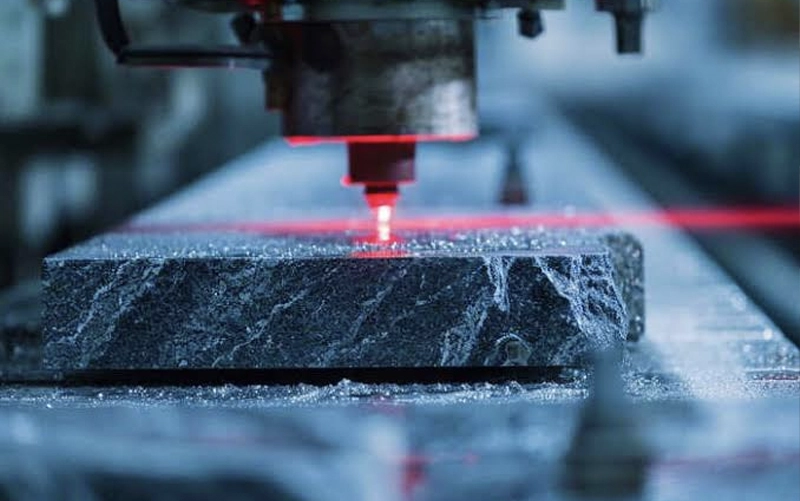
CNC machinery can reproduce approved geometry accurately, but it cannot determine whether a slab has been planned well, whether the chosen edge suits the material or whether the project specifications are correct.
Modern custom stonework therefore combines digital production with material knowledge and quality control. Teccorp Stone’s guide to high-quality stone fabrication explores these technical considerations in greater detail.
One of the most important changes in modern custom stonework is that stone is increasingly considered alongside cabinetry, fixtures, lighting and architectural proportions rather than selected as an isolated finish at the end of the project.
This does not require every room to use the same stone. Instead, the goal is to understand how each stone element relates to the surfaces and features around it.
A visually striking slab may be appropriate for one application and less suitable for another. Before narrowing the material selection, it helps to define what the stone needs to do within the room.
Useful questions include:
A kitchen island intended as the focal point of a room may justify a very different material and slab-layout strategy from a restrained vanity top or fireplace surround.
Stone patterns are experienced differently depending on the size and orientation of the application. A vein that appears subtle within a small sample may become a dominant feature across a large island or full-height wall.
Likewise, a highly expressive slab may lose some of its visual continuity if it is divided into several small pieces without considering how the pattern moves between them.
Looking at the full slab or full product design can therefore provide more useful information than relying only on small samples when pattern is an important part of the project.
If a project includes a countertop, backsplash, waterfall panel, fireplace or another nearby stone feature, deciding whether those elements should match, complement or intentionally contrast with one another can influence material quantities and layout decisions.
Early coordination does not mean every detail must be visually identical. It simply allows the stonework to become part of a deliberate interior composition rather than a collection of unrelated surfaces.
Modern stone interiors are influenced by changing design preferences, but custom stonework does not need to depend on short-lived visual trends. Material, proportion and detailing often have a greater long-term influence on the appearance of a project than any single fashionable feature.
Natural stone already contains colour, movement and variation. In some projects, simple geometry allows those characteristics to become the primary visual feature without adding complex edges or excessive detailing.
Engineered surfaces can support a similar principle through controlled patterns and colours that integrate with cabinetry, flooring and other finishes.
Custom fabrication makes many details technically possible, but technical possibility is not the same as design necessity.
Waterfall panels, mitered edges, full-height backsplashes and heavily patterned slabs can all be effective when they support the architecture of the room. Adding them simply because they are available can produce a less coherent result.
Design Check: A custom stone detail should solve a functional requirement, strengthen the material composition or support the architecture of the room. Complexity alone does not make a project more successful.
The evolution of residential stonework has created more design possibilities, but that does not mean every home needs stone in every room. A more useful approach is to identify where the material can make a meaningful functional or architectural contribution.
Kitchen countertops and islands combine daily use with large visible surfaces, making material selection, edge details, cutouts and fabrication particularly important.
For these applications, the relationship between slab dimensions, cabinetry and fixtures should be resolved before fabrication rather than after the material has been cut.
Feature walls, fireplace surfaces and full-height backsplashes provide opportunities to display slab movement vertically. These applications can make the natural or manufactured pattern more visible than it would be on a smaller horizontal surface.
Teccorp Stone’s guide to stone feature wall design explores material and layout considerations for this type of application in more detail.
No single surface is automatically the correct choice for all residential stonework. Granite, marble, quartzite, engineered quartz and porcelain each bring different visual and technical considerations.
Homeowners who are still comparing options can explore Teccorp Stone’s stone surface collection before narrowing the project to a particular slab or manufactured product.
Custom stonework refers to stone or slab components that are measured, planned and fabricated for the requirements of a specific project rather than supplied only in standard dimensions.
No. Residential applications can include vanity tops, fireplace surrounds, feature walls, backsplashes, waterfall panels and other architectural components in addition to countertops.
Depending on the application, materials may include natural stones such as granite, marble and quartzite as well as manufactured surfaces such as engineered quartz and porcelain. The selected material should be evaluated for the specific project.
Neither category is universally better. Natural stone offers individual slab variation, while engineered surfaces can provide greater visual predictability. Suitability depends on the material, application, design priorities and care expectations.
No. Custom fabrication simply means the stone is produced for the project. A simple countertop or wall panel fabricated to precise dimensions can be just as custom as a more elaborate architectural feature.
Slab layout can influence where veins, mineral features or manufactured patterns appear across finished components. It becomes particularly important for large islands, waterfalls, walls and projects using several adjoining pieces.
No. Digital and CNC equipment can support accurate production, but the finished result also depends on reliable measurements, correct specifications, material planning, finishing and quality control.
Custom stonework in modern Canadian homes reflects a broader shift in how stone is used: from a general building material toward a precisely planned component of the interior.
Natural stone continues to provide individual slab character, while engineered quartz and porcelain expand the range of manufactured design options. Modern measurement and fabrication methods allow these materials to be shaped around increasingly integrated kitchens, bathrooms, fireplaces and architectural surfaces.
The strongest projects are not defined by how much stone they use or how complex the fabrication appears. They begin with the space, select materials according to the application and use custom fabrication where it improves fit, function or visual continuity.
For projects involving multiple stone applications or more specialized components, Teccorp Stone’s custom stone services provide a broader overview of project-specific fabrication and installation applications.
Explore Custom Stonework for Your Home
Share your project, preferred materials and design requirements with Teccorp Stone to discuss suitable stone applications and fabrication options.