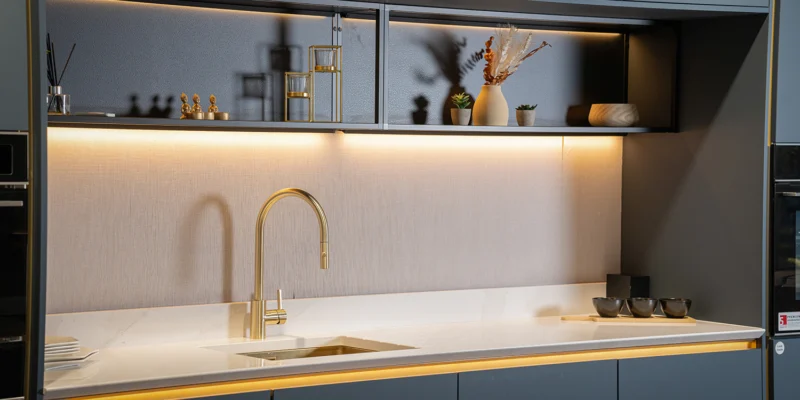
Kitchen countertop buying mistakes can become expensive once final measurement, fabrication or installation has started. A surface may look appropriate in a showroom but prove unsuitable in the completed kitchen when daily use, cabinet readiness, slab variation, cut-outs or the complete project scope were not reviewed in advance.
Colour and material price are important, but they do not explain how a countertop will respond to cooking, spills, heat precautions, seams, sink openings or long-term maintenance. The finished result also depends on measurement, fabrication, cabinet support and the responsibilities assigned to each contractor.
A successful purchase connects material selection with the actual kitchen. The homeowner should understand what is being supplied, what remains outside the countertop scope and which decisions must be finalized before production begins.
This guide explains seven common kitchen countertop buying mistakes and provides a practical process for comparing materials, quotations and fabrication details before approving a project.
Quick Buying Rule
Do not approve the countertop until the material, complete quotation, cabinet condition, fixtures, slab appearance and maintenance expectations have all been reviewed together.
The following mistakes can affect material satisfaction, project cost, fabrication accuracy and installation readiness.
| Buying Mistake | What Can Go Wrong | Better Decision |
|---|---|---|
| Appearance before performance | Unexpected etching, staining, heat restrictions or visible wear | Shortlist materials according to use before choosing colour |
| One material rule for every surface | The surface does not suit the sink, cooking, seating or exterior zone | Evaluate the exposure and function of each area |
| Comparing material rates | Cut-outs, edges, delivery or installation appear later as added costs | Compare quotations using the same complete scope |
| Unclear provider responsibilities | Missing tasks, trade conflicts or installation delays | Confirm every included and excluded service in writing |
| Incomplete cabinets or fixtures | Incorrect dimensions, openings, overhangs or support | Complete the required readiness steps before measurement |
| Small-sample approval | Unexpected veins, colour variation or pattern repetition | Review the actual slab or a representative large-format sample |
| Ignoring maintenance | Dissatisfaction with sealing, patina, heat care or cleaning restrictions | Approve the care routine before approving the material |

Colour, veining and finish are often the first characteristics considered, but appearance should be evaluated only after the surface has been matched with the household’s daily use.
A kitchen used for frequent cooking, baking and entertaining may place greater demands on cleaning, stain management and heat precautions than a lightly used serving area.
Consider:
Quartz, granite, porcelain, quartzite and marble can all be suitable in the right context, but they do not offer identical performance or care requirements.
Review the guide to durable countertops for busy kitchens when resistance to daily use is a primary requirement.
Terms such as stain-resistant, heat-resistant or low-maintenance should not be interpreted as stain-proof, heat-proof or maintenance-free.
Marble may etch and develop patina. Quartz requires protection from concentrated heat. Natural stone may require slab-specific sealing. Porcelain edges and corners should be protected from concentrated impact.
A material is suitable when these expected characteristics are compatible with the homeowner’s priorities.
Performance-First Principle
Select a suitable material category first, then choose the preferred colour, pattern and finish from within that shortlist.
A sink run, preparation counter, cooking zone, seating island and outdoor BBQ surface do not experience identical conditions. Selecting one material without reviewing these differences can create avoidable performance or maintenance conflicts.
Identify where the countertop will be exposed to:
A feature island may prioritize pattern and visual impact, while a heavily used perimeter counter may prioritize straightforward cleaning and controlled maintenance.
Different materials may be used for the island and perimeter when their roles differ. The surfaces should still relate through undertone, finish, pattern colour or compatible edge proportions.
Mixed materials should solve a functional or design problem rather than being introduced only to display more options.
An indoor product is not automatically suitable for direct sunlight, rain, freezing conditions or outdoor cooking heat. Manufactured products require explicit confirmation for exterior use, while natural slabs should be evaluated for absorption, finish and exposure.
The slab or square-foot rate represents only part of the purchase. Final cost may also include measurement, fabrication, cut-outs, edges, seams, vertical pieces, delivery and installation.
Confirm that each proposal is based on the same:
A lower quotation may exclude necessary work, while a higher quotation may include more material or fabrication. The totals cannot be compared accurately until the scope is aligned.
Review the kitchen countertop cost guide for the main variables that can affect a completed project.
Early quotations may rely on approximate dimensions, standard cut-outs or unconfirmed fixture information. The proposal should identify which figures are confirmed, which are allowances and which may change after final measurement.
Quote Comparison Rule
Compare the completed installed scope line by line. The lowest material rate does not necessarily produce the lowest final project cost.
A countertop project involves more than purchasing a slab. Measurement, layout planning, edge fabrication, cut-outs, transportation, seams and installation all influence the completed result.
The mistake is not choosing a provider that works with other contractors. The risk is approving a proposal without understanding who is responsible for each stage and which services remain outside the countertop scope.
The written proposal should clarify responsibility for:
Plumbing, electrical work, appliance connections, cabinet repair and wall finishing may require separate trades. These tasks should not be assumed to be included unless the quotation states so clearly.
| Project Stage | What Should Be Confirmed | Possible Problem if Unclear |
|---|---|---|
| Before measurement | Cabinet readiness, fixtures and final layout | Measurement delay or dimensions based on incomplete conditions |
| Before fabrication | Material, slab layout, seams, edges and openings | Unexpected pattern placement or missing fabrication details |
| Before installation | Access, removal, disconnections and site preparation | Installation cannot proceed as scheduled |
| After installation | Plumbing, appliances, backsplash and wall finishing | Unassigned work delays completion of the kitchen |
Useful questions include:
Broad phrases such as complete service or professional installation are not enough by themselves. The proposal should identify the work included in the actual project.
Review the kitchen countertop installation process to understand the typical stages from preparation through installation.
Scope Approval Rule
Approve the provider and the written project scope together. A competitive price does not resolve responsibilities that were never clearly assigned.
Countertops are fabricated for the conditions recorded during final measurement. Changes to cabinets, finished panels, islands, sinks or appliances after that stage can affect dimensions, openings, seams and support.
Before final measurement, the relevant cabinet components should be installed securely in their final positions. Depending on the project, this may include:
A countertop should not be expected to correct loose, uneven or unsupported cabinetry. Cabinet adjustments should be completed by the appropriate contractor before fabrication dimensions are approved.
Review how cabinet design affects countertop installation for additional coordination guidance.
A sink cannot be specified accurately by general width alone. The model, mounting method, bowl dimensions, reveal preference and cabinet clearance can all affect the fabricated opening.
Faucets, soap dispensers, filtered-water taps and air switches also require confirmed positions. Their placement should account for the sink rim, backsplash, wall and available space beneath the countertop.
Changing a sink after fabrication may require a different opening that cannot be created safely in the completed piece.
Cooktop and appliance openings should follow the exact manufacturer specifications. Nominal dimensions do not always represent the required cut-out or installation clearance.
The project should also consider:
Island dimensions, seating direction and overhangs influence slab use, support and installation access. Waterfall panels, sinks, cooktops and electrical components should also be included before final measurement.
A larger overhang should not be approved only for appearance.





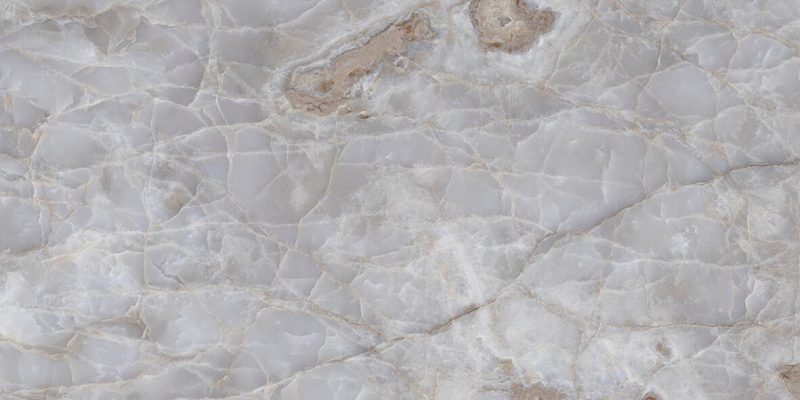

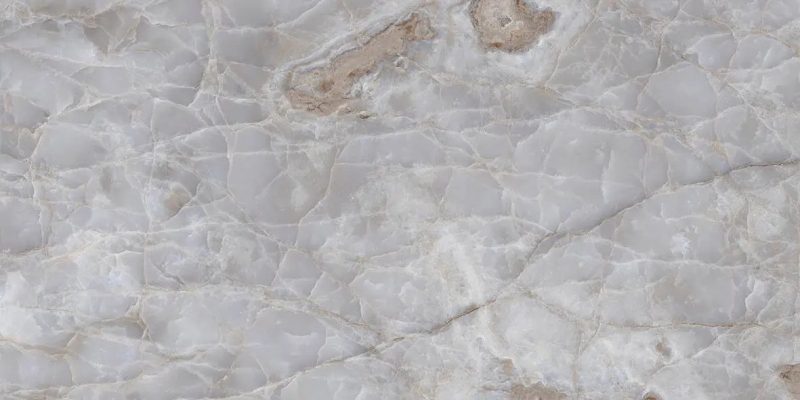




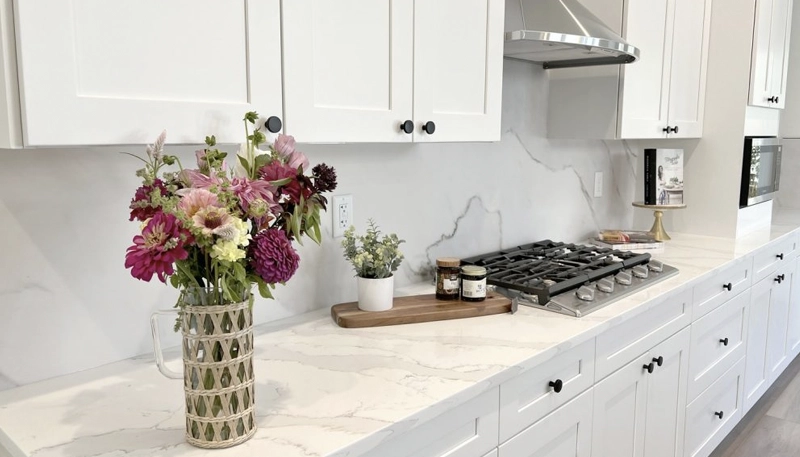
A small sample can help compare base colour, finish and undertone, but it may not show the full pattern, natural variation or repetition that will appear across a complete kitchen.
Granite, marble and quartzite may contain changes in movement, mineral features and colour across one slab. The actual slab should be reviewed when these variations influence the design.
The layout should consider:
A feature visible on the full slab may be reduced, divided or removed by fabrication unless its position is mapped in advance.
Quartz and porcelain may provide greater consistency, but a small sample may still conceal pattern repetition, large directional veins or differences between printed areas.
Strongly patterned manufactured surfaces should be reviewed using a full-slab image, large sample or layout information appropriate to the selected product.
Samples should be compared with the cabinets, flooring, backsplash and lighting that will remain in the completed kitchen. Undertones can appear different under daylight, warm artificial lighting or beside existing finishes.
Polished, honed and textured finishes can also respond differently to light and daily handling. The finish should be reviewed as carefully as the colour.
Slab Approval Rule
Use a small sample to shortlist the material, but use the actual slab or representative large-format view to approve pattern, variation and focal placement.
A countertop may meet the project budget and design goals but still become a poor purchase when its maintenance requirements do not match the household’s expectations.
Low-maintenance does not mean maintenance-free. Every surface requires appropriate cleaning, heat precautions and protection from concentrated impact. Natural stone, engineered surfaces and porcelain also differ in how they respond to staining, etching, sealing and visible wear.
Staining occurs when a substance enters or discolours the surface. Etching is a chemical reaction that changes the finish, commonly after acidic substances contact acid-sensitive stone such as marble.
Sealing may help reduce absorption in some natural stones, but it does not prevent etching and does not make the countertop stain-proof. The need for sealing should be based on the exact slab and finish rather than a universal schedule.
Heat resistance should not be interpreted as permission to place hot cookware directly on any countertop. Concentrated heat and rapid temperature change may affect resins, sealants, finishes or vulnerable areas around openings.
Trivets or heat-protective pads remain appropriate for quartz, granite, porcelain, marble and quartzite. Heat-producing countertop appliances should also be used according to the appliance and surface guidance.
Before purchase, ask for care information for the exact product or slab. General advice for one material category may not apply equally to every surface sold under that name.
Different countertop materials and damage types have different repair possibilities. Minor surface issues may be improved in some cases, while chips, cracks, burns, etching or damaged printed patterns may remain visible after repair.
A material should not be purchased on the assumption that every future problem can be restored invisibly. Prevention, appropriate use and realistic expectations remain more reliable than depending on a later repair.
Maintenance Approval Rule
Approve the cleaning routine, heat precautions, sealing expectations and likely appearance changes before approving the countertop material.
Use the following checklist to control the purchase from material selection through installation preparation.
| Decision Stage | Confirm Before Proceeding | Do Not Proceed When |
|---|---|---|
| Material shortlist | Daily use, heat precautions, staining, etching and maintenance expectations | The choice is based only on colour or an online image |
| Quotation review | Material, measurement, fabrication, edges, cut-outs, delivery and installation scope | Included and excluded services remain unclear |
| Site readiness | Cabinets, panels, fixtures, appliances, island and support conditions | Components affecting countertop dimensions may still change |
| Surface approval | Actual natural-stone slab or representative large-format manufactured pattern | Variation, repetition or focal features have not been reviewed |
| Fabrication approval | Edges, seams, openings, overhangs, pattern placement and vertical pieces | Important details are described only as standard or to be confirmed later |
| Installation preparation | Access, removal, disconnections, site protection and remaining trade responsibilities | The installation area or delivery route is not ready |
Review the guide to preparing your home for countertop installation before the scheduled installation date.
Choosing a surface by appearance or material rate without reviewing performance, complete project scope and site readiness is one of the most consequential mistakes.
The design direction can be developed together, but final countertop measurement requires the relevant cabinets, panels and island components to be installed in their approved positions.
Not necessarily. A lower quotation may exclude measurement, cut-outs, edges, delivery, installation or other required work. Compare proposals using the same material and complete scope.
Full-slab review is valuable when natural variation, veining and focal placement affect the design. A small sample cannot show the complete appearance of granite, marble or quartzite.
A different sink may require another opening, reveal, faucet position or cabinet clearance. Any proposed change should be reviewed before fabrication proceeds.
No. Seams may be required because of slab dimensions, layout, support, access or openings. Their location and pattern relationship should be planned, but a completed seam may remain visible.
Maintenance depends on the exact product and household expectations. Quartz and suitable porcelain often provide straightforward routine care, but neither is heat-proof, impact-proof or maintenance-free.
No universal rule applies to every slab. Sealing recommendations depend on the material’s absorption, finish and installed conditions.
No. Cabinets should be stable, level and adequately supported before final measurement. The countertop should not be expected to correct cabinet construction or movement.
These details should be reviewed before fabrication. Waiting until installation limits the ability to change piece divisions, pattern placement or finished edges.
A successful countertop purchase is not based on one material claim, sample or price. It requires alignment between daily use, the complete quotation, cabinet readiness, confirmed fixtures, slab appearance and fabrication details.
Before approving production, make sure every major decision has been documented and that responsibilities outside the countertop scope have been assigned to the appropriate trades.
Avoid Costly Countertop Buying Mistakes
Share your kitchen layout, selected fixtures, material preferences and project scope to review the countertop requirements before fabrication.
Discuss Your Countertop Project
Explore Kitchen Countertop Services
Browse Countertop Materials