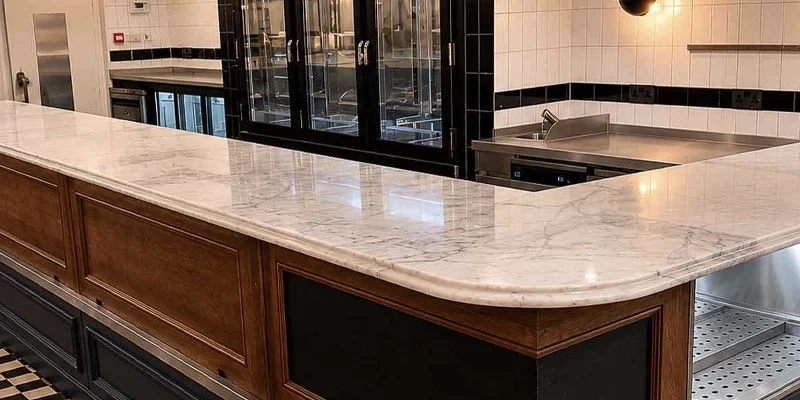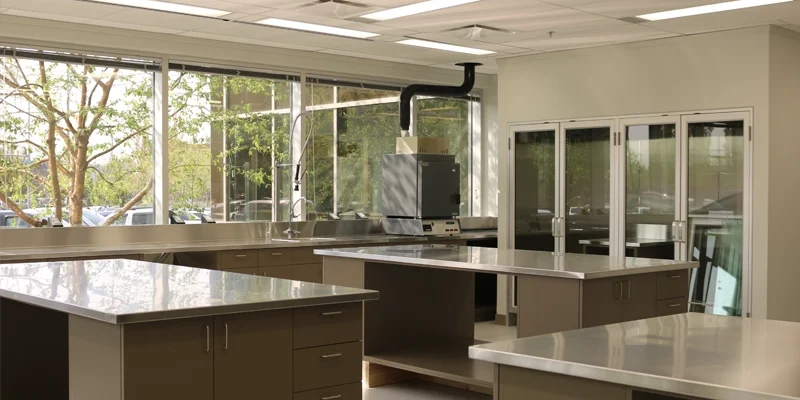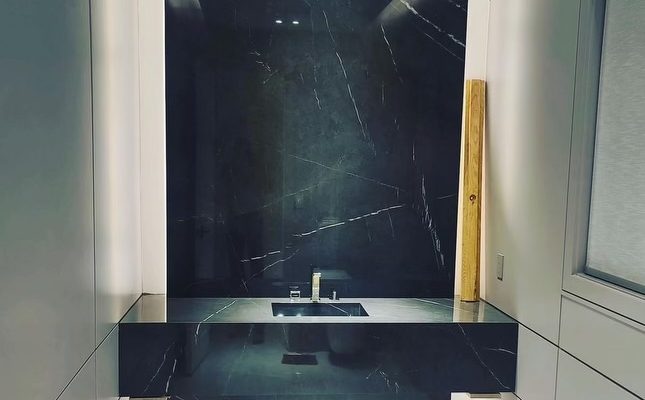

The countertop fabrication process is the sequence that turns a selected slab or manufactured surface into finished countertop components made for a specific project. It connects material selection, verified measurements, slab planning, cutting, openings, edge details, finishing and installation requirements before the countertop reaches the site.
Understanding this process is useful because many decisions that affect the finished countertop are made before any stone is cut. Sink specifications, cooktop dimensions, overhangs, edge profiles, slab pattern and seam locations can all influence how the individual pieces are planned and fabricated.
The overall workflow is similar across many countertop projects, but the details can change according to the selected material and design. Granite, marble and quartzite require attention to the characteristics of the actual slab, while engineered quartz and porcelain follow product-specific fabrication requirements.
This guide follows the countertop fabrication workflow from early project planning through production and installation coordination. More specialized topics—such as digital templating, CNC machining and fabrication-quality evaluation—are covered only at the level needed to understand where they fit within the process.
Project Planning | Measurement & Templating | Slab Layout | Fabrication & Installation Coordination
Countertop fabrication is the production stage in which slab material is converted into pieces designed for the dimensions and specifications of a particular kitchen, bathroom or other countertop application.
Depending on the project, fabrication may involve:
The purpose is not simply to reduce a slab to size. Fabrication translates the project design and site information into physical components that can later be installed in the prepared space.
Buying a slab and fabricating a countertop are separate activities. A material supplier provides the selected natural stone or manufactured surface, while fabrication converts that material into project-specific pieces.
Some projects coordinate supply and fabrication through the same provider, while others use separate companies. Either arrangement can work, but responsibilities should be clear before production begins.
Homeowners still comparing materials can review Teccorp Stone’s broader Stone Surfaces collection before choosing a specific slab or product.
Fabrication happens before the finished pieces are placed at the project site. Installation is the later stage in which those pieces are positioned, aligned and joined within the prepared space.
The two stages are connected, but one cannot replace the other. Installation depends on components produced from appropriate dimensions and specifications, while fabricated pieces still need suitable site conditions when they arrive.
The fabrication process begins by defining what needs to be produced. A kitchen project may include perimeter countertops, an island, waterfall panels and a full-height backsplash. A bathroom project may involve a vanity top with one or more sink openings.
At this stage, relevant decisions can include:
Material selection is also important because the fabrication plan should reflect the actual surface. Homeowners may be comparing granite, marble, quartzite, engineered quartz or porcelain, each of which can introduce different visual and technical considerations.
Once the relevant site conditions are ready, the countertop area needs to be measured accurately enough to create reliable production information.
Depending on the project and measurement system, the information may include:
Digital templating is one method used to capture this geometry. The deeper technical process belongs to Teccorp Stone’s digital countertop templating guide, while the commercial measurement service is covered under Countertop Survey & Measurement.
The important principle at this stage is that fabrication information should reflect the actual project conditions. Changes to cabinetry, fixtures or dimensions after measurement may affect the approved production data.
Before cutting begins, the selected slab or manufactured product should be reviewed in relation to the project.
For natural stone, this can include colour variation, veins, mineral movement and other slab-specific characteristics. Where the countertop contains a large island or several visible pieces, the actual slab can influence how those components should be arranged.
Manufactured surfaces can provide greater pattern predictability, but they still need to be reviewed for product, finish, dimensions and directional design where applicable.
Planning Check: Material approval should consider the actual countertop design, not simply the material name. Full-slab pattern, component dimensions and visible areas can all influence the fabrication plan.
Slab layout determines how the countertop pieces will be positioned within the available material before cutting. This stage can affect both material use and the visual relationship between finished components.
Planning may consider:
Natural stone with strong movement can make these decisions particularly visible. Manufactured surfaces with directional or large-scale patterns can also require deliberate layout.
The purpose is not to eliminate every seam or maximize complexity. It is to develop a workable relationship between the selected material, the required countertop pieces and the final design before fabrication moves into cutting and machining.
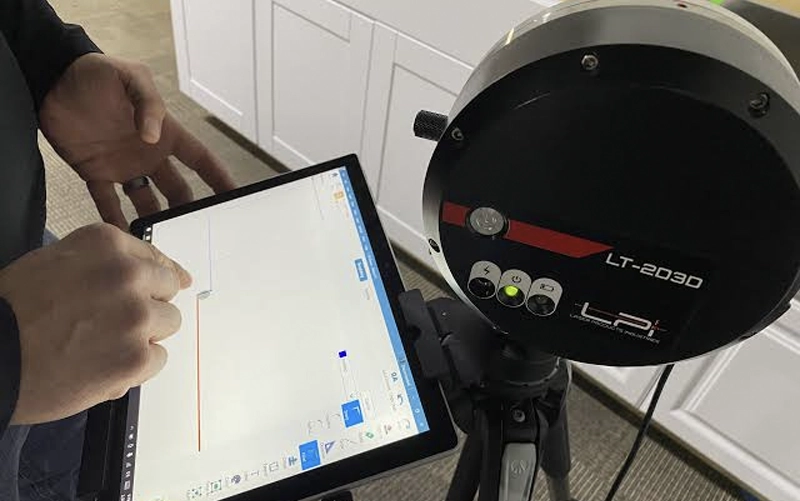
Once measurements, material approval and slab layout are finalized, the project moves into physical fabrication. The approved countertop geometry is transferred into the production workflow so individual pieces can be cut from the selected material.
Depending on the fabrication facility, material and project, this stage may involve bridge saws, CNC equipment, waterjet systems or other specialized stone-processing tools.
Cutting decisions should reflect:
Technology can support accurate and repeatable machining, but the machine is working from information established earlier in the process. Incorrect measurements or outdated specifications can still lead to incorrect pieces even when the cutting equipment operates accurately.
Countertop openings are produced according to the approved fixtures and project specifications. This can include undermount or other sink configurations, cooktops, faucets, soap dispensers and selected countertop-mounted accessories.
Before fabrication, the relevant model information should be confirmed because different products can require different opening dimensions and clearances.
This stage is particularly important around areas where several project elements meet. For example, a sink opening may need to coordinate with cabinetry below, faucet placement behind it and nearby seams or backsplash conditions.
The objective is to fabricate the opening according to confirmed project information rather than relying on generic dimensions for a category of fixture.
Exposed countertop edges are then produced according to the selected design. Edge profiles can range from restrained eased or bevelled details to more involved fabricated configurations.
The appropriate edge depends on several factors:
More complex does not automatically mean better. A simple edge that suits the material and cabinetry can be more appropriate than an elaborate detail added without a clear design purpose.
After machining, exposed edges may require additional finishing so that their appearance is consistent with the intended countertop design.
Before fabricated pieces leave the production environment, they should be reviewed against the approved project information.
A practical review can include:
This stage is not intended to redefine the design. Its purpose is to identify discrepancies between the approved fabrication information and the finished components before delivery.
A deeper discussion of workmanship and evaluation criteria belongs to Teccorp Stone’s guide to high-quality stone fabrication.
After fabrication and review, countertop components need to reach the site in a condition and sequence appropriate for installation. Large islands, long runs and vertical panels can create different handling and access requirements from smaller countertop pieces.
Delivery planning may therefore need to consider:
Fabrication and installation remain separate stages, but information should carry consistently from one to the other.























Digital templating belongs near the beginning of the fabrication workflow because production decisions depend on reliable project geometry.
A digital measurement system can record walls, corners, cabinet runs, islands, openings and other relevant site conditions. That information can then become part of the digital production data used later in planning and machining.
However, digital templating should not be treated as an automatic guarantee of accuracy. The measurement still needs to capture the correct site conditions, and the project specifications linked to it need to remain current.
If cabinetry, fixtures or other relevant dimensions change after templating, the production information should be reviewed before fabrication continues.
The full measurement workflow is covered separately in the guide What Is Countertop Templating?, while homeowners requiring the service itself can review Countertop Survey & Measurement.
Slab layout connects design decisions with fabrication. Although the basic planning occurs before cutting, its consequences remain visible throughout the finished project.
For natural stone, slab layout can influence where veins, colour changes and mineral features appear across islands, perimeter runs, backsplashes and waterfall panels. With manufactured surfaces, directional or large-format patterns can create similar planning considerations.
Efficient material use matters, but layout should not be judged only by how many pieces can be fitted onto a slab. Highly visible projects may also need to consider:
A future dedicated slab-layout guide can address this subject in greater depth. On this page, the important point is that layout is a defined fabrication stage—not an incidental decision made after cutting starts.
CNC equipment can be used during countertop fabrication to perform programmed cutting, routing, drilling and selected edge-machining operations based on approved digital production information.
Depending on the equipment and material, CNC systems may support tasks such as:
The main advantage of CNC within the workflow is repeatability: programmed geometry can be reproduced consistently when the source information, machine setup, tooling and material handling are appropriate.
But CNC does not decide whether a seam is well positioned, whether the slab layout makes visual sense or whether the site measurements are correct. Those decisions occur elsewhere in the fabrication process.
Technology Check: CNC machinery supports fabrication accuracy and repeatability, but successful production still depends on reliable measurements, appropriate material planning, correct programming, tooling and finishing.
For a detailed explanation of machine types, digital files and machining operations, see the dedicated CNC Stone Fabrication guide.
The overall countertop fabrication process may follow a similar sequence, but the details can change according to the selected material. Natural stone, engineered quartz and porcelain should not be treated as though they all respond to cutting, layout and finishing in exactly the same way.
Granite is a natural stone with slab-specific variation in colour, mineral structure and pattern. Fabrication planning should therefore consider the actual slab, particularly when several pieces will remain visible together.
Large islands, seams and adjoining components may benefit from deliberate pattern placement before cutting begins.
Marble can contain prominent veining and directional movement that make slab layout especially important. Fabrication should also account for the characteristics of the specific stone and the intended edge or opening details.
The material should not be treated simply as a decorative substitute for granite or quartz, because its surface and care characteristics can differ.
Quartzite is another natural stone where the actual slab matters. Pattern, structure and material characteristics can vary between individual stones sold within the category.
Fabrication methods, tooling and finishing should therefore be selected according to the specific slab rather than broad assumptions about all quartzite.
Engineered quartz provides greater control over colour and pattern than natural stone, but fabrication still needs to follow the requirements of the selected product.
Product thickness, pattern direction, edge details and manufacturer guidance can influence production decisions.
Porcelain is a separate manufactured-surface system with its own handling and fabrication considerations. Thickness, edge construction, cutouts and product-specific guidance can affect how porcelain countertop components are planned and produced.
Material Principle: The fabrication workflow should adapt to the actual slab or manufactured product rather than forcing every countertop material into one universal production method.
Several project decisions can directly affect the geometry of the fabricated countertop. Confirming them before production reduces the risk that the approved fabrication information becomes outdated.
Sink and cooktop models can determine major countertop openings. The approved product information should be available before those openings are fabricated.
Faucets, soap dispensers and other countertop-mounted accessories may require additional holes. Their positions should be coordinated with nearby fixtures and cabinetry.
The selected edge detail should be finalized before the relevant pieces are machined and finished.
Overhang dimensions and vertical waterfall components affect piece geometry and slab allocation. These details should be identified before final layout and cutting.
If the project includes a full-height or slab backsplash, it should be considered alongside the countertop rather than added to the fabrication plan after the main slab has already been allocated.
Fabrication produces the countertop components. Installation places those components within the prepared site.
The distinction matters because problems associated with one stage should not automatically be attributed to the other. A fabricated piece can match its approved production information yet encounter difficulties if the site conditions have changed. Likewise, installation cannot fully correct a component produced from incorrect dimensions or specifications.
Installation responsibilities should also be distinguished from other renovation work. Plumbing, electrical, cabinetry modification and structural work should not be assumed to be included unless they are explicitly part of the agreed scope.
Many countertop issues can be traced to incomplete or changing information rather than to the cutting stage itself.
If cabinetry or other elements that determine countertop geometry change after measurement, the original production information may no longer reflect the installation area.
A different sink, cooktop or accessory may require different openings. Product substitutions should be reviewed before fabrication continues.
Strong natural veining or manufactured movement can appear very different when viewed across a full island or backsplash. Small samples alone may not provide enough information for layout planning.
Seams can be required because of slab dimensions, project geometry, transportation or access. Their presence alone does not indicate poor workmanship.
Digital templating and CNC machining can support repeatable production, but they depend on accurate source information and appropriate project decisions.
Homeowners comparing fabrication providers can review Teccorp Stone’s Countertop Fabricator Toronto guide, while broader architectural stone projects are covered in the Stone Fabricator Toronto guide.
It is the workflow used to turn selected slab material into project-specific countertop components through measurement, layout planning, cutting, openings, edge fabrication, finishing and preparation for installation.
Physical production begins after the relevant project information, measurements, material and fabrication details have been approved.
Measurement methods vary by project and provider. The important requirement is reliable project geometry appropriate for fabrication.
The measurement information can be reviewed alongside material selection, slab layout, openings and other production details before cutting begins.
Not necessarily. Fabrication methods depend on the facility, material and project. CNC is one production technology that can support programmed machining.
Installation timing depends on project readiness, fabrication completion, delivery planning and scheduling. There is no universal timeline that applies to every project.
Some changes may no longer be practical once material has been cut. Important dimensions, fixtures, edges and component details should therefore be confirmed before production.
No. Equipment is only one part of the process. Measurements, material planning, programming, finishing, project specifications and quality review all contribute to the finished result.
The countertop fabrication process works best as a connected sequence rather than a collection of isolated technical steps. Project planning establishes what needs to be produced. Measurement captures the relevant geometry. Slab layout relates the material to the design. Cutting, openings and edge fabrication turn that information into physical components, while review and installation coordination prepare those pieces for the finished space.
Understanding where each stage fits also makes it easier to separate specialized topics. Digital templating supports measurement, CNC supports selected machining operations, and fabrication-quality evaluation considers how well the overall process has been executed.
For homeowners planning a kitchen project, Teccorp Stone’s Kitchen Countertop Services provide the commercial service path from material selection through project-specific fabrication and installation planning.
Plan Your Countertop Project
Share your layout, preferred materials, fixtures and project requirements with Teccorp Stone to discuss the appropriate fabrication path for your countertop.