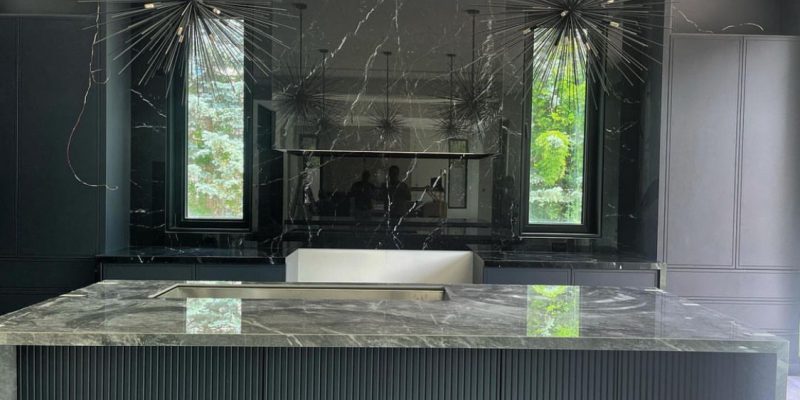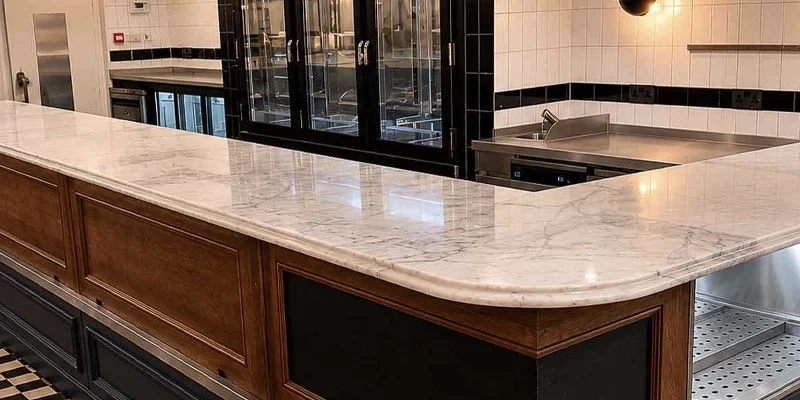
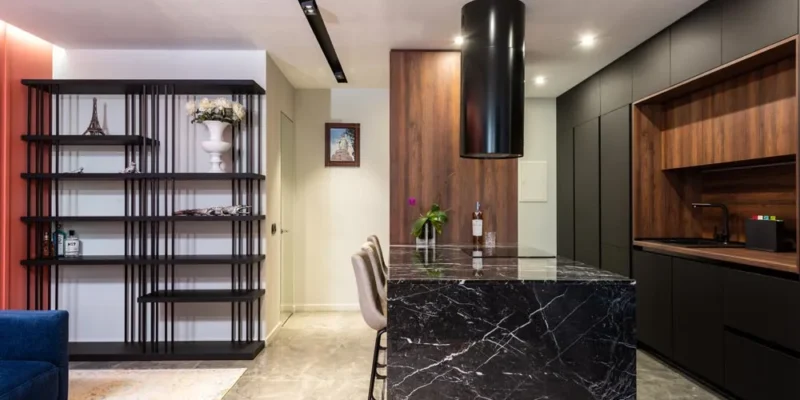
Kitchen countertop materials in Ontario vary considerably in appearance, maintenance, performance and fabrication requirements. Choosing the right surface therefore involves more than comparing colours or selecting the material that looks best in a showroom.
Homeowners should consider how the kitchen will be used, how much routine maintenance they are comfortable with, whether they prefer consistent patterns or natural slab variation, and which fabrication details are required for the sink, island, edges and backsplash.
The main slab-based options include engineered quartz, natural granite, quartzite, marble and large-format porcelain. Other materials such as laminate, solid surface, butcher block, concrete and stainless steel may also suit specific budgets or design requirements.
This guide compares the most common countertop materials by appearance, maintenance, daily performance and suitable applications. Teccorp Stone specializes in the professional fabrication and installation of quartz, granite, quartzite, marble, porcelain and custom stone surfaces across Toronto, the GTA and its Ontario service areas. Explore our kitchen countertop services for project-specific guidance.
Quick Material Selection Summary
Quartz: consistent appearance and low routine maintenance
Granite: unique natural variation and strong everyday performance
Quartzite: premium natural movement for statement surfaces
Marble: distinctive veining for design-led kitchens where natural patina is acceptable
Porcelain: large-format, thin-profile and contemporary applications
No material is best for every kitchen. The right choice depends on daily use, maintenance expectations, design priorities and the confirmed fabrication scope.
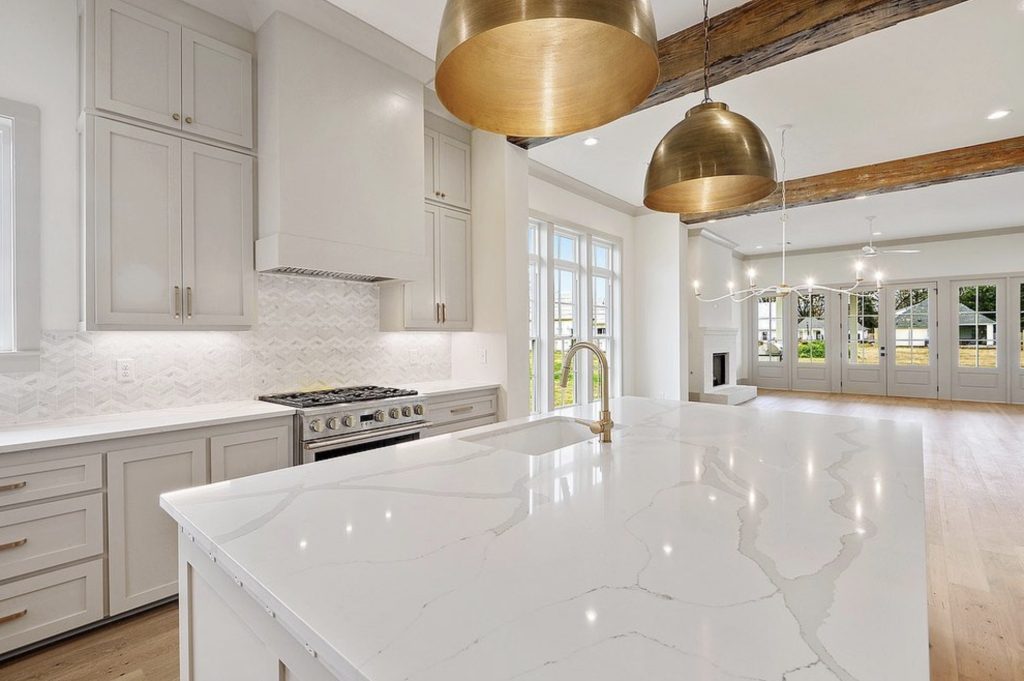
A useful countertop comparison should evaluate how each material performs in the actual kitchen rather than relying on one general durability ranking. A surface that works well in a lightly used design-focused kitchen may not be the best fit for a busy household with frequent cooking and limited time for maintenance.
Consider how frequently the kitchen is used, who uses it and what activities take place on the countertop.
Relevant questions include:
Low-maintenance engineered surfaces may suit busy households, while natural stone can be appropriate for homeowners who value individual slab character and understand its care requirements.
Maintenance varies by material, finish and product. Quartz and porcelain generally require relatively simple routine cleaning, while many natural stones may require sealing or material-specific care.
Maintenance considerations may include:
A homeowner who wants minimal ongoing care may make a different selection from someone who accepts natural changes in exchange for distinctive stone movement.
No countertop should be treated as indestructible. Heat protection, cutting boards and appropriate cleaning remain advisable regardless of the selected material.
When comparing surfaces, review:
Performance descriptions should always be confirmed for the specific product, slab and manufacturer rather than assumed from the material name alone.
Engineered quartz typically provides more controlled colour and pattern consistency. Natural stone offers individual mineral movement, colour variation and slab-specific features. Porcelain provides manufactured large-format designs that can reproduce concrete, stone or marble-inspired appearances.
Directional patterns also require additional planning around seams, islands, waterfall panels and adjoining sections.
The selected material can affect feasible edge profiles, sink and cooktop openings, countertop section sizes, handling requirements and structural support.
Large islands, waterfall panels and full-height backsplashes should be reviewed with the fabricator before the material is approved. Detailed compatibility checks are covered later in this guide.
Material category is only one factor in the complete countertop budget. Brand, slab availability, required quantity, pattern placement, edge details, cutouts, delivery and installation can all affect the final quotation.
A standard quartz collection may cost less than rare granite or quartzite, while readily available granite may offer better value than premium engineered quartz. The actual selected product and project scope matter more than a broad material label.
For detailed project pricing, review our guide to kitchen countertop cost in Toronto.
The table below provides a high-level comparison of the five main materials relevant to Teccorp Stone projects. The descriptions are general and should not replace product-specific care instructions or evaluation of the actual slab.
| Material | Surface Type | Routine Maintenance | Visual Character | Heat Consideration | Relative Cost Position | Commonly Suited To |
|---|---|---|---|---|---|---|
| Quartz | Engineered stone | Low | Consistent colours to directional veined designs | Use heat protection | Mid-range to premium | Busy residential kitchens and controlled design schemes |
| Granite | Natural stone | Moderate and stone-specific | Unique mineral movement and natural variation | Generally strong; heat protection remains advisable | Mid-range to premium | Natural-stone kitchens and distinctive slab applications |
| Quartzite | Natural stone | Moderate and stone-specific | Strong natural movement and statement patterns | Generally strong; confirm the selected stone | Premium | Feature islands and design-led natural-stone kitchens |
| Marble | Natural stone | Higher | Distinctive veining and natural patina | Heat-tolerant but sensitive to acids and surface etching | Premium | Statement surfaces and homeowners who accept natural wear |
| Porcelain | Manufactured ceramic slab | Low | Controlled large-format and architectural designs | Strong heat and UV performance | Mid-range to premium | Contemporary, thin-profile and full-height applications |
These categories are general comparisons rather than guarantees. Performance and maintenance requirements vary by product, finish, slab, fabrication details and manufacturer.
Quartz countertops are engineered surfaces made using quartz minerals, binders and pigments. They are available in controlled solid colours, subtle patterns and directional marble-inspired designs.
Quartz is suitable for homeowners who want a more predictable appearance than most natural stones. The level of consistency varies by collection: some designs are relatively uniform, while premium veined products require deliberate slab layout and seam planning.
Quartz can work well in:
Large directional patterns should be reviewed carefully around corners, seams and waterfall panels because pattern continuity may affect material use and fabrication planning.
Quartz is non-porous and generally does not require routine sealing. Routine cleaning can usually be completed with mild products appropriate for the surface manufacturer.
Its controlled surface and relatively simple maintenance make it practical for kitchens exposed to frequent spills and daily activity. However, spills should still be cleaned promptly and abrasive products should be avoided unless approved by the manufacturer.
Quartz should be protected from direct or prolonged exposure to hot cookware. Trivets or heat-resistant pads should be used rather than placing hot pans directly on the surface.
Other considerations include:
Quartz is a strong general-purpose option, but the selected product should still be evaluated according to its manufacturer guidance and the specific kitchen design.
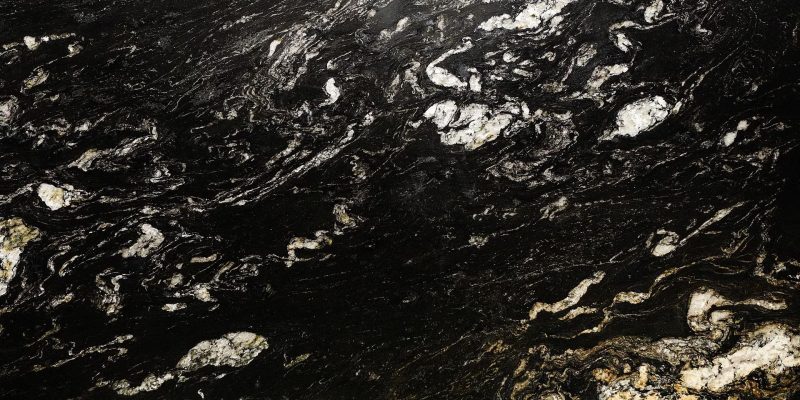
Granite countertops are fabricated from natural stone slabs, each with its own mineral composition, colour movement and visual characteristics.
Granite is appropriate for homeowners who want genuine natural variation rather than a manufactured repeating pattern. Even slabs sold under the same stone name may differ in movement, colour balance and usable areas.
The actual slab should be reviewed before fabrication, particularly when the kitchen includes:
Natural features are part of granite’s character and should be considered during slab selection rather than treated automatically as defects.
Granite generally provides strong performance for everyday kitchen use when it is properly fabricated, installed and maintained.
Sealing requirements vary by the specific stone, finish and porosity. Some granite surfaces may require periodic sealing, while others absorb very little. Care recommendations should therefore be based on the selected slab rather than a universal schedule.
Although granite typically performs well around heat, heat protection remains advisable to reduce thermal stress and protect both the surface and surrounding cabinetry.
Natural variation can make exact matching difficult across multiple slabs or future replacement sections. Slab dimensions, mineral features and unusable areas can also affect material yield.
Additional considerations include:
Granite is a suitable choice for homeowners who value natural stone character and are comfortable selecting the actual slab and following material-specific care guidance.
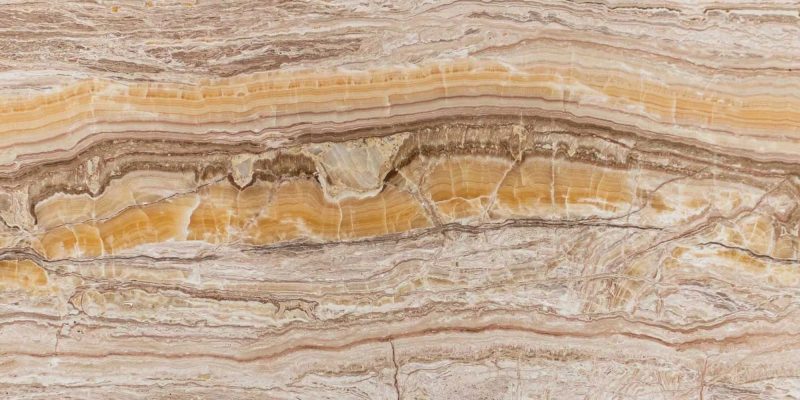
Quartzite is a natural stone valued for its individual slab movement, distinctive mineral patterns and ability to create visually prominent kitchen surfaces. It is commonly considered for statement islands, full kitchen countertops and projects where the homeowner wants genuine natural variation.
Quartzite should not be confused with engineered quartz. Quartzite is quarried as natural stone, while quartz countertops are manufactured using quartz minerals, binders and pigments.
Quartzite slabs can display soft movement, dramatic veining, layered colour and crystalline features. The appearance varies significantly from one slab to another, even when the slabs are sold under the same commercial name.
Quartzite may be suitable for:
The actual slab should be reviewed before fabrication. A small sample cannot accurately represent the complete pattern, colour distribution or usable areas of a full quartzite slab.
Many quartzites provide strong surface performance and good heat tolerance, but care requirements vary by the selected stone, finish and porosity.
Depending on the slab, maintenance may involve:
Heat protection remains advisable even when the stone itself performs well around heat. Trivets help protect sealers, seams and surrounding cabinetry from sudden temperature changes.
Materials sold under the quartzite name can vary in geological composition and practical performance. Some slabs may behave differently from what a homeowner expects based only on the commercial stone name.
Before selecting quartzite, confirm:
Quartzite is most appropriate for homeowners who value natural movement and are prepared to approve the actual slab and follow stone-specific maintenance guidance.
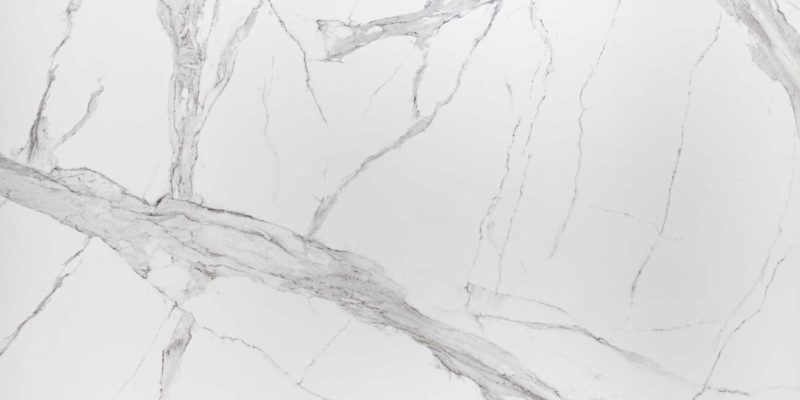
Marble countertops are selected primarily for their distinctive veining, soft natural movement and ability to create an architectural focal point within the kitchen.
Unlike surfaces intended to retain a highly controlled appearance, marble naturally develops signs of use over time. This developing patina can be acceptable or even desirable to some homeowners, while others may prefer a material with greater resistance to visible surface change.
Marble can work particularly well in kitchens where the countertop is treated as a major design feature rather than only a functional work surface.
Common applications include:
Slab layout is especially important with marble. Vein direction, seams, corners, waterfall panels and backsplash sections should be planned together before fabrication begins.
Marble is generally more sensitive to acidic ingredients than quartz, granite or porcelain. Lemon juice, vinegar, wine and some cleaning products can affect the surface finish and create visible etching.
Sealing can help reduce absorption and staining risk, but sealing does not prevent acid etching. Homeowners should understand the difference between staining, scratching and etching before selecting marble for a frequently used kitchen.
Routine care may include:
Marble can be an appropriate choice when the homeowner prioritizes natural beauty and accepts that the surface may develop patina, fine scratches or etching through normal use.
It may be less suitable for someone who expects a heavily used countertop to retain a completely unchanged, showroom-like finish.
The decision should therefore be based on both visual preference and realistic maintenance expectations—not appearance alone.
Porcelain countertops are manufactured ceramic slabs used for contemporary countertops, islands, wall applications and full-height backsplashes.
Porcelain is available in controlled designs that may reproduce the appearance of stone, concrete, metal or other architectural finishes. It is particularly relevant to projects requiring thin profiles, large-format surfaces or continuity between horizontal and vertical applications.
Porcelain can support a clean and architectural appearance, particularly in modern kitchens with minimal edge profiles and large uninterrupted surfaces.
Common applications include:
Large-format designs can reduce the number of joints in some applications, although the final section sizes still depend on slab dimensions, transportation limits and property access.
Porcelain is generally non-porous and offers strong resistance to heat, UV exposure, staining and many common household chemicals.
Routine maintenance is usually straightforward, but cleaning recommendations should still follow the slab manufacturer’s guidance. Surface finish can affect how fingerprints, water marks or residue appear.
Edges and corners require appropriate care because impact resistance at a finished edge may differ from performance across the main surface.
Porcelain requires specialized cutting, handling and fabrication methods. Thin slabs, mitred edges and large-format pieces must be planned carefully to reduce the risk of damage during production, transport and installation.
Important considerations include:
Homeowners considering this material can review the detailed guide to porcelain countertops in Toronto for additional information about thin profiles and large-format applications.
Need Help Narrowing Down the Options?
Share your kitchen style, preferred colours, maintenance expectations, island requirements and project details so suitable stone and porcelain options can be reviewed.
Teccorp Stone specializes in quartz, granite, quartzite, marble, porcelain and custom stone surfaces. The following non-stone materials are included for general comparison and should not be interpreted as Teccorp Stone service offerings.
Laminate is commonly considered for budget-conscious renovations, rental properties and secondary kitchens.
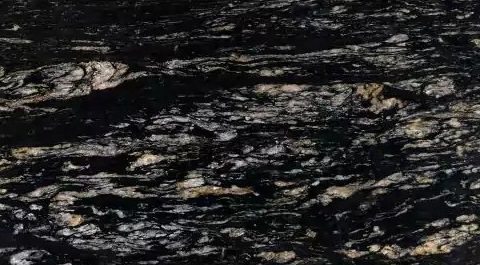

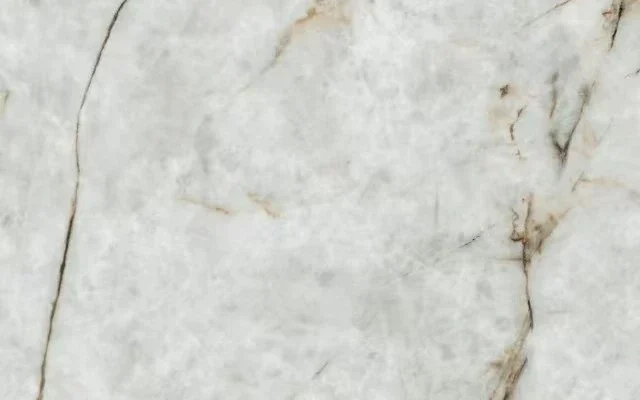


Solid surface is a manufactured material valued for its controlled appearance, non-porous surface and ability to create visually subtle seams. Minor scratches may sometimes be repairable, but the surface generally requires greater protection from direct heat and sharp objects than granite, porcelain or many quartz products.
Butcher block introduces wood grain, warmth and natural texture into a kitchen. It is often used as an island or accent surface rather than throughout the entire room. Regular oiling or refinishing may be required, and areas around sinks need careful maintenance because prolonged moisture exposure can damage the wood.
Concrete countertops can be customized in colour, texture, shape and thickness, making them relevant to industrial and architectural interiors. They require specialized fabrication, substantial cabinet support and appropriate sealing. Natural tonal variation, surface movement and fine cracking may develop as part of the material’s character.
Stainless steel provides a hygienic, non-porous and heat-resistant work surface associated with professional kitchens. It is suitable for contemporary interiors and intensive preparation areas, but fingerprints, water marks and scratches can remain visible. Over time, the surface may develop a uniform working patina.
The terms natural, engineered and manufactured describe different material categories. They should not be used interchangeably because each category has different visual characteristics, maintenance requirements and fabrication considerations.
| Material Category | Examples | Main Characteristics | Selection Considerations |
|---|---|---|---|
| Natural stone | Granite, quartzite and marble | Unique mineral variation and slab-specific movement | Review the actual slab, care requirements, usable areas and pattern placement |
| Engineered stone | Quartz | More controlled colours and patterns with low routine maintenance | Confirm manufacturer guidance, heat protection and pattern alignment |
| Manufactured ceramic slab | Porcelain | Large-format designs, thin profiles and strong heat and UV performance | Specialized cutting, edge treatment, support and professional handling |
| Non-stone alternatives | Laminate, solid surface, butcher block, concrete and stainless steel | Different combinations of budget, appearance, maintenance and performance | Confirm availability, contractor scope and compatibility with the kitchen design |
Natural stone is not automatically superior to an engineered or manufactured surface, and low-maintenance materials are not automatically suitable for every design. The better choice depends on the homeowner’s priorities and the requirements of the specific project.
The selected material should be evaluated together with the kitchen layout, slab dimensions, edge details, sink and cooktop openings, access conditions and long-term care expectations.
The best kitchen countertop material depends on which characteristics matter most to the homeowner. Maintenance, natural variation, edge details, island design and expected daily use should be prioritized before comparing individual colours or patterns.
Quartz and porcelain are often suitable for homeowners who want relatively simple routine care and surfaces that do not normally require periodic sealing.
Quartz provides a more controlled appearance and is widely used in busy residential kitchens. Porcelain offers strong heat, UV and stain performance, particularly for contemporary and large-format applications.
Neither material is maintenance-free. Quartz should be protected from direct heat, while porcelain edges and corners require appropriate fabrication and protection from heavy impact.
Granite, quartzite and marble are appropriate for homeowners who value individual slab movement, mineral variation and a surface that cannot be reproduced exactly.
The actual slab should be reviewed before fabrication because natural-stone appearance and practical characteristics vary from one slab to another.
Porcelain is often considered for thin-profile countertops, waterfall panels, full-height backsplashes and coordinated wall applications.
Its controlled designs and large-format production can support clean architectural interiors. However, successful results depend on specialized cutting, edge construction, support and professional handling.
Quartzite, marble, premium granite and directional quartz can all create a prominent kitchen island. The better choice depends on whether the homeowner prefers natural variation, controlled patterning or lower routine maintenance.
Statement-island planning should consider:
Reviewing island dimensions against the selected slab before finalizing cabinetry can improve pattern placement and material use. Additional planning information is available through Teccorp Stone’s kitchen island countertop service.
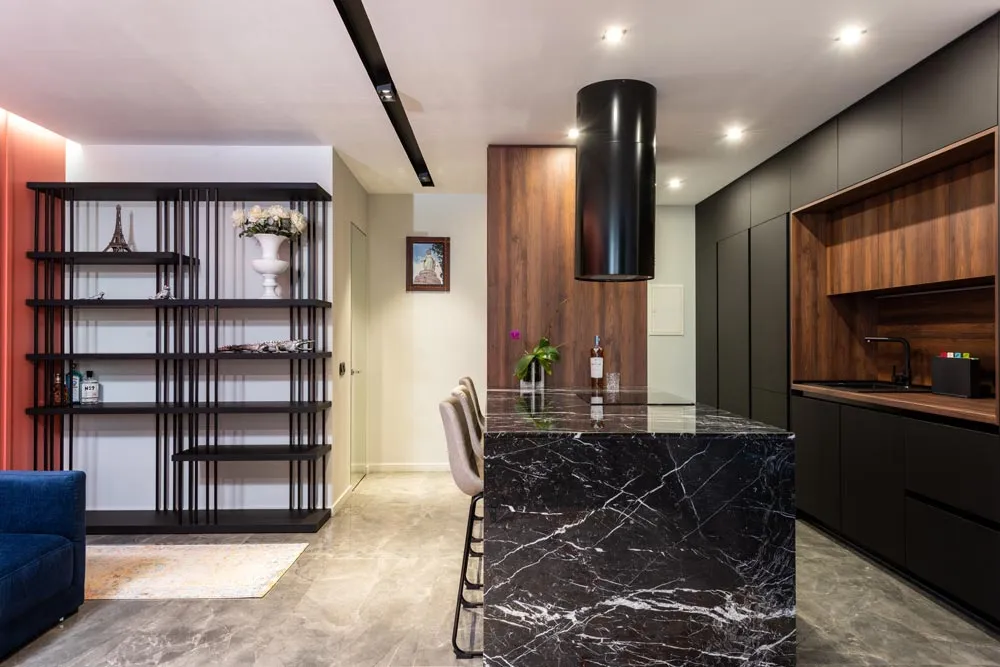
Laminate is generally the most budget-oriented option among the materials discussed in this guide. Solid surface and selected entry-level stone or quartz products may also suit projects where appearance, maintenance and total cost must be balanced.
The least expensive material is not always the least expensive completed project. Slab quantity, fabrication, edges, cutouts, delivery and installation should be considered together.
For more cost-control strategies, review the guide to affordable kitchen countertops in Ontario.
Butcher block can introduce warmth and natural wood texture when used on an island, beverage area or another selected section.
It may be combined with quartz, granite, quartzite, marble or porcelain on the primary work surfaces. Moisture exposure, oiling requirements and long-term refinishing should be considered before using wood near sinks or heavily used preparation areas.
Material Selection Principle
Choose the material according to daily use, maintenance expectations and design requirements. Select the colour and pattern only after confirming that the material category is suitable for the kitchen.
A material should not be approved based only on a small sample, online photograph or general performance description. The actual product, slab, kitchen layout and fabrication requirements should be reviewed together.
Natural-stone slabs should ideally be reviewed in full before fabrication. A small sample may not show the complete colour movement, mineral features, vein direction or areas that may affect section placement.
For quartz and porcelain, review a sufficiently large sample or full-slab image when possible. Directional patterns can look substantially different across a full island or multiple countertop sections than they do on a small display piece.
When reviewing a slab or product, consider:
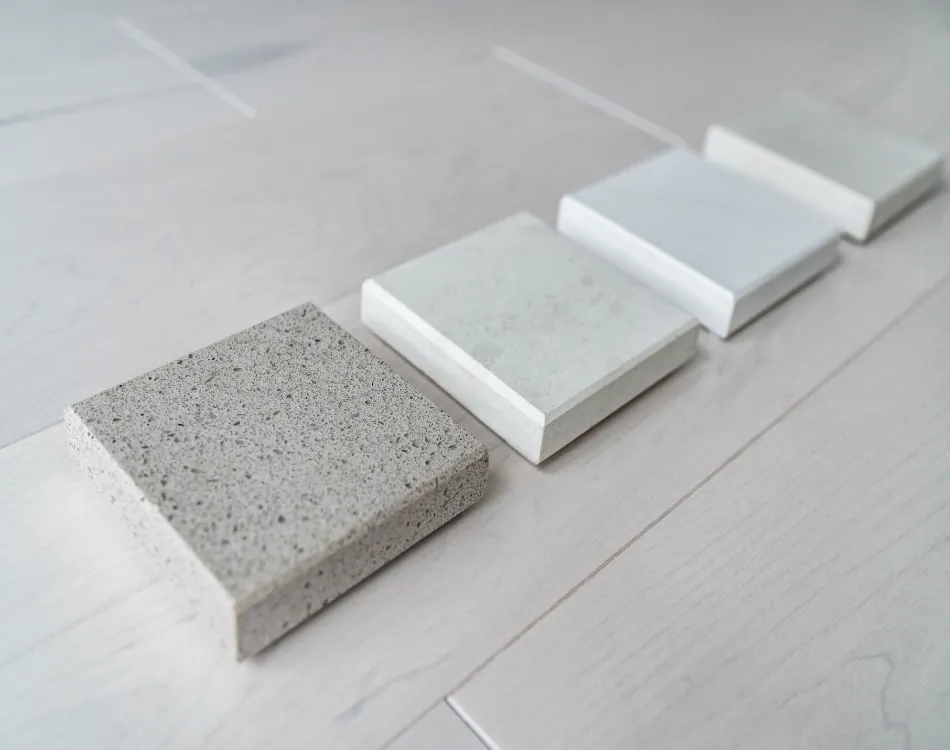
The selected sink, cooktop, faucet and countertop accessories can affect cutout dimensions, edge finishing and the amount of material remaining around openings.
Confirm the following before final templating:
Some materials and thicknesses may require different fabrication or reinforcement strategies around openings and finished edges.
A kitchen may require more than one slab even when its measured countertop area appears modest. Island dimensions, directional patterns, waterfall panels, full-height backsplashes and required seam locations can affect material quantity.
Before finalizing a large island, compare its dimensions with:
A design that fits on a slab must also be capable of being transported and installed safely within the property.
Ask for care guidance that applies to the specific product or stone rather than relying only on general statements about the material category.
Confirm:
Maintenance expectations should be understood before the material is approved—not after installation.
The fabricator should review whether the selected material is suitable for the proposed edge profile, island dimensions, openings, overhangs, waterfall details and access conditions.
Important questions include:
For installation planning, review the guide to kitchen countertop installation costs in Ontario.
There is no universal best material. Quartz is often suitable for homeowners who prioritize low routine maintenance and controlled patterns, while granite, quartzite, marble and porcelain may be better suited to different design and performance priorities.
Quartz and porcelain generally require relatively simple routine cleaning and do not normally require periodic sealing. Product-specific care instructions should still be followed.
Quartz countertops are engineered surfaces manufactured using quartz minerals, binders and pigments. Quartzite is a natural stone quarried in slabs, with individual variation and stone-specific sealing and maintenance requirements.
Both can work well. Quartz offers controlled patterns and low routine maintenance, while granite provides natural variation and strong practical performance. The choice depends on appearance preferences, sealing expectations and the selected product or slab.
Marble does not automatically stain, particularly when spills are cleaned promptly and appropriate sealing guidance is followed. However, acidic foods and cleaners can etch the surface. Sealing may reduce absorption but does not prevent acid etching.
Yes. Porcelain can be used for islands, waterfall panels and thin-profile designs when slab thickness, support, edge construction, openings and installation handling are planned correctly.
Yes. A kitchen may combine materials to create visual contrast or meet different functional needs. Examples include quartz perimeter countertops with a natural-stone island or a butcher-block accent surface with stone around the sink and cooktop.
Viewing the actual slab is strongly recommended for granite, quartzite and marble because natural movement and usable areas cannot be represented fully by a small sample. Large directional quartz and porcelain designs should also be reviewed at an appropriate scale.
Yes. Material thickness, slab dimensions, edge treatment, weight, opening requirements and handling characteristics can affect fabrication methods, section sizes, seams, support and installation planning.
Compare the complete project scope rather than material prices alone. Slab quantity, fabrication, edges, cutouts, delivery and installation can substantially affect the final quotation. Review the guide to kitchen countertop cost in Toronto for detailed cost planning.
The right countertop material should support the kitchen’s daily use, design direction, maintenance expectations and fabrication requirements.
Teccorp Stone provides material guidance, measurement, custom fabrication and professional installation for quartz, granite, quartzite, marble, porcelain and custom stone projects in Toronto, the GTA and its Ontario service areas.
Send your kitchen photographs, cabinet colours, approximate dimensions, preferred appearance and maintenance priorities so suitable materials can be reviewed around the actual project.
Choose a Countertop Material for Your Kitchen
Share your kitchen design, preferred colours, dimensions and maintenance expectations to receive guidance based on your project requirements.
Request Material Guidance
Explore Kitchen Countertop Services
Browse Stone Collections