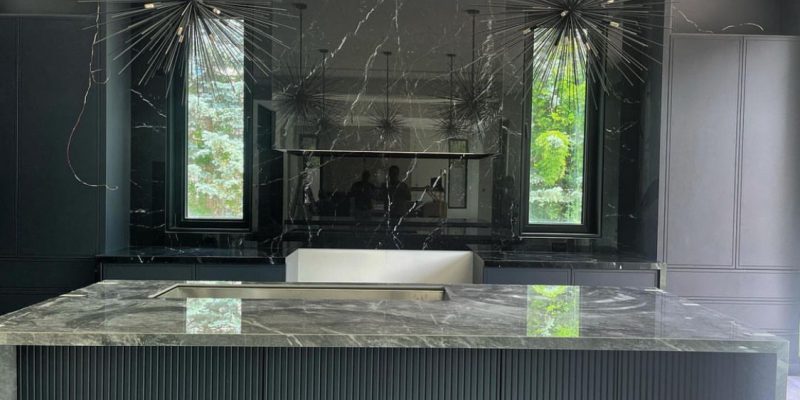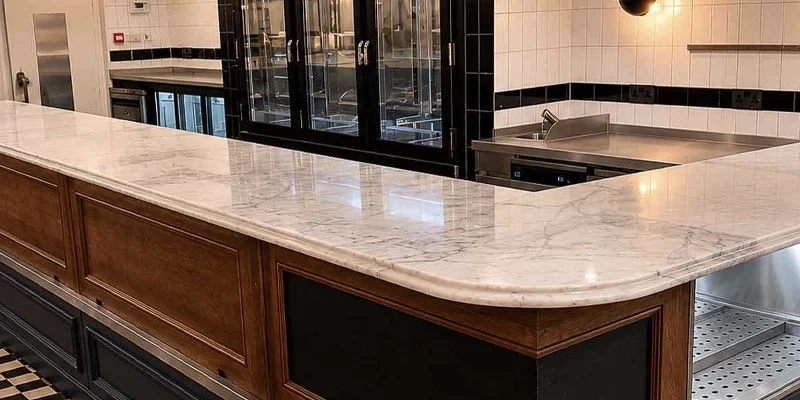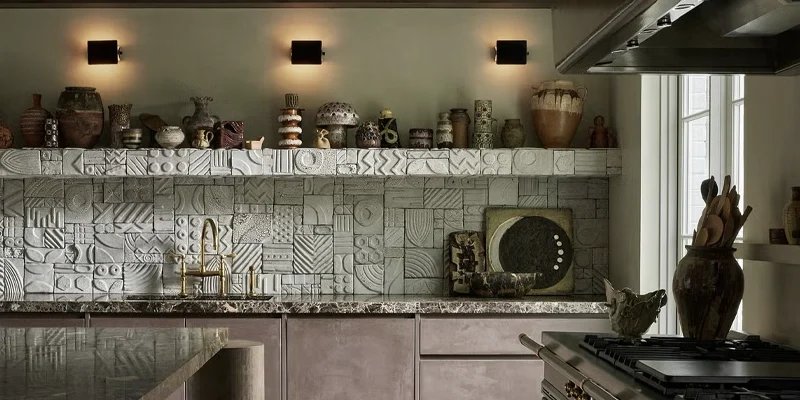

Countertop questions often begin with materials and colours, but Ontario homeowners usually need clear information about maintenance, durability, budgeting, measurement and installation before approving a project.
The right countertop depends on how the room is used, which forms of wear matter most, how much maintenance the household accepts and how the surface will be fabricated for the actual kitchen or bathroom layout. No material is automatically the best option for every property.
This guide answers 15 common countertop questions with practical starting points. Each answer is intentionally focused so homeowners can understand the main decision without replacing the more detailed material, cost and installation guides linked throughout the page.
Quick Decision Rule
Compare the exact product by maintenance, stain response, heat precautions, edge vulnerability, repair expectations and complete installation requirements—not by appearance or material name alone.
The following directions are useful starting points rather than universal rankings. The final choice should be based on the exact slab or manufactured product.
| Project Priority | Useful Starting Options | What Still Needs Confirmation |
|---|---|---|
| Straightforward routine care | Quartz or suitable porcelain | Heat precautions, edge details and approved cleaners |
| Natural-stone character | Granite, quartzite or marble | Slab variation, absorption, sealing and expected aging |
| Active family kitchen | Quartz, granite, quartzite or porcelain | Likely stains, heat zones, impacts and maintenance habits |
| Prominent design feature | Expressive natural stone or a controlled manufactured pattern | Full-slab appearance, seams, openings and focal placement |
| Outdoor application | Suitable granite or exterior-approved porcelain | Product approval, drainage, freeze-thaw exposure and installation system |
There is no single best countertop for every home. Quartz may suit homeowners seeking controlled patterns, low absorption and no routine sealing. Granite may appeal to those who prefer natural variation and accept slab-specific care. Porcelain can support contemporary applications with low absorption, while marble is usually selected by homeowners who value its natural character and accept etching or patina.
The comparison should begin with:
Review the Ontario kitchen countertop service for the main material and project considerations.
Quartz and suitable porcelain are commonly considered when straightforward routine care and low surface absorption are priorities. Most quartz products and porcelain slabs do not require routine sealing.
Low maintenance does not mean maintenance-free. Quartz requires protection from concentrated heat, while porcelain corners and exposed edges can be vulnerable to impact. Both materials require approved cleaners and appropriate fabrication around sinks and cooktops.
Granite may also provide a manageable care routine, but sealing recommendations depend on the actual slab and finish. Marble generally requires greater acceptance of etching, staining and visible aging.
Neither category is universally better. Natural stone and manufactured surfaces provide different types of value.
Granite, quartzite and marble offer unique slab variation, mineral depth and natural features. Their absorption, care and appearance may differ from one slab to another.
Engineered quartz usually offers greater visual consistency, low absorption and no routine sealing, but its resin content creates heat-related limitations. Porcelain is a separate manufactured mineral surface with its own edge, opening and fabrication requirements.
The better option is the one whose actual behaviour, appearance and maintenance requirements suit the project.
No countertop material guarantees a specific increase in property value. Buyer perception depends on the complete kitchen, including cabinet condition, layout, flooring, lighting, installation quality and how well the finishes coordinate.
A clean, well-installed and broadly compatible countertop may strengthen buyer appeal more effectively than a rare or expensive slab that conflicts with the kitchen or requires visible repairs.
Quartz and granite may feel familiar to many buyers, while porcelain, quartzite or marble may suit particular design and property contexts. The strongest resale-oriented choice is usually proportionate to the home and compatible with the surrounding finishes.
Review whether stone countertops are worth the investment for a fuller distinction between buyer perception, ownership value and financial return.
A countertop budget should account for the complete installed project rather than only the material rate or an advertised square-foot figure.
The scope may include:
Two kitchens with similar countertop area may have different costs because of slab yield, openings, access, seams and fabrication complexity.
Review the kitchen countertop cost guide for the main variables that influence a complete quotation.
Budgeting Rule
Compare complete installed scopes using the same material, dimensions, edges, openings and installation responsibilities—not material rates alone.

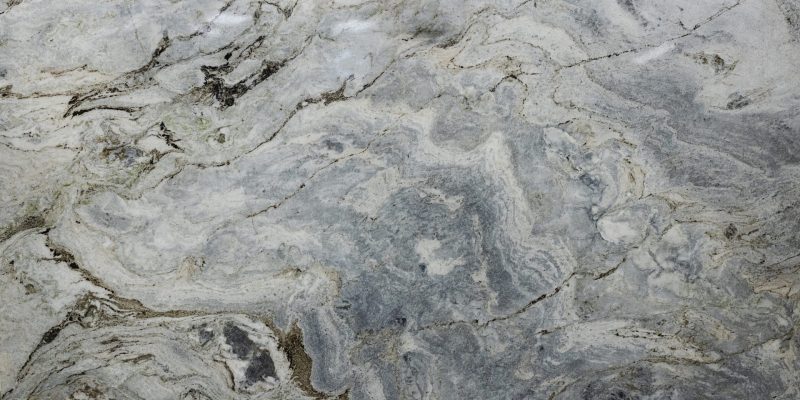


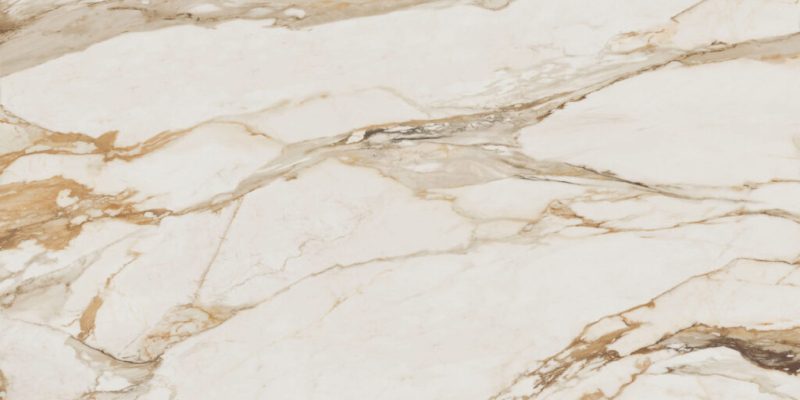


A busy kitchen needs balanced performance rather than a material that excels in only one category. Frequent cooking, spills, cleaning, small impacts, seating activity and heat exposure should all be considered.
Quartz may suit households prioritizing low absorption, controlled patterns and no routine sealing. Granite can provide practical everyday performance for homeowners who prefer natural stone and accept slab-specific care. Correctly identified quartzite may suit kitchens seeking natural movement and regular-use performance. Porcelain can provide low absorption and straightforward cleaning when edges, openings and support are planned carefully.
The decision should reflect:
No surface is completely stain-proof, scratch-proof, heat-proof or impact-proof. Cutting boards, trivets, prompt spill cleanup and care around exposed edges remain appropriate for every material.
Review the guide to durable countertops for busy kitchens for a detailed comparison of stains, scratches, heat, edges and repairability.
Suitable natural stones and countertop-grade porcelain may offer useful surface-level heat performance, while engineered quartz contains binders that can respond to concentrated heat. However, broad material rankings do not describe the complete installed countertop.
Heat can also affect:
Rapid temperature change may create additional stress even when the main surface is considered heat tolerant. The exact product documentation should therefore take priority over a general category claim.
Trivets and heat-protective pads should be used under hot cookware on quartz, granite, quartzite, marble and porcelain. This precaution reduces uncertainty caused by differences between individual products, slabs and installation conditions.
Heat Protection Rule
Select the material using product-specific guidance, but use trivets as a normal precaution regardless of the countertop category.
Bathroom countertops should be selected for moisture exposure, cosmetics, cleaning products, sink configuration and the level of maintenance the homeowner accepts.
Quartz is often considered because suitable products provide low absorption and generally do not require routine sealing. Porcelain can also offer low absorption and controlled contemporary patterns. Granite may suit homeowners seeking natural stone and willing to follow slab-specific cleaning and sealing guidance.
Marble may provide strong visual character, but cosmetics, acidic products and unsuitable cleaners can stain or alter its finish. Sealing may reduce absorption in some marble, but it does not prevent acid-related etching.
Bathroom planning should also address:
The best bathroom material is the one whose appearance, moisture response and care requirements match the actual vanity installation.
Long-term value is different from resale value. It describes the relationship between complete installed cost, daily usefulness, maintenance, durability and how long the surface is expected to remain compatible with the kitchen or bathroom.
Quartz may provide strong ownership value for households prioritizing controlled appearance and straightforward routine care. Granite may provide value through natural character and practical everyday performance. Quartzite can suit projects seeking expressive natural movement, provided the actual slab and care requirements are confirmed. Porcelain may provide value through low absorption and coordinated architectural applications.
Marble and other specialty materials may also provide meaningful value when their appearance is central to the design and the homeowner accepts patina, etching or additional maintenance.
Long-term value can be reduced when:
The lowest initial cost is not automatically the best value, but the most expensive slab is not automatically the strongest investment. Review whether stone countertops are worth the investment for a fuller comparison of ownership value, buyer perception and financial return.
A useful quotation should make the proposed countertop scope clear enough to compare it with other proposals and identify work that remains the homeowner’s or another contractor’s responsibility.
Depending on the project, the quotation may identify:
Plumbing, electrical work, appliance connections, cabinet repair and wall finishing should not be assumed to be included unless the proposal states so clearly.
| Quote Area | What to Confirm | Common Source of Confusion |
|---|---|---|
| Material | Exact product, finish, thickness and quantity | Comparing different products under the same material name |
| Fabrication | Edges, openings, seams and vertical pieces | Assuming every custom detail is included |
| Installation | Delivery, access, installation and included site work | Confusing countertop installation with plumbing or cabinet work |
| Pricing status | Confirmed pricing, allowances and items subject to measurement | Treating an early estimate as the final project total |
Quotes should be compared using the same material, dimensions, edges, openings and installation responsibilities. A lower total may exclude work that another proposal includes.
Quote Comparison Tip
Confirm what is included, excluded, estimated and awaiting final measurement before comparing quotation totals.
The best material for a kitchen island depends on whether the island is primarily used for preparation, seating, entertaining, cooking or as a visual focal point.
Quartz may suit active islands where controlled patterning, low absorption and straightforward routine care are priorities. Granite and quartzite can provide distinctive natural movement for a prominent island. Marble may suit homeowners who accept etching and patina, while porcelain can support contemporary profiles and coordinated waterfall panels when fabrication details are planned carefully.
Island material selection should also account for:
A visually dramatic material should not be approved until the full slab or representative pattern has been reviewed against the openings, seams and principal sightlines.
Review the kitchen island countertop service for additional island planning and fabrication considerations.
Yes. Different materials can be combined to define work zones, create contrast or concentrate a distinctive surface in the most visible part of the kitchen.
For example, a low-maintenance material may be used on heavily used perimeter counters while a natural stone or expressive manufactured pattern is selected for the island. The combination should solve a functional or design requirement rather than introducing unnecessary complexity.
Before mixing countertop materials, compare:
Materials do not need to match exactly, but they should share a clear visual relationship through colour, finish, cabinetry or surrounding architectural details.
Mixed-Material Rule
Use different materials when each surface has a defined role and the thickness, maintenance, transitions and fabrication details have been coordinated.
Replacing the backsplash with the countertop is often practical, but it is not required for every project. The decision depends on the condition of the existing backsplash, the countertop thickness, wall condition and the intended design.
Coordinating both surfaces can help resolve:
An existing backsplash may need alteration if the new countertop has a different thickness or if removing the old countertop damages adjoining tile or wall finishes.
A full-height stone or porcelain backsplash requires additional planning for slab quantity, pattern placement, outlet openings, wall preparation and installation sequence.
Review the kitchen stone backsplash service when coordinating countertop and vertical slab applications.
Professional measurement or templating is normally required before custom countertop fabrication. Homeowner dimensions can support early budgeting, but they should not be treated as final production measurements.
Final measurement may confirm:
Cabinets, finished panels, islands and components affecting the countertop dimensions should be complete and in their approved positions before final measurement.
Sink and appliance specifications should also be available when required. Changing the cabinet configuration, sink or cooktop after measurement can affect fit, cut-outs, support and fabrication.
Review the kitchen countertop installation process for the typical sequence from site readiness through fabrication and installation.
Begin with the way the surface will be used rather than selecting a colour immediately. Defining the project requirements first creates a more useful material shortlist and reduces the risk of choosing a surface that does not suit the household.
Homeowners should also review the guide to kitchen countertop buying mistakes before approving the material or quotation.
| Decision Stage | Confirm Before Proceeding | Warning Sign |
|---|---|---|
| Material selection | Use, maintenance, heat, stains and appearance | Selection is based only on colour or an online image |
| Project scope | Cabinets, fixtures, appliances and vertical pieces | Components affecting dimensions may still change |
| Quotation | Included, excluded, estimated and confirmed items | Only the material rate is being compared |
| Fabrication approval | Seams, edges, openings and pattern placement | Important details remain undefined after measurement |
Final Selection Checklist
Confirm the exact material, finish, slab or product, care guidance, edge details, openings, seams, measurement process, installation scope and complete quotation before fabrication.
These 15 answers provide a practical starting framework, but the final decision should be based on the exact slab or manufactured product and the confirmed project conditions.
Product documentation, full-slab or large-format review, accurate measurements and a clearly defined fabrication scope provide more reliable guidance than universal material rankings.
Continue with these detailed resources:
Plan Your Countertop Project
Share your layout, cabinet information, preferred materials and confirmed fixture details for an initial project discussion.
Discuss Your Countertop Project
Explore Kitchen Countertop Services